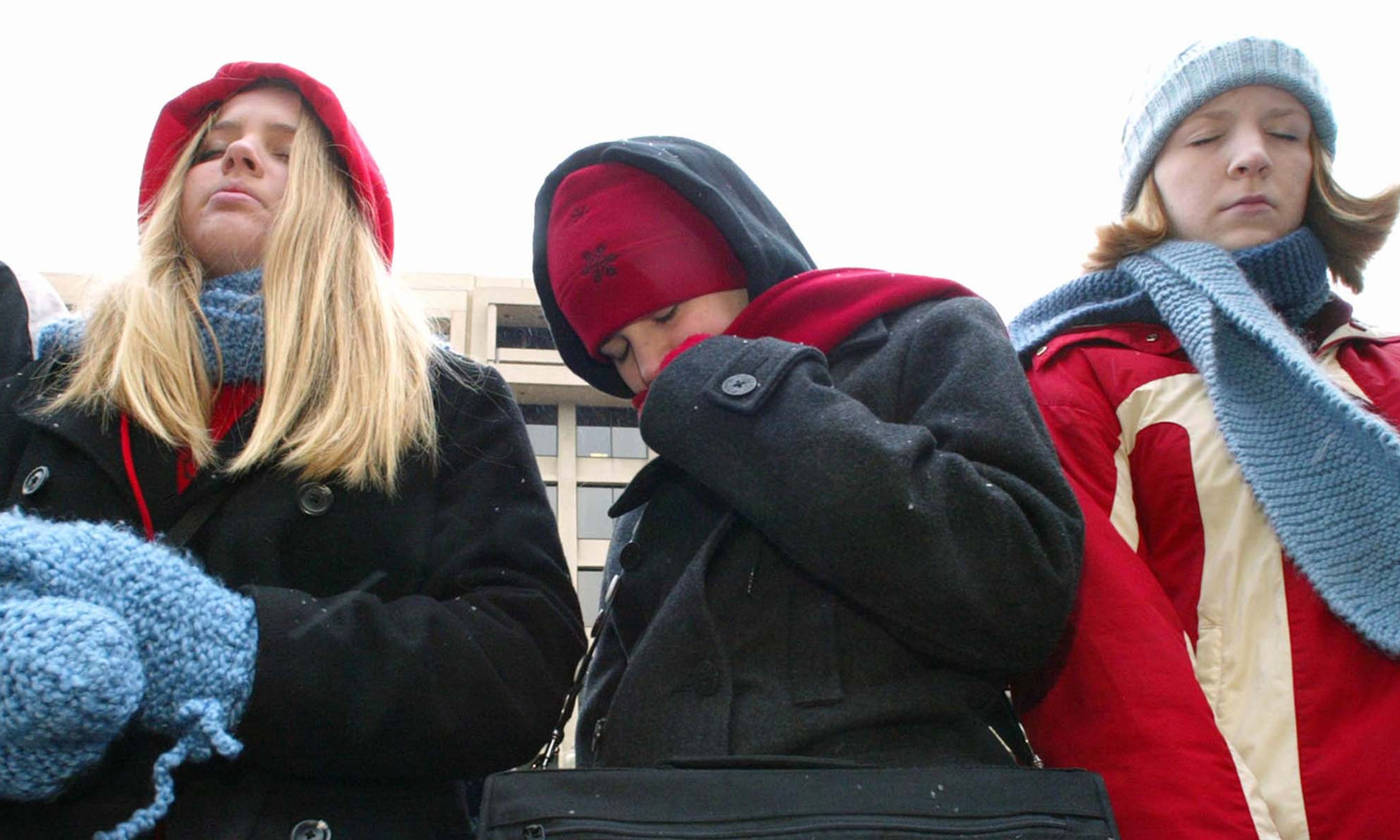
Iwas doing a play in the Village some years back. On the corner of the block was a Planned Parenthood clinic. Every day, on my way to work, I saw two older women, across the street from the clinic. They were poorly dressed, and seemed to be religious — just standing, looking at the clinic, and silently weeping.
And every day, across from them, outside the clinic, about to enter or just leaving, there were women hugging each other and weeping. Every day.
It was not that those two groups had “so much in common” but that they were, in fact, just one group: women, sharing the most basic, genetic essence of womanhood, which is a responsibility for the continuation of life.
The women having abortions were moved by the tragedy as much as and identically with their sisters across the street, who did not and would not have children.
Where was, and where is, the common ground between these two positions? The women praying were debarred by law from crossing the street; their sisters, outside the clinic, had they looked across, would have seen the possibility of unity, and so, perhaps, of comfort, and, then, finally, of resolution — if not of the trauma of the moment — of a needless, wickedly engineered divide: the separation of women from each other, and the denigration of their sex by politics.
Each of the groups was involved in a tragedy. They differed on its name, but were united in understanding their situation’s nature.
Tragedy is the highest of the dramatic arts. It refines all superficial human differences to an irreducible commonality: We Must but we Can’t, we are born and we die, we try to do good and we do evil; and, finally, human life is uncertain, and we are deluded creatures given to folly and sin, and addicted to calling it “reason.”
The two groups of women shared this: that each was facing its tragedy honestly. They were not slandering, or indicting, or canceling, or assaulting the other group but, rather, dealing, each, with their sad situation according to their lights.
Why could they not reach some common ground? (For, certainly, honest folk can — because they must — find a common ground that allows them to abide each other.)
For all the viciousness and hatred at the extremes, America is essentially a centrist country. Rabble-rousers, ideologues, and outright thugs enflame passions for their own purposes, but, at street level, we in the majority would prefer to get along.
How is it, then, that honorable, intelligent citizens can’t find the middle ground?
Here’s an answer.
Parents of an autistic child are, at minimum, twice as likely to divorce as are those of a neurotypical child.
Each parent is faced with a tragedy, and each wants, above all things in life, to aid their child. And yet, in that quest, they tear the marriage apart.
In On Death and Dying (1969), the psychiatrist Elisabeth Kübler-Ross posits five stages of grief. These are denial, anger, bargaining, depression, and acceptance. The tragedy of autism differs from that of birth defects in this: The birth defect is a fait accompli and, however prolonged, the progress of the stages of grief, ends in acceptance.
But as autism holds out the promise of hope, its acceptance may be understood by the parent as treason to their child. And, so, the grieving process never ends. It is stimulated by hope, dampened by anger, tinted by depression, and so on, interminably.
To compound the trauma, the marriage partners cycle through these stages in different orders. They are like two eccentric gears, which meet at the same point only infrequently, and then only for a moment. Each partner, in his or her momentary stage, is absolutely assured of the position’s rectitude and, so, of the spouse’s intractability and folly. Divorce allows them to lessen the trauma, not of the autism but of the fury of their marital battles.
An understanding of this process might lead them to the best possible outcome of their otherwise irresolvable tragedy: to hold each other weeping. Vide: the centrist liberals, and the centrist conservatives, and their dying charge, which is their country.
It can be saved only by an understanding of the process of that which is not shame, or guilt, or rage but, at rock bottom, grief.
What might follow can’t be seen. But it will become apparent when the center avows the tragedy, and meets in the middle of the street.












Comments