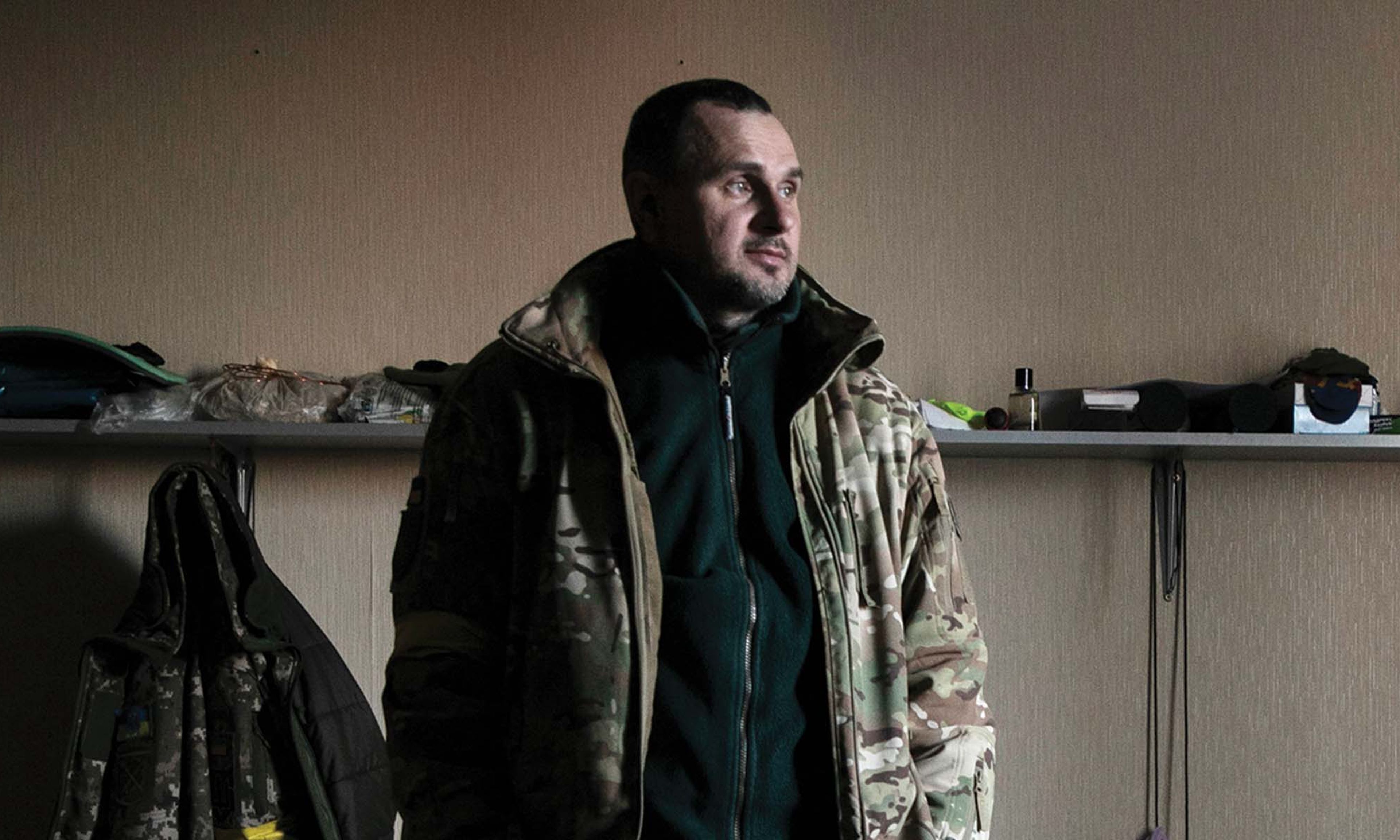
Oleh Sentsov is a filmmaker who has not had much time to make films of late. From 2014 to 2019, he was a political prisoner of the Kremlin — one of the most prominent such prisoners. On February 24, 2022, the Russian government launched its all-out assault on Ukraine. Sentsov is a Ukrainian. Like many of his countrymen, from all walks of life, he joined up. He’s in the army, fighting the enemy on the front lines, in the east.
No one would have planned the life that Sentsov has lived. Some lives roll easier than others. The life of every Ukrainian has been . . . deeply affected. (Many of those lives have been ended.)
When people like me were writing about Sentsov as a political prisoner, we tended to write “Oleg”: “Oleg Sentsov.” Today, in the press, I usually see “Oleh.” I am able to ask Sentsov himself about this in a conversation via the Internet. The issue of “h” versus “g” is very important to him. It’s little, but meaningful. “Oleg,” simply, is Russian, and “Oleh” is Ukrainian.
And isn’t that what the war is about, says Sentsov? The right to a country, and nationality, and existence independent of Russia?
The Russian assault has given the world a crash course in Ukrainian identity. Most of us know more than we did before February 24. (That includes the Kremlin.) When it comes to identity, the case of Sentsov is interesting, though not atypical.
He was born on July 13, 1976, in Simferopol, the second-largest city in Crimea. (The largest is Sebastopol, the port.) His parents came from Russia; he is ethnically Russian. How has he viewed himself, over the years? As Soviet? Russian? Crimean? Ukrainian?
His sense of identity has evolved, inevitably — and there were waymarks in this evolution: the independence of Ukraine (1991); the accession of Putin to power in the Kremlin (2000); Ukraine’s Orange Revolution (2004); the Euromaidan and Revolution of Dignity (2014). This last was decisive, says Sentsov. After that, there was no turning back. He was a Ukrainian.
In December 2019, I spoke with Vitaly Portnikov, a leading journalist in Ukraine. He said that, after 2014, “everyone sang the national anthem.” I thought he was speaking figuratively. It turned out he was speaking literally. Before 2014, he said, only ethnic Ukrainians sang the anthem. Afterward, everyone did: Tatars, Russians, Greeks, Armenians, Jews, Georgians . . . “Ukrainian” was no more an ethnic designation, merely; it was a political and national one.
Oleh Sentsov did not dream of being a filmmaker — at least when he was a boy. In 1989, he told a schoolteacher that he wanted to work in “the economic sector.” Great, said the teacher. We have a planned economy. No, said young Sentsov: I want to work in a market economy. Well, dream on, said the teacher. This is the Soviet Union!
Yet two years later, the Soviet Union was no more. And Sentsov would indeed work in a market economy, pursuing several ventures. He studied at the Kyiv National Economic University. Eventually, he owned a computer club, in the arena of “cybersport.” We’re talking about competitive gaming. And his breakout film was Gamer (2011). He knew the environment well, needless to say.
In March 2014, the Russian government annexed Crimea. Ukrainian troops were trapped on their bases. Sentsov was part of an effort to deliver food and supplies to them, and to evacuate them. On May 11, he was arrested by agents of the FSB — Russia’s secret police, the successor to the KGB. They also arrested three others around this time.
Sentsov was tortured for 24 hours straight. The others were tortured too, naturally. The goal of the FSB was to force confessions out of them — to get them to confess to false crimes. About the torture, it is not easy for Sentsov to speak.
He was detained at Lefortovo, the notorious prison in Moscow. (Virtually any prison in Russia is notorious.) His case went to trial on July 21, 2015, a year and two months after his arrest. The trial was held in a military court, which hears terrorism cases — a court in Rostov-on-Don.
Sentsov was charged with just that: terrorism. The charges were absurd. The trial was a farce. That was the word used by many around the world, including the U.S. ambassador to Ukraine, Geoffrey R. Pyatt: “farce.” Sentsov, on trial, could see the comical nature of it all. (A very dark comedy.) Everyone was playing an assigned, scripted role. Sentsov figured he would be sentenced to 20 years — and he was.
When the sentence was announced, on August 25, 2015, he did something amazing. So did a fellow defendant of his, Oleksandr Kolchenko. Together, smiling, in their defendants’ cage, they sang the national anthem. The Ukrainian national anthem.
“I am a terrible singer,” Sentsov tells me. “So, I was not very glorious, from the point of view of singing. And I messed up some of the words. But it was truly a moment of glory.” Some 100 members of the media were assembled in the courtroom. People were stunned by what was happening. “The judge just walked away,” says Sentsov.
Ukraine wanted Sentsov, its citizen, back. Russia refused to hand him over — on grounds that he was a Russian citizen. Moscow had imposed Russian citizenship on Crimeans in general. But Ukrainians knew that Sentsov was one of their own.
On the day of the sentencing, Ukrainian president Petro Poroshenko penned a message to Sentsov, circulating it through social media: “Be strong, Oleh. There will come a time when those who organized this so-called trial will themselves sit on the bench of the accused.”
Sentsov was confined to many prisons and labor camps. I wonder: “Was there a worst one, or were they equally bad?” They were all bad, says Sentsov — but there was a worst one: Labytnangi, up at the Arctic Circle. I stumble over the name a bit. “Don’t worry,” he tells me. “It took me six months of being there to memorize the name.”
While at Labytnangi, he staged a hunger strike: 145 days (about four and a half months). This has been a tactic of political prisoners for generations. Probably the two best-known hunger strikers in the Soviet Union were Andrei Sakharov and Anatoly Shcharansky (later to be called “Natan Sharansky”).
Why did Sentsov go on hunger strike, specifically? To call for — to demand — the release of Ukrainian political prisoners (forgetting his own case).
While in prison, Sentsov had a lot of support from the world beyond. He could not know the extent of it, however, in his cells and camps. Fellow film directors signed an appeal to Putin. (These included Pedro Almodóvar, the famed Spaniard.) Paris made him an honorary citizen. The European Parliament awarded him its Sakharov Prize for Freedom of Thought.
The president of the parliament, Antonio Tajani, made a statement: “Through his courage and determination, by putting his life in danger, the filmmaker Oleg Sentsov has become a symbol of the struggle for the release of political prisoners held in Russia and around the world.”
What about Russians themselves? In a touching gesture, the Memorial society hosted a screening of Gamer. The society did this while the director was still in Lefortovo, still in detention, in the summer of 2015. Memorial was the leading civil-society organization in Russia. The Kremlin shut it down at the end of 2021, when the lights in general were going out in Russia.
Up at the top, Putin pronounced on Sentsov’s case in December 2016. Sentsov had not been convicted for his “art,” said Putin. Rather, for “terrorism.” Because, sadly, the artist had decided to “devote his life to terrorism.” Putin could not intervene in the case. He was firm about this. It would not be the “Russian way” or the “Christian way,” he explained. Who was the president to interfere with court procedures?
He was a regular James Madison, Vladimir Putin.
On September 7, 2019, Oleh Sentsov was part of a prisoner swap. (So was Oleksandr Kolchenko.) The Ukrainian government sent 35 Russian prisoners back to Russia, and Putin sent 35 Ukrainians back to Ukraine. On this occasion, Putin had statesmanlike words. The swap, he said, was “a good step forward toward the normalization” of relations between Russia and Ukraine.
Sentsov, free, allowed himself four days off. A four-day breather. Then he hit the road, campaigning for Ukrainian political prisoners still in Russia. He did this for six months. He was supposed to meet Pope Francis, at the Vatican, but the pandemic came and things changed. Still, Sentsov found ways to continue his human-rights work.
Eventually, he got some film work done. Rhino premiered at the Venice Film Festival on September 9, 2021. It’s about a young Ukrainian gangster, nicknamed “Rhino,” in the wild ’90s. In the summer of 2022, he was to make another movie, Kai, about autism — a very sensitive, rarely discussed issue in his part of the world. (He has a son, 18, with autism.) That movie will have to wait.
About two years and five months separated Sentsov’s release from prison and February 24, 2022 — when Russian forces lunged at Ukraine, to subjugate, or re-subjugate, the whole of it. People might have excused Sentsov from joining up. He had paid his dues, so to speak, with those five years as Putin’s special guest. But Sentsov doesn’t see it that way at all.
I say to him, “Other filmmakers get to concentrate on their films. But your career keeps getting interrupted by prison, by combat. Are you ever tempted to envy those other directors?” Sentsov will have none of it. He has done what conscience has compelled him to do. That includes the activism and the soldiery.
Before we end our conversation, I ask whether there’s anything else he wishes to say. There is. Ukraine needs more weapons and other matériel in its fight against Russia. Ukraine will win the war, Sentsov believes. But the longer the war lasts, the greater Ukrainian casualties will be. A faster end to the war would mean a lower body count.
There is one other thing he’d like to say — say to me. He’s a little embarrassed about my writing about him. He has a degree of fame, owing to his movies. But there are so many other Ukrainians, doing more, deserving attention. I understand. I understand entirely. And over the years, many people such as Oleh Sentsov have said exactly the same thing to me.
I assure him that I have written about a variety of Ukrainians and will keep doing it. They all should have their stories told, in this nightmare they are living.











Comments