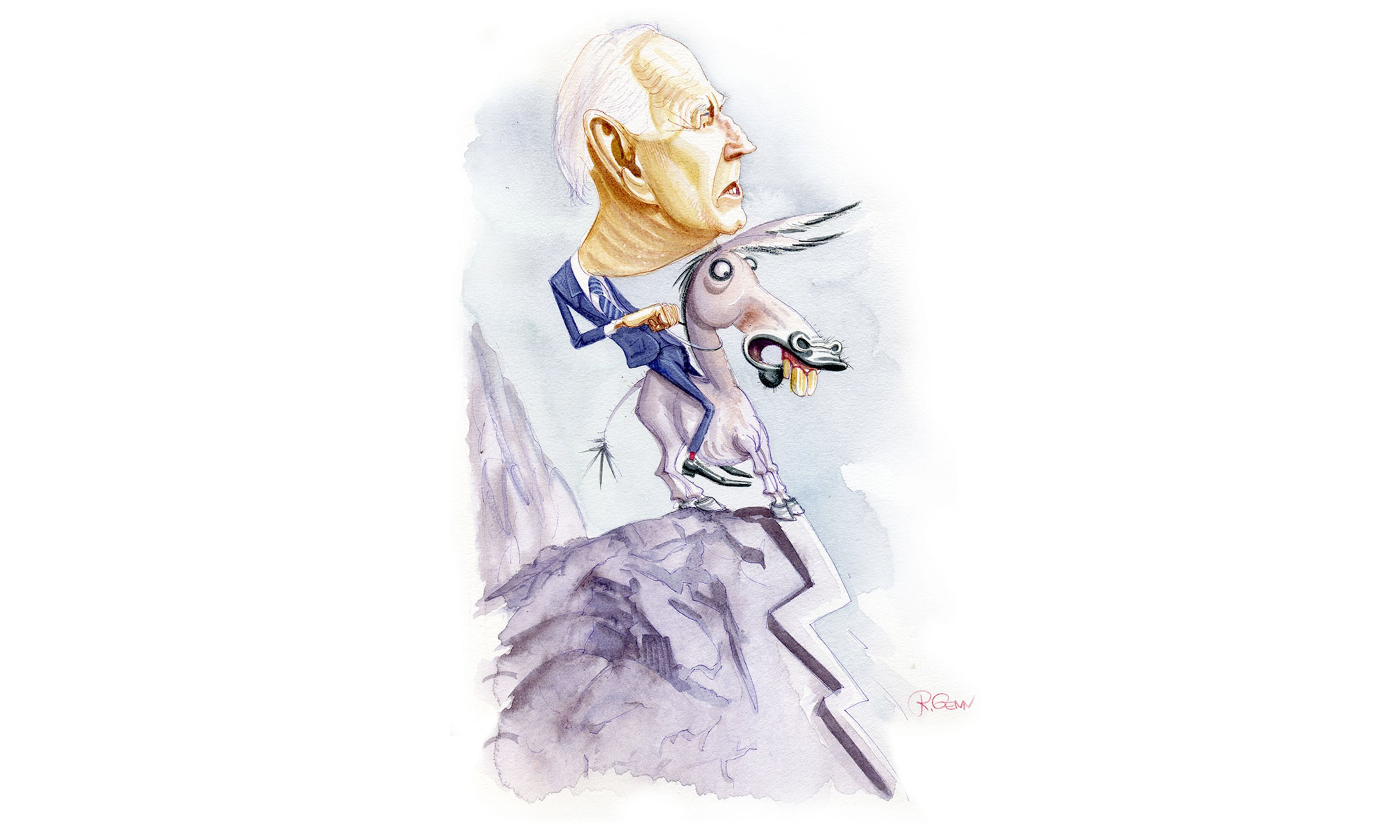
Like scholastics debating how many angels can dance on the head of a pin, Washingtonians spent much of the summer fighting over the precise definition of a recession.
Is it back-to-back quarters of economic contraction? If so, then America entered a recession sometime in the first half of 2022.
Or should the public rely on the technocrats at the National Bureau of Economic Research (NBER), who consider a variety of factors, such as growth, unemployment, and wages, as they measure the peaks and troughs of business cycles? If that is true, then White House press secretary Karine Jean-Pierre may have been right to say on August 4 that the economy is not in a recession, but in a “transition to a stable and steady growth.” No one will know for sure until the NBER makes an announcement.
In the meantime, the public has reached its own conclusion. Since the spring, majorities of Americans have been telling pollsters that the economy is in a recession. The University of Michigan index of consumer sentiment began its current plunge in April. At the time of writing, it remains near a historic low. In a New York Times/Siena College poll conducted over the summer, 58 percent of registered voters said that the economy was “poor.”
A June poll from the Economist/YouGov found that 56 percent of adults said the recession was here. By early August, that number had risen to 61 percent. A CNBC/Survey Monkey poll of small-business owners released during the first week of August found that a majority believed the recession had arrived.
This economic pessimism has political consequences. Recessions hurt incumbents. Since 1980, according to the NBER, there have been five recessions during election years: 1980, 1982, 1990, 2008, and 2020. The opposition party did well in each contest. In 1980, Ronald Reagan beat Jimmy Carter, Republicans took control of the Senate, and the GOP won more than 30 seats in the House. In 1982 the Democrats struck back, gaining 26 seats in the House and one in the Senate.
In 1990 the Democrats won seven House seats and one in the Senate. The economic hangover helped Bill Clinton win the White House two years later. In 2008, Democrats captured the White House, 21 House seats, and eight Senate seats. And in 2020, Joe Biden defeated Donald Trump, Democrats held the House, and Republicans lost control of the Senate.
Biden wants to avoid a similar fate. That is why he remains adamant that there is no recession. He is finding it hard, though, to convince the public that the economy is hunky-dory. Biden talks up job and wage growth, but he has been unable to placate voters suffering from inflation, high fuel prices, and supply and labor shortages. Prices are rising faster than incomes. Consumers can’t make ends meet. And the president shoulders the blame.
“The vibes in the economy are . . . weird,” wrote entrepreneur Kyla Scanlon in a recent New York Times guest essay. You don’t have to consult a tarot deck for an explanation. What voters are saying is not irrational, amorphous, or inexplicable. Regardless of whether they have a job, voters hate inflation. And with good reason: Inflation makes financial planning more difficult. It erodes purchasing power. Savings depreciate. Transportation becomes more expensive. Essential goods such as baby formula are hard to find.
Emotions are not the cause of Biden’s trouble. Reality is. Biden’s job-approval rating, for example, began to fall in May 2021. That is when inflation started to take off. Prices have not come down since. Nor has Biden recovered. By the end of July 2022, his job approval in the Gallup poll had reached a low of 38 percent. Since 1946, the average loss for a president under 50 percent approval on Election Day has been 37 House seats. The Republicans need only four to take control.
Voter dissatisfaction with Biden’s handling of the economy is the main reason that the FiveThirtyEight election forecast gives the GOP an 80 percent chance of winning the House of Representatives. Toward the end of July, Bloomberg Economics analyzed each state’s “Misery Index” — that is, the sum of the unemployment and inflation rates. It concluded that Republicans stand to gain 30 to 40 House seats.
Around the same time, CBS News/YouGov projected that Republicans would hold 230 House seats next year. That may be a conservative estimate. “There is no battle for the House, at least this cycle,” election analyst Sean Trende tweeted recently. “It would take a miracle for Ds to hold on.”
The silver lining for Democrats is that voters have yet to translate their disapproval of Biden into support for Republican Senate candidates. FiveThirtyEight, for instance, is averaging polls in six key Senate races. At the beginning of August, Republicans were running behind in all but one.
Why? One reason may be that GOP voters have yet to consolidate behind nominees who won closely divided and bitterly fought primaries. Henry Olsen of the Ethics and Public Policy Center also points out that independents who disapprove of Biden remain undecided in Senate races. “History shows that these voters tend to break sharply against the president’s party by Election Day,” Olsen wrote in a July piece for the Washington Post.
But Republicans should not measure the drapes of the Senate majority leader’s office just yet. A third reason for the lackluster polls may be candidate quality. The Trump-endorsed candidate won the nomination in each of the six Senate races, and Trump bases his picks more on personal loyalty than on general electability.
Kyle Kondik of the University of Virginia’s Center for Politics observes that the GOP Senate field has little political experience. Only two challengers in high-profile races, Ted Budd in North Carolina and Adam Laxalt in Nevada, have held public office. Notably, they are more competitive with their Democratic opponents than other Republican Senate candidates in the FiveThirtyEight average.
Candidates without backgrounds in politics are unknown quantities. They can appeal to the public as agents of change. They also can make rookie mistakes that cost their party a majority. “The preponderance of Republican Senate candidates without formal elected experience in 2022 is striking compared to the slate of candidates the party nominated in 2014, the last time Republicans flipped the Senate from blue to red,” Kondik writes.
Remember that swings in the Senate during recession years have been less dramatic than shifts in the House. House races are highly correlated with presidential approval ratings, Senate races less so. Senate contests are like mini presidential elections. Voters pay close attention to what a candidate says and does. Small vote margins make the difference between victory and defeat. Lackluster House candidates benefit from the protective shield of gerrymandering. Senate candidates do not enjoy that luxury. They must be nimble. They must appeal to a wide audience.
The great political journalist Jack Germond liked to say that “when the economy is bad, the party in power is blamed. When the economy is good, people look at other issues.” Germond, who died in 2013, never had the chance to cover today’s tribal, turbulent, ideological politics, where so much is up in the air. Education, for example, was just as important as inflation to Virginia governor Glenn Youngkin’s victory in 2021.
This year, education has receded as a priority, and the right to life has moved to the foreground. In a post-Dobbs world, Republicans who focus on prosecuting the case against Biden’s economic mismanagement may leave themselves vulnerable to attack on culture. If Republican candidates talk only about stagflation, Democrats could use the opportunity to define the party as outside the mainstream of opinion on abortion. A lot depends on whether Mehmet Oz and Herschel Walker can counterattack sincerely, compassionately, and substantively.
Then again, it might not matter what they do. In June, Gallup looked at presidential job approval, congressional approval, satisfaction with the direction of the country, voter assessments of current economic conditions, and party affiliation. “On their own,” wrote Jeffrey M. Jones and Lydia Saad, “those numbers would all predict a greater-than-average loss of seats for the Democratic Party this fall.” The situation has not improved in the months since.
As campaign season begins in earnest, Republicans are betting that the fundamentals of this election will outweigh substandard candidates and a potential Supreme Court backlash. It is a safe bet. It is a reasonable bet. It is the obvious bet. On November 8, we will see if it pays off.











Comments