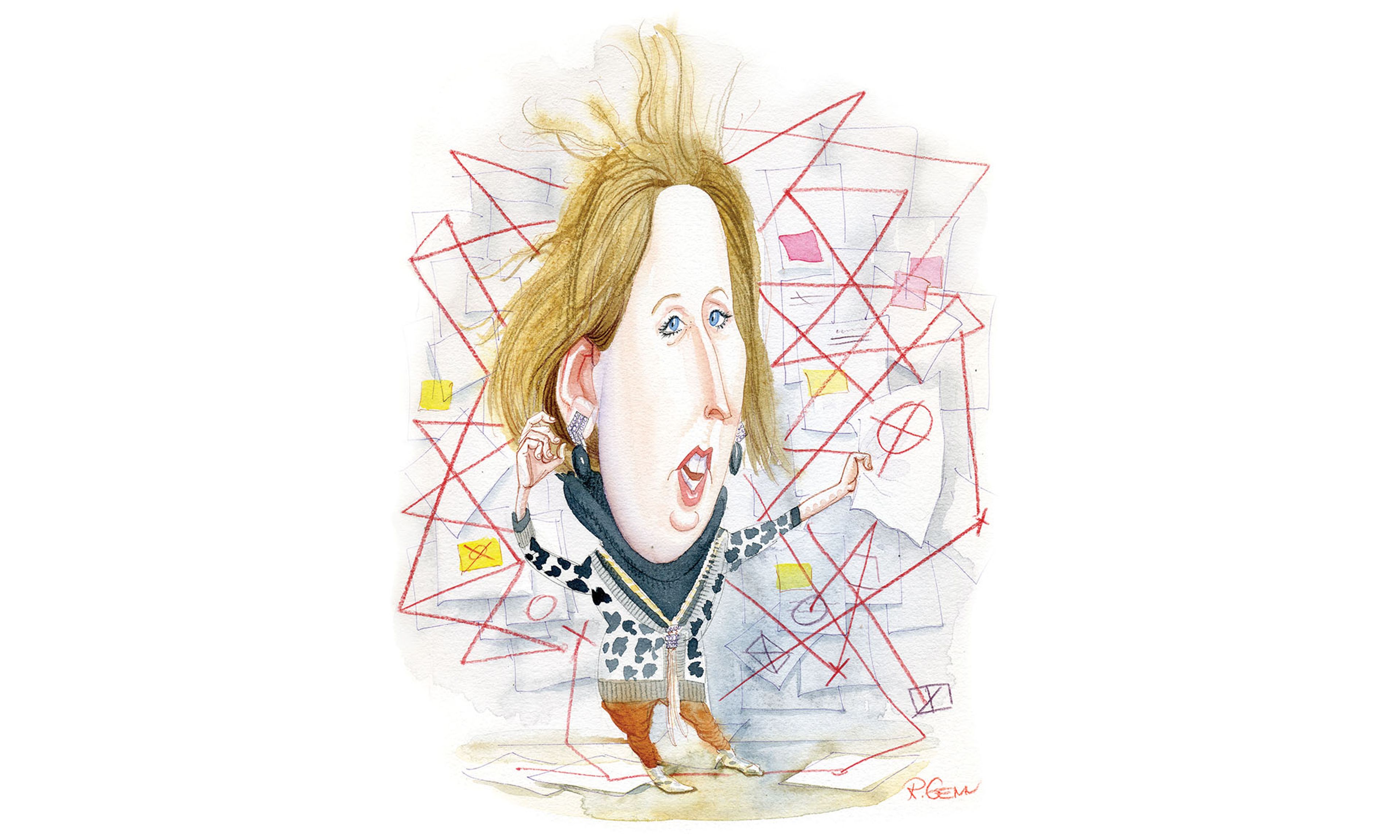
• Yes, we’ve just turned 65. No, we aren’t changing our minds about Social Security.
• As the Pequod sinks at the end of Moby-Dick, the last of its crew to vanish are Queequeg, Tashtego, and Dagoo, the harpooners atop its floundering masts. Their analogues in Donald Trump’s presidential campaign were Rudy Giuliani, Jenna Ellis, and Sidney Powell, making ignorant, frivolous, and fantastical post-election arguments in an attempt to overturn the results in Pennsylvania. Ignorant: Giuliani, the president’s personal lawyer, has not been in a courtroom for decades, bobbled elementary legal terms, and was not up on current procedure. Frivolous: They claimed that, because some Pennsylvania counties treated their absentee ballots differently, all absentee ballots in the state should be thrown out. Fantastical: Powell, who was dropped from the team when she became too embarrassing even for her colleagues, insisted that Trump, pre-cheating, had won 70 percent of the popular vote (a feat no candidate has accomplished since popular voting became the norm). Her promise to release the Kraken, a mythical all-destroying sea monster, turned out to be all myth and no monster. The ship has sunk; it’s over.
• Chris Krebs was the director of the Cybersecurity and Infrastructure Security Agency in the Department of Homeland Security. After this year’s elections, Krebs said that Americans could have confidence in the integrity of those elections. Promptly, President Trump fired him. Trump says, among other things, that Dominion Voting Systems is a “Radical Left” company that deleted Trump votes or switched them to Biden. There is no evidence of this whatsoever. Dominion was, incidentally, used in North Carolina, a state that President Trump won. It was used in 14 counties of Pennsylvania — twelve of which the president won. Another of his lawyers, Joseph diGenova, said of Chris Krebs, “He should be drawn and quartered. Taken out at dawn and shot.” On the contrary, he should be commended.
• On Thanksgiving Day, President Trump made a statement about Brad Raffensperger, the secretary of state in Georgia: “He’s an enemy of the people.” Raffensperger is one of the many Republicans across the nation who have executed their offices honorably under tremendous pressure in this post-election atmosphere. The roll includes several Michiganders: Aaron Van Langevelde, of the Board of Canvassers; Tina Barton, the clerk in Rochester Hills; Mike Shirkey, the senate majority leader; and Lee Chatfield, the house speaker. These last two were summoned by Trump for a meeting at the White House. Afterward, they issued a statement, saying, “Michigan’s certification process should be a deliberate process free from threats and intimidation.” In Arizona, one could cite Rusty Bowers, the speaker of the house, and Clint Hickman, the chairman of the Maricopa County Board of Supervisors. In Pennsylvania, Judge Matthew W. Brann, and on the Third Circuit, Judge Stephanos Bibas. Many of these Republicans have received serious threats on their lives and have required personal security. On faithful executors of their offices does our republic depend.
• President-elect Biden’s delivery is mild and slow; he trips over familiar words on the teleprompter. Yet in his Thanksgiving address he expressed sympathy for the distress of COVID-plagued Americans, and called for patience and fortitude. There is a lesson in political dynamics here. If you leave the ordinary virtues lying in the street, others will pick them up. Aggression and pizzazz can be stimulating, at least for a moment. But if you cede common humanity, only your rivals will be good, and they will look even better. Ronald Reagan was masterly at invoking the pieties. Biden is not in his league, but after the last four years he is the only one in that league.
• Trump’s pardon of retired lieutenant general Michael Flynn, who fleetingly served as his first national-security adviser, was a justified act of clemency. One need not be a fan of either Flynn or the sometimes objectionable manner in which Trump has wielded pardon power to acknowledge that this is so. Flynn should never have been the subject of an FBI investigation — there was no basis to believe either that he was a clandestine agent of Russia or that he had committed a criminal offense. Yet the FBI’s probe proceeded on these premises, and its behavior in interviewing Flynn, then the president’s top security aide, was reprehensible: willfully ignoring protocols that required obtaining permission from the Justice Department and the White House; misleading Flynn about the nature of the interview; and discouraging him from alerting White House counsel or retaining a lawyer of his own. Attorney General Bill Barr’s decision to drop the prosecution was reasonable and, significantly, was the executive branch’s call to make. Judge Emmet Sullivan’s refusal to grant the dismissal motion and search for ways to continue the prosecution over Justice Department objections was outrageous. The pardon accords with the constitutional order.
• Raphael Warnock, the Georgia Democrat running against Republican senator Kelly Loeffler in a January 5 runoff election, is trying to run away from his radical record, but no one should be fooled. Warnock refuses to say whether he would vote to pack the Supreme Court. He portrays himself as a friend of Israel, but in 2019 he signed a statement likening Israel to “oppressive regimes” such as “apartheid South Africa.” In 2018, he condemned Israelis as “birds of prey” who viciously kill innocent Palestinian “brothers and sisters.” Warnock is a Baptist preacher, but he should not be given a free pass because he made some of these remarks at a pulpit — any more than other pastor politicians before him, including Republican Pat Robertson and Democrat Jesse Jackson, were. Warnock’s admiration of anti-Semitic pastor Jeremiah Wright is also a legitimate issue. The Democratic Senate candidate called Wright’s infamous “God Damn America” sermon “very fine.” In that “very fine” sermon, Wright likened America to al-Qaeda and accused the U.S. government of “inventing the HIV virus as a means of genocide against people of color.” Warnock’s radicalism makes it all the more important that President Trump not foment division among Georgia Republicans, who need to be energized and united to win this race, by accusing them of letting Democrats steal the election from him.
• In the wake of positive data from multiple COVID-19 vaccine trials, it is easy to forget that more than one million Americans are testing positive for the virus every week. Rapid medical breakthroughs, a testament to American ingenuity, are heartening, but they also increase the urgency of curbing infections. They destroy the argument for tolerating new cases as a way of reaching herd immunity, and make every case delayed a potential life saved. Changes in individual behavior — mask-wearing, travel reductions, and remote work — have reduced infections and deaths. Superspreader events, once common, decreased dramatically in the summer and fall. But the recent spike in cases is a reversal of progress. This is no time to declare victory.
• To test their COVID vaccines, Pfizer and Moderna used cell lines developed from ones that may have been derived from an abortion decades ago. The vaccines themselves do not, however, use cell lines with any historical connection to abortion. To take these vaccines is thus not to cause, to encourage, or to confer approval of abortion. The remoteness of their connection to abortion, coupled with the morally important goal of protecting both ourselves and our communities from severe illness, should ease any concerns that pro-lifers have about these vaccines. They are likely to save many lives without being implicated in the destruction of any.
• New York governor Andrew Cuomo thinks he can limit the capacity of churches and synagogues to ten people in areas besieged by COVID-19 — while other, more “essential” activities face no limit at all. The Supreme Court disagrees, quite rightly: Legally speaking, Cuomo’s rules are neither “generally applicable” nor “narrowly tailored.” Different types of establishments face different rules, with churches on the very restrictive end of the spectrum. And the policy is obviously not tailored to minimize the harm to religious observance while preventing COVID-19’s spread, because it does not even allow greater attendance in bigger churches and synagogues. Some of these buildings can seat more than 1,000 people, but all are limited to ten in areas coded “red” for COVID prevalence (and to 25 in “orange”). Reasonable people can disagree as to how a church should be treated relative to, say, a liquor store; people don’t congregate for an hour and sing in the latter. But there is no excuse for limiting a 1,000-seat church to a handful of people while liquor stores are categorized as “essential” and given no capacity limit at all. So far, the Court has only issued an injunction while the case continues, but Cuomo should come up with a fairer system before the judiciary forces him to.
• Going into the final month of the year, more than 40 percent of children go to schools that offer only virtual learning, according to the data service Burbio. Some schools have not opened at all since the summer; others, including those in New York City, have newly closed in response to the third wave of COVID-19 infections. By any measure, this has been disastrous for education, with grades and attendance slipping. And while nothing is risk-free in the age of COVID, schools appear to play a minor role in the virus’s spread, and children, especially younger children, are the demographic least at risk of severe cases. In New York in particular, random tests of students and staff have revealed a positivity rate of just 0.17 percent, and yet the schools were shut down when the city-wide positivity rate exceeded 3 percent — the lowest such threshold in the country. The schools were then reopened. Keeping them open, with precautions, should be a priority: Risk is an unavoidable aspect of life, and the job of responsible grown-ups is to figure out how to responsibly mitigate it.
• In November, as coronavirus cases surged in California and its governor, Gavin Newsom, emphasized caution, he also enjoyed a friend’s birthday dinner at the French Laundry, a high-end restaurant. As it was indoors in close quarters, and its participants were unmasked, the gathering violated many of the rules Newsom himself had imposed. When outed, he apologized for failing to “preach and practice.” On the other side of the country, New York governor Andrew Cuomo urged residents of his state to forgo traditional Thanksgiving celebrations to keep the virus from spreading. Then it emerged that Cuomo had planned a Thanksgiving dinner with two of his daughters and his 89-year-old mother. He canceled, but the gall of having said one thing and planned to do another is hard to dispel. Figures such as Newsom and Cuomo seem not to realize how damaging such actions are. They not only contribute to the always toxic perception (and frequent reality) that there is one set of rules for the governing class and another for the governed; they also feed into a cynicism about the coronavirus response that can incline people to take it all less seriously than they ought.
• Cuomo’s bizarre victory lap dedicated to his pandemic leadership continues apace. First, despite a towering body count, the governor commissioned a campy, cartoonish “New York Tough” poster, complete with jokes aimed at his daughter’s boyfriend. Then, amid surging case counts and civil unrest in New York aggravated by his incompetence, he found the time to write a memoir touting his “leadership lessons.” Now, in a news item you would expect to see in The Onion, the governor has accepted an Emmy Award “in recognition of his leadership during the COVID-19 pandemic and his masterful use of television to inform and calm people around the world.” This from the governor who disastrously presided over one of the worst outbreaks in the Western world. They say, “Fake it till you make it.” We’ll grant that Andrew Cuomo has mastered the first half of that dictum.
• As Newsom considers whom to tap to fill Kamala Harris’s Senate seat, he finds himself in a traffic jam of racial, ethnic, and sexual claims. California secretary of state Alex Padilla, a longtime ally, is Hispanic. But Long Beach mayor Robert Garcia is both Hispanic and gay. Representatives Barbara Lee and Karen Bass are black women; Representative Ro Khanna is Indian-American, Representative Judy Chu Chinese-American. Checking identity boxes is an old tradition in American politics: One 1961 New York campaign jingle went “How can you miss / With a ticket like this? / Lefkowitz, Gilhooley and Fino?” (N.B.: All three candidates lost, being Republicans.) The modern version seems more strident because of the hovering presence of critical race theory, a late Marxist doctrine that seeks to employ minorities of whatever kind as foot soldiers in remaking society. The Californians want jobs, like all pols, and recognition, like all minorities. When they ask for more, honor their origins, fight their plans.
• The Left is increasingly pressuring Joe Biden to forgive student debt via executive order. It would be an appalling combination of bad policy and questionable law. While it’s become fashionable to call student debt a “crisis,” the typical four-year college graduate who borrowed starts with a debt of $28,500 — while college grads out-earn high-school grads by something like a million dollars over the course of their lives. For those who do struggle, especially those who took on massive grad-school debt but ended up earning low incomes, current law also provides “income-based” payment options, in which borrowers pay a set percentage of their income for ten to 25 years and any remaining debt is forgiven. To the extent that problems remain, they mainly concern people who took out small loans and didn’t graduate, a problem that across-the-board forgiveness fails to target. And legally, while Congress has unwisely granted the executive branch a broad authority to modify, compromise, waive, or release students’ debts, this was clearly not meant to authorize a mass-scale jubilee, and federal law also directs agencies to “try to collect” the debts they are owed. College costs too much, but not so much that we need to throw taxpayer money at the most educated people in our society.
• Alexander Hamilton, first Treasury secretary and toast of Broadway, has been branded by Jessie Serfilippi, a historical interpreter, as an “enslaver” — an owner of slaves himself, and a dealer of them for himself and others. Her essay, touted by the New York Times, had the misfortune to be examined by Michael Newton, Hamilton scholar (among Newton’s recent finds: the correct year of Hamilton’s birth, long a matter of dispute). “Serfilippi’s essay,” he writes, “is riddled with errors, omissions, assumptions, speculations, and misrepresentations.” Hamilton acted as a banker for his in-laws in a few transactions involving slaves, but census records show he never owned slaves himself. “As a legislator,” Newton goes on, “he signed a memorial to abolish the slave trade. As a statesman, he . . . rejected the return of slaves taken by the British. As an individual, he was a leading member of the New York Manumission Society, where he . . . helped set up a school for black children, and helped pass a law to gradually outlaw slavery in New York.” America’s long commerce with slavery is bad enough without careless moderns making it worse.
• China and 14 of its Asian neighbors signed the Regional Comprehensive Economic Partnership (RCEP), the largest free-trade agreement ever. The deal itself is not especially consequential: Most of its provisions are already covered under existing bilateral and plurilateral arrangements. But the sheer extent of the trade zone should worry Washington, which has missed opportunity after opportunity to convert the grievances of China’s neighbors into meaningful policy victories. The Trans-Pacific Partnership, a more comprehensive agreement than the RCEP, would have strengthened ties between Asia and the West, to China’s detriment. Trump’s scuttling of that deal paved the way for Beijing to cement ties with its neighbors, even democracies such as South Korea and Japan eager to stall China’s rise. Unfortunately, we don’t expect any better from President-elect Biden, who has a history of downplaying the Chinese threat and has not announced plans to rejoin the TPP or put together an alternative trade deal. The longer Washington neglects its leadership role in Asia, the sooner Beijing’s dream of regional dominance will come to fruition.
• “Believe in something. Even if it means sacrificing everything.” That’s the tagline on a Nike ad featuring Colin Kaepernick. One thing that Nike, in addition to Coca-Cola and Apple, is willing to sacrifice is the Uyghur people. It’s widely known that hundreds of thousands of members of this ethnic-minority group have been herded into a vast system of industrial slavery across China. Now the New York Times reports that the Uyghur Forced Labor Prevention Act — a bill, with bipartisan support in Congress, meant to fight this mass atrocity — has become the subject of intense lobbying by multinational corporations that find their financial interests threatened by a provision requiring that the U.S. government treat any product from Xinjiang as the result of slave labor. The provision would place the burden of proof on the companies to demonstrate otherwise, and would almost certainly have an impact against the ongoing Uyghur genocide. But it would also disrupt supply chains: Many of the lobbying companies, including Nike, have sourced products from factories tainted by CCP slave labor even as their PR reps have sold specious claims that they’ve made great strides against this. In this case, commerce should yield to justice and basic humanity.
• Russian hackers attacked the University of Vermont Health Network, the state’s largest provider. Patient lives were put at risk in a situation that one nurse described as “dire.” The network’s electronic medical records remained down for nearly a month. Cancer patients, most of whom had to seek treatment elsewhere, bore the brunt of the harm as staff slowly pieced together medical histories and chemotherapy protocols from memory to decide who should be prioritized. Although such attacks are typically followed by a ransom demand, this one was not, leading experts to believe that the point was to send a message. Our leaders should treat the attack — and the vulnerability of other hospitals across the country — as a threat to national security.
• Even by the standards of the Middle East, the assassination of Mohsen Fakhrizadeh is an extraordinary event. A physicist, he was the head of Iran’s nuclear program. Traveling to a family villa in the country, he was in the second car in a convoy of three. There is more than one account of the fatal ambush, but it seems likely that the shots were fired from a remotely operated machine gun mounted on a truck with a self-destruct mechanism. In other words, gathering of information, planning, and technology had to be faultless, and indeed were. Iranians mostly suspect that Israel was responsible, and it adds to this suspicion that Israel neither denies nor confirms its role but meanwhile is braced for retaliation.
• With that uncouth Donald Trump on his way out of the White House, the EU’s leaders are eagerly drawing up a list of “shared priorities” to discuss with Joe Biden in order to, as Bloomberg puts it, “repair relations soured by Donald Trump.” Biden has already handed Brussels a gift by deciding to rejoin the Paris climate agreement, a move that will, if seriously followed up, erode much of the energy advantage that the U.S. now enjoys over the EU. The “shared priorities” identified by Brussels include, reportedly, cooperation on “the responsibility of online platforms” (EU-speak for the introduction of Merkel-style censorship of social media) and a coordinated approach on antitrust and taxation with regard to digital services, something that will — only coincidentally — have the effect of damaging the leading companies in a sector in which the U.S. has succeeded and the EU has failed. Also on the EU’s menu: Washington’s acceptance of the EU’s protectionist carbon border tax and of the United States’ working with Brussels on carbon-pricing mechanisms that will, again entirely coincidentally, erode U.S. energy competitiveness. All of these “shared” priorities make the U.S. take the pain and give the EU the gain. That’s the kind of partnership that the EU is naturally eager to resume.
• In 2017, the average Venezuelan lost 24 pounds as years of corruption and economic mismanagement brought the poverty rate to nearly 90 percent. The same year, Venezuela’s national assembly found that the socialist regime of Nicolás Maduro had embezzled more than $200 million from the country’s food-distribution agency. The humanitarian crisis has only worsened since, with inflation reaching 6,500 percent. Starving Venezuelans have fled en masse, but those unable to migrate rely on the handful of charitable organizations able to scrape by in the country. Feed Solidarity (Alimenta La Solidaridad), one such charity, managed to serve 25,000 children in Venezuela’s poorest regions. No longer: The regime has raided the charity’s facilities and frozen its bank accounts. This latest display of barbarism should serve as a warning to those advocating a friendlier posture toward the Venezuelan government.
• She would like doctors to hasten her death when she thought the time was right, a Dutch woman stipulated in an advance medical directive. Several times they asked her whether it was time. “Not yet,” she said. In 2016, after dementia had set in and she could no longer answer, a geriatric specialist and the patient’s family answered for her. The doctor laced her coffee with a sedative. She struggled against the lethal injection anyway, as relatives held her down. A Dutch medical board reprimanded the doctor. Hundreds of Dutch physicians spoke out against the abuse of advance directives. This spring, the supreme court of the Netherlands dismissed the decision of the medical board and exonerated the doctor. The Regional Euthanasia Review Committees of the Netherlands has issued a new guideline to let doctors put sedatives into the food or drink of dementia patients before euthanizing them. In cases of severe dementia, according to the revised code, “it is not necessary for the doctor to agree with the patient on the time or manner in which euthanasia will be given.” So the notion that the Netherlands permits euthanasia only when it’s voluntary passes into obvious fiction.
• Believed to be the highest-ranking Catholic prelate ever to have been laicized for sexual misconduct, Theodore McCarrick personifies the clerical corruption that, rampant in the Church in the second half of the 20th century, continues to scandalize the faithful and the general public as the picture of that era slowly comes into sharper focus. Rumors of his habitual sexual advances to minors and adults, particularly seminarians, impeded but did not prevent his steady career progress. Pope John Paul II appointed him to the plum position of archbishop of Washington, D.C., in November 2000 and consecrated him a cardinal three months later. In 2018, an investigation that the Vatican had finally launched into the longstanding allegations against McCarrick ended in his removal from ministry. He resigned from the College of Cardinals and was defrocked. Last month, the Vatican released a 460-page report on the McCarrick scandal. It documents lapses of judgment or character by Popes John Paul, Benedict XVI, and Francis. At various junctures they dismissed the allegations, or credited them but then failed to take decisive action. The report, which contains some new information but no surprises, makes for grim reading, bitter but necessary medicine.
• A 67 million–year–old murder mystery is being investigated by scientists at the North Carolina Museum of Natural Sciences. Locked together in an apparent fight to the death, the skeletons of a T. rex and a triceratops were found in a Hell Creek, Mont., hillside ten years ago. After surviving the excavation, a legal battle, and shipment to a warehouse, the fossils were purchased by the Friends of the North Carolina Museum of Natural Sciences. According to the AP, the organization is gifting the skeletons, still embedded in the sediment in which they were discovered, to the museum’s vertebrate-paleontology collection. The “dueling dinosaurs,” as they are known, are an exceedingly rare find, owing not just to their evident combat but to the 100 percent–completeness of the T. rex and the near-completeness of the triceratops. Valued in the millions, the fossils will be part of the museum’s permanent collection in Raleigh starting in 2022. Under the circumstances, that’s not a long wait.
• In the 1960s and 1970s, a common phrase was: “If we can put a man on the moon, we can . . . ,” followed by whatever one’s favorite cause was. “We” was generally envisioned to be some sort of government agency, though as memories of the New Deal and World War II gave way to the realities of the Great Society and Vietnam, the declaration lost much of its resonance. Yet space exploration continues its breathtaking and inspirational course, only now private enterprise is taking the lead: As we went to press, Elon Musk’s SpaceX company was set to launch its prototype Starship rocket on a test flight to 50,000 feet, part of a program that will culminate in a manned landing on Mars. NASA’s 1960s Apollo program was and will always remain a staggering accomplishment, but now SpaceX is showing what American high tech can do on its own. If we can privatize putting a man on Mars . . .














The SpaceX Falcon 9 rocket carrying the Crew Dragon capsule launches with four Crew-1 astronauts on the first operational NASA commercial crew mission at Kennedy Space Center in Cape Canaveral, Fla., November 15, 2020.
Thom Baur/Reuters
• Daniel Cordier was a Frenchman galvanized by the fall of France in 1940. Hitherto a member of an extreme anti-republican group, he escaped to Britain and joined the Free French fighting to restore the republic. In 1942 he was parachuted back into France. Jean Moulin, the head of the Free French in France, picked him as his right-hand man. Covering his tracks, Cordier posed as an art dealer. Arrested in 1943, Moulin was tortured to death by the Gestapo, and Cordier once again escaped, this time over the Pyrenees into Spain. When Moulin was accused after the war of being a Soviet agent, Cordier disproved the charge in a definitive work in four volumes. He became a genuine art dealer and always said that in the war he was only doing his duty. Died aged 100, R.I.P.
• “A little bit with the head of Maradona, and another little bit with the hand of God,” said the Argentine midfielder to the gaggle of rapt reporters who wanted his account of how he had scored a controversial goal in Argentina’s victory, just completed, over England in the 1986 World Cup quarterfinals. The hand was Diego Maradona’s, though, as the whole world saw on replays on TV, unless he meant that the ref’s blindness to his blatant foul was the result of divine intervention. A second miracle, the Goal of the Century, followed minutes later, after he dodged four opposition players in a 60-yard, ten-second zigzag of a sprint to the English line. There he executed a quick feint, flummoxing the goalie, before slamming the ball into the net. Argentina went on to win the final, against West Germany, as Maradona, el Pibe del Oro, was canonized a soccer saint by popular acclaim. After a playing career that spanned a few decades (from the 1970s to the ’90s) and a couple of continents (South America, Europe), he managed professional teams here and there. He had weaknesses for cocaine and leftist caudillos. But what thumos! Dead at 60. R.I.P.
• David Dinkins, New York City’s first black mayor, liked to call his multiracial, multiethnic constituents the “gorgeous mosaic.” During his tenure, however, the mosaic chipped and cracked. A Korean fruit stand in Flatbush was boycotted by black racists; an anti-Jewish riot in Crown Heights claimed the life of a young Orthodox man. Dinkins, a man of notably honorable views himself, seemed unable to deal effectively with the baser passions. Crime spiked early in his tenure; he took some steps, such as hiring more cops, to begin bringing it down. But the aura of disorder enabled the election of former prosecutor Rudy Giuliani. Dinkins devoted his retirement to his great avocation, tennis. Dead at 93, R.I.P.
• Edward J. Perkins was a distinguished career diplomat of the United States. He was ambassador to three countries: Liberia, Australia, and, in the last years of apartheid, South Africa. He was also ambassador to the United Nations, and director general of the Foreign Service. He grew up in Pine Bluff, Ark., the grandson of ex-slaves. Ambassador Perkins has now died at 92, having lived an inspiring American life. R.I.P.
• The distinguished economist Edward Lazear died at the age of 72. Lazear was a professor at Stanford’s Graduate School of Business and a fellow at the Hoover Institution, having made his name as an economist at the University of Chicago, where he taught for almost 20 years before moving to Stanford. Lazear was best known as a pioneer in the field of personnel economics. More broadly than that, he was a staunch defender of free markets, both inside the ivory tower and outside, whether through his nonacademic writing or his public service. He was chairman of the White House Council of Economic Advisers in the later years of the George W. Bush administration and a key figure in helping the president as the financial crisis broke. Lazear was known for following his own analysis rather than the conventional wisdom and stood out for arguing in 2018 that the economy could continue to grow without overheating the jobs market despite the lowest unemployment rate in decades. Not for the first time, he was proved right. It is a source of pride for us that Professor Lazear had recently started writing for NR’s Capital Matters. His last article for us concluded as follows: “If a system’s benevolence is measured by the living standards of the poor, then free-market capitalism receives high marks.” R.I.P.
Trump’s Disgraceful Endgame
President Trump said the other day that he’ll leave office if he loses the vote of the Electoral College on December 14.
This is not the kind of assurance presidents of the United States typically need to make, but it was noteworthy given Trump’s disgraceful conduct since losing his bid for reelection to Joe Biden on November 3.
Behind in almost all the major polls, Trump stormed within a hair’s breadth in the key battlegrounds for winning reelection, and his unexpectedly robust performance helped put Republicans in a strong position for the post-Trump-presidency era. This is not nothing. But the president can’t stand to admit that he lost and so has insisted since the wee hours of Election Night that he really won — and won “by a lot.”
There are legitimate issues to consider after the 2020 vote about the security of mail-in ballots and the process of counting votes (some jurisdictions, bizarrely, take weeks to complete their initial count), but make no mistake: The chief driver of the post-election contention of the past several weeks is the petulant refusal of one man to accept the verdict of the American people.
Almost nothing that the Trump team has alleged has withstood the slightest scrutiny. In particular, it’s hard to find much that is remotely true in the president’s Twitter feed these days. It is full of already-debunked claims and crackpot conspiracy theories about Dominion Voting Systems, even as the president’s own attorney general, Bill Barr, says Justice Department investigations have uncovered no fraud that would affect the outcome of the election.
Elected Republicans have generally taken the attitude that the president should be able to have his day in court. It’s his legal right to file suits, of course, but he shouldn’t pursue meritless litigation in Hail Mary attempts to get millions of votes tossed out. This is exactly what he’s been doing — it’s why reputable GOP lawyers have increasingly steered clear, and it’s why Trump has suffered defeat after defeat in court.
In its signature federal suit in Pennsylvania, the Trump team argued that it was a violation of the equal-protection clause of the U.S. Constitution for some Pennsylvania counties to let absentee voters fix, or “cure,” their ballots if they contained an error, while other counties didn’t. Trump’s team maintained that it was another constitutional violation for Trump election observers not to be allowed in close proximity of the counting of ballots. On this basis, the Trump team sought to bar the certification of the Pennsylvania results or have the Pennsylvania General Assembly appoint presidential electors.
In giving all of this the back of its hand, a unanimous panel of the Third Circuit (in an opinion written by a Trump appointee) noted that the suit contained no evidence that Trump and Biden ballots or observers had been treated differently, let alone evidence of fraud. Within reason, it is permissible for counties to have different procedures for handling ballots, and nothing forced some counties to permit voters to cure flawed absentee ballots and others to decline to do so.
On top of this, the court pointed out that the suit challenged the procedures to fix absentee ballots in seven Democratic counties, which don’t even come close to having enough cured ballots to change the outcome in the state.
Trump’s most reprehensible tactic has been to attempt, somewhat shamefacedly, to get local Republican officials to block the certification of votes and state legislatures to appoint Trump electors in clear violation of the public will. This has gone nowhere, thanks to the honesty and sense of duty of most of the Republicans involved, but it’s a profoundly undemocratic move that we hope no losing presidential candidate ever even thinks of again.
Getting defeated in a national election is a blow to the ego of even the most thick-skinned politicians and inevitably engenders personal feelings of bitterness and anger. What America has long expected is that losing candidates swallow those feelings and at least pretend to be gracious. If Trump’s not capable of it, he should at least stop waging war on the outcome.
Partial Victories
This magazine was founded 65 years ago to protest — no, to overthrow — a stultifying liberal consensus that viewed history as a train and itself as the destination. The universities, the newspapers and the networks, the Democratic Party and much of the Republican Party were united in believing that centralized rule by benevolent experts was our inevitable fate.
We won. Not on our own: We had many allies, including reality, which proved much less amenable to social engineering than our mid-century ruling class imagined. Liberalism is no longer a confident consensus, even if it is more eager than ever to stultify. We have a real, if imperfect, two-party politics. The Constitution — its words and its underlying philosophy — are more central to our legal and political debates than they were then. The Soviet Union, which the forward thinkers of 1955 told us had to be accommodated as a fact of life rather than defeated, is no more.
We didn’t win completely. Too much of our founding statement speaks to our day as well as its own. “The largest cultural menace in America is the conformity of the intellectual cliques which, in education as well as the arts, are out to impose upon the nation their modish fads and fallacies, and have nearly succeeded in doing so.” If we were writing that afresh, we would merely need to find a place to stick “woke” and mention journalism and social media, too. The growth of centralized government we decried has slowed but not reversed. Yesterday’s historicism has a faint and tinny echo in the boasts of today’s Left that the future still belongs to it. Our reference to the need for a “responsible dissent from the Liberal orthodoxy” implied a danger that has not disappeared. We have sometimes erred, have sometimes faltered, and still have much to do.
But conservatism begins in gratitude for all the blessings we can have done nothing to deserve. We are grateful to many: to the Founders whose political bequest we seek to conserve; to William F. Buckley Jr., for his enduring achievements; to writers and editors departed and living; and to the readers and benefactors who have kept us going all these years. We are richer, freer, and safer for all of their labors. As we said at our outset: “There is, we like to think, solid reason for rejoicing.”












Comments