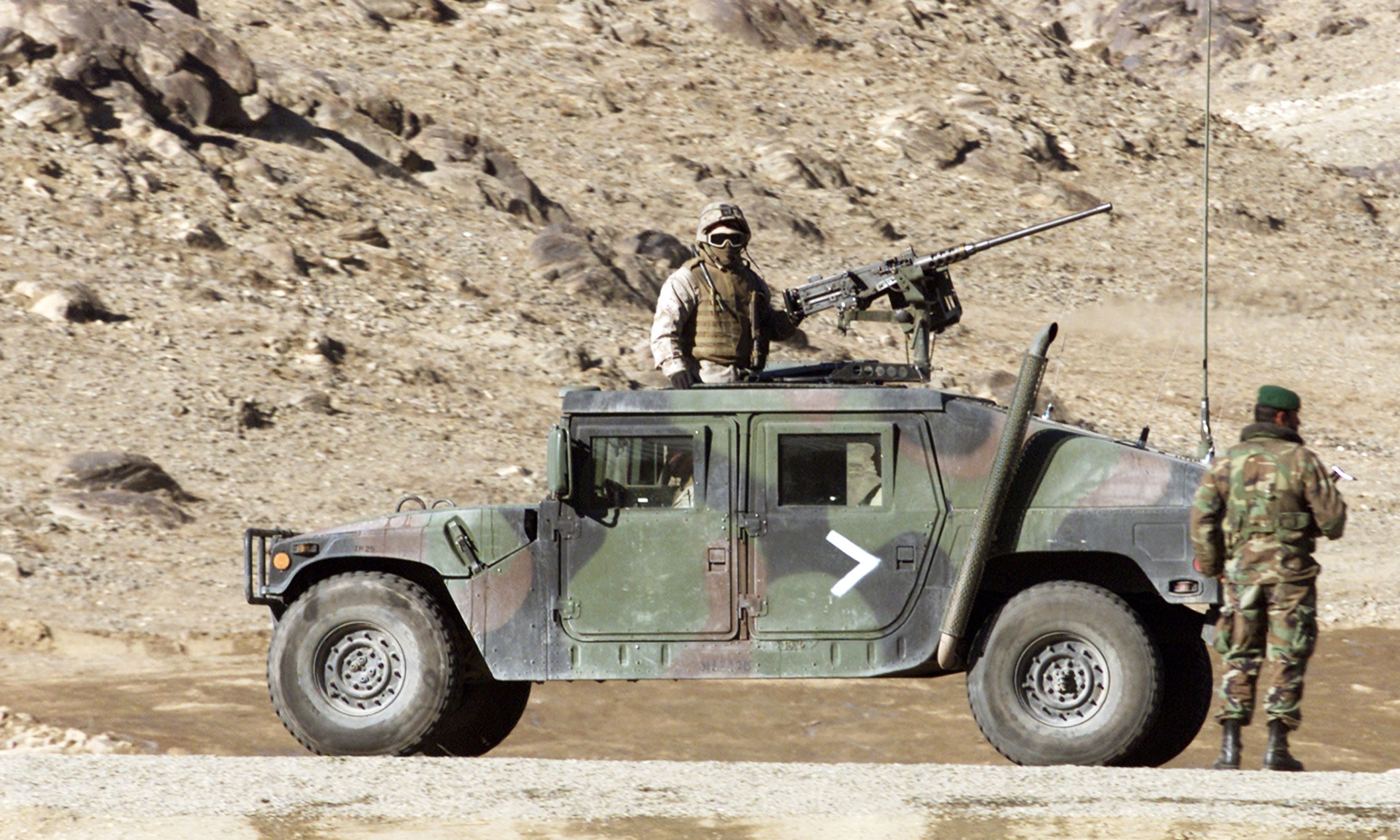
Amidst spiraling deficits and scandals such as those involving Solyndra and Fast and Furious, it is sometimes easy to forget what the United States is capable of achieving. This is something that repeatedly struck me during a recent week-long trip to Afghanistan with other national-security experts at the invitation of International Security Assistance Force commander Gen. John Allen.
In late October, as we witnessed a medal-pinning ceremony under a clear blue sky in a desolate corner of Kandahar Province, just miles from Taliban leader Mullah Omar’s hometown, it was impossible not to be amazed at what America’s men and women in uniform are bringing about, with great personal sacrifice, more than ten years after the start of Operation Enduring Freedom.
The three soldiers being honored were lined up in front of rows of their comrades at a small combat outpost surrounded by Hesco barriers. Their lieutenant colonel outlined their feats in combat. Two had displayed courage as their unit was ambushed, putting themselves at risk as they dragged their wounded comrades and the bodies of the dead to safety. The third was severely wounded in a different incident and sent back to the United States, only to recover and insist that he be allowed to return to his unit.
In recent months, despite suffering significant casualties, the members of Task Force Spartan from the 3rd Brigade, 10th Mountain Division, have cleared Taliban-infested areas of Kandahar. Villagers are now free to walk the streets of Omar’s hometown as he likely cowers across the border in Pakistan. Young children ran up to our group, roughhoused with U.S. forces, and posed for pictures in an area in which, just months ago, it would have been unsafe for them (or us) to venture outside.
Spending time with America’s soldiers and Marines in Afghanistan, I recalled Winston Churchill’s words to the British Desert Army in 1943: “And when history is written and all the facts are known, your feats will gleam and glow and will be a source of song and story long after we who are gathered here have passed away.”
The recent achievements of our armed forces in Afghanistan are nothing short of extraordinary. Signs of the progress enabled by the surge in forces President Obama announced in December 2009 were everywhere we visited — from Kandahar, where the soldiers of Task Force Spartan have cleared away the Taliban; to remote sites in contested areas, where Army Rangers live among the Afghan people; to Helmand Province, where we spent time with the 3rd Battalion, 6th Marines, who have stabilized towns such as Marjah and are giving the people a chance at a better life.
The surge has created the space for these gains, but to consolidate and maintain them, we should ensure that troop levels are not decreased again until the planned transition to Afghan forces in 2014. Success in the south of Afghanistan is already being put at risk because of the so-called surge recovery that President Obama announced in June, which will result in the drawdown of 33,000 troops by the end of September 2012. The risks were summed up by Gen. James F. Amos, commandant of the Marine Corps, who told the Associated Press, “Will it work? I don’t know. But I know we’ll do our part.” These reductions will make it more difficult eventually to shift the campaign’s focus to areas in the east that are increasingly restive, as the military has planned to do. Our commanders are doing their best to limit the impact of the drawdown, but it will be essential that we maintain the post–surge recovery force level of 68,000 troops until 2014.
Unfortunately, recent press reports suggest that, at a NATO summit to be held in Chicago in May, the White House may announce that further troop reductions are to take place, in 2013. President Obama hinted as much during his October 21 announcement that all U.S. forces would be withdrawn from Iraq by the end of 2011, saying, “We’re beginning to bring our troops home from Afghanistan, where we’ve begun a transition to Afghan security and leadership. When I took office, roughly 180,000 troops were deployed in both these wars. And by the end of this year that number will be cut in half, and make no mistake: It will continue to go down.”
There is no military reason, only a political one, for an announcement of additional troop drawdowns next year. Afghan and U.S. officials with whom we spoke suggested that such a drawdown would be disastrous to our effort. They also emphasized that a more robust and assertive U.S. policy toward Pakistan is essential. Pakistan’s harboring of insurgents, and in some cases its explicit support for the insurgency, will make it difficult, if not impossible, for the nascent Afghan security forces to maintain the hard-fought gains achieved by U.S. forces as NATO continues to transition areas of the country to Afghan control in the run-up to 2014. Additional drone strikes against insurgent groups such as the Haqqani network and Quetta Shura, as well as cross-border Special Forces raids targeting factories that produce IED components and other elements of the insurgent support networks inside Pakistan, should be considered. If Islamabad does not heed our warnings, more extreme action may need to be taken, including suspension of U.S. military aid. It is morally questionable for us to fund the military of a country that is involved in killing our men and women in uniform as a matter of state policy. Islamabad needs to realize that continued support for groups that are killing Americans and destabilizing Afghanistan will be considered an act of war.
Part of Pakistan’s posturing in Afghanistan is driven by its generals’ questioning of America’s will to succeed — which brings us back to the question of whether troop drawdowns are wise. Despite the Obama administration’s implementation of the surge, its repeated talk of timelines and drawdowns has sent the message that U.S. patience is limited, and that there is limited commitment to Afghanistan’s stability beyond 2014. This message has been received not only by Pakistani generals, but also by our Afghan allies, insurgents and their sponsors, and regional allies such as India.
The best way to address our perception problem is to ensure that the soon-to-be-concluded U.S.-Afghan Strategic Partnership Agreement includes a strong and clear commitment to a post-2014 U.S. military presence in Afghanistan. But it seems that the White House intends to reprise in Afghanistan its dangerous decision to completely withdraw U.S. forces from Iraq. “We have been very clear that we do not seek permanent bases in Afghanistan or a long-term military presence that would be a threat to Afghanistan’s neighbors,” a White House spokeswoman recently told the Wall Street Journal.
Given Afghanistan’s location — bordering key Central Asian states as well as Iran, Pakistan, and China — a long-term U.S. presence in the country is in America’s strategic interest. And the Obama administration’s obsession with limiting long-term U.S. commitments to Iraq and Afghanistan is completely out of character with how America has fought previous wars. The United States has consistently sacrificed greatly “in the interest of preserving the rights of people,” as former secretary of state Colin Powell famously put it, because “that is the kind of nation we are.”
I witnessed this quiet, selfless determination repeatedly during my week in Afghanistan — from the special operator on his fifth combat tour since 9/11 who emotionally spoke about the four comrades he had lost this year, to the Marine who said that his fellow warriors were interested only in answering the questions, “What did you do? Where did you go? What did you achieve?”
Our soldiers, airmen, and Marines have much to be proud of. The question now is whether a lack of political will at home will undermine their victories and prevent them from completing their mission. We owe it to these modern-day equivalents of Churchill’s Desert Army, as well as the Afghan people, to get this right. The stakes in Afghanistan and the broader region are too high for political considerations to trump sound strategy yet again.












Comments