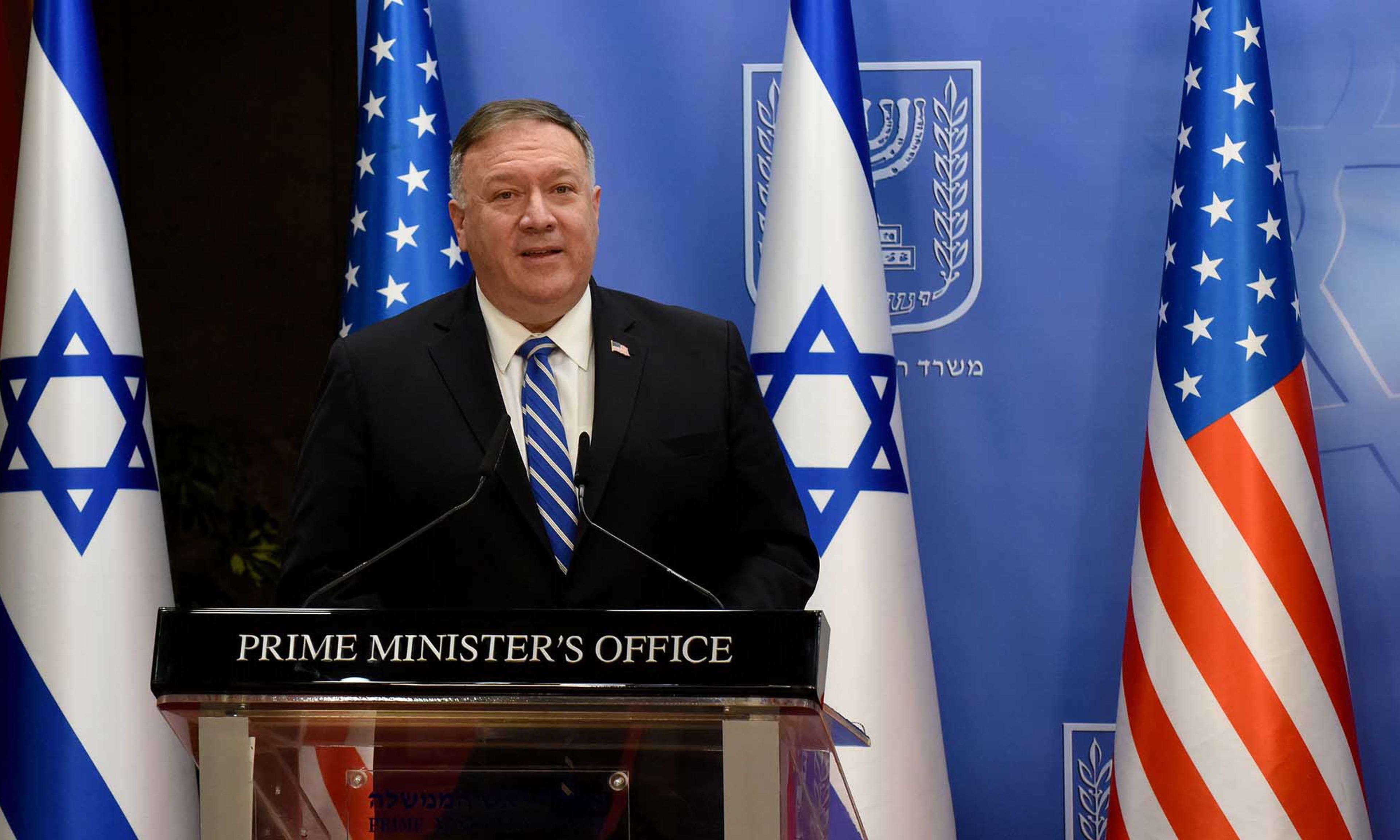
America’s strong relationship with Israel is founded in part on the American Right’s love of the Jewish state. A recent Pew survey shows that a full three-quarters of conservative Republicans view Israel positively. Within their ranks are devout Christians, counterterrorism hawks, foreign-policy internationalists, isolationists, and self-described defenders of Western civilization. Republican politicians sing the country’s praises as a matter of course. Megachurches fund-raise prolifically for pro-Israeli causes. Conservatives feel deep kinship with Israelis and see in them much to commend, such as unapologetic patriotism and an adamant defense of national sovereignty.
Contrast that with the Left’s growing enmity to the Jewish state. Formerly pro-Israeli liberals in the Democratic Party are seemingly giving way to progressive firebrands brimming with hostility. A Gallup poll last year found that while 42 percent of all Democrats (and 48 percent of moderate and conservative Democrats) sympathize more with the Israelis in the Israeli–Palestinian conflict, compared with 39 percent who sympathize more with the Palestinians, the net sympathies of liberal Democrats are with the Palestinians by 15 percentage points.
That said, is there reason to worry about waning support for Israel on the right? American conservatives are arguably as pro-Israeli as they have ever been. What could make them change their minds?
Perhaps the People’s Republic of China. In the eyes of many foreign-policy professionals, the Middle East is receding in geopolitical importance while East Asia grows more important by the day. The United States seeks to devote the lion’s share of its resources to the Indo-Pacific in the long term, and events in Israel’s neighborhood simply do not register in Washington the way they used to.
Debates about how best to tackle an increasingly aggressive and revanchist PRC persist. Conservative internationalists such as John Bolton argue that the United States must continue to confront every adversary, China being one among many. So-called Asia Firsters such as Elbridge Colby, a former Trump-administration Pentagon official, think the China threat is so urgent that every other region should be greatly deprioritized. Neither side has yet prevailed in this debate, but the Asia First crowd has serious momentum in Washington. Even those favoring major assistance to Ukraine or continued U.S. military presence in eastern Syria often concede that China is America’s most important state-actor threat, and the U.S. Department of Defense still refers to China as America’s “pacing challenge.”
So far, an increasingly Chinese-centric foreign policy has not weakened the American Right’s embrace of Israel, but this might not always be so. Political shifts are notoriously difficult to predict, great-power rivalry often mars relationships with middle powers, and there’s no universal law requiring the GOP to be pro-Israeli in perpetuity.
The rapidly shifting balance of global power is poised to make the next few decades more volatile than the last. The United States no longer presides unchallenged over the world order it built after the end of the Cold War. China and a welter of other powers, many malignant, wish to dismantle the U.S.-led system. Israel has hedged its bets. It has stayed close to Washington while getting closer to Beijing — much to the chagrin of many American conservatives, the authors included, who see potential long-term peril in this courtship. China has been among the greatest points of friction between Washington and Jerusalem for the past half decade. Even as Israelis try to reassure their American counterparts, as Assaf Orion, a retired Israeli brigadier general and a fellow at the Washington Institute, did in a recent essay in Mosaic, ample evidence suggests a deep-seated foreign-policy misalignment between the U.S. and Israel.
Sino–Israeli ties, strong after a decade of economic courtship, show little sign of weakening. The two countries reportedly hope to conclude a free-trade deal by the end of this year. Israel still lacks a foreign-investment-review mechanism as stringent as America’s Committee on Foreign Investment in the United States. Despite recently announced improvements, Israel’s foreign-investment regime continues to exempt from review foreign investments in Israel’s private-sector high-tech companies. These investments, a significant portion of China’s total investment in Israel, often involve sensitive, advanced technology that would fall under the purview of America’s screening system. Under Israel’s regime, they slip through. Consequently, a major source of tension remains.
Similarly, many in Washington view Israel’s current export- and technology-control regime as inadequate. Trade between Israel and China remains robust, notwithstanding the Covid pandemic. According to a late-2021 report by the Institute for National Security Studies, a think tank in Tel Aviv, the most significant export category from Israel to China, by far, is “machinery, mechanical and optical devices, computer and medical equipment.” Israel is continuing its deep commercial and advanced-technology relationship with China, even as close U.S. allies and partners such as Australia, Canada, and Taiwan start to backtrack on theirs.
Some will claim that this is just background noise. The U.S.–Israeli relationship, their argument goes, is surely a net benefit for America. They have a point. Jerusalem shares vital intelligence with Washington, fights Islamic extremists who are out for American blood, and will, one expects, do whatever it takes to stop the Iranian mullahs from acquiring a nuclear weapon. There is also meaningful technology collaboration between the two countries, and not only in the military sphere. America profits a good deal from its partnership with Israel, and vice versa.
Yet, in the end, those U.S. interests pale in comparison with keeping China in check. Blessed with bountiful energy reserves of its own, the United States is far less dependent on Middle Eastern oil today than it was in decades past, despite self-inflicted energy restraints. In fact, in recent years, the U.S. has been a net oil exporter. While the Middle East represents a smidgen of global GDP, the Indo-Pacific economy is the world’s largest. No country has the means to dominate the Middle East, but the one country that threatens to dominate Asia is the world’s second-most powerful — and America’s most dangerous adversary. Asia simply matters more to most American strategists.
Consider the damage Beijing is already inflicting on the United States. China has played a key role in fueling America’s opioid crisis, which killed more than 71,000 Americans in 2021 alone. Its negligence and subsequent cover-up are likely responsible for the Covid-19 virus’s apparent escape from the Wuhan Institute of Virology and consequently the deaths of more than 1 million Americans. For perspective, that number is more than twice the number of U.S. combat deaths in World War II.
China has arguably equaled, or perhaps even surpassed, America’s once-dominant military position in the South China Sea and inside the First Island Chain. The Chinese Communist Party has overseen an ongoing, 30-year military buildup producing the world’s second-best armed forces, virtually all of which are concentrated in a region where the U.S. is overstretched. China now possesses the world’s largest navy and is churning out modern warships far more quickly than the United States. It has undoubtedly malign intentions, evident in everything from its brutalization of minority populations, its bullying of neighboring states, and its manifestly hostile rhetoric toward the United States. Having trampled Hong Kong’s autonomy and unlawfully built permanent military installations in the South China Sea, Beijing now threatens Taiwan with increasing bellicosity. It routinely violates Taiwan’s Air Defense Identification Zone, and recently it conducted large-scale cross-service military exercises, including ballistic-missile launches, near the small island nation. China possesses hundreds of nuclear weapons, and there are serious indications it may have more than a thousand within the decade. No Middle Eastern adversary, including Iran, comes close to matching such capabilities.
Talking points about Israel’s being the sole democracy in the Middle East lack the purchase they had in the aftermath of 9/11 and during America’s bloody wars in the region. Many conservatives and liberals alike no longer see vital interests in the Middle East. Most Americans think the wars in Afghanistan and Iraq were not worth fighting. On the other hand, the Asian theater looms large in the American mind. Conservatives, 64 percent of whom consider China an enemy, may brook only so much stonewalling, especially by friends and allies. The Trump White House pressured other countries, not least Israel, to get serious about the threat from Beijing. Expect more of the same from future GOP administrations. Sooner or later, conservatives may come to view every global issue through a China lens, much as they viewed every global issue through a Soviet lens during the Cold War.
Such a shift could have serious policy implications.
Take, for instance, the massive yearly check that Washington writes to Israel ($3.8 billion being no small percentage of the country’s roughly $23 billion military budget). Recent assistance to Ukraine aside, Israel receives by far the most American military aid of any country, despite its postage-stamp size, small population, and location in a region that is no longer America’s primary focus. Washington may find it increasingly difficult to sustain such largesse to Israel, which is buoyed by the Middle East’s most innovative economy, most formidable military, and only nuclear deterrent, when close U.S. partners such as Taiwan find themselves increasingly in Beijing’s crosshairs. Many in Washington, and not just Asia Firsters, may be inclined to prioritize future assistance to key Indo-Pacific countries that see eye to eye with the United States on China.
During the Cold War, Israel’s most salient argument for American aid was that it was fighting Soviet proxies in the Middle East. Israel’s pitch after 9/11 — that it was playing a pivotal role in the War on Terror — resonated with conservatives. Today, the Soviets are long gone, and with the destruction of the ISIS caliphate and 9/11 in the rearview mirror, jihadis do not seem as threatening as they once did to the American public. Against this political backdrop, it may become increasingly hard to justify providing current levels of aid to a country that does so much business, including some that has security applications, with China. Is it entirely far-fetched to think the White House or Congress will either pare back military aid when the current memorandum of understanding with Israel expires in 2026 or, at the very least, impose more-exacting conditions on Israel’s relationship with Beijing?
Mike Pompeo, while serving as secretary of state in arguably the most pro-Israeli U.S. administration ever, publicly threatened to reduce intelligence-sharing, a key pillar of the bilateral relationship, absent movement on China. The Biden administration has kept up the pressure, raising the issue at high-level meetings and pushing Israel to strengthen its system of foreign-investment review and remove China from key Israeli infrastructure projects.
Foreign-policy observers may not be the only ones growing wary of Israel. The GOP’s new populist base could as well, as these Americans correctly deem China the source of many of their most pressing concerns, from the fentanyl crisis to the destruction of manufacturing jobs in the industrial heartland. Will their support for Israel fade as they appreciate how close Israel and China have become? There are few signs of this today, but the Sino–American rivalry could last decades. There is plenty of time for domestic views of Israel to sour, especially if tensions between Washington and Beijing escalate further.
Indeed, there have been many points of friction in the GOP’s relationship with Israel. Not so long ago, Republicans were hardly more supportive of Israel than Democrats were. GOP statesmen such as John Foster Dulles, who served as Dwight D. Eisenhower’s secretary of state, were notably leery of Israel and took Egypt’s side during the Suez Crisis in 1956. Every Republican president has butted heads with Israel in some way. Israel’s nuclear program unsettled Richard Nixon, who, along with Henry Kissinger, feared a region-wide war. Ronald Reagan was so aghast at the Israeli raid on the Osirak reactor in Iraq that he wrote “Armageddon is near” in his diary, while his administration publicly condemned the strike. Reagan’s successor, George H. W. Bush, had a reputedly poor relationship with Yitzhak Shamir. After Ariel Sharon accused Washington of trying to “appease” the Palestinians, Bush the Younger’s White House called his remark “unacceptable.” Angered by Israel’s noninvolvement in the strike that killed Qasem Soleimani, even Trump said he was “very disappointed in Israel.”
For the moment, the Right remains almost uniformly pro-Israeli, and it could take time for the consequences of an Asia First foreign policy to arise. But the latent threat to the U.S.–Israeli relationship is real, and meaningful cracks are already forming because of the China question. While no one is suggesting a sharp break, this underlying tension could, over time, degrade the U.S.–Israeli “special relationship” to just another security partnership. This would be a loss for both countries.
Perhaps Israel will see the light and greatly curtail its ties with Beijing. Doing so could, and should, pave the way for deeper U.S.–Israeli collaboration. Alternatively, the Chinese Communist Party might collapse, fundamentally changing the dynamics of the Sino–American relationship. But neither of these developments is likely, notwithstanding the recent protests in China. As long as the United States perceives a preponderant threat from Beijing and thinks Israel is wedded to Chinese commerce, especially in advanced technology, friction in U.S.–Israeli ties will remain. In the long run, it could threaten the GOP’s strong support for the Jewish state. Americans and Israelis alike should hope it never comes to that.
Daniel J. Samet is a doctoral candidate at the University of Texas at Austin and a Rumsfeld Foundation Graduate Fellow. Andrew Gabel is a J.D. candidate at Duke University School of Law. Both were 2021–22 Krauthammer Fellows at the Tikvah Fund.













Comments