
Over the course of three weeks in October, internecine House GOP warfare claimed the scalps of Speaker Kevin McCarthy, Majority Leader Steve Scalise, Judiciary Committee chairman Jim Jordan, and Majority Whip Tom Emmer. But on October 25, an unassuming 51-year-old Louisiana congressman named Mike Johnson emerged from the political carnage not only with his scalp firmly attached to his skull but with the speaker’s gavel in his hand.
It helped that Johnson was low enough on the totem pole not to have any real enemies, but comments from two members of the House GOP tell you a lot about how he did it. Matt Gaetz, the leader of the eight House GOP rebels who joined with 208 House Democrats to depose McCarthy, crowed that he made “MAGA Mike Johnson” speaker. But Don Bacon, a traditional Republican congressman who represents an Omaha-based district that Biden carried by seven points in 2020, sees Johnson in a different light. “His message is clearly Reagan Republican,” Bacon told me. “He speaks Ronald Reagan, for sure.” Both congressmen are right. And that’s why Johnson was able to win the speakership with the unanimous backing of the Republican conference.
His inaugural speech to the House of Representatives as speaker was as far from Trump’s “American Carnage” speech as “American Carnage” was from Reagan’s “Morning in America.” Johnson quoted Reagan, Abraham Lincoln, and G. K. Chesterton. He spoke about “seven core principles of conservatism”: individual freedom, limited government, the rule of law, peace through strength, fiscal responsibility, free markets, and human dignity. “We all know that the world is in turmoil, but a strong America is good for the entire world,” said Johnson. “We are the beacon of freedom, and we must preserve this grand experiment in self-governance.”
When I spoke to Speaker Johnson by phone on November 2, the ninth day of his speakership, the first thing he said was: “I’m a big fan of National Review. I’ve read all the Buckley biographies.” He placed the writings of Russell Kirk among his favorite books and said that just before the speaker’s race began he was reading through a collection of essays edited by William F. Buckley Jr. — Did You Ever See a Dream Walking? American Conservative Thought in the Twentieth Century. “I’m a child of the Eighties, and Ronald Reagan was the standard-bearer and remains a political hero of mine,” Johnson says when asked whether he had a political hero or role model. “I just liked the way he conducted himself and his demeanor and his attitude. He was always optimistic. He was a happy warrior. He believed that America was exceptional, and he was never afraid to say that, and I think that inspired confidence in the people as well, and it became contagious.”
Johnson, a Southern Baptist who worked as an attorney at the socially conservative legal nonprofit Alliance Defense Fund (now Alliance Defending Freedom) from 2002 to 2010, grew up at the intersection of America’s conservative movement and its Evangelical bloc. As a law student at Louisiana State University, Johnson and his wife, Kelly, began mentoring a 14-year-old boy named Michael through Young Life, a Christian youth group, and when Michael became homeless at age 16, the Johnsons took him in and raised him as their son. In the wake of the George Floyd murder in 2020, Johnson looked back at the experiences of two of his sons, saying that “Michael, being a black American,” faced more challenges than “Jack, being white Caucasian.” Some mainstream-media reports expressed skepticism about Johnson’s having an adopted black son because the Johnsons did not legally adopt Michael, and Michael has avoided the spotlight since Johnson’s election to Congress. On November 3, Michael, now 40, told the Daily Mail: “I always felt loved like I was a part of their family.” Lanny Keller, a veteran political columnist for the Louisiana Advocate, says that with Johnson, “what you see is what you get.” He adds: “I don’t know that there are any deep secrets to unlock outside of, you know, twelve or 14 chapters of Romans.”
Much of the Democratic outrage over Johnson’s election has focused on Johnson’s record of staunch social conservatism. Since his ascension, Johnson has said people should pick up a Bible if they want to know what he believes, but he has also downplayed the political salience of social issues. While Johnson argued fiercely against gay marriage 20 years ago, he told Sean Hannity in his first interview as speaker that he’s a “rule-of-law guy” who accepts that the Supreme Court’s Obergefell decision “settled” the issue. “When the Supreme Court issued the Obergefell opinion, that became the law of the land,” Johnson told Hannity. “I respect the rule of law, but I also genuinely love all people, regardless of their lifestyle choices.” Some of the work he was most proud of at ADF, Johnson told me, involved cases affirming the right of Americans to offer public invocations, a right vindicated by the Supreme Court in a 5–4 decision, Town of Greece v. Galloway, in 2014. After the Dobbs decision overturned Roe v. Wade, Johnson co-sponsored a bill to generally prohibit abortions later than 15 weeks of pregnancy, but he notes that there’s no consensus in Congress or the GOP about whether the federal government should enact a federal limit.
Those who know Johnson well say he’s always emphasized the importance of civility. Congressman Jodey Arrington of Texas, who entered the House the same year that Johnson did and delivered the speech nominating Johnson for speaker in the House GOP conference, recalls that his first memory of Johnson was his encouraging members of their freshman class to sign a civility pledge. Before he was elected to Congress in 2016, Johnson served a single term in the state legislature. “We have the same voting record, and the Left loved him and hated me,” says Louisiana state representative Alan Seabaugh. “You can disagree with Mike politically, but it’s really, really hard to dislike Mike personally.” Their friendship dates back two decades to Seabaugh’s time as Johnson’s Sunday-school student at Calvary Baptist Church in Shreveport. “He’s always quoted Ronald Reagan and John Adams and George Washington in his speeches — even in his Sunday-school sermons going back 20 years,” says Seabaugh.
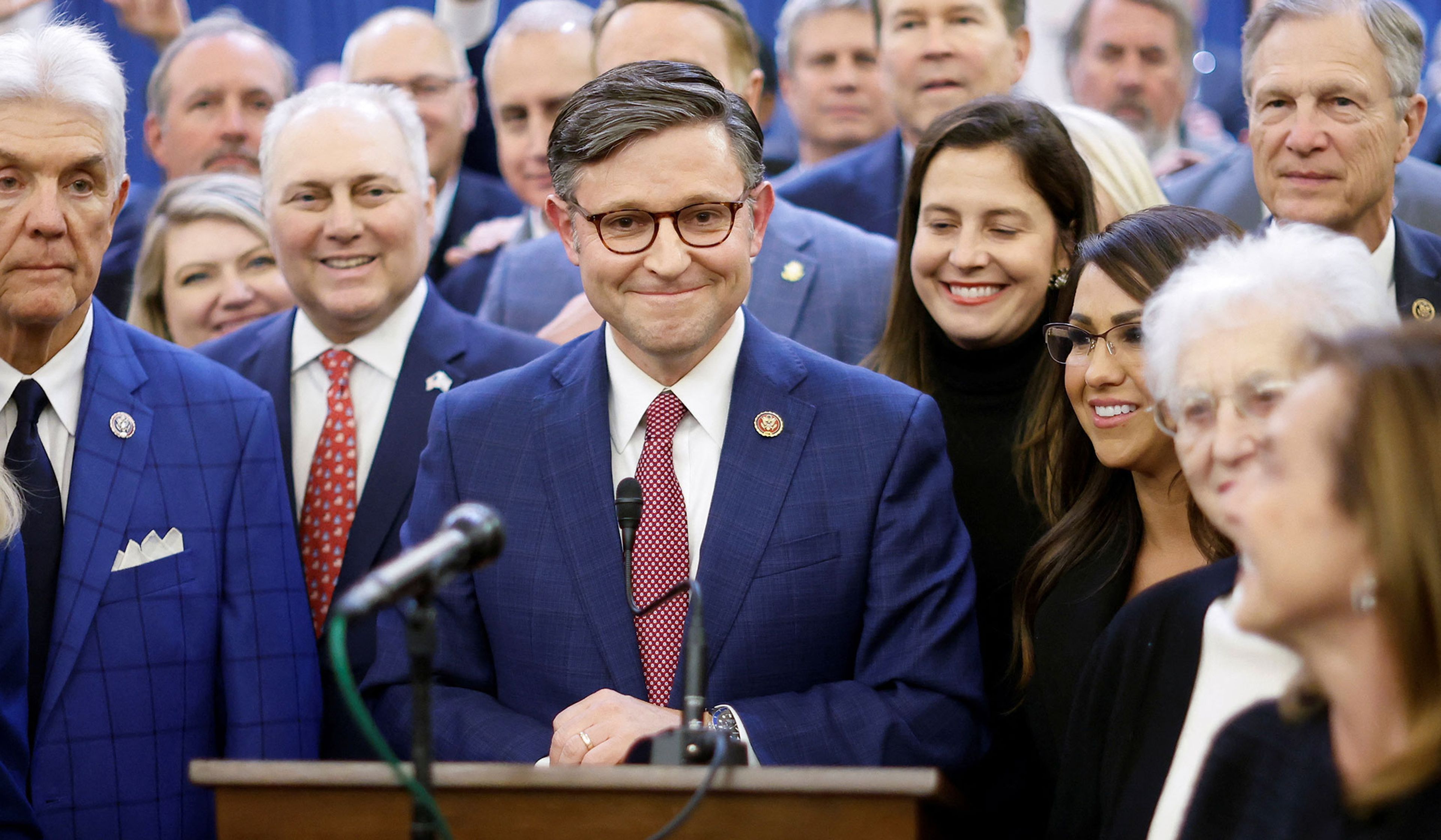
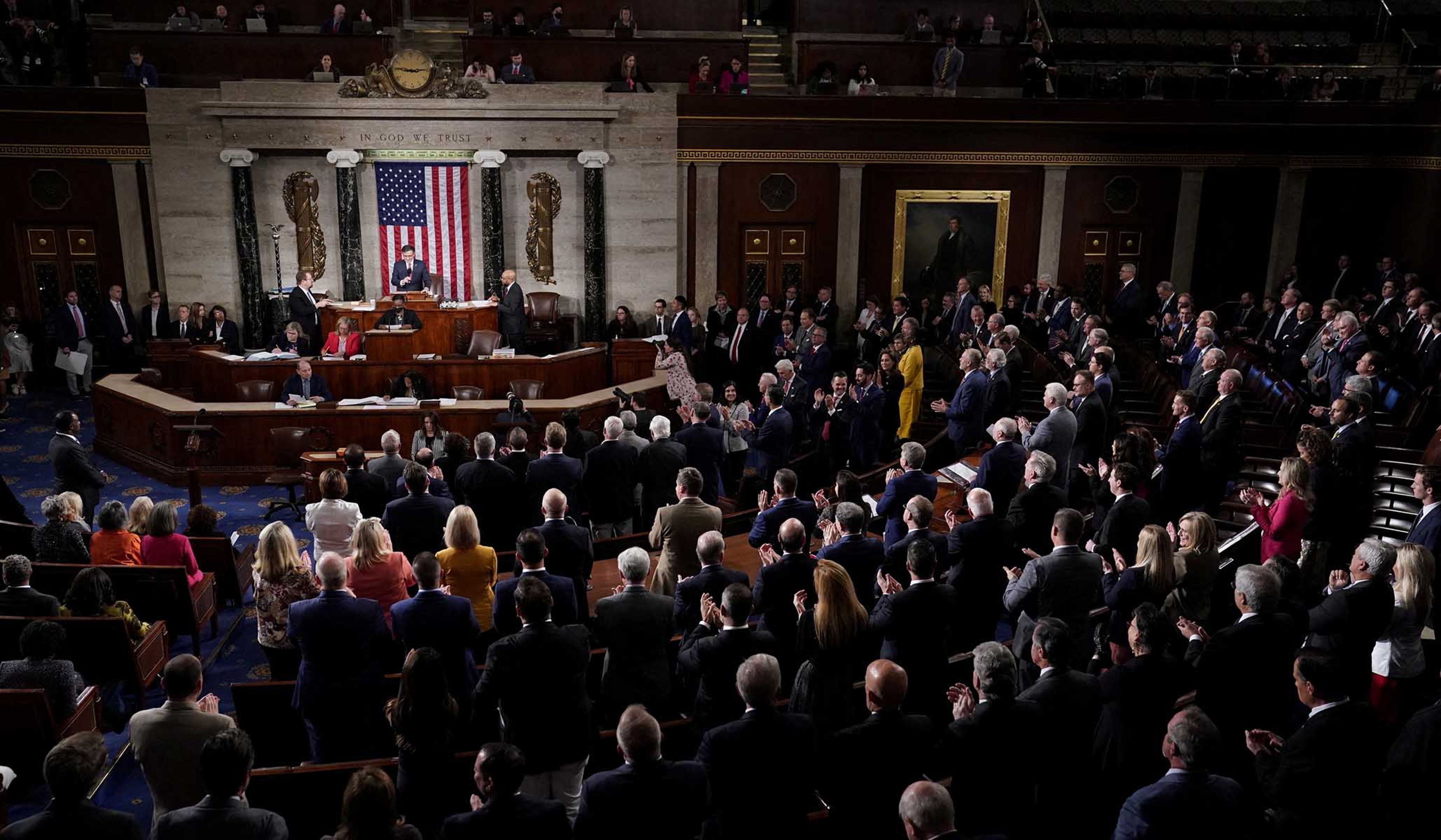
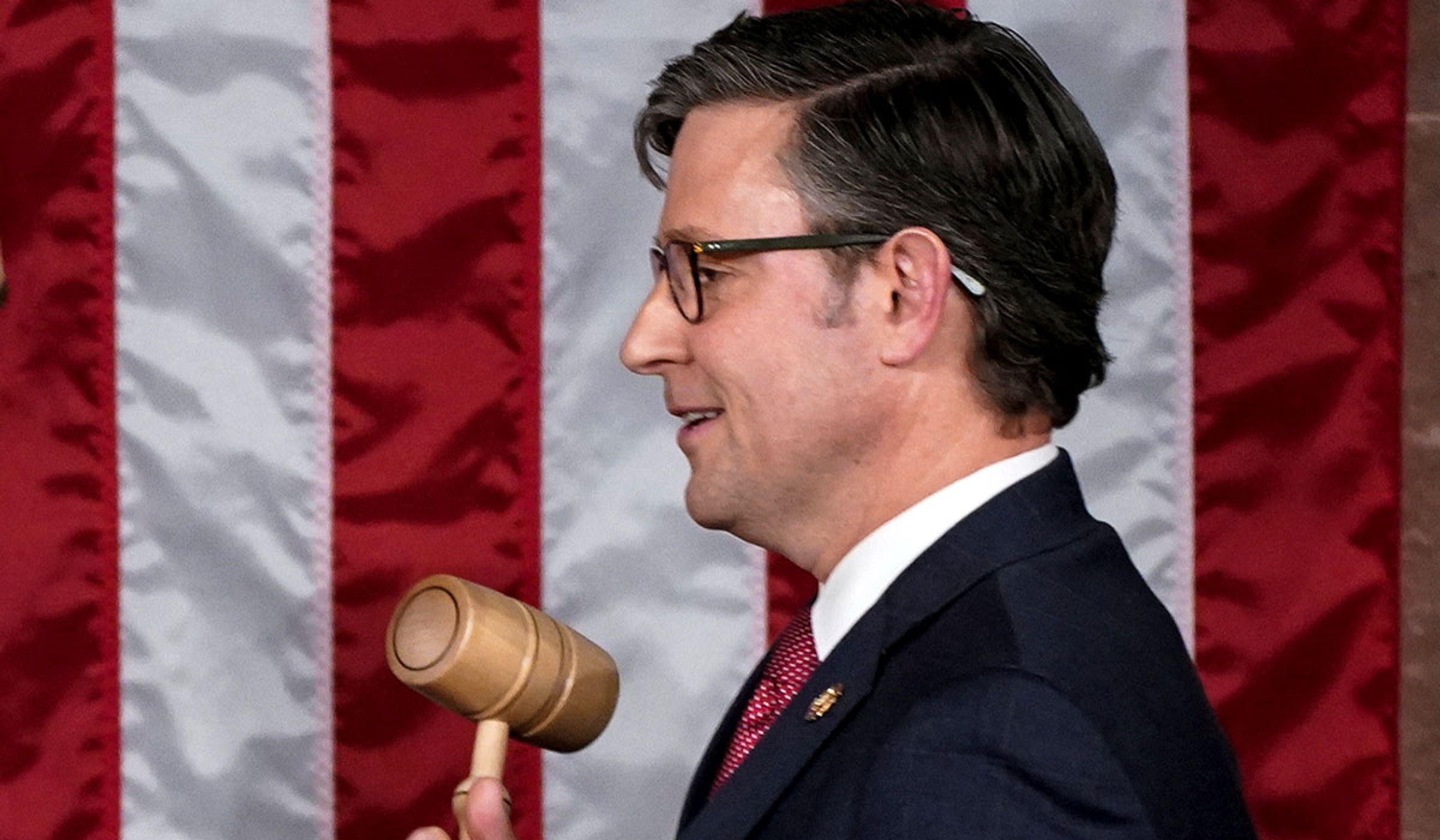
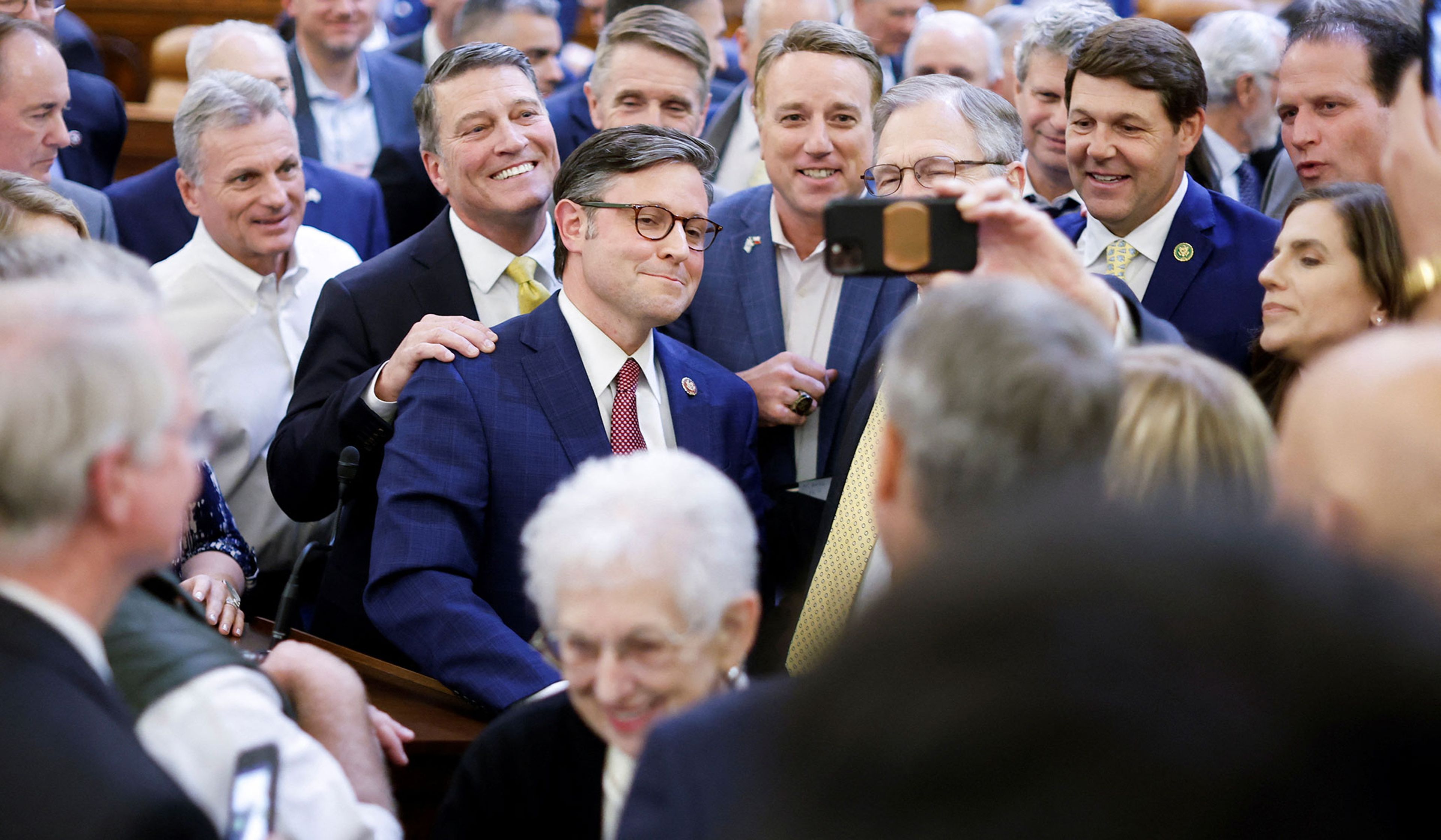
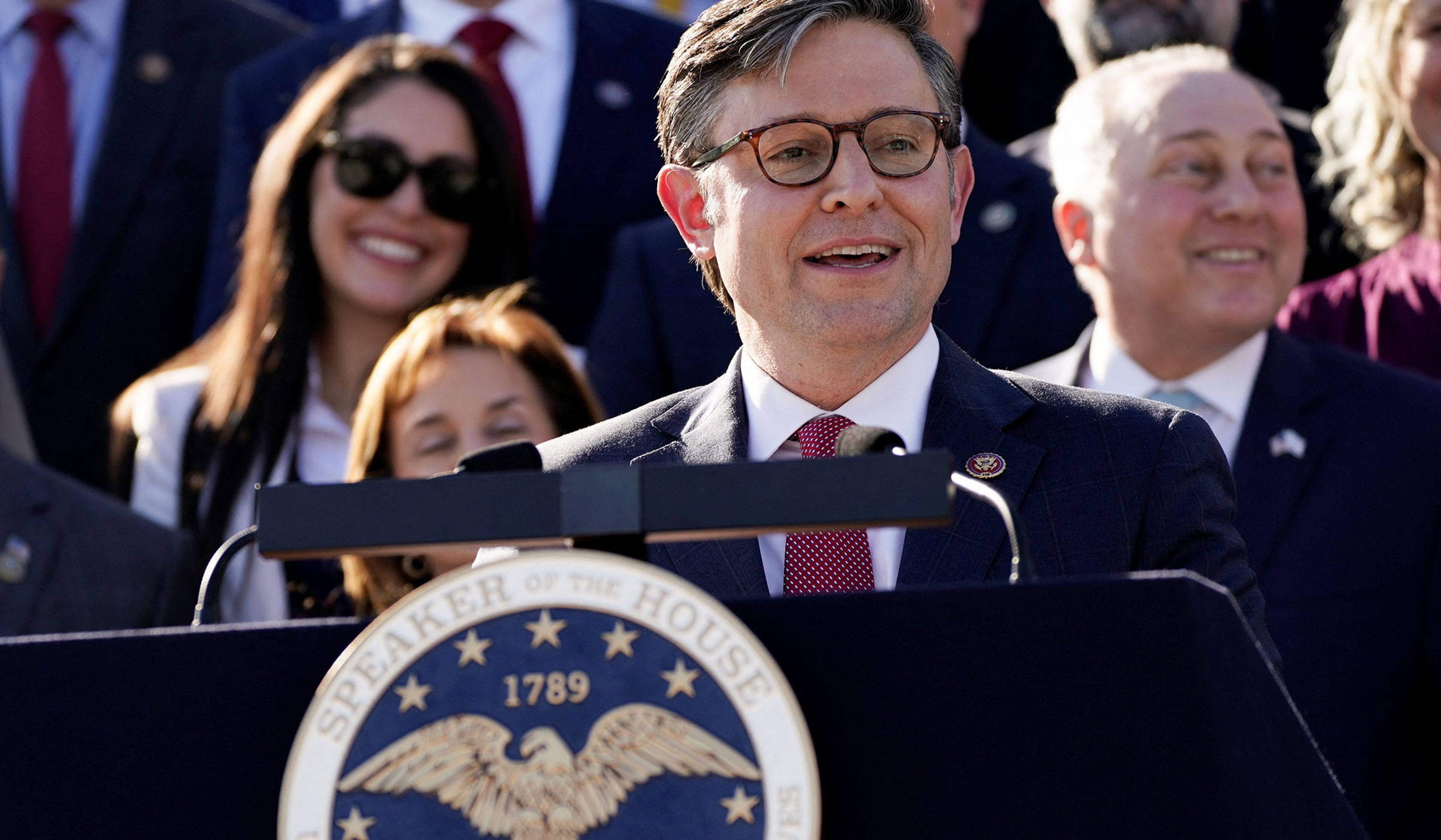
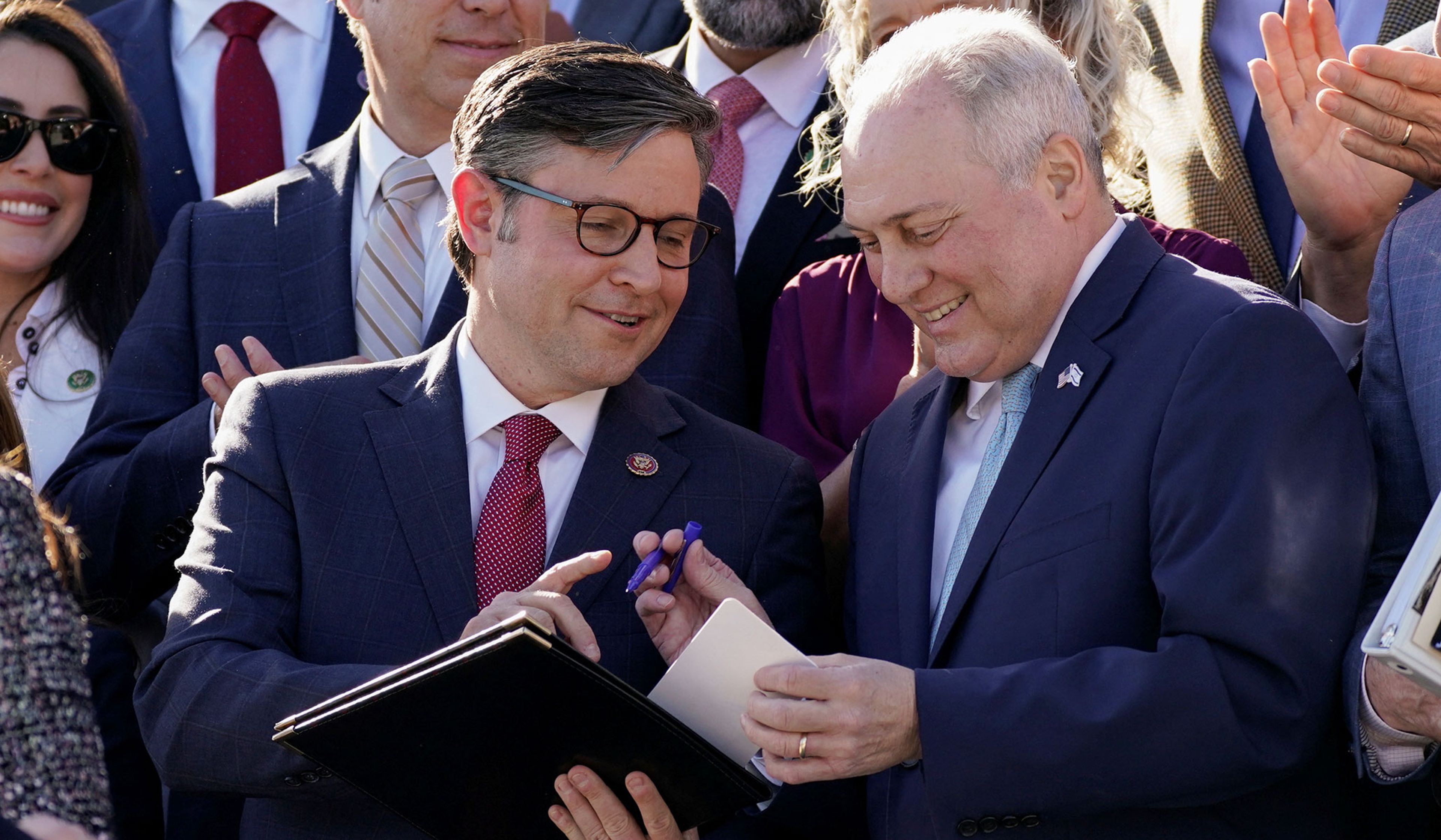
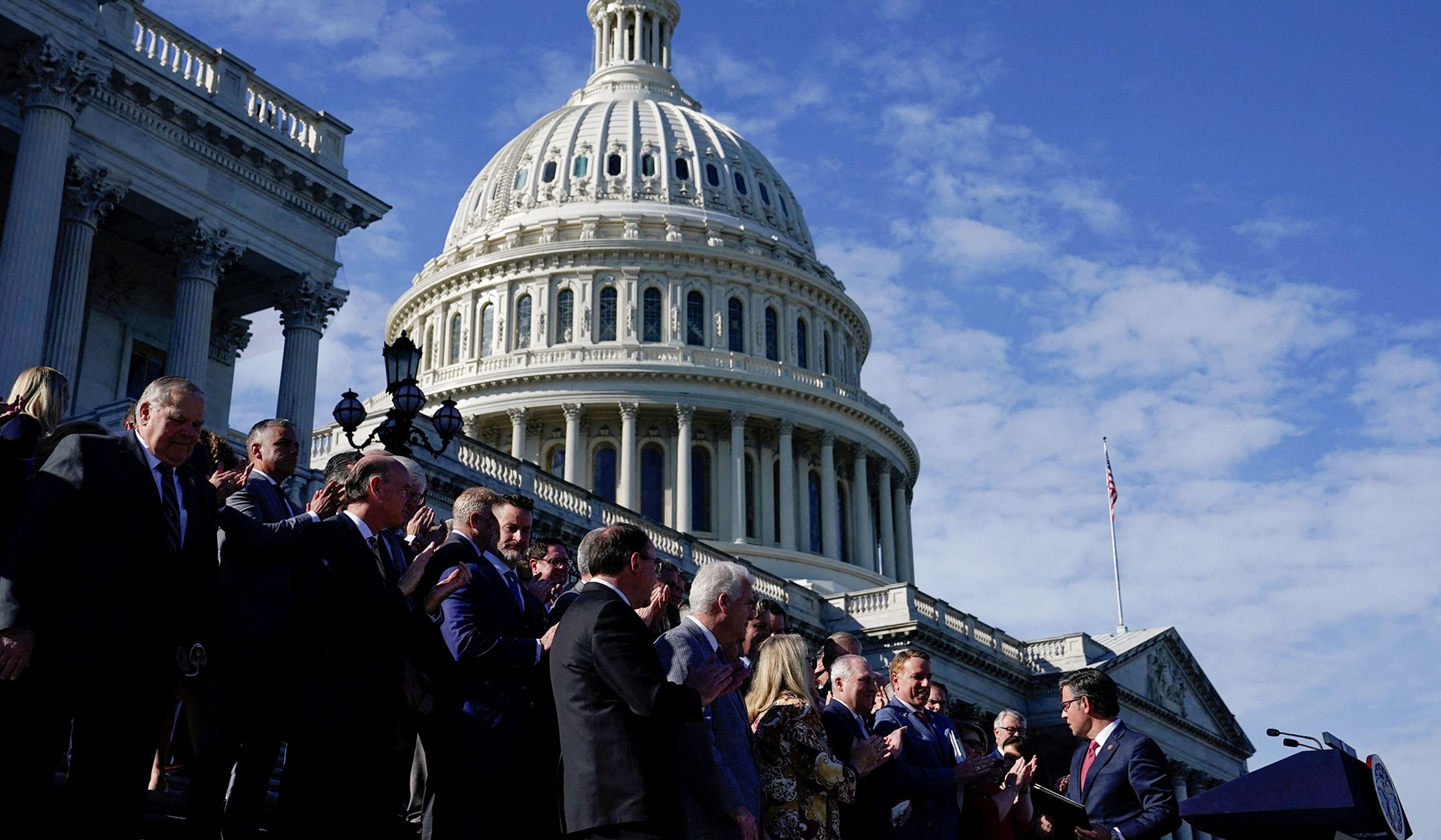
Rep. Mike Johnson (R., La.) is surrounded by fellow members as he speaks to reporters after securing the nomination for House Speaker from the Republican conference on Capitol Hill in Washington, D.C., October 24, 2023.
Jonathan Ernst/Reuters
While Johnson has talked the Reagan talk throughout his life, he’s also walked the MAGA walk in Congress. Johnson served as a member of the defense team during both of Trump’s Senate impeachment trials, and he helped lead the effort to get House members to sign on to an amicus brief supporting the State of Texas’s lawsuit attempting to invalidate the election results in four states that Biden won in 2020. The Supreme Court refused to hear the Texas case on the grounds that the state lacked standing, but on January 6, Johnson relied on the lawsuit’s underlying argument — that changes to election procedures because of Covid precautions had rendered Electoral College results invalid in states where changes were not approved by state legislatures — as a rationale to vote to reject the counting of Electoral College votes from some states where Biden won. When I asked Speaker Johnson on November 2 whether he regretted any of his actions between the 2020 election and January 6, 2021, he told me: “No, I stand by that position, even today, adamantly.”
Pointing to a 1,200-word statement he issued on January 6, Johnson said: “In terms of that constitutional argument, I stand by that 100 percent today because it’s still precisely right. It’s not an opinion based on the Constitution. It comes straight out of the black-letter law, right off the page. And so, you know, no one’s ever been able to argue the counter to that.” Many legal scholars have, in fact, countered that argument. For example, National Review’s Andrew C. McCarthy wrote on January 5, 2021, that Congress had “no legal basis to object” to, “much less to reject any state’s electoral votes. Every state has certified. Every state has just one lawfully designated slate of electors.” The overwhelming majority of Senate Republicans and a substantial minority of House Republicans opposed efforts to reject the results of the Electoral College. Texas GOP congressman Chip Roy, for example, methodically picked apart the arguments in favor of rejecting Electoral College votes on January 6.
Johnson’s signing on to the Texas lawsuit did not make him unique — a majority of the House Republicans did so, including leaders McCarthy, Scalise, and Emmer. But Johnson did go out on a limb to lend credence to one of Trump’s most absurd and reckless claims. “You know the allegations about these voting machines, some of them being rigged with this software by Dominion — look, there’s a lot of merit to that. And when the president says the election is rigged, that’s what he’s talking about,” Johnson said in a November 17, 2020, radio interview. Asked about the comment, Johnson told me: “I don’t even recall saying that. But if I did, we would have been dealing with information that we had on November 17. A lot more has come out, obviously, since then.” Does he agree now that the allegations have been disproven? “Well, I mean, Dominion software is still used on voting machines all around the country. I don’t guess the states would still be using it if they thought it was fraudulent. I’m sure that’s all been checked out,” he replies. “I mean, frankly, I’m not an election-law expert, and I haven’t spent any time digging into the issue myself.”
There were plenty of news articles debunking Trump’s claims about Dominion at the time Johnson said there was “a lot of merit” to them, and a hand recount of paper ballots in Georgia that was concluded two days after Johnson made his initial remarks definitively disproved the theory that the machines had counted a Biden vote as more than one vote and a Trump vote as less than one. Fox News paid Dominion $787 million to settle a defamation case earlier this year.
Johnson emphasizes now that a unique set of circumstances was present in 2020 that ultimately served as the basis for his objections. “That election was unlike any other in history and hopefully unlike any that will happen in the future. And it’s because, occasioned by Covid, you had all these irregularities” regarding election procedures, he says. “We may never know how much [fraud] was ultimately involved.”
Johnson’s conduct in the run-up to January 6 makes it difficult to imagine any scenario in which he’d oppose Donald Trump, but it’s also very difficult to imagine a scenario in which Biden wins the Electoral College and Johnson remains speaker. The House GOP gained only a thin majority despite winning the popular vote by three percentage points in 2022, and if Biden wins a second term in 2024, that would almost certainly mean that House Republicans nationwide had lost the popular vote.
With twelve months to go until the 2024 election, there are a lot of unknowns about how Johnson will handle his job. Military aid to help Ukraine repel the Russian invasion now divides the House GOP. While Johnson has voted against it in the past, he has signaled he would support more military funding for Ukraine if it were paired with money to address the illegal-immigration crisis at America’s southern border. “We cannot allow Vladimir Putin to march through countries undeterred. It upsets the world order that we’ve had since post–World War II,” Johnson told me when asked to identify the U.S. interest in the war. “There’s a belief here, and I think across the globe, that if Putin was successful in Ukraine, he would not stop there. He would continue to march through other countries, and so clearly that is something that the United States has an interest in stopping.” But, Johnson added, “Congress and the people in this country are apparently split on the issue [because] they believe that we can’t continue to just dole out billions of dollars for the war effort in Ukraine without proper accountability and without clearly defined goals from President Zelensky and the White House.”
On the issue of funding the entire government, Johnson’s goal, as this issue went to press, was to pass a continuing resolution to fund the government at current levels through January. He identifies the national debt as the “greatest threat to our national security” and has proposed a bipartisan debt commission to come up with a long-term response. When asked whether reforming entitlements such as Medicare for younger Americans would necessarily be part of any long-term plan to rein in the debt, Johnson replied: “We have to maintain and preserve those programs. They’re regarded by almost all Americans as being essential. I’ve not predetermined what the outcome of that is.” Arrington, chairman of the Budget Committee and a close friend of Johnson’s, told me, “Of the $120 trillion in unfunded liabilities out 30 years, according to CBO, 99 percent of that unfunded liability is [entitlement] programs, Social Security and Medicare. So it’s a mathematic reality.” But, Arrington added, pushing for entitlement reform without Democratic support would be “an exercise in futility, and you actually risk your entire party’s political fate to try to take them on you unilaterally.”
Any Republican speaker in 2023 faces a couple of fundamental problems. “Our problem is we’re not one party,” says Congressman Bacon. “We’re divided between the populists and the Reagan Republicans. If you subtract either one, you don’t have a majority.” The other big problem, of course, is that Democrats control the Senate and the White House, so for any bill to become law, it will require some Democratic support. Swapping out Kevin McCarthy for Mike Johnson won’t change those fundamental problems. But there’s good reason to believe that the anti-McCarthy rebels will at least cut Johnson more slack, not only because an election is now less than a year away but also to justify their decision to depose McCarthy in the first place.










Comments