You come to realize that the road traveled by great men is dark and lonely, and lit only at intervals by other great men, and sometimes they’re your enemies. But they’re the only true luxury you have. Yes, it’s a dark and difficult road, and I do not look down upon anyone who has the good sense not to take it.
— Teddy Roosevelt in The Wind and the Lion
When B-movie star and raconteur George Hamilton approached a young screenwriter named John Milius in 1970 to write a film about then-unknown stuntman Evel Knievel, he asked Milius what he wanted in return for his best efforts. The 26-year-old responded bluntly: “I want girls, gold, and guns.”
He would get all three. The story is but one of many in a public legend that lives on not only in his own filmography as screenwriter, director, and producer but in cinematic history as well (in the form of The Big Lebowski’s Walter Sobchak, a fun-house parody of Milius’s look and personality meant as an inside joke by his friends the Coen brothers). Thus Milius is at least superficially known to all fans of “New Hollywood” cinema — the blustering conservative standout in that brief era in the Seventies when enfants terribles like Coppola, Lucas, Spielberg, Scorsese, and Friedkin briefly conquered a weakened studio system and made some of cinema’s greatest masterpieces. But he is also curiously misunderstood by many: either caricatured by the overwhelmingly liberal critical consensus as the allegedly deranged chest-thumping macho behind Conan the Barbarian and Red Dawn, or crudely adopted by those who miss the deeply felt nuances of his strikingly coherent and personal thematic oeuvre.
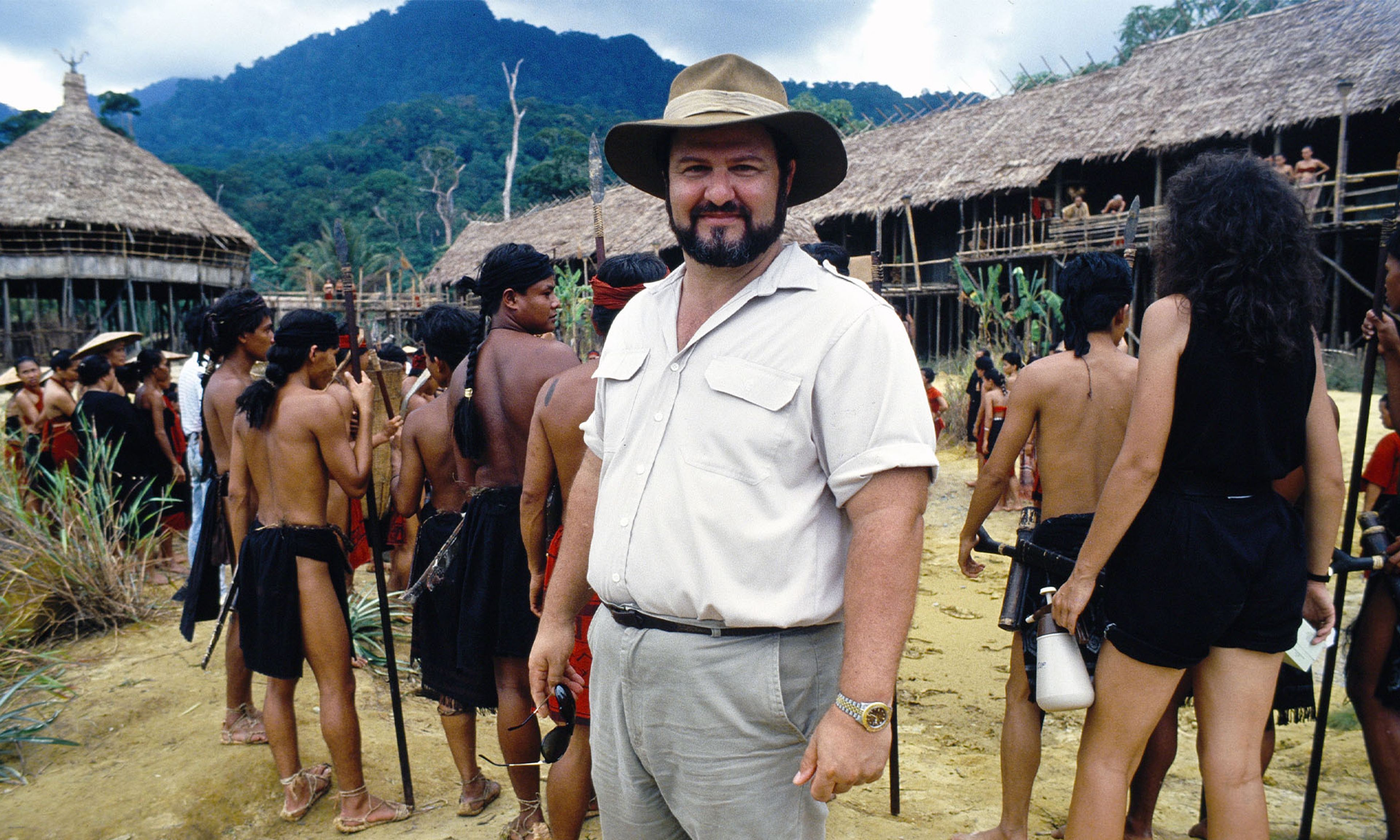
Milius is too often epitomized by his most famous, instantly recognizable lines of dialogue: “What is best in life?” “I love the smell of napalm in the morning.” “Go ahead, make my day.” Immortal lines all, yet to treat them as the sum total of what his work stood for is to reduce his unique ethos of haunted masculinity — the typically solitary search for experiences beyond civilization’s veneer — to a bloody cliché. From 1972’s Jeremiah Johnson all the way through the HBO series Rome, Milius spoke the language of cinematic violence with aplomb not because it was gratuitous — his dialogue and plotting are in fact almost always more interesting than the action in the films he helmed — but because to him it was an essential aspect of depicting brutal insights about humanity at its extremes: Whether navigating frighteningly alien cultures and landscapes (think the wilds of Borneo in the 1989 film Farewell to the King or the amorally pagan fantasy world of Conan’s Cimmeria) or driven to dire straits beyond the bounds of traditional morality, Milius’s protagonists either never know the safety and comfort of society or choose to live outside of it, oftentimes building it anew in their own image.
Milius began his Hollywood career as a writer in the early Seventies, first making his name with the scripts for Jeremiah Johnson and The Life and Times of Judge Roy Bean (as well as an unfilmed script, called “Apocalypse Now,” that was the talk of the town) before transitioning to directing his own work “as an act of self-defense.” As a writer-director, he had the curious ability to alternate between capacious rhetoric and laconic bluntness; as often as people deliver brilliant speeches in his movies, they also wander through his scripts like shell-shocked soldiers, not inhuman but stripped of their pieties, their pity, and the need to speak beyond the brutal point. Heroes, antiheroes, and anonymous masses die alike in his films, their lives ending unsentimentally. What Freud was writing during the early 20th century may have been purely speculative fiction, but if indeed all human life reduces to the two essential drives of Thanatos and Eros, Milius cast his vote squarely with Thanatos.
Yet to reduce Milius to that is to completely misunderstand why this sort of elemental struggle is at the forefront of his work: because it lies at the core of mankind’s experience, outside the warm and reassuring blanket of civilization. It also lies at the core of Milius’s other great cinematic concern, the meaning of “greatness”: how it is achieved, its nature and true costs, and whether the old codes by which men used to abide while in search of it have any real value or inhibiting power at all. Jeremiah Johnson forsakes civilization to live alone by his wits and becomes a folk legend. (He nearly fails several times, proving that not all ascents follow a steady incline.) John Dillinger, “the best bank robber ever,” lives only by loyalty to his own people. Judge Roy Bean erects his own private fiefdom in the West Texas desert before destroying it like a vengeful creator-deity. Conan is schooled upon both the Wheel of Pain and the Tree of Woe before toppling a tyrant to avenge his parents. And few have ever journeyed farther beyond the threshold than Colonel Kurtz — the man who presumed to be a god beyond good and evil — and his hunter Captain Willard in Apocalypse Now. With Milius, man’s search for greatness, whether noble or monstrous, dovetails inextricably with not only his essential loneliness but his dance with darkness as well.
* * *
To understand John Milius’s fascinations one must grasp how, in his case, the child truly was father to the man. Just as Martin Scorsese’s filmmaking has always been inflected by his New York Italian-Catholic upbringing, so too was Milius strikingly the sum of his formative influences. His father, born in 1889, was a disciplinarian, a role model from a very different era. When the family moved from St. Louis to California in the early Sixties, it was perhaps predictable that the son would grow into a teenager with a wildly rebellious streak — a hothead surfer haunting the beaches of Malibu — while also subliminally embracing other aspects of his father’s tougher, older sensibility. The counterculture around him, then quickly turning into a suffocating and politicized youth monoculture, provided something even more satisfying to kick against. (While an undergraduate at USC film school in the late Sixties, Milius famously altered the peace-sign button saying “nirvana now” into a B-52 bomber demanding “apocalypse now.”)
And yet his oppositional and conservatively contrarian nature was clearly driven not just by a contempt for mass opinion; behind it all lay a restless — and inherently masculine — need to justify what otherwise seemed to Milius like a meaningless life. Given that several U.S. presidents sought to dodge service in Vietnam, people sometimes have difficulty believing that a man of Milius’s talents and background eagerly wanted to serve in the Marines — but then the stories of those who volunteered, compared with those who were drafted, are rarely told. His denial (because of chronic asthma) was perhaps the defining moment of his life: Devastated at missing the chance to prove himself, or at the very least to attain some meaning through dying, he was left reeling and bereft of purpose until a chance encounter with the films of Akira Kurosawa sent him spinning off in a creative direction. “I missed going to my war,” he later lamented, with real feeling.
It was a feeling Milius would never let go of. When anti-war protest was at its height, his friends George Lucas and Steven Spielberg suggested he scale his private literary Olympus: writing an adaptation of Joseph Conrad’s Heart of Darkness, updated to the Vietnam War and utterly indifferent to its domestic politics as opposed to the surrealism of the actual experience of it. The script for Apocalypse Now, whose title repurposed his old college slogan, circulated like samizdat throughout Hollywood in the early Seventies, universally admired and universally regarded as unfilmable for both political and budgetary reasons. Once Francis Ford Coppola could finally call his own shot, in 1975, history was made. The screenplay will forever remain Milius’s most celebrated achievement — the sheer audacity of the film’s imagery, ideas, and dialogue is, as Coppola himself concedes, almost entirely down to the writing.
Milius’s two most famous films under his own name remain 1982’s Conan the Barbarian and 1984’s Red Dawn — arguably to his reputational detriment. Quality is not the reason; Conan is an authentic fantasy classic of brutally minimalist elegance that made Arnold Schwarzenegger a star, and the oft-derided “Soviets invade Colorado” premise of Red Dawn belies hard lessons about the futility of hatred for its own sake and the painful anonymity of sacrificial valor. Though neither is truly a Milius script (the former was in fact an adaptation written by a pre-fame Oliver Stone — the shared credit makes for quite the odd couple), the movies’ popular preeminence has generated the crude overgeneralizations about his style already mentioned. Milius himself often names the curiously limp Big Wednesday (1978) as his most personal film, for the simple reason that it was about his life experiences as a teenage surfer in Southern California.
Yet it is 1975’s The Wind and the Lion that in many ways feels like Milius’s most personal film, a distillation of all that ever inspired him. He once described the movie — a rousing adventure about the real-life abduction by a Moroccan tribal leader of an American expatriate to be used as a political bargaining chip during Theodore Roosevelt’s first term — as “my first adult film.” It is also his finest. This is a film about two men of classically virile greatness, one whose era is inevitably passing while the other’s inexorably approaches. The performances are equal to those demands: Brian Keith channels the spirit of Teddy Roosevelt through Milius’s words in an act of near-mediumship, while Sean Connery had such a rewarding experience playing Raisuli that he later called in Milius to rewrite all his dialogue in The Hunt for Red October.
Wind resonates not only because of its riveting tale and fantastic acting turns, but because it is shot through with so many themes at the heart of his filmmaking fascinations. Connery’s Raisuli represents the flickering ember of a dying era: a self-assured and cunning warrior, fierce in battle, honorable toward noncombatants, yet noticeably slowing with the advance of age. Also aging but still vigorous, Roosevelt well understands these virtues and this man, for he himself has one foot set in the martial old world. But Roosevelt also properly understands his role as an avatar of a world to come, of a bold, assertive America conscious of its strength. He regrets that great powers are destined to sweep men like Raisuli away in a pitilessly modern wind, for he respects the boldness and worthiness of adversaries who fight for great causes.
The tale is told with poetry and enormous verve (Captain Jerome, the hell-for-leather soldier eager to plant America’s flag wherever and whenever possible, may be the closest Milius ever came to depicting his own aspirational self on-screen), and the twin endings of The Wind and the Lion epitomize the twin aspects of Milius’s worldview more beautifully than anything else in his career. First, Roosevelt sits alone in the White House reading a letter from Raisuli chiding him for his interference: “Between us there is a difference: I, like the lion, must remain in my place while you, like the wind, will never know yours.” Then Raisuli is seen on horseback in the distance, as a friend laments that they have lost everything. With utter equanimity, he concludes: “Is there not one thing in your life that was worth losing everything for?” And his friend joins him in hard-earned laughter at both the absurdity and the truth of it. An entire worldview in all its complexity snaps into perfect focus.
* * *
Milius suffered a devastating stroke in 2014, just as he was beginning work on a film about Genghis Khan, his first in nearly two decades. (If ever a man was born to bring the life of the Mongol horde to the screen, it surely is Milius.) Sadly, he has remained in retirement ever since. But I am optimistic he will receive the critical reassessment he deserves, for his vision has proven infinitely more resilient — at times, it is eerily prophetic — than his detractors thought when he was active.
Why have critics looked away from Milius for so long? I suspect it’s precisely because they misinterpret his vision of men either reduced to the Hobbesian state of nature or going off to live outside of society as deranged wish-fulfillment rather than an insight into what man is truly capable of. With the advancing creature comforts of Western society in the Eighties and onward, his obsessions inevitably felt anachronistic, even sneeringly so, to the delicately urban progressive sensibilities of an entire generation of critics. A world that confidently believed after the fall of the Berlin Wall in the ideological “end of history” had no time for tales of great men living outside its seemingly ironclad laws or for the resolutely maverick Hollywood filmmaker obsessed with them. But history has not ended, as we have all too cruelly been reminded in recent years, and the wolf is always scratching at the door. When and if that door is finally breached, look to filmmakers like John Milius, telling tales of hard men living in hard worlds, for the best explanation of what may happen next, and why.












Comments