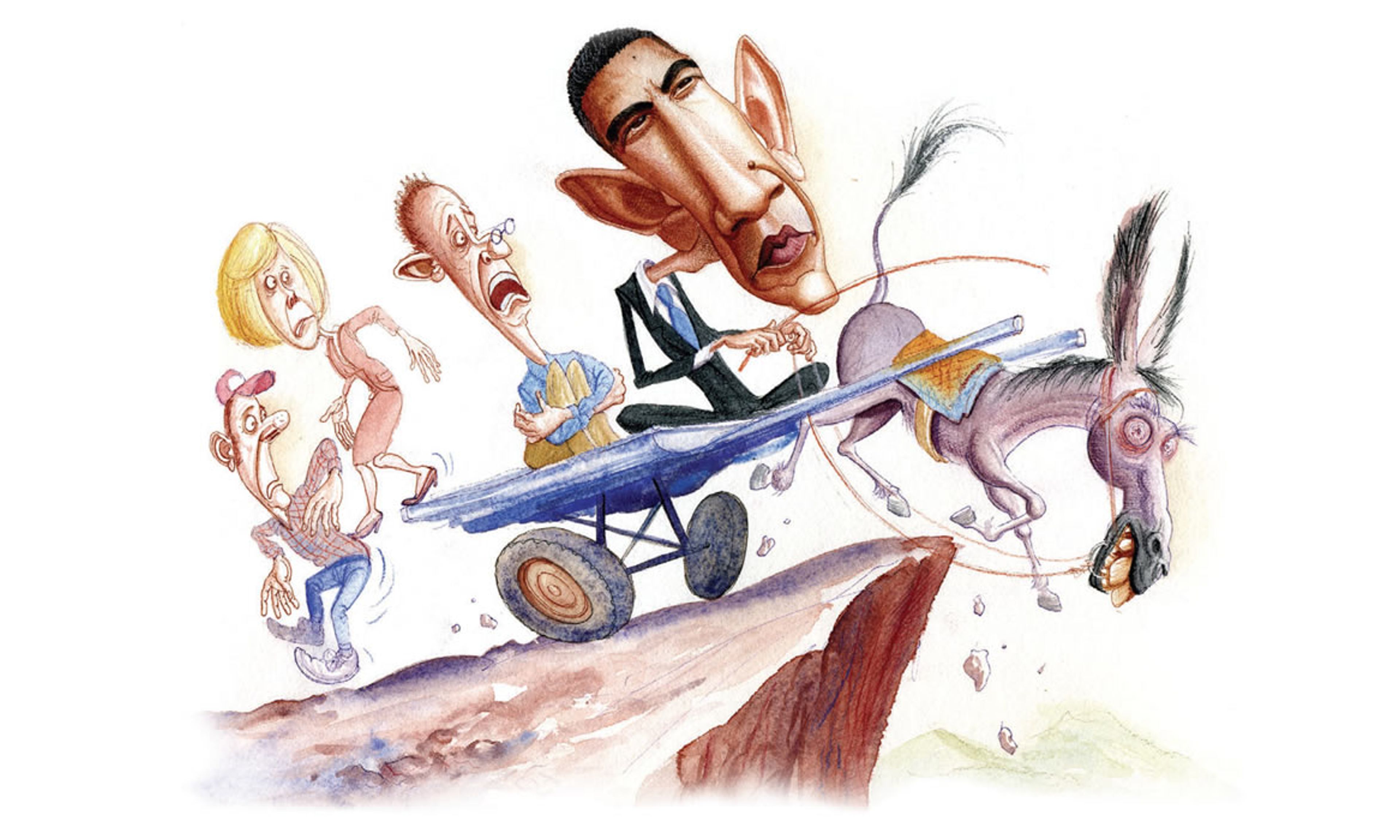
Barack Obama’s election was supposed to signal a monumental shift in public affairs. His victory was to be the liberal counterpoint to 1980, with Obama as the left-wing Ronald Reagan. He was the leader of a new majority, one that demanded a more active role for the government in the average American’s life.
So much for that! Less than a year after the 44th president’s inauguration, conservatives are on the rebound. Gallup recently found that self-identified conservatives accounted for two out of five Americans, double the number of liberals. The public is also coming around to the Republican party, both in polls and at the ballot box: Republicans won a major victory in the New Jersey gubernatorial race last month, swept the field in Virginia, and gained ground in Pennsylvania.
What is the cause of this rebound? Some liberals — Markos Moulitsas comes to mind — have argued that the Democratic party has not been liberal enough. But make no mistake: This government is about as liberal as any since the New Deal, and the return of the Right is a consequence of the Left’s overreach.
A metric commonly used to track the ideology of members of Congress is the DW-Nominate system developed by Profs. Keith Poole and Howard Rosenthal. Their data show that the 110th House of Representatives — the last one in Pres. George W. Bush’s term — was as liberal as any since the Great Depression. The 111th House has about 25 fewer Republicans and 25 more Democrats, though it’s too soon to tell for sure whether it’s more liberal by the DW-Nominate metric.
As for the Senate, there has been a noticeable leftward shift thanks to the election in 2008 of new Democratic senators. Using a different methodology, Poole and Rosenthal estimate that Mary Landrieu of Louisiana and Mark Pryor of Arkansas are in the middle of the upper chamber this year — and historically these two have earned fairly liberal scores from the DW-Nominate system.
The liberalism of southern Democrats like Landrieu and Pryor illustrates another feature of the 111th Congress: Conservative Democrats from Dixie are in short supply. The tenure of Rep. Heath Shuler (D., N.C.) is a case in point. Shuler — who represents Asheville and the western part of the Tar Heel State — has gotten flak from his party for bucking Speaker Pelosi on a series of important votes. Most recently, he broke with the leadership by voting not only against the health-care bill, but also against the motion to bring it to the floor. Yet 50 years ago, his politics would have been about those of an average Southern Democrat. Republicans once aligned with such members to defeat the programs of the Democratic left wing. Nowadays, there are simply not enough Heath Shulers to form such a coalition.
Broadly speaking, this kind of polarization has characterized both parties, even if the mainstream media’s focus is solely on how “radical” the GOP has become. In the last 50 years, Republicans have become more conservative, and Democrats have become more liberal. So, while the Democratic party controls as many seats now as it did in 1971, today’s Democratic congressmen are substantially more liberal.
What’s more, the few moderate Democrats left in the chamber do not have control over the important committees. When she won the speaker’s gavel in 2007, Nancy Pelosi made a consequential decision to award committee chairmanships on the basis of seniority. Fifty years ago, that would have been a boon to southern, conservative Democrats, because the South was a one-party region and southern Democrats, once elected, rarely lost. But Dixie is no longer solely the domain of the Democrats, and southern Democrats are less likely to have the seniority needed to gavel Ways and Means or Judiciary. Meanwhile, urban and coastal congressional districts have become one-party fiefdoms. Ultra-liberal members like Charlie Rangel and John Conyers never have to worry about defeat — and thus they hold the important gavels. The most moderate committee chairman is probably Ike Skelton of Missouri, of the Armed Services Committee — and it is a stretch to label him a moderate.
As if this were not enough, Barack Obama is the president of the United States. Few Democratic presidents have had weaker ties to the South, the historic base of the party of Jackson. That Obama could win the presidency without much support from the South says a great deal about the Democrats’ slow, steady transformation into a party dominated by northern and western liberals.
So can it be any wonder that this government has pursued the agenda it has? The stimulus bill, the cap-and-trade bill, and the health-care bill were all designed under the direction of liberal committee chairmen, voted upon by a Congress that tilts farther to the left than any since the Great Depression, and promoted by a president that National Journal labeled the most liberal senator of 2007. Not only that, Obama and the congressional leadership have again and again shown their willingness to shed the votes of the more “moderate” members in order to pull these bills as far left as possible. Ike Skelton may be a liberal by historical standards, but the health-care bill voted on last month was too liberal for him. Thirty-eight Democrats joined him in defecting on the president’s top domestic priority. There were even more defections on the cap-and-trade vote.
The public increasingly sees this government for what it is. Around the time of Obama’s election last year, just 28 percent of likely voters told Rasmussen that then-senator Obama was “very liberal.” Today, that number is up to 46 percent. So it is fair to ask: Is this dramatic leftward shift what the country voted for last November?
I highly doubt it. When Barack Obama ran for office, he campaigned as a bipartisan healer. He railed against the “phony bipartisanship” of his predecessor and the “pettiness of our politics.” He wanted to change the tone, to adopt the best ideas of both sides and forge a broad consensus. He has not governed in this way. Instead, he has shown himself to be much more partisan than George W. Bush, who was able to garner bipartisan support on his major domestic reforms. Obama, by contrast, has pushed liberal bills that few if any Republicans could support, then blasted Republican obstructionism and pettiness. The media excuse this kind of attack because — being the northeastern social liberals they generally are — they are part of his core constituency. But that does not mean the broader public has failed to notice.
Additionally, 49 districts voted for John McCain for president while sending a Democrat to Congress. Many of these congressional Democrats are Blue Dogs, and won election by emphasizing their independence from the national party or their roots in the district. The size of the current Democratic majority is 41 seats, meaning that these McCain Democrats make the difference between Pelosi as speaker and Pelosi as minority leader. There are also 13 Democratic senators in states that John McCain won. This is more than the size of Harry Reid’s majority.
So it is indeed a stretch to argue that the country voted for a dramatic leftward “correction” in public policy last fall. It voted for a presidential candidate who promised to reach a hand across the aisle, and in many congressional districts the people split their ballots — which if anything should be interpreted as an endorsement of Obama’s broken promise to bridge the nation’s political divides.
This conclusion accounts for the country’s subsequent shift to the right in the polls and at the ballot box. If voters last fall did not seek root-and-branch change but are now having it foisted on them anyway, we should expect to see exactly the backlash we are seeing. And if voters are in search of a moderate, bipartisan course for public policy and the governing Democratic party is not delivering it to them, then bringing back the Republicans is their only option.
Americans have rarely used the biennial election as an occasion to change the government dramatically. Yet if the Democrats continue to pursue uncompromising, dogmatically liberal policies, we should expect the country to take advantage of the opportunity the framers wisely granted it.












Comments