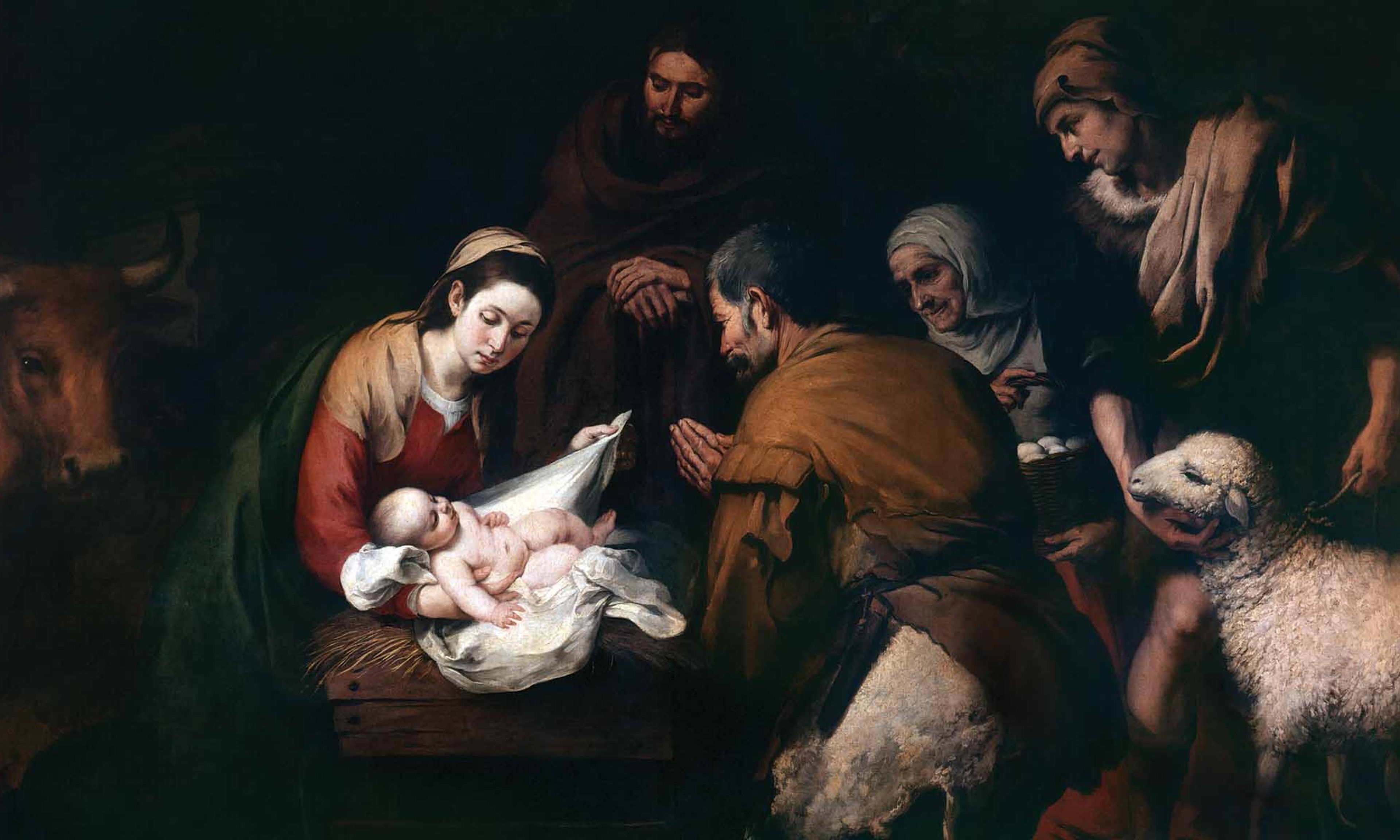
For about 800 years, since the first Nativity scene was arranged in medieval Italy, animals have figured in our mental picture of the night when Jesus was born. Though purists note that Luke’s gospel says nothing of oxen, donkeys, lambs, or other beasts, their presence at the birth was assumed by a local friar whose idea it was to re — create the moment using townspeople and live animals, the man history credits with originating the crèche — Saint Francis of Assisi. So bound up in the story are animals that it is practically impossible now not to hear their shuffling, lowing, and braying off in the background of that first Christmas, when, as Chesterton wrote, “the absolute once ruled the universe from a cattle stall.”
With so much in the whole cosmic drama intended for our benefit, we can well afford to reflect sometimes on its implications for the humble animals, and on their place among us today. It’s no slight to humanity — though some people always take it that way — to shift focus to them and to recall that they too were represented when the good news came into the world. Whatever their precise whereabouts in the stable, they were deemed worthy company of the Prince of Peace, a child of such low birth that he lay in what we would today call a trough. We’re led to believe, here and there in Scripture, that animals even had a stake in the events unfolding, as we are also reminded, frequently, of their own special standing, goodness, and individual dignity as living creatures — belonging not to us but to their Maker.
To Judaism we owe, among so much else, the understanding of animals as more than just the extras, objects of fantasy, figures of superstition, or the great mass of interchangeable nonentities that they had been to the pagan mind. True to the faith of the powerless, hounded, and persecuted, gentle attention in the Bible is often accorded to other creatures. We find a sense of fellowship, shared travail, shared happiness, and common direction, and indeed acts of compassion for animals are on several occasions held to be a mark of the upright and faithful. A touching and neglected detail in Genesis comes as the animals are “blessed” and sent forth into creation — before we even make our appearance — a distinction at least as notable and worth pondering as their role in Bethlehem.
During his mission on earth, when Jesus points to animals, it is typically to illustrate some larger idea or principle: the hen gathering her chicks; the birds with their nests and foxes with their dens while the Son of man has no place to lay his head; the two sparrows sold for a farthing, and yet not one of them falling to the ground without divine concern; the sheep in the hands of the hireling. They serve metaphorically, usually by way of saying that if no creeping thing or fowl of the air escapes attention, how much more certain are we to be counted and known. Yet the examples seem to reveal something beyond their application to us. What kind of mind was it that went back again and again to animals to convey images of providential care, unending love, or guiltless suffering?
What comes across in Scripture is a feeling most of us acknowledge to be true regardless of religious conviction, whether we belong to other faiths or to none at all: Humanity’s authority over animals carries a serious duty never to abuse it — never to merely exploit, bully, or lord it over them. We have a basic obligation of honorable, lenient conduct toward fellow creatures, formed of the same dust as we are, sharing the breath of life, none of us so far above them that we can brush off their needs or hurts as nothing. “Dominion,” a weighty word often invoked to excuse our offenses, is not just the Bible’s more elevated term for domination and destruction. Clearly, on any careful reading, more is expected of humanity than that, which helps explain why, in Western societies, the animal-protection cause was begun by Christians.
Of course, in the Old and New Testaments, we are not exactly presented with a peaceable kingdom, either, whatever the drift of Isaiah and other prophets might be. Consider a side story in the parable of the prodigal son. The repentant wastrel has returned, all is forgiven, father and son rejoice. Then the father calls out, “Bring hither the fatted calf, and kill it; and let us eat, and be merry.” And later, when the elder son protests to the father, it’s only because his record is spotless and yet no such feast was ever held for him. Again things are made right, another relationship repaired, and amid the jubilation we’re left to imagine the moment when the servants follow their orders, a stall door swings open, and the startled creature has to face his doom.
It’s an extraneous detail, granted, in an allegory for the ages about something else. For that very reason, however, we are free to envision a still more ecstatic ending in which the spirit of clemency reaches one step further, not only the wayward son spared from severe consequences but also the calf. Give the young man his ring and robe and let that be enough. Fill the table with breads, fruits, olives, nuts, herbs, and sweets. In celebration of rifts healed through boundless mercy, no blood-spilling!
Nothing is lost in the lesson if merrymaking for the people doesn’t involve an animal’s coming to grief. And even if one accepts the killing and feasting as right and proper, just the way of the world — why else was the calf even there? — we have good cause to reconsider some of our own assumptions today, measuring the things we do or permit against the standards that most of us profess.
Above all, if we take any of this seriously, there is our era’s moral catastrophe of industrial animal-farming to confront. It is by far humanity’s harshest and most extensive use of animals. If the subject can be disquieting, and only more so amid holiday-feast preparations, perhaps that’s because of practices so remote from any sacred source and so plainly in need of second thoughts. At very least, factory farming is a regression in our relationship with animals, modern in method and pagan in spirit. It is a profound failure and a betrayal of them, inflicting endless pain just to serve our purposes. Talk about rifts in need of healing.
Before the industrial age, after all, animal-farming was little different from what the ancients knew. Not always pleasant by any stretch, but for animals at least not filled with tribulation from beginning to end. In our time, everything has changed. We have seen the enterprise twisted and transformed into the mass “processing” of animals, a system of hyperintensive cruelty that produces about 95 percent of animal products. The system is so widespread that, as historian Yuval Noah Harari points out, if you include all species and the human population, “the majority of large animals on planet earth are domesticated farm animals that live and die as cogs in the wheels of industrial agriculture.” In a given year, that comes to about 70 billion mammals and birds, and was any majority ever so voiceless?
So, for example, in the United States alone some 510,000 pigs are slaughtered every day, a datum reported in the business pages as “industrial output,” as if they were car parts or coal instead of fellow creatures who suffered and went to their deaths in terror. Psalms and proverbs bid us to be gentle, but the authors of these, were they to see what we have made of animal husbandry, would hardly have the words to reproach wrongdoing on such a scale.
If the two sparrows are not forgotten, what are we to say of the half a million pigs — creatures who rival dogs in aptitude and sensitivity? If denying one draft animal rest on the Sabbath gave us the maxim “The righteous man regardeth the life of his beast, but the tender mercies of the wicked are cruel,” what kind of rebuke is in order for denying billions upon billions of animals even the least of comforts and kindnesses? What’s the Judeo-Christian verdict on a worldwide industry in which they are torn away from their mothers, confined, mutilated, hauled about, and slaughtered, all by the most heartless of methods? Are we really to respect other creatures, or is that all just platitude?
A candid accounting would have to confess that we’ve turned animals over to the corporate hirelings who do our cattle-raising and flock-tending. They “grow” the creatures in dungeons, rush things along at maniacal speeds, call it an improvement when the tortures are slightly relieved, and do all in their power to help keep the truth out of sight and out of mind. With walls, real and emotional, we place these creatures beyond the reach of our compassion. How so many people can manage to tolerate something so obviously abhorrent is a mystery. It’s as though none of it really counts as cruelty so long as the process is hidden at a distance and delegated to others.
There are plentiful substitutes for meat and other animal products, happily embraced by many men and women. Yet at the mention of such alternatives, so many other people grow defensive or dismissive, and even very pious authorities insist that where animals are concerned, human beings operate by absolute right because our interests must always come first. That leaves us to figure out how living off such vast and avoidable animal affliction could ever be in our moral interest. And such guidance would be, if correct, the highly unusual case in which Christian ethics required zero personal effort — no sacrifice, no contrition, no change in habits, nothing.
All this fear and dread inflicted on farmed animals got worse, strangely, at just the time when mankind began to better understand and appreciate the lives and minds of animals in general. Our shabby, two-faced stewardship of them requires that we repress not only normal human sympathy but also recognition of their intelligence, feelings, social needs, and natural desires, all of which are now well known and readily demonstrated. The billions of animals condemned to their blighted existence are no less complex and impressive than the many animals we name, care for, and protect and love as companions, often counting them as our fur-bearing family members. Subjective judgments bestowing moral value on the animals near at hand while withdrawing it from those others far from view might make things convenient, but they bear no relation to reality.
It is fair to ask how, in good faith, anyone can follow along in Scripture’s lovely teachings about the worth of all animals, or join in such moving hymns as “All Creatures of Our God and King,” while living with this inconsistency. Worse, some complain that merely to call attention to the suffering of farmed animals is rude and trivial-minded — “Why aren’t you more concerned about human needs?” This is a way of pushing off the problem, obscuring the fact that humans cause it, and refusing to accept personal responsibility.
The point becomes easier to see in the attitudes and actions of others. Consider the growing market in China for the skin and flesh of donkeys, which in recent years unleashed what Newsweek has called “a global massacre.” Around the world, donkeys are disappearing into the hands of local traders who kill them and ship the desired parts to China, following the implacable logic that if there is demand to be met and money to be made, then that’s justification enough. Other donkeys wind up at China’s live-animal markets, to face the horrors of those places and then to be slaughtered on site. All this as various animal charities, the usual steadfast and often heroic people who confront cruelty, are trying to save the donkeys.
Here is an intelligent, sensitive, affectionate animal, as deserving as any of mercy in light of the species’ thousands of years of hard service to humanity. Here are creatures who can live 50 years but usually last just ten or 15 because they are already so maltreated and overburdened. And here is the very creature that, as if attendance by the manger weren’t enough, was raised up, in the words of Malcolm Muggeridge, “from a somewhat lowly position in the animal hierarchy to a share in the glory of the first Palm Sunday. . . . To this day in the Middle East, as they toil, heavy-laden, along the same dusty roads as in Jesus’s time, they wear an expression which seems to be saying: What these old eyes have seen and what these long ears have heard!”
Yet all of a sudden, for all of their labors, for all of their innocence, donkeys are trucked, whipped, or dragged by the millions into filthy, ramshackle slaughterhouses in Africa, Latin America, the Middle East, Pakistan, and elsewhere, because of items that some Chinese consumers simply refuse to do without, even though there are substitute products on offer. It’s depressing, galling, contemptible: the cold selfishness of such demand, for something nobody really needs.
And yet why should we call this any worse than demands and practices that in our own societies we consider normal? Since when are already badly abused animals off-limits? Since when is actual need the guiding rule? Any credibility we might have had, any claim of consistent judgment, we’ve given up. The ruthlessness of animal-use industries is a pervasive injustice, but we can’t think straight about other people’s transgressions until we have dealt with our own.
We get used to our big, efficient systems, must-have products, ritual menus, and all of the distortions of reality that can go with them. It’s a good time of year to shake off that mindset, break free of it, and open our hearts to greater things, including a sense of kinship and wonder toward other creatures; to invest ourselves more in their well-being and flourishing, to divest ourselves more from their abuse and degradation. How cheap and meaningless, when you stop to think about it, are so many of the items that humanity extracts at a cost of animal suffering and bloodshed, weighed against the rewards that come with leaving them in peace.
There’s a gallery of pictures, available online, called “Animals in the Womb” — recommended viewing in this week for contemplating mysteries. It’s a series begun in the 1960s by the renowned photographer Lennart Nilsson and continued later, using a combination of cameras and 4D-ultrasound scans, by both National Geographic and Nova, with amazing results. All but the most jaded among us will marvel at the sight of horses, kangaroos, elephants, dolphins, dogs, cats, pigs, cows, and animals of every kind during gestation — being “knitted,” as the psalm puts it, inside their mothers just as we were. Seeing these images leaves us hard-pressed to refrain from religious sentiment, even if we’re not usually given to it, for unmistakable is the master touch, in each one of these dear creatures coming into being.
The general effect is a moral wake-up call for anyone who thinks that all any animal can ever be is a “resource” of one type or another, subject ultimately to the wishes, designs, or appetites of mankind. Indeed, in the case of the piglet, calf, and other future livestock photographed in utero, it takes concentration to see them forming and then to comprehend that only two experiences await them in the world, the hell of the factory farm and the nightmare of a slaughterhouse. Such beautiful preparation for such an ugly, wicked fate. For every exploitative industry — profiting from meat, skin, fur, blood sport, experimentation, and all the rest — “Animals in the Womb” is an unanswerable indictment of human presumption and greed, proof that uncaring people can torment, imprison, and mass-produce animals, but they can’t erase their dignity as living creatures. They can take all the happiness out of life. They can’t take the miracle out of it.
By this and other means, science and technology have confirmed, truly, “how manifold are thy works! In wisdom hast thou made them all.” Whatever beauty and goodness we find in creation was hardly reserved exclusively for us. Human beings are never so special or important that we can’t bother noticing that and giving animals their due, or at least refraining from harsh treatment they don’t deserve. “Peace on earth,” our Christmas prayer, is a tough enough proposition given our own tendencies toward conflict with one another, to say nothing of all the violence in nature itself. It surely doesn’t help matters to spread yet more fear and gloom and misery at the expense of innocent creatures who stand defenseless against us. Changing our ways can involve extra effort, even a bit of sacrifice. But then what are a few inconveniences when all seems so hopeless and we have it in our power to dispel the darkness?









Comments