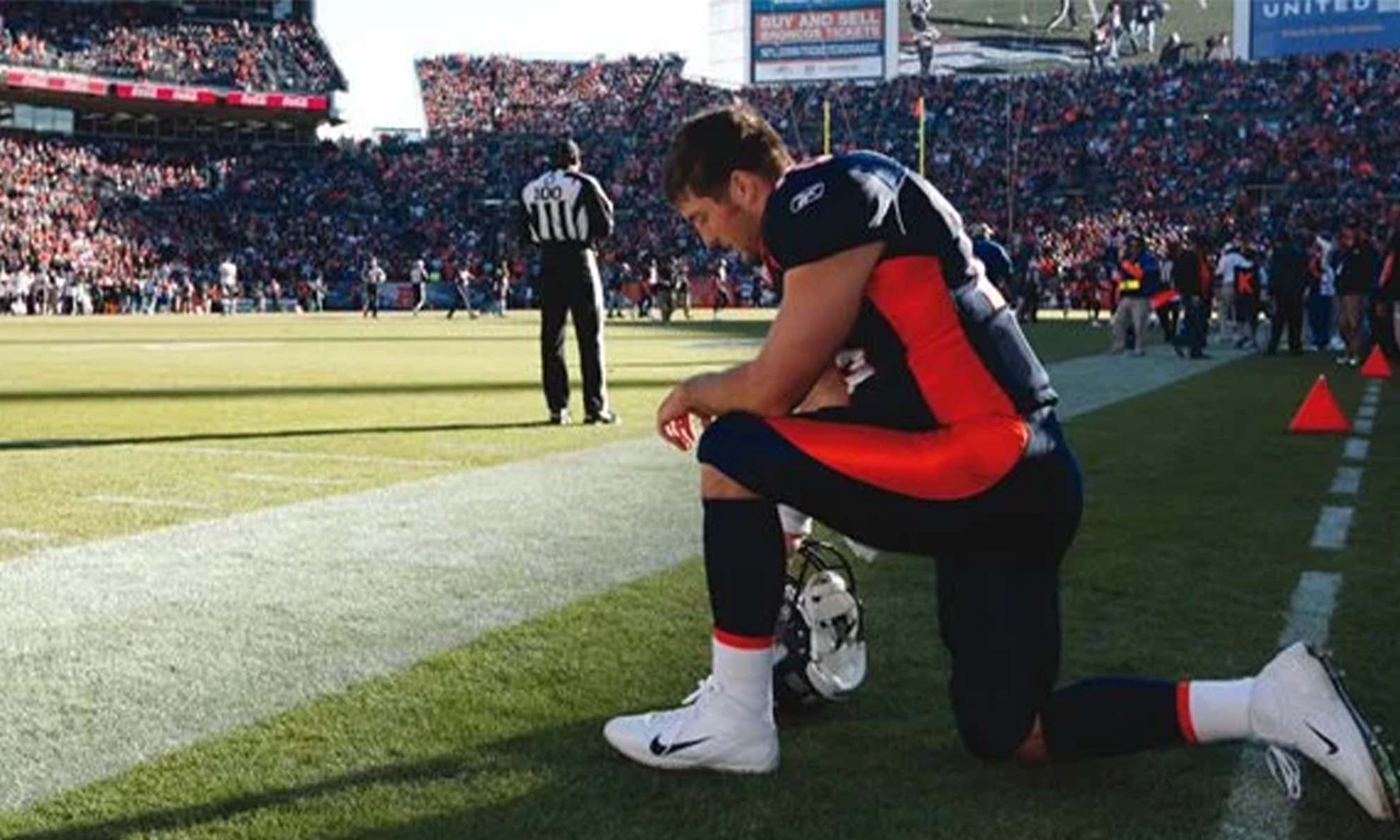
When the Detroit Lions’ Stephen Tulloch sacked the Denver Broncos’ Tim Tebow in the first quarter of their Week Eight match-up, the linebacker immediately kneeled next to the prone Denver quarterback in a mockery of Tebow’s habit of praying on the field, most recently seen after the Broncos’ miraculous fourth-quarter comeback against the Dolphins the week before.
The insult coincided with and reinforced the explosion of “Tebowing” as an Internet meme, complete with a Twitter feed and website where you can see an act of communion with the Creator rendered as a bit of pop-cultural ephemera and scroll through pictures of folks striking the pose everywhere from Oxford to Istanbul, with that muddle of irony and enthusiasm that has become my generation’s trademark.
But there isn’t an ironic bone in Tim Tebow’s body. That’s what makes him conspicuous. That’s what makes the fact that he’s managed to stay squeaky clean, in a sport that notoriously is not, conspicuous. And that’s why the power of Tebow’s evangelical Christian faith, and the earnestness with which he professes it, annoys so many people.
Even other religious quarterbacks have, in a friendly way, advised Tebow to tone down his religiosity to avoid turning fans off. Said former Super Bowl champion Kurt Warner, himself known to have led on-field prayers: “I’d tell him, ‘Put down the boldness in regards to the words, and keep living the way you’re living. Let your teammates do the talking for you. Let them cheer on your testimony.’” Likewise, when Packers QB Aaron Rodgers was asked about Tebow in the context of his own more subdued avowals of faith, he offered the elliptical advice of Saint Francis of Assisi: “Preach the gospel at all times. If necessary, use words.”
It’s easy to understand why Tulloch, a mediocre middle linebacker who was a fourth-round pick out of North Carolina State, would want to take Tebow down a peg. For good and for ill, head games and intimidation are as much a part of football as tackling is (not to mention that Tebow has four inches on Tulloch and is a talented enough athlete that he might even make a better backer).
But there is also something a bit nastier in Tulloch’s mockery, in the phenomenon of “Tebowing” as a whole, and in the criticisms by players such as former Broncos quarterback Jake Plummer, who said of Tebow, “When he accepts the fact that we know that he loves Jesus Christ, then I think I’ll like him a little better.”
So what is it that so many around football — players, pundits, fans — are so peeved about? Why has Tebow’s faith generated so much controversy and criticism in a sports-entertainment complex that is so filled with clichéd Jesus praise that, to quote Homer Simpson, you’d think God helped only professional athletes and Grammy winners?
I have a theory. Part of the resentment is redirected anger at Tebow’s success, after the whole of the football smart set had come to the bizarre conclusion that, although he was clearly one of the ten or so best quarterbacks ever to play in the NCAA, Tebow had no shot in the NFL. Football doesn’t like to be wrong; they’re mad enough when surefire prospects turn into busts, but when surefire busts succeed, they’re livid. They don’t like to see a guy who winds up to throw passes like he’s pitching for the Yankees — and only occasionally sees them land anywhere near their intended target — marching down the field in the fourth quarter, week after week.
But the greater part of it has to do with our culture’s curious double standard when it comes to public religion. All but the most committed atheistic crusaders in this country have come to tolerate what the legal community has dubbed “ceremonial deism,” an unwittingly damning term for those acceptable celebrations of the Divine stripped of their divinity, the kind that take their place in rote recitations of pledges and patriotic songs: God as a feel-good placeholder, an empty signifier, a carrier of anything or nothing, the unremarkable and earthly god whose name graces the almighty sawbuck. This is the god we routinely hear invoked by the professional athletes. With very few exceptions — Mariano Rivera comes to mind, as well as Curt Schilling, and post–Prime Time Deion Sanders — athletes’ professions of faith strike most believers, nonbelievers, and agnostics alike as empty ritual, an extended solipsism in which big men with bigger egos congratulate themselves for having God on their side. How could it be otherwise? We see that in fact so many of them are supremely arrogant — materialists, abusers, and lechers. We accept their professions of faith precisely because they are empty. And we’ve become cynical and secular enough that the dissonance between their actions and their stated beliefs doesn’t bother most people. The hypocrisy is actually sort of comforting, a confirmation that that old hokum in the Bible has no bearing on the world as it actually is. It’s the same sort of glee you see from some when Christian politicians and ministers are felled by all-too-human moral — especially sexual — foibles.
By contrast, Tebow is the last Boy Scout: a leader on the field and off who spent his college years not indulging in any of the worldly pleasures afforded to Heisman Trophy winners but doing missionary work in Thailand, helping overworked doctors perform circumcisions in the Philippines (you read that right), and preaching at schools, churches, and even prisons. This is a young man with such a strong work ethic that, according to teammates, he can’t even be coaxed into hitting the town on a night after a Broncos win, because he is too busy preparing for the next week’s game. This is a young man who even turned the other cheek at Stephen Tulloch’s Tebowing, saying, “He was probably just having fun and was excited he made a good play and had a sack. And good for him.”
That’s way too much earnestness for the ironic. It’s way too much idealism for the cynical. And it’s way too much selflessness for the self-absorbed. In short, people aren’t upset at Tebow’s God talk. They’re upset that he might actually believe it.










Comments