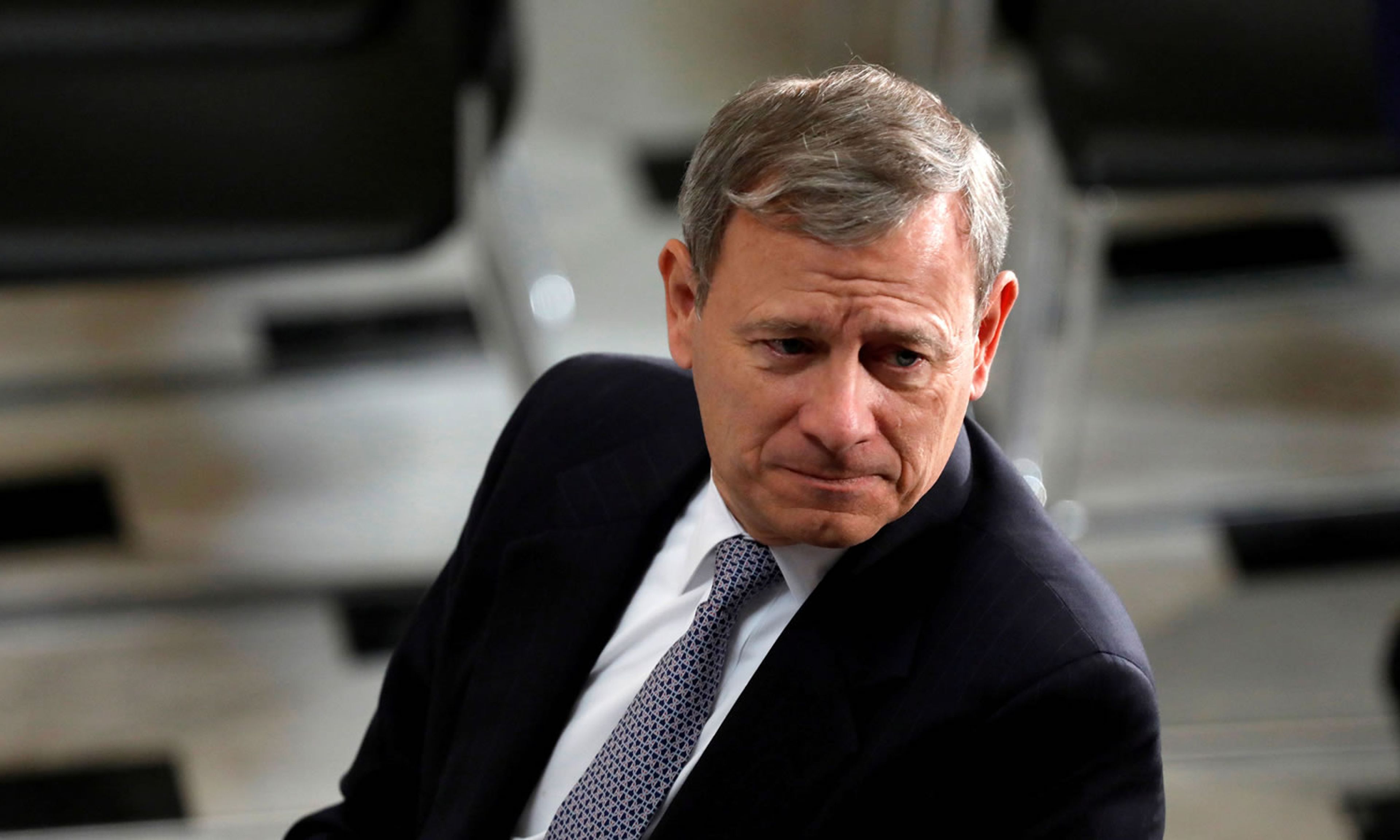
John Roberts is an extraordinarily risk-averse chief justice. Even were that not the case, though, the Supreme Court would resist entanglement in elections, particularly presidential elections. The justices were never going to take it upon themselves to intervene in the contest President Donald Trump has lost to President-elect Joe Biden. Nor ought they have done so, much less reverse Biden’s fairly narrow but credibly undeniable Electoral College victory.
The justices unanimously found no merit in the risible lawsuit that Texas petitioned to file against four battleground states won by Biden. In the aftermath, Trump and his more rabid supporters claimed that Justices Samuel Alito and Clarence Thomas, perhaps the tribunal’s most conservative jurists, had dissented. They hadn’t. The other seven justices — including Trump appointees Neil Gorsuch, Brett Kavanaugh, and Amy Coney Barrett, the Court’s newly minted member so recently smeared by Democrats as a plant to assure Trump’s victory — denied the Lone Star State’s bid.
Texas lacked standing because a state has no cognizable interest in how other states conduct elections. Alito and Thomas demurred from that finding. But this was a technicality, given that the pair adhered to their long-held view that the Court must accept cases involving a state seeking to sue another state. The two justices agreed with their colleagues that Texas’s other motions — e.g., to restrain the four “defendant” states, Pennsylvania, Michigan, Wisconsin, and Georgia, from voting in the Electoral College — should be denied. If the Court had permitted the complaint to be filed, Alito and Thomas would undoubtedly have concluded that Texas lacked standing. It was just a formal question of when to so rule.
This was not quite the last nail in the coffin of Trump’s litigation campaign. That was hammered in just 24 hours later, when a Trump-appointed judge in Wisconsin rejected the president’s claims on the merits, after offering his lawyers every opportunity to prove his claims of gargantuan ballot fraud and vote-rigging. This belied Trump’s mendacious claim that he had “won by a lot” and could establish that the election was stolen if only judges would stop hiding behind such niceties as the “standing” doctrine to ward off his lawsuits. Indeed, the campaign’s factual claims withered upon examination by state courts; and every time a federal court scheduled a hearing, as had Judge Brett Ludwig in Wisconsin, the Trump campaign folded, conceding that it was neither claiming fraud nor in a position to prove that a single vote was fraudulent.
As the weeks have gone by, it has become increasingly clear that the president, petulantly unwilling to admit defeat, is stoking a grievance-mongering political narrative. He never really wanted it tested in the courts . . . and that’s fine with the courts, especially the nation’s highest one.
The “democratic process” is how a self-determining people governs itself in a republic dedicated to ordered liberty. That process is inherently political. To describe something as “political” is to give it a pejorative connotation, and, to be sure, there is no rinsing sharp-elbowed partisanship out of practical politics. The democratic process, however, is political in the formalistic sense relating to the governance of our republic — the manner in which it structures, divides, and exercises power. The democratic process confers legitimacy on the exercise of public authority. In the peculiarly American sense, in the Declaration’s expounding of our very DNA, political legitimacy requires that governments “derive their just powers from the consent of the governed.” They are no longer legitimate when the form of government becomes destructive of that arrangement, as it would if unaccountable courts picked the president.
The franchise epitomizes the political nature of the democratic process. Through it, we elect the political branches of government, which have that designation not because they engage in hardball tactics but because they are accountable to us. The federal judiciary is not. It is intentionally insulated in the expectation that (a) it will limit its intrusions on public life to controversies in which someone has suffered a concrete harm owing to an illegal act, and (b) it will decide the resulting cases based solely on the law, not public sentiment. Courts are thus anti-democratic. We expect them to tune out the will of the people, the opposite of governing in accordance with it.
The last six weeks since the presidential election, then, have proceeded along the lines of an illusion: the notion that, in light of litigation in multiple states over voting procedures, ballot integrity, and tabulation processes (in which Team Trump stacked up loss upon loss), the Supreme Court would inevitably decide the winner. That was never going to happen.
It is understandable that people believed that it would. In the past century, we’ve become inured to the idea that nothing is really final until the courts rule. Activist judges deserve much of the blame for that, but they are not the the guiltiest of culprits. Just as Congress has delegated much of its authority to administrative agencies, so too has it left to the judges the burden of divining the terms of its bulging, often byzantine enactments.
More to the point, just 20 years ago a cliff-hanger (or was it a chad-hanger?) of a presidential election was not determined until the Supreme Court weighed in. The justices were pained by this. It was not a pose. The opinions in Bush v. Gore gush with anguish over the predicament. But it is precedent all the same. All presidential campaigns now line up battalions of lawyers in the expectation that litigation — before, during, and after voting — will feature prominently.
In 2020, a peculiarity of history brought this assumption into sharp relief. On September 18, progressive icon Justice Ruth Bader Ginsburg succumbed after a long battle with cancer. Not only was this just six weeks before Election Day; early voting was already under way in over a dozen states. Over wails of Democratic protest, President Trump nominated Judge (now Justice) Barrett to fill the vacancy. In conformance with the circus that is the modern confirmation process, Barrett’s Senate hearing oozed innuendo that a desperate Trump had elevated her to bolster his chance of being reelected by the Court in the likely event of a ballot-box defeat.
In reality, the election was tighter than anticipated. Despite losing the popular vote by 7 million (out of a record 158 million ballots cast), Trump actually appeared to surge ahead in key battleground states on Election Night. It was an illusion owing to timing. Trump spent the campaign inveighing against mail-in voting, and his voters turned out heavily at the polls — the votes that are counted first in most states. Mail-in votes, tilted Democratic and historically heavy because of the pandemic, were tabulated in the later waves. This gave the appearance of Biden’s steamrolling improbably from behind. In reality, his victory followed the expected pattern, though not by the expected margin.
No one would have expected Trump to personify graciousness. Still, his refusal to come to grips with defeat, which degraded into an obsession to stamp Biden as illegitimate, marked an execrable new low — tit for tat for the damage inflicted on him by the Democrats’ Russia-collusion and Ukraine-impeachment escapades. The turn to the judiciary, naturally, became a core component of this strategy. In a display that still seemed jarring even after years of outrageous tweets, Trump demanded that the courts “#OVERTURN” the election and raved, “The Supreme Court has a chance to save our Country from the greatest Election abuse in the history of the United States. 78% of the people feel (know!) the Election was RIGGED.”
The cynical howling stirred the Trump base to “Stop the Steal” fanaticism. It could not alter reality — the lack of fraud evidence and the judicial resistance to second-guessing voters.
The word that best describes the post-election litigation in 2020 is mismatch. From the start, there have been gross mismatches between the extravagant claims of fraud that Trump-campaign surrogates posited in public and the modest claims of impropriety that they pled in court. Between the loaded allegations of literally millions of invalid ballots proclaimed in their court filings and the hard evidence — as opposed to outlandish inferences and suppositions — offered as “proof” of those assertions. Between the small-potato irregularities they were arguably able to establish and the earth-shattering remedies they proposed: the disenfranchisement of tens of millions of American voters; the vacating of several states’ popular election of Joe Biden, to be supplanted by the appointment of Electoral College slates (i.e., Trump slates) by Republican-controlled state legislatures, notwithstanding the utter absence of judicial authority to order such relief. Talk about “RIGGED”!
It is not worth rehashing the “Kraken” paranoia offered up by Trump allies Sidney Powell and L. Lin Wood, the lawyers who claimed that voting-machine software had been secretly programmed by Communists overseas to change Trump votes to Biden votes — uncovered, Powell, er, explained, only because the unexpected outpouring of Trump support “broke the algorithm.”
The post-election litigation rolled out by Trump’s own legal team had a pattern. First, advance monstrous allegations of ballot-box stuffing and election theft, based on a few quotidian instances of error and irregularity, such as the incorrect crediting of about 6,000 votes to Biden in Antrim County, Mich., which was discovered and reversed in routine, bipartisan canvassing. Couple these allegations with scattered, exaggerated suppositions about ballot-handling shenanigans. Finally, see it all evaporate upon examination, often by Republican judges, some of them appointed by Trump himself.
In the main, though, the “case,” such as it was, stacked inference atop unsupported inference. In place of real evidence, there was dark suspicion about the unprecedentedly extensive use of mail-in voting, which state governments — particularly those run by Democrats — had enthusiastically endorsed. The potential for fraud in such an arrangement is patent. Attorney General Bill Barr warned about the dangers several times. There is a difference, however, between perils that are plausible and perils actually established. Barr acknowledged as much weeks after the election, in announcing that the Justice Department had found no proof of fraud so widespread that it could conceivably affect the outcome. (Barr, among Trump’s best appointments, became a Trump piñata after that concession and has since announced he will be leaving by Christmas.)
No one, it seems, better understood the difference between projection and reality than Trump and his counsel. In Michigan, they filed a federal lawsuit with great fanfare, only to drop it after a judge threatened to dismiss it for failure to prosecute (after nearly a week, they’d failed to serve the secretary of state). When a federal judge in Pennsylvania scheduled a hearing, Team Trump dropped the fraud counts from their complaint, admitted that galactic fraud was not actually being alleged, and agreed that no hearing would be necessary. And when Judge Ludwig in Wisconsin pointedly denied objections by state officials that Trump lacked standing, meaning it was put-up-or-shut-up time, Team Trump stipulated that it was not claiming fraud and that it agreed with the state’s description of how the election was conducted. The Trump appointee promptly rejected the president’s weak legal objections to such election-administration procedures as the use of secure drop boxes to collect mail-in ballots — which had been recommended by Trump’s own Department of Homeland Security.
American courts have no business deciding elections and, fortunately, no appetite to enter that most political of frays. The only thing they apparently desire less is to be used as a prop in political theatrics.











Comments