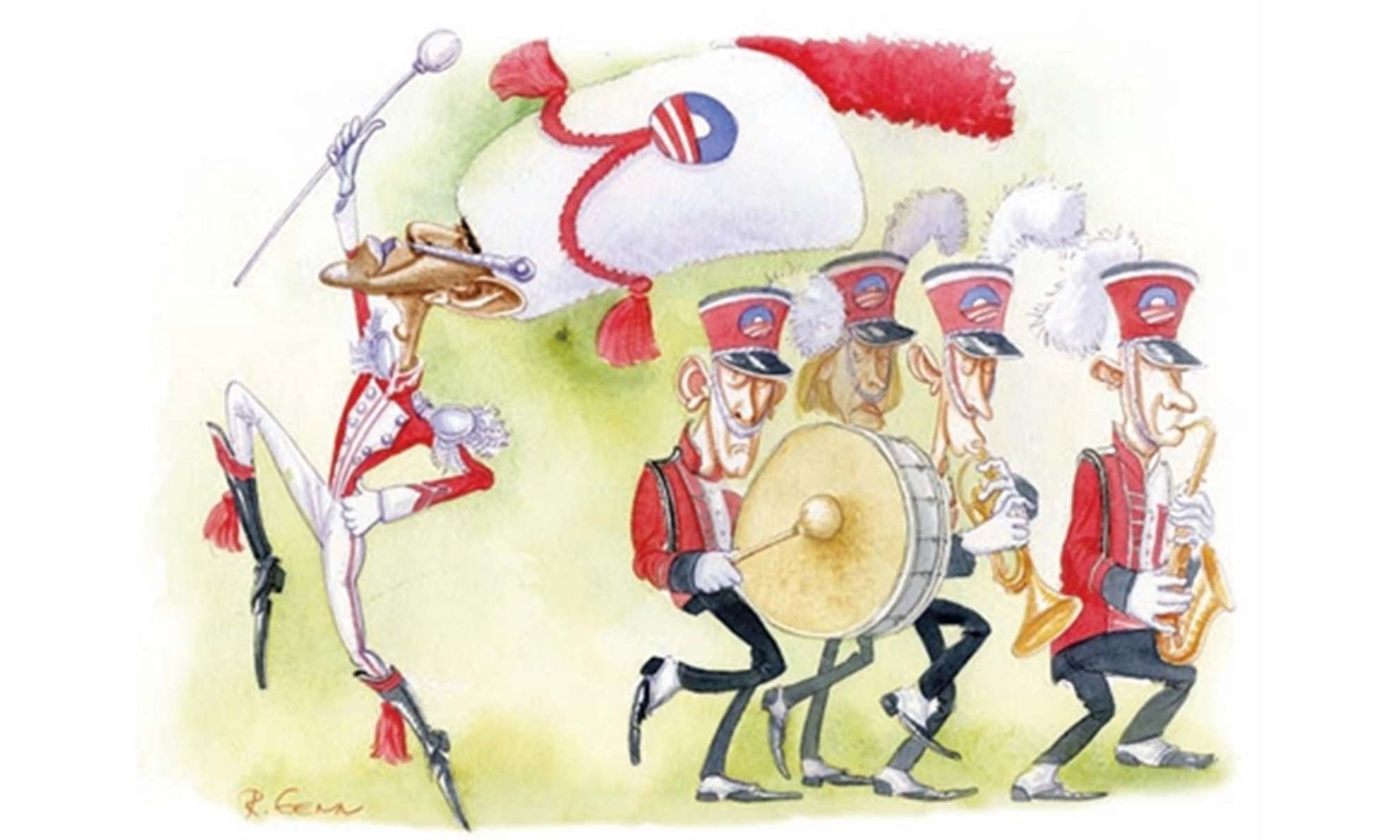
• It is our fond hope that Democrats win another landslide among non-voters next time.
• Comparisons are odious. But on a night of GOP wins, pride of place belonged to Wisconsin governor Scott Walker. First elected in 2010, he began his tenure by loosening the grip of public-sector unions on the public fisc. Union members descended on the state capitol in Occupy-like mobs to pressure Walker to back down. When he wouldn’t, he was subjected to a recall election, the state’s first. He won that election in 2012. Then Democratic DAs launched an investigation of allegedly illegal campaign contributions to conservative groups, in hopes of blackening Walker. That effort too failed to stick. This November, Walker won his third election in four years — all with votes in the range of 52–53 percent, none of his Democratic opponents breaking 47 percent. Wisconsin has not gone for a Republican presidential candidate since 1984. Whether it would go for him, or whether he could even win a GOP nomination, are questions for the future. But for now, Scott Walker is the titanium man.
• In his day-after press conference, President Obama explained the wipeout that his party had just suffered by drawing on a concept of Richard Nixon’s: the silent majority. “To everyone who voted,” Obama said, “I want you to know that I hear you. To the two-thirds of voters who chose not to . . . I hear you, too.” But since the no-shows chose silence, what did Obama think they said? “The American people,” he explained, “sent a message”: “They expect the people they elect . . . to get the job done.” So? “So, I plan on spending every moment of the next two-plus years doing my job the best I can.” As a rhetorical face-saver, this passes muster. As a guide to action, though, it fails. Obama’s party got pasted because most voters did not like the job he and it are doing. And even if all the stay-at-homes were secret Democrats, they weren’t motivated to show it. Nixon at least hoped to draw his silent majority to the polls. Obama, it seems, will spend his next two years relying on the support of imaginary friends.
• Celebrity is a bitch: One day you’re Kim Kardashian, the next you’re Kim Kardashian’s derrière. Jonathan Gruber has been on the political equivalent of the celebrity slide: Over the past few years, the MIT prof made millions of dollars consulting with the federal government on how to structure Obamacare, and state governments on how to comply with it. But in the last month, he became a goat when videos surfaced of him explaining, at academic conferences, that the law’s “lack of transparency” was a necessary feature in recommending it to “the stupidity of the American voter” (at latest count there are seven such videos). Nancy Pelosi and Barack Obama tried to minimize Gruber’s importance, yet both had praised him and the president had met with him in the White House. In order to make America more like Sweden, dishonest politicians and a corrupt intellectual gofer wrote an unreadable law; the gofer chortled about the credulity of their gulls. Government of the people, by the people, for the people, 2014.
• On Election Day, Ron Paul, the erstwhile congressman and presidential candidate, gave an interview to Russian state television. He said there was no real difference between the two major parties in America. “What do they do with our young people? They send them all around the world, getting involved in wars and telling them they have to have democratic elections. But here at home, we don’t have true democracy. We have a monopoly of ideas that is controlled by the leaders of two parties. And they call it two parties, but it’s really one philosophy.” We have to admit that in neither party would most politicians see fit to complain about American democracy on Russian state TV.
• The Supreme Court agreed in early November to hear King v. Burwell. At issue is whether the provision granting tax-credit subsidies only to insurance purchased on an exchange “established by the state” in fact includes insurance purchased on federal exchanges, too — in other words, whether the law should or should be not applied as written. Obamacare proponents have decried the suit as a faux controversy over a “typo.” But at least some proponents of the law thought this “typo” might serve a purpose. As Obamacare “architect” Jonathan Gruber declared in 2012: “If you’re a state and you don’t set up an exchange, that means your citizens don’t get their tax credits.” He has since tried to explain away those comments. In July, the Fourth Circuit Court of Appeals ruled that the IRS, by granting subsidies to plans purchased on the federal exchange, had interpreted reasonably an ambiguous statute. But the Supreme Court’s decision to grant certiorari suggests that at least four justices want to take a closer look. If the Court rules for the plaintiffs, it would end subsidies, and effectively end the employer mandate and individual mandate, in the 36 states that chose not to set up state exchanges. The crippling consequences would require nothing short of wholesale revision of the law. Obamacare’s most deadly enemy could turn out to be its own authorizing law.
• The great deal of lawless judicial opinion written by federal judges about the issue of same-sex marriage now has an important counterweight: The Sixth Circuit Court of Appeals has sensibly ruled that nothing in the Constitution compels state governments to recognize same-sex marriages. Marriage laws in the states under the court’s purview, in Kentucky, Michigan, Ohio, and Tennessee, can stand. It’s the first time a panel of circuit judges, the top level of the judiciary below the Supreme Court, has stood athwart the cause of same-sex marriage since the high court struck down the Defense of Marriage Act last year. As the author of the majority opinion in this case, Judge Jeffrey Sutton, explained, states have always been in charge of marriage policy. Indeed, advocates of same-sex marriage made a great fuss about this very point a few years ago, as part of their argument against a constitutional amendment securing the old definition. Unconstitutional marriage laws are possible, but the traditional definition of marriage has a rational basis, unlike, say, laws against interracial unions. The Constitution leaves states free to reject the traditional definition, if their voters or legislatures so choose, but also free to maintain it. Which is another way of saying it leaves the courts out of that decision.
• ISIS released its fifth snuff film, a video of the beheading of American Abdul-Rahman (né Peter) Kassig. Kassig served as a Ranger in the Iraq War, went back to the Middle East in 2012 as an aid worker, and converted to Islam after being captured in Syria. Kassig, said John Kerry, “personified the values of altruism and compassion, which are the very essence of his adopted religion of Islam.” Could we stop with the amateur theologizing, please? It will not impress ISIS, which believes that beheading and kidnapping and rape are the essence of their religion. Who is right about Islam, Kassig or his murderers, is a judgment that Muslims and non-Muslims must make for themselves. Meanwhile, can we get on with degrading and destroying?
• The Senate failed to pass a bill approving construction of the long-stalled Keystone XL oil pipeline, a final bit of economic malfeasance from Harry Reid’s do-nothing caucus. Among the Democrats supporting the measure was Mary Landrieu, an endangered difference-splitter from oil-rich Louisiana who has been partially liberated by the Democratic party’s abandonment of her Senate race against Republican Bill Cassidy, currently favored to win. President Obama is in a pickle: He must oppose the project in order to satisfy environmentally minded money-men such as billionaire Democratic benefactor Tom Steyer, but he does not wish to be seen publicly opposing the project, which enjoys broad support, including in states in which Democrats are vulnerable. The president is forever going on about “investments” in “infrastructure,” but here we have an actual investment — the commitment of real private capital — in actual infrastructure, one of many such investments necessary to fully develop the North American energy industry, a project important to the economy and to American foreign policy in a world full of Russian adventurism and Islamic fanaticism: The economy, the Putin regime, and jihad all run on oil, and the stronger the hand the United States and its nearest neighbors have in that market, the better.
• The deal President Obama reached with the Chinese government about controlling carbon emissions has been called unprecedented and historic. Maybe so: No president has heretofore thought it would be a good idea to commit to cut American carbon emissions dramatically in the coming years in exchange for a vague promise from China to stop increasing its emissions farther in the future. Of course, few presidents have been as desperate for a foreign-policy victory and a sop to their liberal base as this one. The agreement bolsters China’s position on the international stage at a time when it hardly deserves it, and will be used as a bludgeon at home to push for more environmental regulation. For the president, that might be, as the Chinese say, a win-win, but it is a lose-lose proposition for the United States.
• One of the most obvious, enduring benefits of the Republicans’ resounding midterm victory will be their ability to check the president with the Senate’s advice-and-consent power. Some in the Senate, strangely, think the time is ripe to restore the filibuster for judicial and executive-branch nominations. This would be meaningless in the short term: Republicans can block liberal nominees without a filibuster. But it would weaken Republicans substantially in the future. Democrats would use the filibuster during Republican presidencies, with the Republicans’ forbearance, while killing the filibuster whenever they are in charge. There is no case for restoring the filibuster on historical or constitutional principle, since it was never used to regularly block judicial appointments until George W. Bush was making them. There are a number of difficult questions that face next year’s Republican Senate majority. Whether to let the judicial filibuster rest in peace is not one of them.
• John Boehner rightly quashed an attempt to change the rules on the taxation of Internet sales during the lame-duck session of Congress. Most states charge sales taxes when their residents buy online, but the buyers are on the honor system. The states want the federal government to give them the power to make businesses outside their jurisdictions collect these taxes. They say it’s only fair, since brick-and-mortar stores charge sales taxes. Those stores, naturally, want to make it easier to tax Internet sales too. And the federal government should act. But it should make state sales taxes follow the seller’s location rather than the buyer’s. That way competitive pressure will moderate tax levels: A state that wants the next Amazon to locate in its borders will have an incentive to keep sales taxes low. Boehner didn’t take that position. He merely said that the issue needed to be considered through the regular committee process rather than sped to the House floor. Good enough, for now.
• President Obama recently made his strongest endorsement yet of “net neutrality”: the idea that Internet-service providers should be regulated as a public utility so that “cable companies can’t decide which online stores you can shop at.” No company is doing any such thing, presumably because customers would not want it. This market may not feature perfect competition, but it has been a great success story and it is not at all clear that government regulation would improve on it. Which may be why even Obama’s appointee to the Federal Communications Commission chairmanship, Tom Wheeler, has balked at these regulations. It is an independent agency, as Obama noted while putting pressure on him; it should take this occasion to prove it.
• Senator Bernie Sanders, the Vermont socialist, has introduced a bill to make Election Day a national holiday. Sanders’s agenda, not surprisingly, is suspect: He yearns for other changes, such as restricting the First Amendment rights of “billionaires like the Koch brothers,” while his goal is high turnout, pure and simple (but isn’t laziness a voter’s own problem? indifference or disgust a voter’s right?). There would be one good effect of a national holiday, though: to restore to voting its ritual quality, which has been eroded by mail-in ballots and early voting. Election Day should be a discrete day on which citizens step forward to be counted. A little solemnity would be no bad thing.
• The New York Times has published an editorial astonishing in its cruelty. The editors object to a U.S. program that facilitates the defection of Cuban doctors when they are working abroad. Almost 1,300 such Cubans defected in the last fiscal year. The Times editors say that our immigration policy “should not be used to exacerbate the brain drain of an adversarial nation at a time when improved relations between the two countries are a worthwhile, realistic goal.” Responding in disgust, Mauricio Claver-Carone, a Cuban-American journalist and activist, observed the following: “According to the NYT’s rationale, Cuba’s doctors must remain good soldiers of the dictatorship, even if they are denied their most basic human rights.” We propose a deal — a swap: Let the Times editors live in a police state, and let the doctors come here.
• Bill Maher was invited to speak at the University of California, Berkeley, in November. Enacting what has become a tiresome ritual on college campuses, students then demanded that his invitation be rescinded because he voiced an opinion they didn’t share. In October, he said on his HBO show that “the Muslim world . . . has too much in common with ISIS” — and that was too much for the more delicate ears inside Sather Gate. “We’re not trying to cut down on his free speech,” said an organizer for the campaign, perhaps mindful of the fact that his campus half a century ago hosted something called the Free Speech Movement. When the student committee that had invited Maher formally disinvited him, Chancellor Nicholas Dirks said no, he will speak. “It should be noted that this decision does not constitute an endorsement of any of Mr. Maher’s prior statements,” read a statement released by the university. “Indeed, the administration’s position on Mr. Maher’s opinions and perspectives is irrelevant in this context, since we fully respect and support his right to express them.” We agree wholeheartedly with the administration of UC Berkeley, which does not constitute an endorsement of any of its prior or future statements.
• The superintendent of Minneapolis public schools has pledged to eliminate the “suspension gap”: Administrators will work to “aggressively reduce the disproportionality” between the suspension rate of “black and brown” students and that of their white peers. This decision followed threats from the Obama administration that it would severely scrutinize school-discipline policies for disparate racial impact. Never mind that a child from a home without a father is more likely to get into trouble and that a “black or brown” child is more likely to fit that profile. To achieve proportionality in suspension rates, either compliant students will be suspended for no good reason or, what is more likely, teachers and administrators will look the other way when other students disrupt the classroom. The policy is unfair to students who are trying to learn and unhelpful, in the long run, even to those who are preventing them.
• Characterized by cronyism, knee-jerk avant-gardism, and bureaucratic torpor, the Eisenhower Memorial Commission is nothing like the man it was tasked with honoring. Fifteen years after it was set up to create a memorial for the 34th president and Supreme Allied Commander, the commission is finally hoping to break ground on Frank Gehry’s now infamous design (described by one critic as a “ruin in advance”). Besides alienating the Eisenhower family, who have implied that the proposed memorial does less to honor their late kinsman than to honor Mr. Gehry, the project has been a black hole for government resources, occasioning a scathing report from the House Committee on Natural Resources titled “A Five-Star Folly: An Investigation into the Cost Increases, Construction Delays, and Design Problems That Have Been a Disservice to the Effort to Memorialize Dwight D. Eisenhower.” For Congress to allocate funding would be to exonerate the backscratching and poor taste that resulted in the Gehry design in the first place; the bureaucratic insulation that has secured the design against the protests even of the honoree’s kin; and the spendthrift habits that have made the project as a whole a marquee example of government wastefulness. Ike’s son John Eisenhower has suggested that “taxpayers and donors alike will be better served with an Eisenhower Square that is an open green space with a simple statue in the middle.”
• Over a million Germans spread out into Berlin to celebrate the 25th anniversary of the reunification of the city by releasing 7,000 illuminated helium balloons and listening to Beethoven’s “Ode to Joy.” Built in 1961 ostensibly to keep West German capitalists out, the Berlin Wall had really served to keep reluctant East German Communists in. Manning this almost insurmountable fortification, border guards over the years had shot dead about 200 would-be escapees. This symbol of ideological division seemed permanent when challenged by Ronald Reagan’s immortal injunction, “Mr. Gorbachev, tear down this wall!” In 1989, there was a rumor, seemingly if mistakenly confirmed by a high official, that permission to travel abroad was to be granted. Enthusiastic crowds rushed to the Wall and started to pull it down with their bare hands. History had taken one of its more unexpected and liberating jumps.
• In Mexico, the recent disappearance of 43 students from an all-male rural teachers’ college in the state of Guerrero has horrified a people long accustomed to the most outlandish acts of drug-cartel brutality. The students were on their way to a political demonstration for increased school funding in a nearby town when they were apparently stopped by local police and, after a brief confrontation, handed over to the region’s chief drug cartel. Allegations emerged that the mayor and his wife had ordered the students’ kidnapping and perhaps also their murder. Together with the local police chief, they fled and were soon arrested in Mexico City. The bodies have not been found, though a recent discovery of badly burned human remains is undergoing DNA testing. Protests throughout Mexico have turned violent. In its weekly editorial, the archdiocese of Mexico City declared, “The crisis through which Mexico is passing can be a path that leads us into a profound abyss of anarchy, or it can be an opportunity to rethink the country and undertake a complete transformation.” Curiously, people said much the same when the country undertook sweeping reforms of the energy sector earlier this year: It would either reform the whole government or turn it irretrievably into a narcoterrorist kleptocracy. That seems to be the general feeling: Mexico can go forward, or it can fall backwards, but it can’t possibly stay the way it is now.
• Jeffrey Goldberg, a Middle East correspondent of The Atlantic, is so well plugged in to the White House that attention has to be paid to his reports. It’s long been no secret that President Obama does not like or respect Benjamin Netanyahu, the Israeli prime minister. Serious issues that separate the two include how to make peace with the Palestinians, settlements, and the status of Jerusalem. Goldberg reveals that personal dislike seeps down from the highest level. Obama-administration officials have described Netanyahu to him as “recalcitrant, myopic, reactionary, obtuse, blustering, pompous, and ‘Aspergery.’ ” To which, the latest additions are “coward” and “chickens**t.” What to do about Iran’s nuclear policy is far the most pressing concern. Afraid that Netanyahu would order the bombing of Iranian nuclear-development sites, the White House mixed confusion and bile, persuading Netanyahu not to bomb only to accuse him of cowardice for being persuaded. According to Goldberg, Netanyahu has written Obama off in the hope that the next American president will know who his allies are.
• NATO’s civilian and military chiefs warn that Russian troops are crossing the border into Ukraine in large numbers. At the G20 meeting in Australia, President Putin stonewalled Western leaders, moderating his rhetoric but giving no hint of Russian concessions. In Putin’s theater of agitprop, these threats might turn out to be a diversion leading to nothing; but it would be prudent to assume that Russian forces will soon engage in serious hostilities. Their most likely aim is a limited one: driving Ukrainian military and political forces from the eastern region, taking the port of Mariupol, and creating a new unofficial border with Ukraine on one side and “New Russia” on the other. Though it might signal Putin’s determination never to yield control of the East, it would achieve little else. Kiev, supported by its people, is equally determined never to accept the loss of the East — and until Kiev agrees to surrender it, some level of conflict will continue. Ukraine’s President Poroshenko proposes to cut off any public spending to the region while it is under Russian control — which would present Moscow with a very expensive obligation at the very time that falling oil prices are depriving the Russian budget of needed revenue. Suppose, however, that Putin intends to send his army all the way to Kiev; he has apparently boasted to Western leaders that the Russian army could do so with little exertion. Doubtless he could conquer and occupy all Ukraine. But could he hold it? Almost certainly not. All in all, far from settling the conflict, the occupation of Ukraine in whole or in part would reinforce the fear — referred to recently by German chancellor Angela Merkel — that Russia is now bent on subverting far more than Ukraine in order to regain its Cold War superpower status. The bear has bitten off more than he can chew.
• Oxford University Students for Life organized a debate of the motion “This house believes Britain’s abortion culture hurts us all,” to be held in November at Christ Church College in Oxford, with journalists Tim Stanley and Brendan O’Neill taking opposing sides. Feminist student groups objected to the existence of such an event. “It is absurd to think we should be listening to two cisgender men debate about what people with uteruses should be doing with their bodies,” said a statement from one of the groups. They demanded an apology and the debate’s cancellation, and threatened “disruptive protests” if it went ahead. Citing “security concerns, both physical and mental,” Christ Church College’s governing student body capitulated, withdrawing itself as a venue for the event. Students for Life has vowed that the debate will be held once an alternative location can be found. In the meantime, Oxford students have won protection from ideas they might disagree with.
• This year’s Christmas advertisement from the British grocer Sainsbury’s has brought out the Grinches. The ad depicts the Christmas Day Truce of 1914, when British and German soldiers, mired in the trenches in the early months of World War I, laid down their weapons and emerged for a soccer game in No-Man’s Land. That brief description does the mini-film no justice, because the imagery is striking, the actors’ performances powerful, and the narrative haunting — all this in just three minutes. Yet Britain’s Advertising Standards Agency has registered more than 130 complaints from viewers calling the ad, among other things, “cynical” and “distasteful.” In the Guardian, columnist Ally Fogg scolded Sainsbury not only for profiteering on the images of the Great War but for “the most dangerous and disrespectful act of all”: making the war “beautiful.” Laying aside the fact that human beings have experienced nature’s glories even in the most dismal settings — as Holocaust survivors will attest — the ad centers on an act of generosity between two soldiers. In doing so, it is a reminder of the incredible capacity of the human heart for goodness even in times of unspeakable horror. An advertisement that uplifts the soul is not merely an ad; it is a work of art. We need more like it.
• The actress and writer Lena Dunham, descending into a self-described “rage spiral” in response to an article in this magazine, canceled part of her European book tour (you’re welcome, Antwerp!) and felt compelled to explain to Time: “I want to be very clear that I do not condone any kind of abuse under any circumstances.” At issue was Kevin D. Williamson’s essay “Pathetic Privilege,” which detailed, among other things, Dunham’s long history of oddball sexual behavior involving her younger sister, Grace, events chronicled in her recently published memoir, Not That Kind of Girl. The Dunhams are old-money prep-school soi-disant Manhattan radicals; for those in less rarefied environments, the sexual attention Dunham describes paying to her baby sister — she jokingly describes herself as a “sexual predator” — is the sort of thing that invites legal intervention. Feminists are divided on their self-appointed spokesgirl, with media figures defending her conduct even as more radical activists demanded that Planned Parenthood terminate its relationship with the young celebrity. Grace Dunham, late of Brown, weighed in with vague and faintly comical protestations about “heteronormativity.” The Dunhams are, if nothing else, a reminder that moral anarchy is a luxury good that ordinary people cannot afford.
• At 2:30 in the afternoon on July 3, 1863, the battle of Gettysburg seemed in danger of turning against the Union. After two and a half days of inconclusive fighting, General Robert E. Lee had decided to stake his army’s fortunes on one last roll of the dice. The resulting attack, immortalized as Pickett’s Charge, broke through the Union lines on Cemetery Ridge, and Rebel forces began pouring into the gap as Union artillery withdrew under heavy bombardment. The only guns left nearby to check the Rebels were two from a battery commanded by Lieutenant Alonzo H. Cushing. Despite having several wounds, Cushing managed to keep his men in place — cajoling and encouraging them, shouting orders amid the din, and threatening to shoot any man who retreated. He gripped a gash in his midriff to keep his insides from spilling out, and when told to leave the battle and seek medical help, he replied, “No, I stay right here and fight it out or die in the attempt.” Soon afterward he died from a Confederate bullet, but the Union lines held, and Lee’s army had to retreat southward. For his gallant conduct, Lieutenant Cushing has just been awarded the Medal of Honor — a distinction well merited, and long overdue.
• “Here I am about 100 years ago,” reads the caption to the sepia photograph, a studio portrait of a beautiful young woman, that Bernice Madigan posted to her Facebook page on November 14. “I am still here!” At 115, Madigan is thought to be the fifth-oldest living person and the oldest on Facebook. “I don’t feel a bit older than I did at 100,” she told a reporter for National Geographic back in July, when she happened to be reading a biography of Reagan. She “liked” him, she said, “but Eisenhower was my favorite.” A lifelong Republican, she attended Warren G. Harding’s inauguration in 1921. “You have asked about secrets to longevity,” she wrote 93 years later, addressing her approximately 600 Facebook friends. “I have a lot of friends, always have, and I love them all very much. They just keep dying on me. So, I make new ones every day. Thank you.” After “the” and “and,” the word that recurs most frequently in the messages that friends write on her wall appears to be “inspiration.” Thank you, Mrs. Madigan.
• “I don’t care if you landed a spacecraft on a comet, your shirt is sexist and ostracizing,” read an unironic headline at TheVerge.com as #shirtstorm, the outrage campaign against Rosetta- project scientist Matt Taylor, built to a fury. Taylor’s crime? Wearing a cheesecake Hawaiian shirt during a press conference shortly after his European Space Agency team landed Rosetta’s Philae probe on Comet 67P. The full-sleeve-tattooed Taylor, whose shirt (a homemade gift from a friend) was adorned with cartoons of half-clad sexy women brandishing guns, has certainly taken the anti-style of the maverick scientist a few light years from the tie-and-pocket-protector days of Mission Control. But Atlantic science reporter Rose Eveleth accused his shirt of making women feel not “welcome” in the scientific “community.” The community of people who can land a probe on a comet 310 million miles from Earth is indeed small, while the community of easily offended buttinskis is vast. Taylor, his consciousness presumably raised, ended up making a tearful apology for his “big mistake” — but not before the shirt itself became a bestselling item online and a “10,000 Likes” Facebook page elevated Taylor to Culture War hero status. The result was a scientific anomaly: At the same time humanity landed a spacecraft on a comet, Planet Earth got a little bit dumber.
• Illegal Pete’s is a chain of burrito restaurants found in hip Colorado neighborhoods, with all the high ideals and social-consciousness-aware policies you’d expect: “sustainable” agricultural practices, fair pay and benefits, “community outreach,” support for the arts, and so forth. Nonetheless, it elicits outrage on the left because of its name, which is variously deemed insulting to Mexicans, Hispanics, or immigrants in general. The burrito chain’s earnest founder, Pete Turner, wrote an appropriately gassy response to his critics that boils down to “It’s just a stupid name”: In a typical college-town origin story, Turner says that he copied the phrase from the name of a bar in a novel he read as an English major and that it has nothing to do with immigration. “What I really wanted it to be,” he told Westword, “was an invitation for further inquiry, to break down a barrier, create a little mystery, maybe even a little anxiety.” Well, it sure worked.
• Born in Chicago, Philip Crane graduated from Hillsdale College, served in the Army, and became a history professor at Bradley University, where he built a reputation as that rarest of things: a conservative academic. In 1969, he won a race for Congress, in a special election to succeed Donald Rumsfeld, who had joined the Nixon administration. In 1973, Crane founded the Republican Study Committee, a base of congressional conservatism ever since. His brief foray into presidential politics involved the gamble that Reagan would forgo a campaign or flop with voters, on account of his advanced age. Soon after, however, Crane found himself eclipsed by a younger generation of House Republicans, led by Newt Gingrich. He continued to serve into the 21st century, clinging to his seat just a little too long: In 2004, a Democrat finally beat him. Crane will be remembered as a loyal and principled supporter of free trade, low taxes, and a strong national defense. Dead at 84. R.I.P.
• Gordon Tullock was one of the great free-market economists of his time, but he never received his undergraduate diploma from the University of Chicago because he wouldn’t pay a $5 fee. He went on to law school anyway, where he enrolled in the only economics course he ever took, and then worked in government, where he observed its inefficiencies. From there, he jumped into academia. In 1962, he and James Buchanan released The Calculus of Consent and became the founding fathers of public-choice theory, which holds that the behavior of politicians and bureaucrats is best understood through the lens of rational self-interest rather than selfless public service. In 1986, the Nobel Foundation awarded Buchanan its prize in economics — a richly deserved honor — but pointedly refused to recognize Tullock and his achievements. Some speculated that Tullock suffered because he lacked formal training in economics and focused on big and bold ideas rather than number-crunching minutiae. Whatever the motive, it was an unfortunate snub, one that Tullock’s friends hoped the Nobel Foundation would rectify before Tullock’s death. Time ran out on November 3, when Tullock died at the age of 92. R.I.P.
The Governing Trap
The election gave Republicans a larger Senate majority than all but the most confident among them had expected, and added to the ranks of their governorships when they were expected to decline. That Senate majority should be expanded further if Republicans do not get complacent about the Louisiana runoff in December.
Already a conventional wisdom about what Republicans should do next has congealed. Supposedly it is up to Republicans to “prove they can govern” even though they do not have the White House. New Jersey governor Chris Christie made that the theme of his talk to House Republicans after the election. On Election Night, Senator Jeff Flake (R., Ariz.) fleshed out the idea for NPR listeners: Republicans should move on trade-promotion authority, the immigration bill the Senate passed in 2013, and corporate-tax reform.
With all due respect to these Republicans and like-minded ones, this course of action makes no sense as a political strategy. First: While trade-promotion authority and a tax reform that includes (but is not limited to) corporations are good ideas, voters are not, in fact, waiting anxiously for any of this. Business lobbies are. The Republican party should not pursue an agenda that is identical to theirs.
Second: The desire to prove Republicans can govern also makes them hostage to their opponents in the Democratic party and the media. It empowers Senator Harry Reid, whose dethroning was in large measure the point of the election. If Republicans proclaim that they have to govern now that they run Congress, they maximize the incentive for the Democrats to filibuster everything they can — and for President Obama to veto the remainder. Then the Democrats will explain that the Republicans are too extreme to get anything done.
Third: A prove-you-can-govern strategy will inevitably divide the party on the same Tea Party–vs.–establishment lines that Republicans have just succeeded in overcoming. The media will in particular take any refusal to pass a foolish immigration bill that immediately legalizes millions of illegal immigrants as a failure to “govern.”
Fourth: Even if Republicans passed this test, it would do little for them. If voters come to believe that a Republican Congress and a Democratic president are doing a fine job of governing together, why wouldn’t they vote to continue the arrangement in 2016?
Which brings us to the alternative course: building the case for Republican governance after 2016. That means being a responsible party, to be sure, just as the conventional wisdom has it. But part of that responsibility involves explaining what Republicans stand for — what, that is, they would do if they had the White House. And outlining a governing agenda for the future is a different matter from trying to govern in 2015. (For one thing, it is not doomed to failure.)
In particular, that should mean laying out alternatives to Obamacare. Republicans should also advance conservative ideas on taxes, jobs, energy, higher-education subsidies, and much else. For the most part, that won’t involve either battle royale or deal-cutting with Obama; it will involve putting up legislation that Senate Democrats filibuster. And that’s all right: Obama won’t be on the ballot in 2016, but many Senate Democrats will.
So will Senate Republicans in many blue states. It would be better for them to be able to point to an attractive Republican agenda on bread-and-butter issues than to be able to say that they had passed trade-promotion authority.
To some extent, of course, they will be able to do both. They should move on trade-promotion authority, and more generally make progress where it is possible. But not much progress is possible until we have a better president. Getting one ought to be conservatism’s main political goal over the next two years.
Resist Executive Overreach
This summer, President Obama announced his intention to effectively amnesty by executive action up to 6 million immigrants illegally in the country. Facing the prospect of a backlash at the ballot box, the president delayed his proposed order until after the midterm elections. Since his early-November shellacking, the president has signaled his intention to implement that order, and sooner rather than later, probably before the end of the current lame-duck session.
The president’s likely action would be to expand the Deferred Action for Childhood Arrivals (DACA) program — itself implemented by executive fiat, via memorandum, in 2012 — to include illegal-immigrant parents of U.S. citizens and possibly illegal-immigrant parents of DACA recipients. The action could include other illegal-immigrant groups, too, and like DACA it would, by providing to illegal immigrants government-issued documentation, secure for them the benefits of lawful status despite the absence of a green card or path to citizenship.
Keen to obscure the unprecedented nature of the proposal, supporters have taken to comparing it to actions by Ronald Reagan and George H. W. Bush. But such examples are largely irrelevant. In the wake of the 1986 Immigration Reform and Control Act, Ronald Reagan made a legitimate exercise of prosecutorial discretion that granted no documents, as President Obama’s amnesty will do, while George H. W. Bush’s “family fairness” policy affected only 140,000 people and was codified by Congress a short time later. Neither is precedent for the president’s sweeping proposal.
Political sentiment, too, is against the president, according to national polls, and even Republican lawmakers in favor of comprehensive immigration reform are uniformly opposed to an executive action — because it is a blatant usurpation of the authority of the legislative branch. Congressmen in both parties should protect their constitutional prerogative.
So what can Republicans do to forestall executive overreach? One possibility would be to restrict funding for the president’s proposed order. House Republicans should consider a bill to fund the government except for Citizenship and Immigration Services (CIS), the agency in the Department of Homeland Security that would be responsible for implementing the president’s order. They could then propose a bill funding just CIS, including in it a prohibition against executing the president’s amnesty. Democrats would have little excuse not to pass the former bill, and, were the president to sign it, both sides could proceed to a focused argument on immigration funding. If the president were to veto the larger bill, or Democrats to block it, a shutdown might occur — but the White House, or congressional Democrats, might end up shouldering the blame.
These and similar options are not foolproof, but if the goal is to resist the president’s lawlessness while reducing the associated political risks, they are the measures most likely to succeed.
It has long been clear that the president is not much interested in submitting to the dictates of the democratic process when he does not like the results, and we can well understand, after the midterm results, that the president desires a new electorate. But that does not give him license to rewrite the nation’s immigration law to suit his desire.












Comments