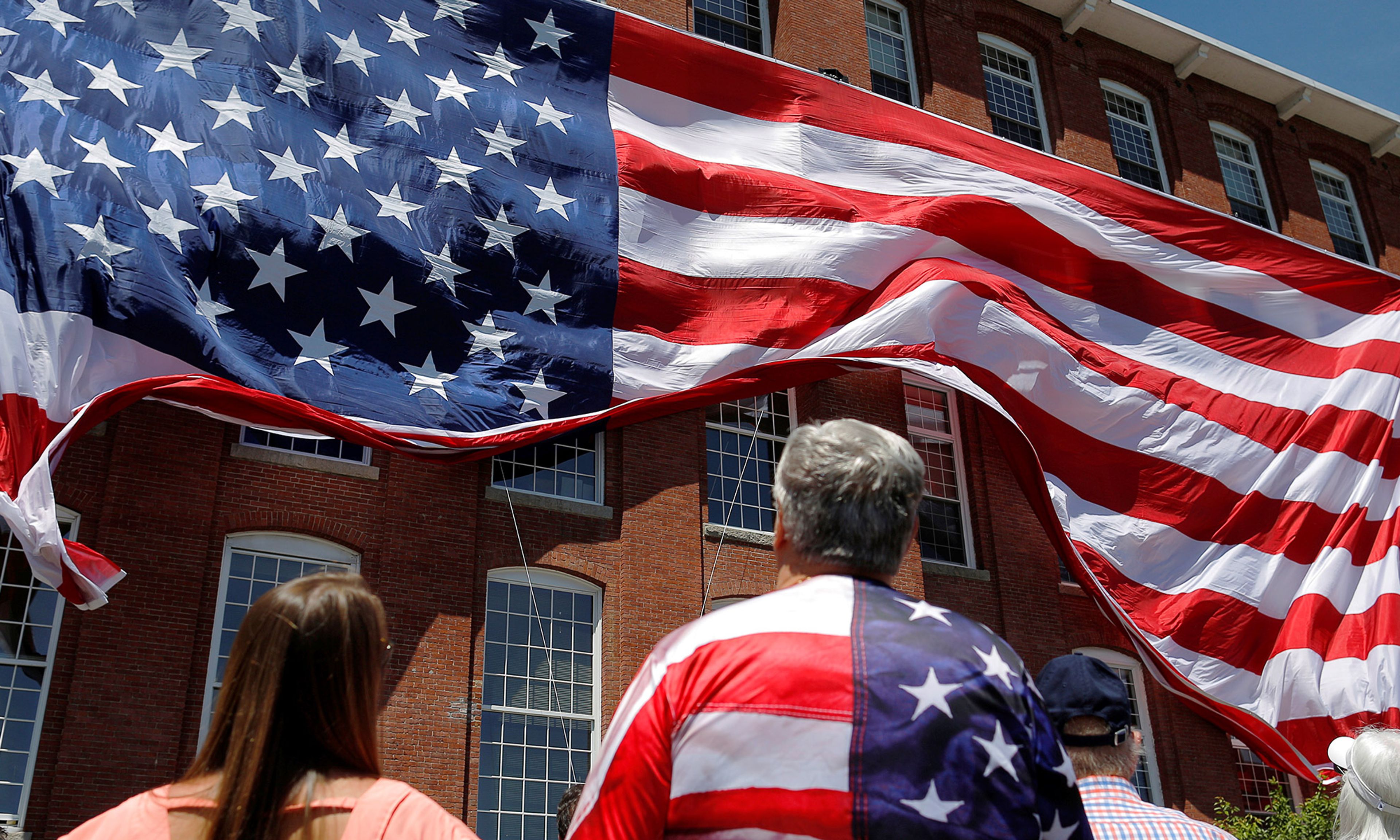
A People and Their Idea
Of the many fine essays in National Review’s 60th-anniversary issue (November 19, 2015), perhaps none rewards careful reading and reflection as much as John O’Sullivan’s “A People, Not Just an Idea.” So first and above all, I want to thank him.
As I read, I was struck by his statement that “an American identity rooted in cultural familiarity will be more genuinely liberal than one attached to the American idea” because “it allows someone to reject the dominant ethos of his society without losing his claim to be an American.” The question arises: What do we mean by “cultural familiarity”? (Surely nothing so trivial as the names of NFL teams.) The answer is suggested, perhaps, when Mr. O’Sullivan later says that “if Americans are a distinct people, with their own history, traditions, institutions, and common culture, then they can reasonably claim that immigrants should adapt to them and to their society rather than the reverse.” “Culture” appears alongside the terms I have italicized, but perhaps history, traditions, and institutions are better understood as constituents of culture.
Now our legal and political institutions certainly embody the liberal principles of the “American idea.” And basic familiarity with American history and traditions — which, as the essay makes clear, do not derive from a single ethnic group or religion and evolve over time — is a precondition for participation in those liberal institutions (and in the liberal American economy), for the simple reason that a separate people cannot readily take a place of equal standing in our civic and economic life. We might mention a common language, too.
So to my mind, the American idea and the American common culture are not competing ways of understanding American identity. Rather, the idea guides us toward a humane and reasonable understanding of which aspects of the culture should matter. Mr. O’Sullivan is surely right that, in the abstract, liberalism does not distinguish America from other liberal nations. But it has played — and plays still — a decisive role in preventing American cultural identity from becoming narrow and exclusionary. It has played that role to a unique degree in world history, and in a way of which Americans are uniquely conscious. And in that sense, I think it is true rather than paradoxical to say that America is not just a people, but also an idea.
Conrad Ensign Via e-mail
John O’Sullivan responds: I am grateful to Conrad Ensign for his kind remarks on my essay, and even our disagreements seem rooted in a common outlook. I see the American idea less as competing with cultural nationhood than as a useful but inadequate distillation of it — Cliff Notes to the Federalist Papers. It might keep America from being exclusionary, as he argues, but the concept of “Un-Americanness” shows how it can be used to exclude internally when separated from the rich culture of American liberty. For instance, how does the American idea cope with the native American Marxist? He denies the American idea but he can’t be denied entry to American institutions? At least in principle the idea insinuates disloyalty but offers no solution to it. A broader cultural concept holds that an American is likely to be a less consistent Marxist in practice than someone brought up in a despotic culture. (Orwell pointed out that radical critics of English liberalism would sometimes slip and declare in outraged tones that some measure or other was a betrayal of the high standards of British liberty.) And, finally, the American idea offers little or no reply to multiculturalism even though the danger that a separate people might “readily take a place of equal standing in our civic and economic life” is no longer entirely theoretical.












Comments