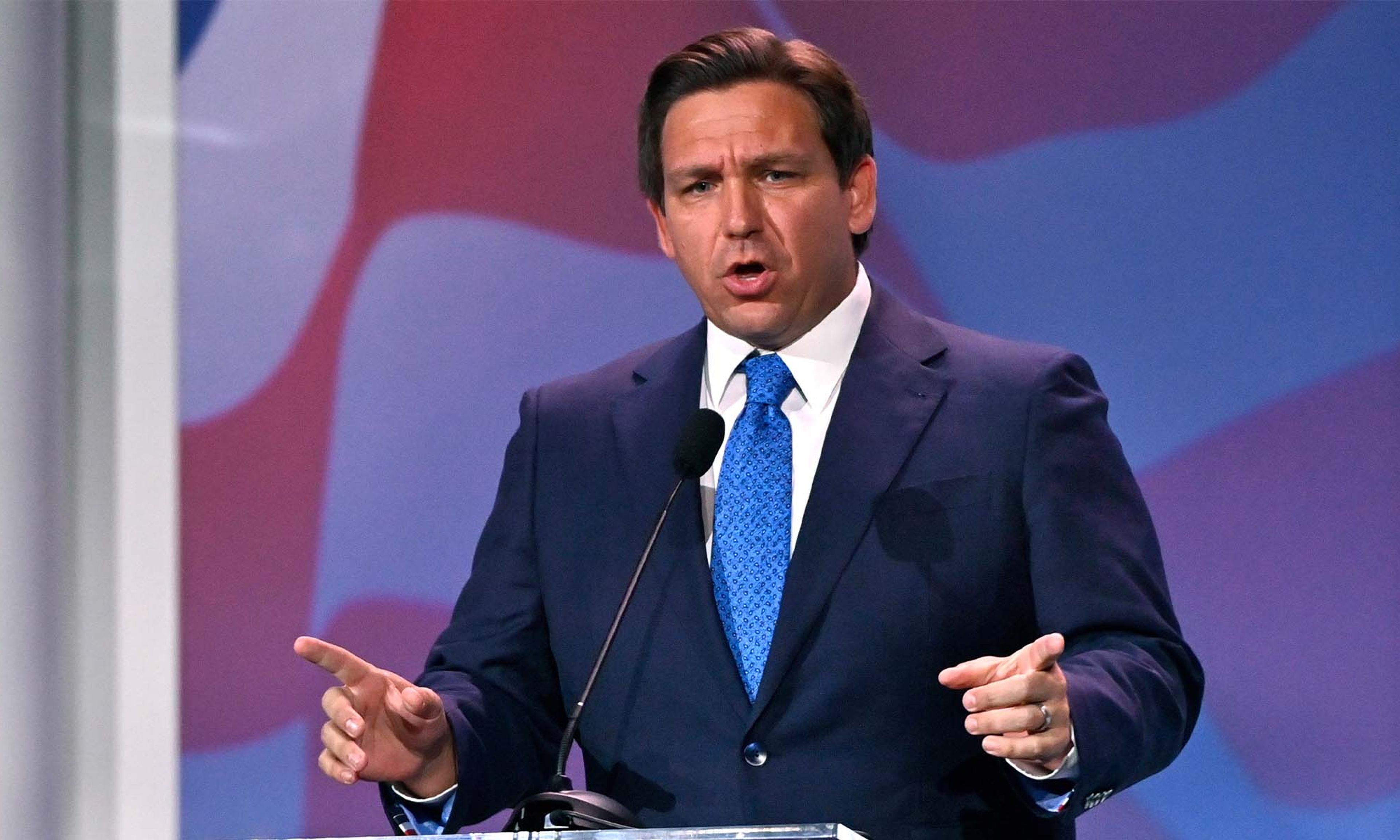
Not since George W. Bush in 1999 has a sitting governor contemplating a run for president attracted as much national buzz as Florida’s Ron DeSantis. Because state chief executives have only modest occasion to engage with matters of foreign policy and national security, it’s natural to speculate about where a governor who may seek to become commander in chief stands on the great foreign-policy questions of the day. Bush chose a foreign-policy profile by association with his father and his father’s advisers. Ronald Reagan carved out his own anti-communist identity on foreign affairs, much of it before and after his tenure in Sacramento. Other governors, such as Jimmy Carter and Bill Clinton, entered their first presidential races with more of a blank slate, as did Mitt Romney in his.
DeSantis is a distinct case in two ways. First, having been a military lawyer in the Navy in Iraq as well as at Guantánamo Bay, he would be the first president since the end of the Cold War to have served in a theater of combat. If he appeals to enough American voters, unlike warriors Bob Dole, John Kerry, and John McCain, he would bring the perspective of a man who has seen war and our enemies up close. That especially informs his unyielding view of Iran. As he explained at a 2017 press conference urging the Trump administration not to abandon America’s Kurdish allies in their battle with Qasem Soleimani and the Quds Force: “For anyone who served over there, that’s a seminal experience in your life. But if there’s one thing I took away from that experience just in terms of understanding the region, it was how nefarious an influence that Iran had in Iraq during the time that we had a lot of troops there.”
Second, DeSantis served three terms in the U.S. House, between 2012 and 2018, before running for governor. He could be the first governor nominated since Franklin D. Roosevelt (who had been assistant secretary of the Navy) to have previously served in federal office. In the century between Martin Van Buren and FDR, three governors who had previously served in the House ran for president, two of them successfully: James M. Cox, William McKinley, and Rutherford B. Hayes, all of them from Ohio. In that earlier age, none made much of a mark on foreign policy in the House. McKinley’s record as a proponent of tariffs offered no sign that as president he would go to war with Spain, nor did Hayes’s tenure in Congress presage his role as the arbiter of the borders in South America. DeSantis served in Congress in an era of more active American engagement abroad.
As a House tenure can only tell you so much, there is another pitfall in assessing prospective candidates based on their records. Unlike social issues, on which permanent principles are expected to yield permanent positions, foreign and national-security policy are situational. The true first principle is triage. Policy-makers must always ask which threats are the largest and which are the most imminent. They must analyze which problems can be solved, which must be managed, and which are intractable. The best thinking about foreign and security policy does not eschew all ideological commitments but filters them through triage assessment in a constantly changing world.
Apparent inconsistencies thus often reflect applying the same thinking to different situations. Pat Buchanan, a ferocious critic of American interventions abroad, was nonetheless a fierce Cold Warrior because of his diagnosis of the threat of Soviet communism. George W. Bush, who ran against purely humanitarian uses of the military for nation-building in Somalia and Haiti, was an ardent nation-builder in the aftermath of overthrowing the governments of Afghanistan and Iraq, steps he initially took on the grounds of the threats those regimes posed.
In the present moment, Republican views on national security are at something of a crossroads. After Joe Biden’s surrender of Afghanistan, the great post-Iraq debate over military deployments to the greater Middle East has receded for now, but that and other debates are still simmering below the surface.
On some matters there is still broad consensus among many different factions within the party. On China, for example, there is much agreement on its responsibility for the Covid pandemic, on the importance of deterring an invasion of Taiwan, and on the need to confront Chinese influence outside of Asia, particularly its trade leverage, information warfare, and economic espionage in the United States. In the greater Middle East, there is consensus on the folly of negotiating with Iran, and there are broad majorities in favor of backing Israel. To our south, most Republicans agree on the dangers of an insecure southern border, the ominous rise in fentanyl trafficking, and the malign nature of the regimes in Cuba and Venezuela. More generally, Republican voters and politicians agree on the intersection of U.S. energy independence with American freedom of action, especially in how we relate to Russia and Saudi Arabia, and on the insanity of subordinating security interests to chimerical climate treaties. There is also little real daylight among Republican approaches to North Korea.
DeSantis, much as he has done in the realm of domestic policy, has long staked out popular positions in line with the consensus on every one of these issues, placing himself in the mainstream of conservative thought. He has been a loud supporter of Israel, sponsoring a bill in Congress to recognize Jerusalem as its capital. He is a persistent critic of Iran and of the Obama administration’s Iran deal and the Biden administration’s attempt to revive it; he vigorously supported the Trump administration’s killing of Soleimani and has accused Biden of playing “footsie with the ayatollah.” He met in December with the ambassadors from Israel and the United Arab Emirates to signal his support for the Abraham Accords, a centerpiece of the Trump-era regional alignment against Iran. He has, unsurprisingly for a Florida Republican, taken a hard line against Cuba, Venezuela, Nicaragua, and Marxist influence in general in Latin America, while cultivating relationships with more conservative politicians in the region.
Which consensus positions DeSantis places his emphasis on bears watching. One has been information warfare and trade with China. He has led Florida’s government to limit access to TikTok, beginning with a 2022 executive order, and other services that use Chinese technology and can be Trojan horses for Chinese spyware, and to reduce the state’s commercial ties with China. DeSantis’s chief financial officer has branded TikTok as “digital fentanyl,” and the governor has taken steps to expel Confucius Institutes from Florida university campuses, limit Chinese purchases of strategic land, and protect against intellectual-property theft. In an executive order, he listed seven “countries of concern” to Florida: China, Cuba, Russia, Iran, North Korea, Syria, and Venezuela. The centrality of the pandemic to DeSantis’s first term as governor has strengthened his profile as a China critic. This also dovetails with his critique of China-linked American tech companies such as Apple.
Another DeSantis theme is the national-security implications of energy production, to which he has returned again and again in discussing American vulnerabilities. This is consistent with his view that a global, interconnected economic order has left us compromised in standing up for our interests. That, in turn, is in line with the broader DeSantis worldview in domestic policy: that conservatives need to exercise more power to reclaim their independence from woke corporations, left-wing educators, and the public-health establishment — even if it means picking a fight with a company that owns the whole center of your state. It always comes back to leverage and who has it over whom.
When Vladimir Putin invaded Ukraine, DeSantis branded the Russian leader an “authoritarian gas-station attendant,” blasted Europeans for buying energy that funds Putin’s regime, and argued that gaining independence from Russian oil and gas by boosting U.S. energy production would hit Putin where it hurts and weaken his grip on power by hitting the pocketbooks of Russian oligarchs.
DeSantis has likewise expressed optimism about the prospect for protests to topple the Iranian regime. But he is more cautious than the most aggressive neoconservative voices about the costs of overthrowing that or other foreign governments. He opposed Obama’s strikes on Syria, worrying that ending Bashar al-Assad’s rule might play into the hands of more radical Sunni forces, as had happened in Egypt and Libya. But he supported strikes in Syria by the Trump administration that raised no issue of regime change. DeSantis has avoided retrospective discussions of the wisdom of the Iraq and Afghanistan wars, but he criticized Biden for his botched withdrawal from Afghanistan.
On where he comes down in the big-ticket foreign-policy debates in Republican circles, DeSantis has shrewdly remained ambiguous enough to inspire hope from all sides. Unlike Donald Trump or other figures on the populist right such as Tucker Carlson (on whose show the governor is a frequent guest), DeSantis has not showered foreign authoritarians with praise or pandered to resentment of Ukraine and its leader. He has been sharply critical of Turkey; in 2017, after the Turkish leader’s security detail attacked protesters on U.S. soil, DeSantis issued a blunt statement “condemning Erdoğan’s goon squad” that concluded, “This is the land of the free and the home of the brave, not an Islamist tyranny.” His rhetorical line has been consistently anti-Putin and pro-Ukraine. Nevertheless he defended Elon Musk, who used his satellites to aid the Ukrainian war effort, when Ukrainian officials criticized him for a comment he made about the war. That drew a reaction from DeSantis in defense of a magnate who has expressed support for the governor: “Don’t bite the hand that feeds you — good Lord!” But he has been circumspect on topics such as the limits of U.S. aid to Ukraine, other than taking an uncontroversial stance against direct American military intervention.
In Congress, DeSantis was frequently allied with hawks such as Arkansas senator Tom Cotton and Florida senator Marco Rubio, co-authoring a 2015 op-ed with Cotton against the Iran deal. He backed military aid to Saudi Arabia in the war in Yemen when some other Republicans bailed and has generally supported a robust defense budget. As a former Guantánamo prosecutor, he criticized efforts to close the detention center. He supported and encouraged the more hawkish stances of the Trump administration on Iran and Syria. But he was also a co-founder of the House Freedom Caucus, which has been a locus of skepticism about defense spending and foreign aid. DeSantis may be more of a hardheaded realist than Rubio, Bush, or McCain on foreign interventions, but he plainly believes in the exercise of American power. He might best be understood as a likely continuation of the Trump administration’s national-security policy in practice but a sharp departure from Trump’s rhetoric and personal style.
There are big-picture decisions ahead. Should we use our limited resources to prioritize China and the Pacific Rim at the expense of supporting Ukraine, or is draining Russia a blow to the China–Russia–Iran axis that signals our seriousness of purpose? Can we afford to expand the Navy to keep pace with China? Should we use military force to defend Taiwan or prevent a nuclear Iran? Should Sweden, Finland, and maybe Ukraine be in NATO — or should Turkey be out? What lessons have we learned about foreign interventions from Afghanistan and Iraq?
On a great many of these questions, DeSantis plays his cards close to the vest. The Florida governor’s reticence will not cost him votes so long as he can be all things to all factions. In the short run that is possible, but it won’t last in the heat of a campaign, especially if Trump or some other candidate goes all-in against aid to Ukraine.
In the meantime, while advocates of favored policies maneuver for the ear of DeSantis, the rest of us can best size him up by his character and attitude. His decision to join the Navy at the height of the Bush-era wars gives him a background more in common with Republican hawks than with anti-interventionist populists. DeSantis can be as corny as Romney when he talks about America and its founding principles, but his approach to politics and domestic policy has been characterized by cynicism about the motives of others, an instinct for pressure points, and a gift for picking his battles and not dissipating his energies on things he cannot influence. Even his avoidance of the presidential fray so far suggests a man with strategic patience. And his mettle in dealing with the world’s roughest customers may be proven if he can navigate his way around the 800-pound gorilla of his own party and his own state. Today Mar-a-Lago, tomorrow the world.











Comments