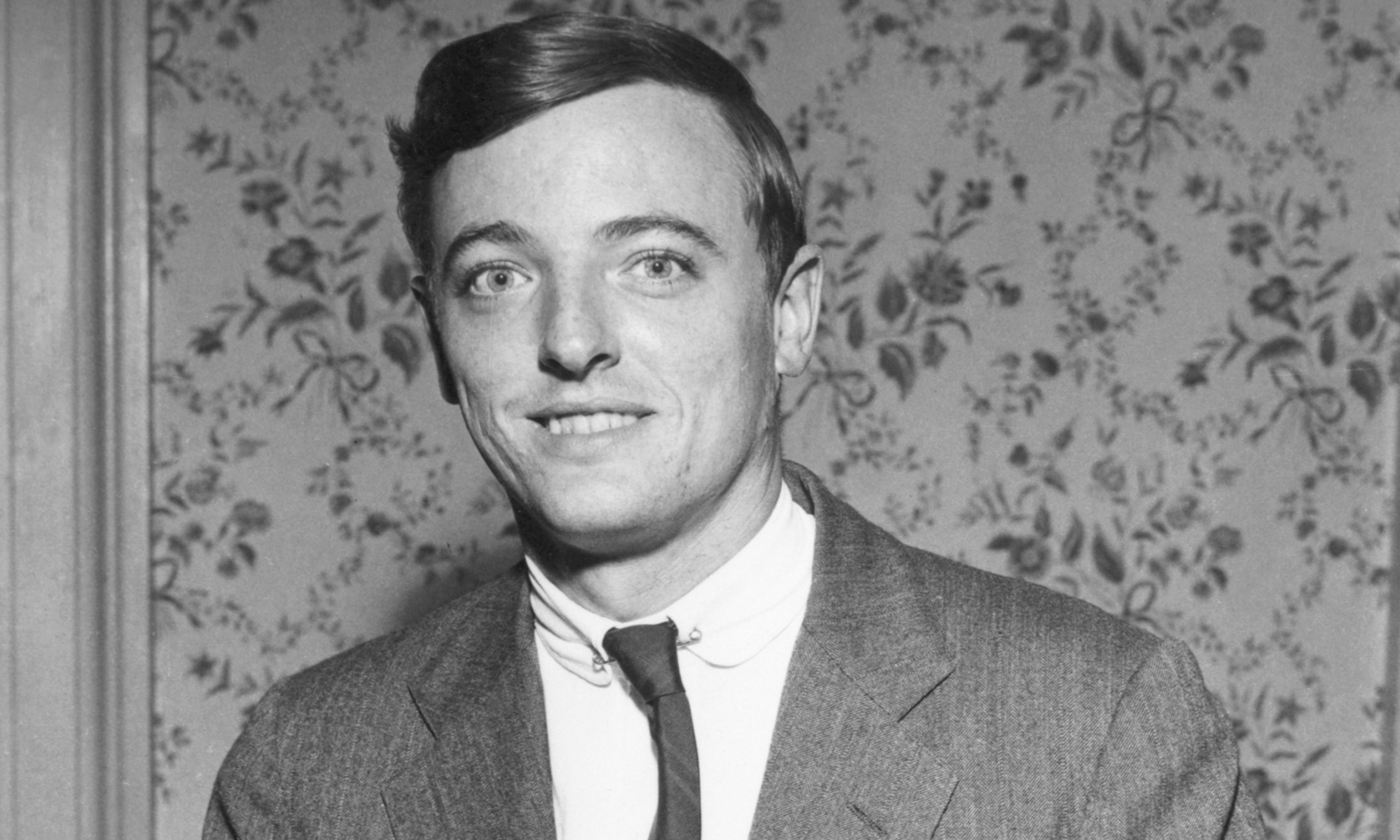
Sometimes, a book is the closest one ever gets to living a dream. William F. Buckley Jr.’s God and Man at Yale is that kind of book, to the point where it’s hard to read it without feeling a twinge of envy. Any conservative who has had the experience of being young, contrarian, and ensconced within a hostile academy has felt a yearning deep in his (or her) soul to do exactly what Buckley did with this wonderfully outrageous tract.
He went to Yale as a devout, conservative Catholic. There among America’s Best and Brightest, he found that his deep convictions and eager arguments were brushed aside with a lazy insouciance. His WASPish elders seemed to feel that he should be humbly grateful for their magnanimity in admitting him to their ranks; they didn’t want to be bothered with his Catholicism or small-government evangelism. He made the best of the situation by tweaking and tormenting them for a few years, and then graduated and wrote a book urging the Yale alumni to rise up and seize the old school back from the contemptible sophists who had commandeered her. It was published in 1951, just in time for the school’s 250th anniversary celebration. The Yale administration extended their generosity still further by being delightfully outraged and demanding that he withdraw the work.
It’s just too delicious. As an Ivy League alum myself, I could not help musing as I read: Is it sinful to enjoy a book this much? God and Man at Yale is the ultimate conservative-nerd revenge fantasy.
Buckley deserved the honor. I cannot really begrudge it. Even if he had not yet proved himself at age 24, he would richly demonstrate in later years that he was the rhetorical prankster the Right needed, able to lunge and parry without losing his charm or his integrity. Buckley had a mischievous spirit, and he gloried in controversy, but he never allowed the thrill of trolling to steal away his honor. It’s an interesting fact that God and Man at Yale, his first book, remains his most famous, though he was extremely prolific and appears to have gone on writing quite literally through the hour of his death. For some writers, that might look like evidence of undeveloped promise. For Buckley it seems fitting, a testament to the youthful energy that drew so many conservative luminaries to him and persuaded them that it could again be morning in America. This was his David moment, when he stood tall on the field of battle, savoring his strength and sense of mission.
That mission, however, was not to the academy. It was to the conservative movement. This is evident already in the pages of Buckley’s first book. He shows a great facility for drawing together and harmonizing different strands of right-wing thought. His Catholic traditionalism is on full display, and he almost sounds like an integralist occasionally in his defense of a very public Christianity, but this is seasoned by a sincere commitment to limited government (reflecting the influence of Albert Jay Nock) and a kind of populist majoritarianism (learned from Willmoore Kendall). Anti-communism is a prevalent theme throughout. The pieces of the new conservative movement were not fully in place yet, but the book might fairly be called proto-fusionist, and, as always, Buckley presents his synthesis in a way that stirs the blood, making a renewed defense of conservatism feel like an epic adventure.
In that particular case, it was an epic, quixotic adventure. There was no real chance that Buckley would make headway at Yale. He presumably knew this. Like his famously futile campaign to be mayor of New York City, the Promethean assault on his alma mater was surely undertaken with every expectation of failure.
Nevertheless, as one would expect, he applied himself to the task with great energy. His volleys rarely missed their mark. He had shrewd insights into the methods and motivations of Yale’s leading personalities, and the pompous figures he gleefully skewered surely have their modern-day counterparts. He was familiar with the casual insolence of left-leaning professors who knew they could get away with some cherry-picking, abusive labeling, and the occasional petty bullying. He saw how appeals to “academic freedom” could be raised or dropped at the convenience of the ideological majority. Today’s reader can chortle with recognition at Buckley’s description of the expertly sanitized alumni magazine, which regularly praises involved alums for their leadership and “critical appreciation of the educational aspects of Yale,” even though it is obvious that their wallets are the only thing of real interest. Buckley was ever attuned to the absurd and unsightly aspects of human nature.
On the other hand, God and Man at Yale never develops a systematic account of what a university is or should be. There are some sticky inconsistencies on this point, or at least unresolved tensions that he doesn’t quite acknowledge. Buckley insists at several points that he is not advancing a normative view of what Yale ought to be but is merely trying to hold it accountable to the wishes of the parents and alums who are paying the bills. He is, in his own words, a champion of “the sovereignty of the customer.” That satisfies the young Buckley’s more libertarian commitments, but it also threatens to undercut his larger project, especially because he makes little effort to demonstrate that Yale’s parents and alumni share his normative views (though he certainly has those in plenty).
Buckley thinks that Christianity should play a robust role in a proper liberal arts education. He upbraids Yale’s economists for allowing mealymouthed Keynesian values to steal the stage from demonstrable economic truths. In an awkward attempt to preserve both a robust practice of soulcraft and the individual scholar’s freedom to pursue truth without hindrance, he ends up arguing that professors should be given broad intellectual freedom in their research while being held to a more rigid orthodoxy in their teaching.
There is a certain logic to this, as a method of connecting the different pieces of Buckley’s emerging conservatism, but there’s no real chance it would either satisfy university scholars or smooth the way for young conservatives on college campuses. In any event, these questions about truth, rationality, and orthodoxy threw the young Buckley into some deep waters that have been plumbed by mighty minds ever since the 13th-century Scholastics took them up at the University of Paris. It is slightly comical to watch him dip in a few toes, then return cheerfully to “the sovereignty of the customer,” as though the sins he documents against truth and justice would somehow be forgivable if Yale’s alumni base did turn out to include a sizable number of atheists, Keynesians, or communists.
These are quibbles, however. No reasonable person expects a 24-year-old to replicate Saint John Henry Newman’s The Idea of a University. Buckley certainly knew what it was like to be a young conservative on a hostile campus, and with each page you can picture him wandering through the hallowed halls of Yale, like Socrates in the agora, sparring gleefully with anyone willing to match wits with him. Buckley may not have been the man to reform the university, but his book exudes a spirit that conservatives should try to embrace more fully, in the academy and elsewhere. Even at his most playful, he draws confidence from deeper sources of meaning. One thinks again of the young David, witnessing Goliath for the first time. All around him his compatriots are cowering in fear, but he is brimming over with righteous indignation. “Who is this uncircumcised Philistine,” he demands, “that he should defy the armies of the living God?”
Buckley was not really the only champion willing to take the field on behalf of Western civilization, of course. There were a number of doughty traditionalists in roughly this same period, working to establish themselves in a largely unwelcoming academy. We might think of the Inklings at Oxford, Elizabeth Anscombe at Cambridge, or Robert Maynard Hutchins at the University of Chicago. It’s interesting that Buckley doesn’t discuss them. In fact, he doesn’t seem fully aware that conservative marginalization in universities is a common or regularly recurring phenomenon. The premise of God and Man at Yale treats this as a startling aberration that the alumni (if they knew!) would surely be anxious to correct. What optimism!
Buckley may not really have believed that the Yalies were firmly in his camp, but there is a larger picture here that he seems not to have fully grasped. There are reasons why conservatives so regularly struggle to carve out a place for themselves in the universities. Intellectuals have restless minds. For the kind of person who yearns to explore strange new scholarly worlds, it’s easiest and most appealing to try to boldly go where others have not. Intellectual demolition is relatively easy; the careful, painstaking work of reinterpreting old truths for new ages is considerably more difficult. It might seem odd to suggest that scholarly subcultures have a natural bent toward heresy and perversion, given that the modern university has deep roots in medieval institutions that were explicitly religious. But the inhabitants of those institutions were themselves very aware of this tendency. This is precisely why questions about orthodoxy, intellectual freedom, and the proper formation of the intellect were debated in the medieval university with such vigor. The pursuit of truth is very important, but important endeavors carry risks.
Medieval universities were also embedded within overwhelmingly Christian societies. American culture has significant traditional influences too, but if Yale was godless in 1951, it’s only realistic to expect that conservative intellectuals have a lot of uphill battles still ahead of them. That’s no cause for despair, though. Sometimes uphill battles can be won. Time and again traditionalists in the academy have surprised their contemporaries with their resilience, courage, and nimbleness, and every time this happens, a new crop of young conservatives seems to rise out of the grass to carry the movement beyond the confines of the campus. Traditionalists are hard to suppress permanently, because their roots run so deep. Progressives, in their shallowness, find this hard to comprehend.
But Buckley understood it. He knew, too, that the struggle for truth is likeliest to succeed when it is undertaken in a heroic spirit, without apology and without fear. God and Man at Yale depicts a young man setting out to win back his school for God, democracy, and free markets, armed with nothing but a typewriter. He lived the dream. Today’s conservatives can continue the work.












Comments