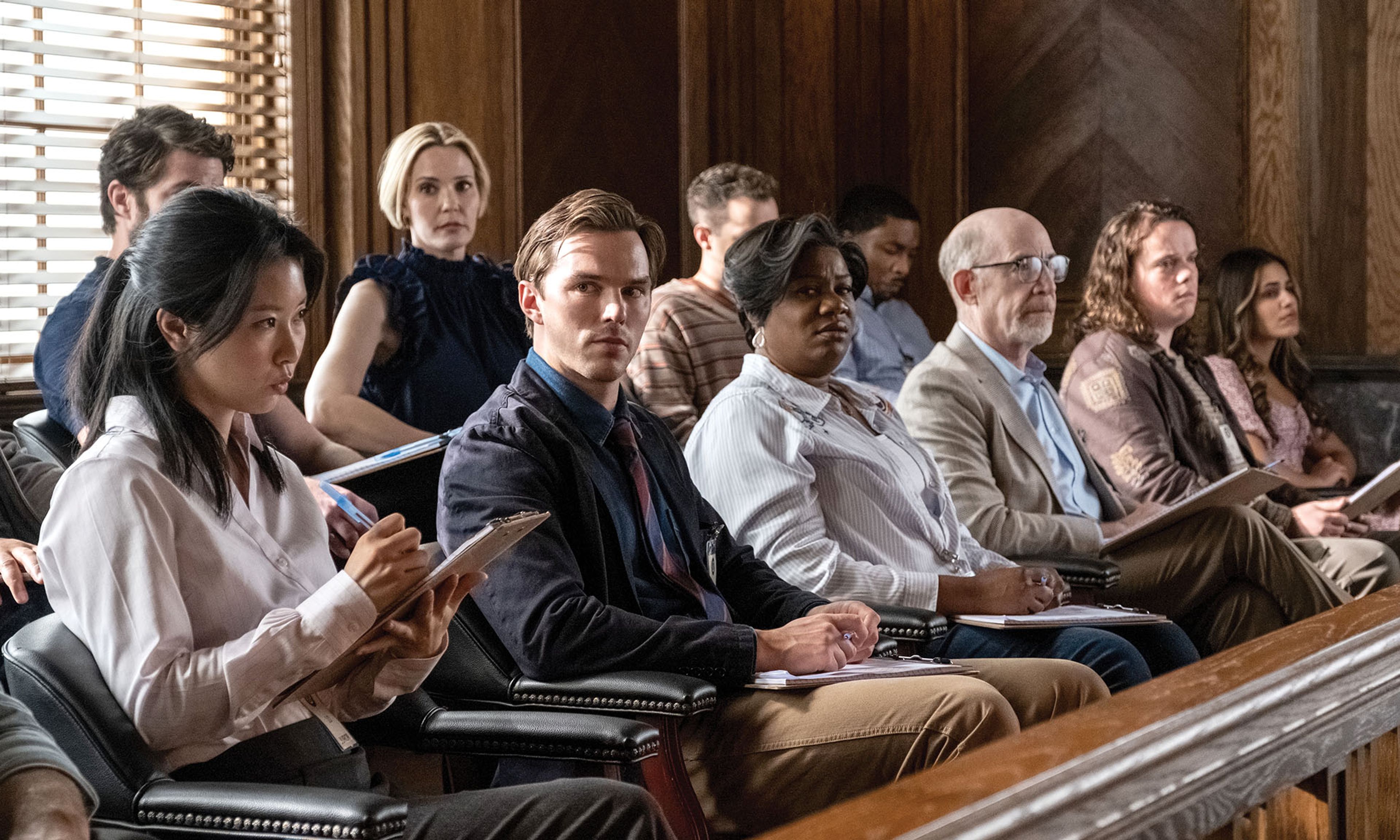
In the old days, when a movie didn’t get much of a theatrical release and there was a groundswell of critical support to boost its fortunes, you could usually rely on the movie in question being arty, or difficult, or outside the Hollywood mainstream in some way. Nowadays the same thing happens and the dogged little movie unjustly denied its place turns out to be . . . a legal thriller directed by Clint Eastwood with a notable cast and a neat initial premise, and by the way it might even be Eastwood’s final film.
Strange times, these, when Warner Bros. barely promotes Eastwood’s Juror No. 2 and delivers it to streaming after an extremely limited release, and then the critics start talking about the movie as if it’s Anatomy of a Murder or at the very least the equivalent of a good John Grisham adaptation.
So I saw it, hoping for a dose of pleasure at the end of another long year of middling sequels and boring branded properties, and maybe a dose of optimism as well. Maybe Hollywood (well, or at least its most ancient director) still knows how to make a gripping grown-up drama; maybe the studios have just forgotten how to market that kind of movie.
And there is something pleasurable about Juror No. 2. It has a novel conceit that could belong to a forgotten Hitchcock movie: An everyman type is called for jury duty, is selected for service, and realizes, early in the murder trial, that he himself might actually be the killer. The everyman is Justin (Nicholas Hoult), a magazine writer and soon-to-be father of a child with the pregnant Allison (Zoey Deutch). He has an alcoholic past that includes a couple of DUI convictions, and he almost fell off the wagon the prior year: After Allison miscarried twins, he went to a bar and sat staring at a drink, before gathering his strength and driving home sober through the pouring rain, clipping a deer along the way —
Except maybe it wasn’t a deer. Maybe it was a woman, a drunk woman who fled a bar fight with her boyfriend and ended up dead on the rocks of a stream below a busy road, and whose boyfriend (Gabriel Basso) now stands accused of clubbing her to death. Which makes Justin the juror the only person who knows that the accused might well be innocent — but he also knows that if he comes forward there’s a good chance he’ll end up in prison, ravaging not only his own life but the life of his wife and his newborn child.
This realization comes amid the familiar architecture of the courtroom drama — the politically ambitious lady prosecutor (Toni Collette), the rumpled, disillusioned, still-idealistic defense attorney (Chris Messina), and then a jury that’s a festival of familiar and semi-familiar character actors, from J. K. Simmons as a retired cop to Leslie Bibb as the harried forewoman to Cedric Yarbrough as the determined lock-him-up vote who becomes Justin’s chief obstacle in his bid to subtly engineer an acquittal.
That engineering effort creates a miniature version of Twelve Angry Men inside the larger story, with Justin trying to instill a sense of reasonable doubt in peers who think the case is open and shut, without even hinting at the real reason that he himself doubts the accused’s guilt. It’s a balancing act that fails, inevitably, with some of the jurors and then even the prosecutor becoming interested in a hit-and-run scenario that creeps uncomfortably close to what Justin fears he really did.
It’s an enjoyable story, all told — but I still ended up with some sympathy for the studio executives who decided it was more of a streaming than a big-screen experience. First, because it looks like it belongs on the small screen: Eastwood has always been famous for his quick, no-nonsense shooting style, but here the cinematography is especially pro forma, with bland interiors and banal compositions better suited to what we used to call a TV movie of the week.
Second, because the script never finds a second-act twist or third-act turn to rival the cleverness of its initial premise. The plotting and writing are workmanlike; the legal action lacks the kind of riveting moments on the witness stand or in the jury room that you want from courtroom drama; a crucial shift that breaks a deadlock happens offstage without adequate explanation; and you keep waiting for a truly surprising revelation in the later action to match the spark that gets the story started.
Finally, because Hoult is not really a movie star. He’s a fine actor, perfectly serviceable, but this is a story that cries out for a leading man who can really sell a certain kind of male desperation — the everyman pushed to his limit, desperately improvising, sweating bullets yet somehow maintaining enough charisma to reassure his wife and sway a room of jurors. Hoult just looks a little pained, anxious, stressed. Maybe in such circumstances I would look the same, but a story like this needs something bigger and broader — the dose of hyperreality that justifies the scale of the movie theater, the performance that’s necessarily a little larger than ordinary life.












Comments