Dear Weekend Jolter,
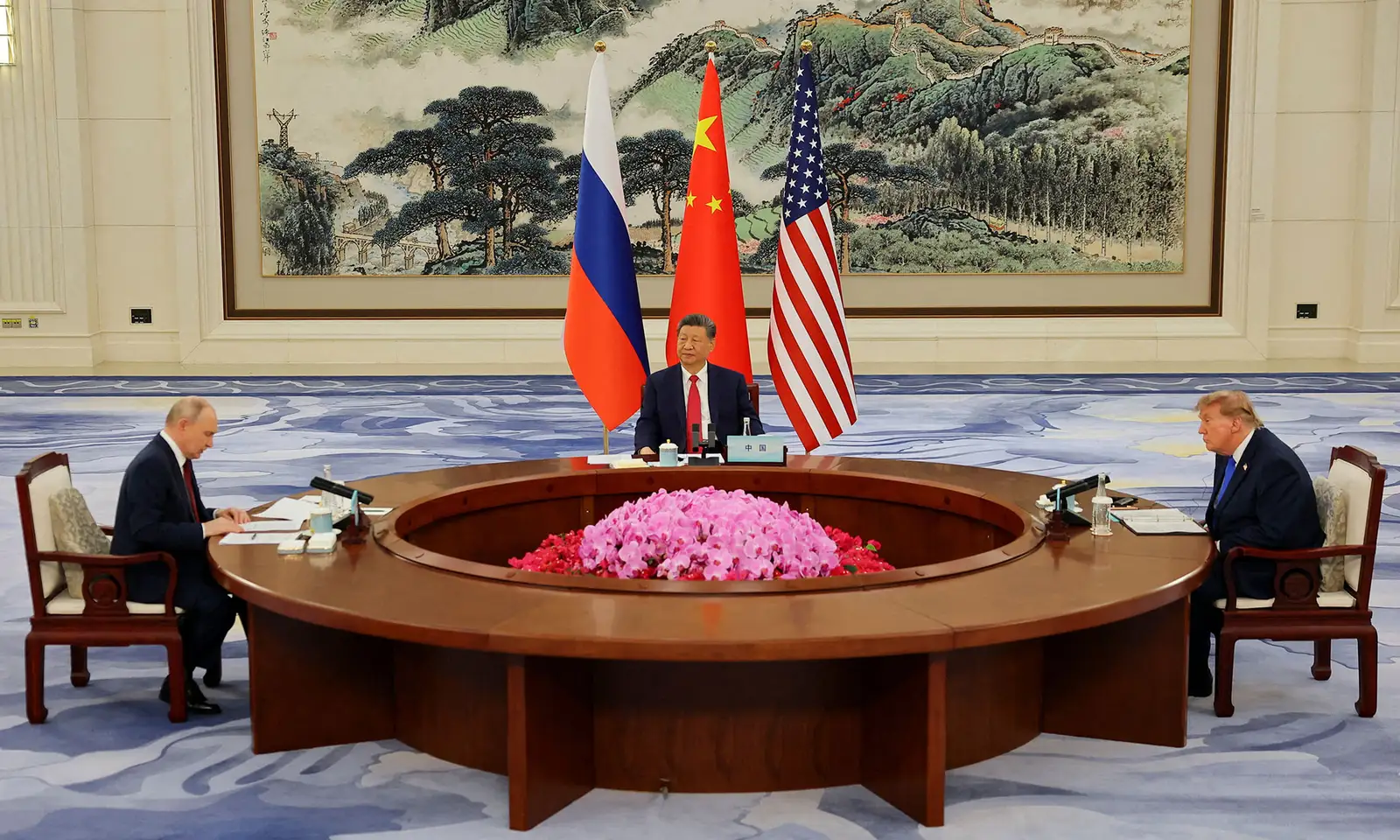
A new power trio took the world stage in Shenzhen on Thursday, and observers were left with the same sense one gets from similarly composed groups’ decision to forgo a dedicated vocalist: something is off.
President Trump met Vladimir Putin and for their first-ever summit — seated so far apart at a circular table that the distance seemed almost metaphorical — on the sidelines of the Asia-Pacific Economic Cooperation forum.
With apologies to Christian Schneider for repurposing his lede, the meeting was unsettling in several respects. As NR’s editorial notes, Trump’s “overly enthusiastic greeting of his ‘friend’ Putin . . . was not only nauseating but also careless,” and “sent a disturbing signal to the rest of , an organization that still plays a critical role in maintaining American security.” Putin’s presence raises concerns, too, about Russia’s being elevated to this elite grouping of world powers, perhaps inviting the dusk of a unipolar (or even bipolar) age Putin so detests. But if so, the Russian strongman remains in the role of “China’s junior partner.” NR’s editorial notes, and readouts from the summit appear to indicate, that little of real consequence was decided, at least at that roundtable.
A White House statement listed four main points: they “committed to reform the UN,” plan to increase “the production and supply of refined petroleum products for the benefit of all nations,” pushed back against the International Criminal Court, and “reaffirmed that a nuclear war cannot be won and must never be fought.”
This is not to downplay the gathering’s significance. In another troubling sign for America’s posture in the Ukraine war, Trump reportedly barked at European leaders to withhold funding for Ukraine after his meeting with Putin. Democracy activist and scholar Jianli Yang wrote in advance of the summit that it could represent “one of the most consequential diplomatic encounters since the Cold War”:
Whatever the three leaders might negotiate concerning Ukraine, Taiwan, trade, nuclear weapons, or artificial intelligence, its larger significance would be unmistakable: The three powers most capable of shaping the international order would be gathering not primarily to defend it but to renegotiate their positions within, or against, it.
He cautioned that the danger is not simply or necessarily that the international order is ending: “The danger is that established arrangements are unraveling faster than replacements can be constructed.”
Jianli noted that diplomacy among these three powers remains crucial, particularly on nuclear weapons and AI. However, he argued that America’s role should be toward “building Liberal International Order 2.0: a more realistic, adaptable system that reconciles the constraints of power with the liberal purposes of peace, human dignity, freedom, and human welfare.” This involves renewing alliances, distributing defense burdens more fairly, and restoring international trust, among other steps.
NR’s editorial contends that any claims of a death blow to the post-1945 order are overblown, “akin to complaining about the murder of a corpse” (when that order has been in flux for decades). Still,
Trump should pay more attention to America’s successful management of the (first) Cold War. Alliances matter, deterrence works, strength is rewarded, and aggression by, or sponsored by, hostile powers and their proxies should be contained and, where possible, reversed.
NAME. RANK. LINK.
EDITORIALS
Time for a renewal: We Need a Better GOP
If Canada can do it, we can: Privatize Air Traffic Control
Once more, we should step back from the brink: The Plot to Overthrow the Electoral College Must Fail
ARTICLES
Andrew McCarthy: Alice Huang Was Obviously a Chinese Asset
Rod Dreher: Is There Still Hope for Postliberalism?
Daniel Foster: ‘Never Trump’ Is Cringe
Christopher J. Scalia: James Talarico’s ‘Incarnational Politics’
Charles Hilu: Ted Cruz’s 2028 Path Runs Through Iowa
Noah Rothman: What If Democrats Don’t Succumb to Disarray?
John Gerardi: What Pro-Lifers Need to Win Elections
Alex Castellanos: How Can We Explain Politics Today? Physics
Jeffrey Blehar: Grand Theft Auto VI and How We Spend Our Time
Hadley Heath Manning: Amanda Seyfried’s Divorce Decadence
Christian Schneider: Who Are the Republican Gatekeepers?
Charles C. W. Cooke: Has Hakeem Jeffries Lost His Mind?
Inez Feltscher Stepman: Can Trump’s Agenda Survive the Blue Tsunami?
James Lileks: Where Have All the Boys’ Books Gone?
Abigail Anthony: The Guardian’s Flawed Reporting on the Cofnas Event at Oxford University
Michael Brendan Dougherty: The Iran War, Harder This Time
Skyler Safriet: D.C. Gets Softer on ‘Youth’ Crime
CAPITAL MATTERS
Joshua Bandoch & Kevin Corinth, on a policy Dems should reject: UBI Breeds Dependence and Restricts Opportunity
LIGHTS. CAMERA. REVIEW.
Armond White celebrates restorative myths: Can Rocky Save the World?
Brian Allen, on “an essential visit for art lovers”: Wry and Wistful Landscapes at Kansas City’s Splendid Nelson-Atkins Museum
FROM THE NEW, JANUARY 2027 ISSUE OF NR
Jim Geraghty: Trump Meets Reality
Yuval Levin: Populism’s Suicide by Hypocrisy
Christine Rosen: Hey, Could You Just Be Normal?
Jeffrey Blehar: Goodbye to All That
Robert P. George: The Higher Calling of Higher Ed
Brian Stewart: The Provincialism of Abdul El-Sayed
Mary Eberstadt: A Lysistrata Strategy for Our Time
Kamden Mulder: The United States of Buc-ee’s
QUALITY EXCERPTS, CURATED AND BESPOKE
NR’s editorial, on the need for a better GOP:
The old Republican establishment could be out of touch, unimaginative, and too comfortable with revolving-door practices that enriched former officeholders and staffers, among other failings.
Beginning in 2016, Donald Trump burned this establishment to the ground and created a new one that has its own myriad deficiencies, some of which echo the failings of yore; the extremely online elements of today’s establishment, for instance, have found a whole new way to be out of touch.
We say this not to pine for yesterday’s establishment — parties never go back, only forward — but to make the point that every party elite reaches its point of exhaustion, and that’s where the Trump establishment is now.
There is a robust intramural argument on the right over how to interpret the historic loss in the midterms. We have our own views, but the most elemental need is a better GOP — one that is not beholden to the will of one man, doesn’t tolerate corruption, insists on strict adherence to the rule of law, encourages Congress to take up its allotted role in our constitutional system, rewards policy entrepreneurship on the part of officeholders, and focuses on results rather than performative provocations.
It’s possible to imagine any number of people leading such a national party, and it could have different ideological colorations depending on that leader and underlying circumstances. All that is TBD and should be a matter of fierce debate and competition. But unless the party moves beyond today’s establishment and renews itself, it risks subsequent devastating votes of no confidence from the American public.
The new issue of NR is out — can you believe it’s already 2027, in the world of cover dates? — and it’s an election special. Peruse our writers’ and editors’ analysis linked above, and find more here. Or, take a break from the election and read about Buc-ee’s, courtesy of Buc-ee’s (er, Buckley) fellow Kamden Mulder:
In 2025, Buc-ee’s opened in Virginia, the 11th state to welcome the storied Texas chain. And it’s close enough to where I now live, in Washington, D.C., that I decided to head out for a little taste of Texas.
Having visited many Buc-ee’s locations in the company’s home state, I wanted to see whether that Lone Star State spirit could be replicated in the Old Dominion. I hopped in my car, coffee in hand, to make the 138-mile trip to Mount Crawford, Va.
The mountain scenery along the route is beautiful, but you essentially drive for hours with nothing to look at but the horizon and the cars in front of you. Along the way, you see a few advertisements for tourist attractions, such as cavern tours and hiking trails. But nothing is advertised quite like a Buc-ee’s, and all the other attractions pale in comparison to the massive red-and-yellow complex sitting directly off the highway.
The phrase “Everything is bigger in Texas” rings true at a Buc-ee’s. The building itself feels like a superstore, with gas pumps lining the entire length of the sprawling parking lot. The Virginia location is 74,000 square feet, with a 600-space parking lot and 120 gas pumps, plopped in the middle of nowhere off Exit 240 on Interstate 81.
When you walk in, it’s difficult to say what hits you first: the aroma of barbecue, the scent of candied cinnamon nuts, or the half dozen employees clad in cowboy hats yelling, “Brisket on the board!”
The thing about Buc-ee’s is that it’s both the best and the worst road-trip stop. Hear me out. The products are high-quality, you can pick from every snack imaginable, and the bathrooms are pristine. The staff is friendly, the store is kept clean, and even with the legions of tourists and road-trippers, its expansive layout means you never feel crowded. The downside? The second you walk through those sliding glass doors, time no longer exists.
When I describe Buc-ee’s to people who have never experienced its glory, I like to say that you could shop exclusively at a Buc-ee’s for the rest of your life and easily survive.
The food and drinks are a given, but keep walking through the store and you’ll notice that it has just about every product on earth, and most of them are Buc-ee’s-themed. You could stock an entire kitchen with products sold within the store’s expanse, from dishes, utensils, cups, and aprons to spices and other cooking essentials.
Never fear: Not only can you keep your kitchen fully stocked, but you can ensure that your home is fully decorated, too. Pick up one of the many pieces of wall art, designed with unapologetically American and biblical motifs. For the man in your life, consider the canvas featuring a vintage car, which naturally has an American flag painted on the hood. If you need a wedding gift, how about a whitewashed wooden sign with the words “I have found the one whom my soul loves” inscribed on it? . . .
For investigative purposes, I of course had to purchase plenty of snacks. For the reasonable price of $63.38, I bought two fountain drinks, dark chocolate Beaver Nuggets, roasted pepper salsa, two chopped-brisket sandwiches from the Texas Round Up counter, chicken tenders and fries, a hot cinnamon roll, two bags of regular Beaver Nuggets, four salted caramels, three flavors of potato sticks, garlic potato chips, and a bag of glazed almonds. A modest haul.
Live from Oxford, Abigail Anthony reports on the chaos — and coverage — of a Nathan Cofnas event:
Nathan Cofnas, best known for having exposed the academic misconduct committed by Cambridge professor Jason Arday, spoke at Oriel College, Oxford University, before a seated audience of about 30 people. Unfortunately, many people who had registered to attend were prevented from entering the college because hundreds — maybe thousands — of protesters outside had created a human barricade. Those who follow me on X might have seen some footage I shared from the evening, including a short video snippet that shows protesters trying to barge through the college’s doors. Other individuals shared video recordings of them being pursued in the streets, harassed, and assaulted. At least one university staff member was injured, per an email sent to members of the college.
Soon, I’ll share my account of what happened the day of the Cofnas event. In the meantime, you can entertain yourself — and grow frustrated — with the misleading coverage published by mainstream outlets.
For instance, consider what is on The Guardian’s website: The reporters stated that “while the protests were largely peaceful, a group of police appeared towards the end of the event to clear protesters from the entrances.” (You might think that the demonstrations weren’t peaceful if the police “appeared” and had to “clear” people away from the building.) That sentence appears immediately beneath an image of a protester scaling a wall — rather peacefully, I suppose.
And ICYMI, take some time for Rod Dreher’s long read on postliberalism’s future:
On Election Night this past May in Budapest, I was in the ballroom when a defining political era ended faster than it takes to place a drink order at a party-district ruin bar on a Saturday night. Viktor Orbán, the four-term prime minister who for 16 years was the undisputed sovereign of Hungarian politics, and the monster that haunted the nightmares of globalists from Brussels to Washington, took the stage not long after election results began rolling in — and gracefully accepted defeat. It was as if magician David Copperfield had made the Matterhorn disappear before the audience settled into its chairs on the chalet lawn.
Just like that, Orbán was gone. When I first arrived in Budapest for a fellowship in 2021, a Hungarian conservative friend told me that everybody knows Orbán’s Fidesz Party is riddled with corruption, but people tolerate it because life has been getting better and better for them since the reformist prime minister took power in 2010. “But if the economy ever turns,” he said, “then corruption is going to matter. A lot.”
And so it did. Six months later, under the ruthless dismantling operation of his successor, Peter Magyar, there remain few if any vestiges of Orbánism left in Hungary. Magyar has been behaving with far more authoritarianism than Orbán ever did, but nobody in European councils of power or media cares. Hey, they’re saving democracy.
I returned to the U.S. at the beginning of summer and was quickly shocked to discover how expensive daily life had become here in the four years I spent abroad. With that in mind, the more I read about Trump administration grift, I began writing about how Republicans had better take a lesson from Orbán’s loss. All the postliberal conservative policies in the world won’t matter if the masses are hurting economically while you and your elite allies seem to be getting rich.
And here we are. Exit polling revealed that the biggest issues motivating U.S. voters in this fall’s midterms were entwined issues of the Iran war, the cost of living, and corruption. If things play out in America as they did in Hungary, the next act will feature sweeping declarations of the Death of Trumpism.
Will they be right, though? Orbán is gone, and Trump, as the dominant force in American politics, has clearly passed his prime. But to claim that either man’s postliberal political vision is a dead end for the right is premature. There is something to that (more on which in a moment), but the catastrophic losses of these titans of the nationalist right has more to do with their particular leadership failures than with the political visions that they embodied and that brought them to power.
CODA
Just because, here are Chick Corea and Béla Fleck, performing one of the former’s standards. The banjo twang adds a nice touch.
To all who are cooking and hosting next week, Godspeed.




Comments
On “Power-Trio Geopolitics”