• If the drones were aliens, why would they have picked New Jersey?
“We are all worms,” said Winston Churchill, “but I do believe that I am a glow worm.” Let no one doubt that William F. Buckley Jr. belonged to the same species. Born in New York City on November 24, 1925, Buckley became by his mid twenties what people then still called a “public intellectual.” In a career that spanned seven decades, he wrote books and columns, hosted a talk show, founded a movement and associated institutions (including notably this magazine), ran for mayor, improved the politics and governance of his country — and still found time to play the harpsichord. To those around him, he was joie de vivre personified. In this issue, we commemorate the centennial of the great man’s birth. May he continue to serve as an object of the gratitude he exemplified and commended in life.
The Editors
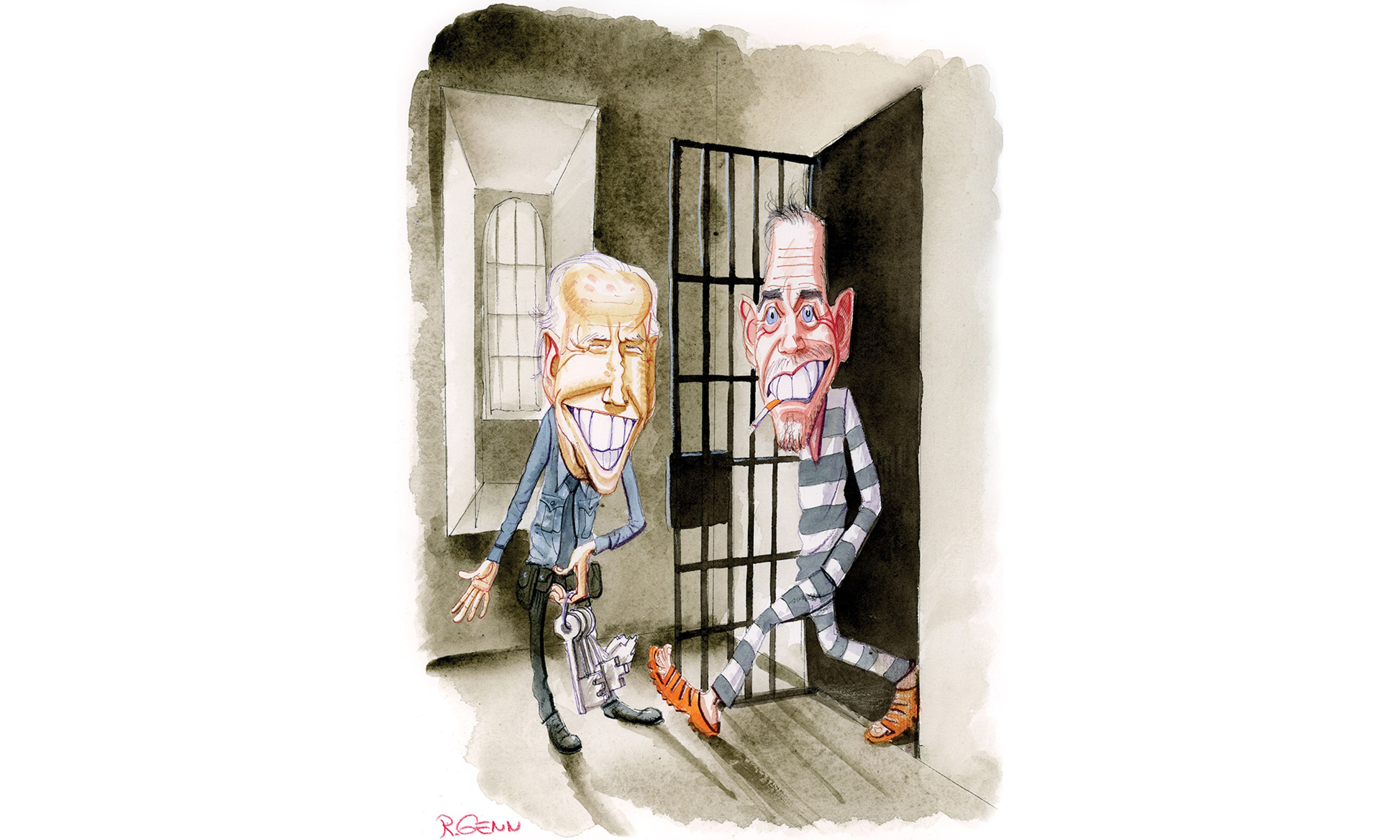
• President Biden pardoned his son just days prior to sentencing for his convictions for gun and tax felonies — notwithstanding the president’s indignant insistence for much of the year that there would be no clemency. Biden’s anguished claims of a recent change of heart owing to fatherly love for a troubled (54-year-old) child were precious. Hunter’s legal strategy — refusing to admit guilt in the face of overwhelming evidence, leading to guilty verdicts (by trial, and then by plea) on all gun counts, with no effort to negotiate a better deal — shows that he knew all along he would be pardoned. If paternal bonds had been Biden’s motivation, he would have pardoned Hunter two years ago, sparing his son anxiety, indictments, and official findings of guilt. The obvious truth is that the campaign calendar influenced Biden. He knew that a preelection pardon would wound his own and, ultimately, Kamala Harris’s election chances. The broad terms of the pardon also conveniently foreclose any investigation of the Biden family influence-peddling business — a business with the president at its center. Most fathers love their children. It’s the rare one who makes tens of millions of dollars corruptly with them.
• Democrats tried mightily to destroy Donald Trump’s presidential campaign — to say nothing of trying to imprison and bankrupt him — in a coordinated lawfare campaign. But they failed (in part thanks to the Supreme Court’s immunity ruling). Now Trump’s appointees will wield the prosecutorial powers that Democrats deployed against him. Hence the Biden White House is considering “preemptive pardons” for officials who pursued Trump. That would be foolish. Even if one believes that these officials abused their powers, the same immunity principles that saved Trump would shield his pursuers from prosecution (and the House January 6 committee is covered by constitutional immunity for legislative acts). No pardons are needed when no crimes have been committed, but the precedent of a preemptive pardon would encourage every administration (including Trump’s) to engage in years of lawlessness knowing there would be pardons at the end. Clemency, moreover, would not insulate officials from the expense and stigma of being investigated. It’s a bad idea . . . though we would be unsurprised if Biden’s term ends with such an act of corrosive cynicism.
• The man who allegedly murdered Brian Thompson, the CEO of UnitedHealthcare, in midtown Manhattan was arrested in a McDonald’s in Altoona, Pa., after an intensive manhunt, having been spotted by a local who was in for his morning coffee. On his person, the suspect had multiple fake IDs, a handgun with a suppressor, and a short manifesto in which he railed against the health insurance industry. Responding to the news, Senator Elizabeth Warren (D., Mass.) spoke for the crazy faction within American politics by insisting that “violence is never the answer, but people can only be pushed so far.” Representative Alexandria Ocasio-Cortez (D., N.Y.) and Senator Chris Murphy (D., Conn.) spoke similarly. Speaking for everyone else, Senator John Fetterman (D., Pa.) observed that the killer was “the asshole that’s going to die in prison,” that social media are a “sewer,” that the legacy media had been irresponsible in their coverage, and that the victim had “two children that are going to grow up without their father.” “If you’ve gunned someone down that you don’t happen to agree with their views or the business that they’re in, hey, you know, I’m next, they’re next, he’s next, she’s next,” Fetterman said. However smart or insightful someone might believe himself to be, he has no license to opt out of the social contract and begin murdering those who he believes are beyond the pale.
• The good old American jury system, a quarter of a millennium after the Revolution, continues to serve as the best means known to man of administering justice. Last year, a man named Daniel Penny intervened on a subway train in New York City after a passenger who had been behaving erratically threatened to kill people. In the ensuing fight, the offender died — which, disgracefully, prompted Manhattan’s errant district attorney, Alvin Bragg, to charge Penny with second-degree manslaughter and criminally negligent homicide. The trial, which gained national attention, eventually ended in chaos: After the jury deadlocked on the manslaughter accusation, the judge took the extraordinary step of dismissing that charge with prejudice and instructing the twelve members to move on to criminally negligent homicide. This the jury did, swiftly finding Penny “not guilty.” Thanks to the principle of double jeopardy, Penny cannot be retried on either count. That is a victory for common sense and justice, but it is a lesser victory than would have been achieved had the prosecution not been brought in the first instance. Clearly, while Bragg remains in office, Manhattan’s priorities will remain upside down, with only the good guys having to fear the prospect of punishment.
• To no one’s surprise, it turns out that there were FBI informants in the mob that stormed the Capitol on January 6, 2021. A Justice Department inspector general’s report found that there were 26 such informants there to surveil the 2020 election protesters, and 17 of the 26 entered the restricted Capitol grounds. None has been prosecuted. The report found that no agents were in the crowd. This proves what longtime observers of the bureau already knew about its methods of spying on the domestic political fringes. The usefulness of these informants is called into question by the IG’s conclusion that the FBI failed to gain any intelligence from them before the fact. This is further proof that the FBI is miscast as an intelligence-gathering organization. That said, the notion that January 6 was some sort of “fedsurrection” entrapment engineered by federal agents remains nonsensical.
• Trump has tapped Harmeet K. Dhillon, a veteran civil rights litigator from California, as assistant attorney general for the Civil Rights Division at Justice (CRD). Republicans regard Dhillon as smart, articulate, and tough. She will need all those attributes. The CRD has been the cutting edge of woke-progressive lawfare through the Obama and Biden administrations. If confirmed, Dhillon will inherit a staff of career prosecutors unabashedly committed to DEI ideology, which they have considered a license to impose precisely the kind of discriminatory regime that race-neutral civil rights laws forbid. Dhillon must be ready on Day One with a plan to implement a nondiscrimination philosophy at the CRD. Dhillon should also address the scourge of antisemitism, which the Biden administration and big-city progressive prosecutors have largely ignored. There will be much more on Dhillon’s plate. She should treat free speech as a civil right that the government must protect; bolster, rather than undermine, voter-integrity laws; restore the proper understanding of asylum for foreigners from Biden-era excesses; and scrutinize the CRD’s proliferation of “pattern or practice” discrimination lawsuits, by which the feds, with their bottomless budget, bludgeon municipalities and their police forces into signing consent decrees that put local law enforcement under federal monitoring. Perhaps Dhillon could begin her tenure by dropping the outrageous prosecution of Dr. Eithan Haim for the “crime” of transgressing the Biden DOJ’s transgender dogma by blowing the whistle on Texas Children’s Hospital. This would be a worthy message to the nation, and to Dhillon’s subordinates.
• In United States v. Skrmetti, the Supreme Court is asked to decide whether a Tennessee law that restricts the use of puberty blockers and hormones by minors violates the 14th Amendment. To begin with the obvious, the 14th Amendment says nothing of the sort; under its original public meaning, this case is no contest. The Court’s decision to treat workplace transgender discrimination as “sex discrimination” in Bostock v. Clayton County (2020) was an error, but it also read different statutory language in a different context. The equal protection clause says nothing about sex discrimination; the ultimate question is whether distinctions make sense. The Court has long and rightly ruled that racial classifications don’t. It has long used “intermediate scrutiny” for sex distinctions because sex differences obviously matter in many contexts. The challengers to the Tennessee law argue that it is sex discrimination to restrict gender transition treatments but not identically restrict every other treatment using the same hormones or puberty blockers. But if boys becoming men is different from boys trying to become women, or if testosterone has a different effect on the bodies of boys from what it does on the bodies of girls, then the Tennessee law draws a rational distinction. The rest is semantics.
• Colleen Shogan, the national archivist, shot down another attempt to smuggle the Equal Rights Amendment into the Constitution. The deadline for ratification passed decades ago, but modern advocates have spent the past few years pretending that they can ignore it. That was too much for even Justice Ruth Bader Ginsburg, who said that the effort would have to start over. The Department of Justice released statements in accord with that obviously correct conclusion during both the Trump and Biden administrations. The activists’ latest tactic has been to get the archivist to agree that the amendment has been ratified. Shogan declined. We have commended her in the past for taking a strong stance against activists who defaced the Constitution and the Declaration of Independence. Now we can commend her for opposing a different type of vandalism against them.
• In 2020, at the peak of corporate wokery, NASDAQ issued three rules pressuring listed companies to disclose the “diversity” of their boards by race, gender, and sexual orientation. NASDAQ compelled companies that failed to employ at least two “diverse” directors to explain publicly why. Those rules, which must be approved by the Securities and Exchange Commission, received the SEC’s blessing in August 2021. Now, a panel of all active judges of the United States Court of Appeals for the Fifth Circuit, by a vote of 9–8, has ruled that the SEC exceeded its statutory authority by approving rules unconnected to the congressional purpose of protecting investors from fraud. This kills the rules unless the Supreme Court revives them. As Judge Andrew Oldham observed in his opinion, the NASDAQ rules aim to coerce: “Corporations that do not meet those objectives must explain why they failed. That is not a disclosure requirement. That is a public-shaming penalty for a corporation’s failure to abide by the Government’s diversity requirements.” Woke capital is an abuse of powers for purposes never granted, and for which there is no accountability to voters or shareholders.
• In California, early voting began nearly a month before Election Day, on October 7. The election was held on November 5. On November 6, with the national outcome clear, Kamala Harris conceded the presidential election. By November 22, not only had Donald Trump begun naming much of his cabinet, but one nominee (Matt Gaetz) had already withdrawn from Senate consideration to be attorney general. On November 28, Americans celebrated Thanksgiving. Two days later, Buffalo was buried under snow. By December 4, the election seemed long ago — except in California, where the state had finally finished counting votes. The nation’s last open House race, in California’s 13th district, was called for Democrat Adam Gray over incumbent Republican John Duarte. California’s inability to perform the basic function of vote counting in a timely fashion would be a national scandal, except that it happens every year. One 2024 House primary, held in early March, wasn’t resolved until May. In 2022, over half of California’s votes were counted after Election Day. Mail-in balloting, generous ballot-curing procedures, and a general lack of urgency and competence all make the Golden State our most dysfunctional democracy.
• Faced with loss on Election Night, three-term senator Bob Casey (D., Pa.) might have been experiencing denial: not the conspiracist kind but rather the natural first stage of grief. This was, at first, understandable. Besides, Pennsylvania law requires a recount when the margin of an election for statewide office is half a percentage point or smaller, which in this case it was. (Republican senator-elect Dave McCormick ended up winning by about a fifth of a point, or 15,000 votes.) Less understandable was Casey’s deploying the oily election lawyer Marc Elias, who attempted to include ineligible ballots in the recount, forcing the state supreme court to intervene. Was this the bargaining stage? Casey eventually reached acceptance and conceded the race to his opponent. At least he called off his state’s costly second ballot count well before California had finished its first.
• In 2006, Crystal Mangum, an erotic dancer with a troubled past, was hired to entertain a party attended by members of the men’s lacrosse team at Duke University. She later alleged that multiple attendees, including team members, raped her. Mangum, now serving time for an unrelated murder charge, recently recanted her allegations in a jailhouse interview. “I testified falsely against them by saying that they raped me when they didn’t, and that was wrong,” Mangum admitted. That confession is welcome but long overdue. The allegations became a national scandal in which the press pioneered some of the abstracted tropes that today typify “social justice” activism. The facts of the case were lost in a sea of hyperbolic and highly theoretical disquisitions about the intersection of sex, race, and privilege. The team was swiftly banned from campus, and several lacrosse players were eventually prosecuted. But the case fell apart when it was learned that the prosecutor, Mike Nifong, suppressed exculpatory evidence. He later resigned and was disbarred, and Duke administrators reinstated the team. But some of the players reportedly found securing employment difficult in the years that followed, and one even felt it necessary to change his name. The episode was an early instance of what our culture is belatedly coming to recognize as woke hysteria.
• Thomas Spence — former president of Regnery Publishing and, as of March, a senior adviser to the Heritage Foundation — was hired by Hachette Book Group to lead the company’s new conservative imprint, Basic Liberty, which will publish “serious works of cultural, social, and political analysis by conservative writers of original thought.” Some Hachette employees wrote a letter to management to express their disapproval of the company’s decision to “platform a person who contributes to the advancement of the Heritage Foundation’s vision for America,” or, presumably, any conservative vision that contrasts with their own. But Hachette has long enriched its catalogue and that of its subsidiary, Basic Books, by “platforming” such authors as Thomas Sowell, Niall Ferguson, and George Weigel. Its employees should stop writing long enough to start reading.
• “University of Michigan Ends Required Diversity Statements,” read the headline in the New York Times. The subheading: “The school, a bastion of DEI, will no longer require the statements in hiring decisions and is considering a broader shift in its policies.” What’s more, the university fired a DEI administrator accused of making antisemitic statements. With all of this good news, we may have to sit down.
• Google, for all its faults, is an American success story. It has established itself as a vital service provider for customers across the globe. Its profitability helps fund its role as a center of American innovation. For example, it has just unveiled a new generation of artificial intelligence technology, its most advanced so far. In an era in which the U.S. is engaged in an increasingly fierce technological race with China, Google is an important strategic asset for the U.S., commercially, geopolitically, and militarily. Its reward? To come under severe attack in Washington. In 2020, during the last months of the Trump administration, which should have known better, the Department of Justice filed suit alleging that the company had illegally maintained a monopoly in the online search market. Earlier this year, a court agreed. The merits of that decision are debatable, but the remedies that the court is now proposing, prompted by submissions from the Biden Justice Department (and various states), are absurd — most notably, the demand that Google sell off Chrome, its browser, an example of judicially crafted “industrial policy” that will do little good for consumers and may well damage this country’s interests. Beijing must be thrilled.
• One of Trump’s selling points is supposed to be his ability to “fight.” But when given an opportunity to stand up for the interests of the nation against those of an extortive and corrupt labor union, he has sided with the union, just as Joe Biden and Kamala Harris did. The International Longshoremen’s Association wants to ban automation technology at the ports it controls, which means every major port on the East and Gulf Coasts, to protect monopoly wages for its roughly 20,000 working members, at the expense of the millions of Americans who bear the costs of inefficient ports. Trump has in the past supported the ILA, and he has reiterated that support after winning the election, even though a dockworkers’ strike could cause him headaches in his new term. The Taft-Hartley Act gives the president the power to enjoin that strike, yet he appears to be embracing unilateral disarmament.
• Presidents have intervened only eight times to block corporate acquisitions under the aegis of the Committee on Foreign Investment in the United States. Never has this extraordinary power been invoked for steel or against a Japanese company. But Joe Biden might, before he leaves office, block the acquisition of U.S. Steel by Nippon Steel, and Trump has said he will when he enters. There are no national security reasons to block the sale, as Japan is one of America’s closest allies, Japan is already the No. 1 source of foreign direct investment in the U.S., and Japanese companies currently employ nearly 1 million Americans. The United Steelworkers and the politicians who want to curry their favor oppose the sale, as does Ohio-based Cleveland-Cliffs, which could get the government to undo the results of the bidding process it lost to Nippon Steel. If the federal government wants to say anything at all about this deal, a simple “thank you” for the billions of dollars in investment would suffice. But ideally it would be silent, as it is for most mid-cap acquisitions, presuming that shareholders know best what to do with the companies they own.
• Tariffs would be deployed “strategically” against America’s enemies, the protectionists promised. Then they said the actual virtue of tariffs would be found in imposing them uniformly on all imports, to reduce the supposedly malignant trade deficit with the rest of the world. Now, Trump is promising 25 percent tariffs on all goods from . . . Canada and Mexico. Trump has said he fixed trade with Canada and Mexico by renegotiating NAFTA during his first term in office (the “largest, most significant, modern, and balanced trade agreement in history,” he said in 2020; the renegotiated deal is NAFTA with some updates and a bit more protectionism), but apparently now the U.S. needs to violate that agreement because of illegal migration and drugs. There is no principle to any of this, except the apparent belief that U.S. trade policy should be determined by the ever-changing whims of the president-elect.
• In a world where academics throwing away all their credibility by displaying hackish Democratic partisanship is common, it’s easy to forget that Paul Krugman was a pioneer. When the economist got a regular New York Times column in 2000, he was known primarily for his research on trade, which was top-quality and influential. But in the pages of the Gray Lady, Krugman did little more than shriek against Republicans. It was only after eight years of that that he was given the Nobel Prize in Economics in 2008, cheapening that award. There was hardly an issue on which Krugman wouldn’t come down on the big-government side, and his arguments were always backed up with those hallmarks of contemporary scholarship: smugness about himself and invective about anyone who disagreed. With the news that Krugman is retiring as a columnist, we wish to thank him for illustrating the shallowness of left-wing argumentation, revealing the bias of academia, and probably creating more conservatives in reaction to his awfulness than he helped the Left by writing exactly what Democrats wanted to read for 25 years.
• Mysterious sightings in the sky tend to multiply. Once news gets out that something strange has been seen up there, blameless aircraft, planets, stars, and weather balloons are quickly transformed by the excitable into spacecraft from another world. The wave of mysterious drones spotted in New Jersey and elsewhere is more a reminder of the power of confirmation bias — that weird light must be one of those drones — than proof of a flying visit from Iran, China, Russia, or some other unfriendly place. That said, some of the sightings have indeed been of unknown drones. However, that is not so unusual. There are a lot of drones flying around these days, but after this “flap” (to use UFO terminology), people notice them more. The belief that they must be malevolent or, say, searching for lost nuclear material probably reflects growing unease over global tension, just as the UFO waves of the 1940s and 1950s were partly a product of Cold War fears. Nevertheless, these drones are a welcome wake-up call. They may be harmless, but will that always be the case? What then?
• Israel has long known that the United Nations Relief and Works Agency (UNRWA), which operates in Gaza, employs Hamas fighters. Hamas documents recently seized by the Israeli military and shared with the New York Times show that at least 24 people UNRWA employed in the schools it runs were members of terrorist organizations. Although the cozy relationship between Hamas and UNRWA — so cozy as to admit no daylight, literally, in tunnels beneath UNRWA buildings — is not news, it is new to see the facts laid out in the Times: “Almost all of the Hamas-linked educators, according to the records, were fighters in the Qassam Brigades” in possession of weapons including Kalashnikovs and grenades. Meanwhile, a Hamas terrorist who took part in the October 7 attacks, killed in an Israeli air strike in November, turned out to be an employee of World Central Kitchen, the U.S.-based charity run by José Andrés. After Israel found that at least 62 WCK staff “were linked to militant groups,” reports Reuters, WCK “fired dozens of Palestinians working for the charity in the Gaza Strip” while maintaining it has seen no proof of those links. Perhaps it should look in its pudding.
• Until December 3, if Americans knew anything about South Korean president Yoon Suk Yeol, it was that he covered Don McLean’s “American Pie” at the White House last year. He achieved much greater notoriety when he launched a farcical auto-coup that was aborted once the opposing party formed a parliamentary quorum and voted it down. It turns out after subsequent revelations under parliamentary inquiry to have been a far more serious affair than realized. The coup was apparently only the culmination of a plot whose initial goal was, as insane as it sounds, to provoke a “limited” attack by North Korea on Seoul as a pretext to outlaw the opposition party. Yoon, facing rising unpopularity, nonetheless survived an early impeachment attempt in parliament, owing to support from his (minority) party. But after the full details emerged, a second attempt succeeded. His trial — and expulsion — await, but for now one of our key Asian allies remains embroiled in domestic political chaos. Yoon can remember December 3 as the day his music died.
• How Canadian to stab someone in the front, not the back, and after a provocation. Justin Trudeau had told Chrystia Freeland, the country’s finance minister, that he no longer wanted her in that job, but he offered her something else. After some reflection, Freeland, who was also deputy prime minister, wrote to Trudeau, resigning from his government. The timing was awkward, coming shortly ahead of the government’s fall economic statement. (Also awkward: The numbers revealed that Canada was running higher deficits than planned.) The reason Freeland gave for resigning was the need to avoid “costly political gimmicks” (some giveaways), given the need to “keep our fiscal powder dry” ahead of a battle with the incoming Trump administration over tariffs (“aggressive economic nationalism”). While Freeland’s discovery of fiscal virtue, however belated, is admirable, she is almost certainly trying to position herself for a leadership challenge. Trudeau, meanwhile, wants to lead his Liberals at an election, which is due no later than October 2025. Conservative leader Pierre Poilievre, far ahead in the polls, wants an earlier vote. Canadians should at least thank Freeland, a key figure in a catastrophic government, if her resignation brings that about.
• The European Union’s Carolingian heartland is in trouble. In June, France’s President Macron reacted to a strong showing by Marine Le Pen’s RN in EU parliamentary elections by calling a snap legislative election back home. Voters could apologize for their lèse-majesté. They declined. France now has a deadlocked parliament in which Macron’s centrists must rely on the RN’s tacit consent to keep the hard Left at bay, a tricky task made trickier still by the need to address the country’s grim financial situation. One prime minister has gone, another is having a try. Across the Rhine, Germany’s incoherent governing coalition of Social Democrats, Greens, and (sort of) classical liberals has collapsed. There will probably be an election in February. Germany’s mighty industrial sector is flailing, brought low by three Merkel-era bets — on Russian gas, renewable energy, and Chinese demand — gone catastrophically wrong. The hard-right AfD is second in the polls, far behind the center-right CDU/CSU. As the AfD are deemed unacceptable partners, the probable outcome will be that the CDU/CSU go into coalition with the weakened Social Democrats. The CDU’s Friedrich Merz would be chancellor. He’s better than Merkel, so there’s that.
• Bashar al-Assad’s monstrous regime, the last of the Baathist governments in the Middle East, has collapsed. The regime’s implosion took place over a single week following more than 13 years of civil war. The collection of rebel groups that will succeed Assad is hardly reliable from the West’s perspective. Assad’s Iranian and Russian backers quickly concluded that their yearslong effort to prop up the moribund regime in Damascus had become a losing proposition. The Turkish-backed Hayat Tahrir al-Sham (HTS), a Sunni Islamist group formerly aligned with al-Qaeda, now controls most of the country’s major cities, but the U.S.-backed, Kurdish-dominated Syrian Democratic Forces (SDF) rebels in the east and a relatively unknown collection of tribal groups in command of Darna and other southern Syrian cities complicate the situation. But Syria’s prospects as a cohesive political unit are tomorrow’s problem. Today’s problems include securing or neutralizing the loose chemical weapons formerly under the Assad regime’s control, eliminating the facilities that produce those weapons, and ensuring that the 50,000 or so Islamic State prisoners in SDS’s custody don’t escape and help revive ISIS. Toward that end, both Israel and the United States have executed hundreds of strikes on military and terrorist targets formerly protected by the Russian air force. Minimizing today’s threats will give the West some breathing room to entertain what has long been an unthinkable proposition: that Syria’s future may be brighter than what has come before.
• Lily Phillips, a 23-year-old British woman, is said in one news account to have made an “unconventional career choice.” She calls herself a “porn star, escort, OnlyFans girl, I don’t really care.” (OnlyFans is a popular site on which young women — often described euphemistically as models and influencers — upload pornographic videos of themselves and virtually interact with their “fans” in exchange for money.) The nature of Phillips’s career was the subject of a recent documentary titled I Slept with 100 Men in One Day, in which she, with the logistical assistance of her nine employees, did just that as a sort of social media stunt. The film makes for grim rather than titillating viewing. She starts out seemingly nonchalant and upbeat, telling the filmmaker that she enjoys her work. After the completion of her feat, she emerges shaken and teary-eyed. “It’s not for the weak girls, if I’m honest,” she says. “It was hard. I don’t know if I’d recommend it.” Nevertheless, Phillips has announced that she plans to break a world record by bedding 1,000 men in a single day. Medical experts quoted in the media have expressed concerns for her physical health. The rest of us might spare a prayer for her soul.
• It was sickening to see the great cathedral in Paris, Notre Dame, burn in April 2019. It was heartening to see it reopen in December 2024. This was a gargantuan effort, restoring the cathedral. The man in charge of the project, Philippe Jost, called it “a national challenge.” And a challenge, he said, “unifies people.” Some 2,000 Frenchmen were involved in the restoration. Workers were asked to do some things that no one had done in 150 years, such as building a Notre Dame–style spire. One of the jobs of a spire is to inspire. If Notre Dame was always an inspiration, it is even more of one now. Félicitations à tous.
• For a half century Dick Allen was a fixture of conservative foreign-policy circles. He was born on New Year’s Day 1936 in New Jersey. He went to Notre Dame. He worked in the Nixon White House. He became an adviser to ex-governor Ronald Reagan, and in 1977 they had an exchange, soon to be famous. It went something like this: “Governor, what is your aim in the Cold War?” “Well, Dick, my idea is: We win, they lose.” After the 1980 election, Allen served as Reagan’s first national security adviser. In his career, he was affiliated with several organizations, including CSIS, Hoover, and ISI. He was a knowledgeable and jovial guest on National Review cruises. He had particular expertise on Korea — the two of them, North and South. Richard V. Allen has died at 88. R.I.P.
• You can think the regulatory state is boring or view the challenge of dismantling it as fun. Fred Smith took the latter view. He founded the Competitive Enterprise Institute in 1984, having worked for the EPA and come to realize that the federal government is more often the problem than it is the solution. CEI has won court cases against the government and produced research that has informed deregulatory efforts ever since. Just about everyone in Washington knew Smith and liked him, even though most people in that capital of bureaucracy strongly disagreed with him. His gregarious personality and fondness for Oreos and cigars made him impossible to hate, and he could explain big ideas such as the importance of property rights with simple sayings such as “You don’t spit on your own doorstep.” A happy warrior for the cause of liberty, Fred Smith has died at the age of 83. R.I.P.
• Maximilian Lerner died in 2022, at 98. Guy Stern died in 2023, at 101. Now Victor Brombert has died, also at 101. All of these men were “Ritchie Boys,” refugees from Europe to America who were trained at Camp Ritchie, in Maryland, to go back to their native continent and gather intelligence for their new country during World War II. Brombert was born in Berlin in 1923. He was Jewish (as were many of the Ritchie Boys). In the war, he was at D-Day, the Liberation of Paris, and the Battle of the Bulge. After the war — which he was amazed to survive — he went to Yale, both for college and for graduate school. He would become a professor of comparative literature, first at his alma mater, then at Princeton. Not until late in his life did he talk about the war. The hundreds of students he had taught over the years were shocked to find out, and deeply impressed. God bless the Ritchie Boys. R.I.P.
• Today, Mississippi is a one-party state, pretty much: Republican. It was a one-party state before: Democratic. Clarke Reed built the Mississippi GOP practically from scratch. He was a businessman, civic leader, and overall force — a shaper of the “New South.” He was a conservative, who read and admired Burke and Kirk and the rest. He was also a “racial liberal,” to use an old term. Reed was not interested in politics primarily but in the ideas that undergird politics. Among his multitudes of friends was WFB, who often hitched a ride on a Reed plane. “I am traveling via the Clarke Reed Air Force,” WFB would say. In 1976, Reed earned the enmity of Reaganites by tilting the Mississippi delegation toward President Ford at the Kansas City convention. This was after Reagan had designated Richard Schweiker, a moderate senator from Pennsylvania, as his running mate. But few could stay mad at Reed for long. He was charming, wise, and noble — and fun. Clarke Reed has died at 96. R.I.P.
• Lance Morrow was the kind to give journalism a good name. WFB called him “a show-stopping wordsmith, one of those masters associated with Time magazine, in the company of James Agee, Whittaker Chambers, and Robert Hughes.” Morrow was born in 1939, the son of Hugh Morrow, a longtime aide to Nelson Rockefeller. Lance Morrow graduated in English from Harvard in 1963. He worked for Time for 40 years, turning out reports and essays. Reviewing a book of Morrow’s in 1995, WFB said, “He writes as if the language were at once a dutiful son, an enchanting mistress, a Strad violin, and Houston Control Center, programmed to deliver his message to the moon and the stars. The language is at his bidding, as completely as to any other writer alive.” Lance Morrow has died at 85. R.I.P.
• There were giants in those days. The founders of the modern conservative movement were human. But you’d hardly know it from their accomplishments. This is why names such as William F. Buckley Jr., Russell Kirk, Frank Meyer, and M. Stanton Evans have endured long after their earthly demise. Lee Edwards, one of the last remaining figures of comparable stature from that era, has now joined their ranks. Born in 1932, Edwards devoted his career to the conservative movement in a way that defies quick summary. He was a signatory of the Sharon Statement and helped found Young Americans for Freedom. He worked on the Barry Goldwater presidential campaign in 1964. He was the author or co-editor of more than two dozen books, including biographies of Buckley, Goldwater, and Ronald Reagan. An inveterate anti-communist, Edwards was the founding chairman of the Victims of Communism Memorial Foundation. He also had deep ties to National Review, to which he first contributed in 1958. He wrote his final article for us last year, and plenty in between. He also served on the Advisory Committee of National Review Institute’s Buckley Legacy Project. This last role was especially fitting for him. As Edwards was keen to stress, Buckley was, apart from his many professional accomplishments, extraordinarily kind. Count this as one of many things that Buckley and Edwards had in common. Dead at 92. R.I.P.
Politics
Curtain Up
Knocking Joe Biden in his last, spectral days in the White House, it is fashionable to say that Donald Trump, pre-inauguration, is already president. That is true, but it cuts both ways. President-elect Trump, jetting abroad, lobbing rhetoric at foreign powers, savoring Army–Navy football, and holding court at Mar-a-Lago, behaves as if this interregnum will be like the rest of his presidency. And so it will — showy, celebratory (especially of self), given to drama and drift. Some of his nominees for his cabinet are excellent (including Doug Burgum for Interior, Marco Rubio for State, Mike Waltz for national security adviser, and Chris Wright for Energy) and others are plausible (Scott Bessent for Treasury, Linda McMahon for Education). But some of his nominees for his cabinet and other executive positions reflect more worrisome tendencies.
Matt Gaetz, Trump’s initial (and execrable) pick for attorney general, has already fallen by the wayside, replaced by Pam Bondi, who joined the Trump chorus claiming that he carried Pennsylvania in 2020, but who has actual experience serving as attorney general for the State of Florida. Gaetz set the bar so low, Bondi looks like Solon.
Robert F. Kennedy Jr., prospective secretary of Health and Human Services, is a celebrity health crank being rewarded for dropping his third-party vanity run. Besides his dubious medical views, Kennedy is, as Trump’s first veep Mike Pence said, “the most pro-abortion Republican-appointed secretary of HHS in modern history.” Trump has affirmed his support for Pete Hegseth, nominee to be secretary of Defense, in the face of past reports of heavy drinking. Hegseth denies such reports, and adds that he won’t drink “a drop of alcohol” if confirmed. Drinkers do not typically respond well in situations of pressure and stress. (The great exception: Ulysses Grant, but Grant had Julia.) Trump’s pick for Labor, Lori Chavez-DeRemer, co-sponsored legislation to weaken right-to-work laws during her term as a congresswoman from Oregon, which is why the Teamsters like her.
There is more beyond the cabinet level. Kash Patel, prospective FBI director, has written children’s books praising King Trump, and drawn up a slapdash enemies’ list for the real one. One good effect of the fall of Bashar al-Assad is that we will no longer have to worry about Tulsi Gabbard’s closeness to him as the director of national intelligence; any tender feelings will be strictly for auld lang syne. Kari Lake, well known for indifference to truth, is an astounding choice for director of Voice of America. Charles Kushner is the crooked New Jersey businessman whom Trump pardoned in his first term because he is the father of son-in-law Jared. Since Kushner’s crime involved hiring a prostitute to seduce his own brother-in-law, Trump evidently considers him a worthy ambassador to France. Kimberly Guilfoyle, recently dumped as Donald Jr.’s fiancée, is to be consoled with the ambassadorship to Greece. Dr. Mehmet Oz was an actual heart surgeon before he became an Oprah expert and yet another failed Republican candidate (losing to John Fetterman in Pennsylvania). One hopes that, as head of the Centers for Medicare and Medicaid Services, he will remember his first profession.
Most of these picks have three things in common: a moderate to high celebrity quotient, Trump loyalty, and little administrative experience. A problem for populists who seek to drain the swamp is that, to do it effectively, one needs appointees who know the relevant organization, and who know how to run organizations. One needs, if not a swamp-dweller, at least a swamp-explorer. None of the above nominees has that experience, except Chavez-DeRemer and Gabbard, who were at least representatives — and the conclusions they drew from their experience were poor. Trump believes that pizzazz and sycophancy will make up for the lack.
Senator Tommy Tuberville (R., Ala.) asked, “Who are we to say that we’re a better picker of people than Donald Trump?” The Constitution does not make senators better than the executive, but it does charge them with the responsibility of voting on the president’s nominees. That means they should weed out the stinkers. Rejecting nominees who will do their jobs poorly, or whose very presence is embarrassing, would be a favor to Trump in the long run.
Not that Trump would appreciate it. The great showman has another installment of the greatest show on earth. Curtain up!
Correction: In “Tiberius, Reluctant Emperor,” by Joseph Epstein (January 2025 issue), a passage from Iskander Rehman’s Iron Imperator was quoted incorrectly. It should have read “the portrait that surfaces from the palimpsest of historical accounts is one of unabashed and frustrating complexity.”
The Stat
81 percent — the proportion of Americans with health insurance who like their plan, according to the Kaiser Family Foundation Survey of Consumer Experiences with Health Insurance.
The 2023 KFF survey was nationally representative and included people with many different kinds of health insurance. In total, 81 percent of people said their health insurance was “excellent” or “good.” Only 3 percent said it was “poor.” This has been a long-running finding of similar surveys over many years. If you ask Americans what they think about health insurance in general, they are more likely to respond negatively, but if you ask them about their own health insurance, the vast majority respond positively. That’s why Barack Obama had to lie about Obamacare by saying, “If you like your plan, you can keep your plan.” He knew lots of Americans liked their plans. (And the KFF survey found that Obamacare marketplace plans are the least-well-liked type of health insurance.) There are plenty of problems with American health insurance, but despite them, most Americans are satisfied with their plan. Ours is not a nation of spiteful health-insurance customers infected by murderous rage, no matter what left-wing demagogues say.
by Dominic Pino












Comments