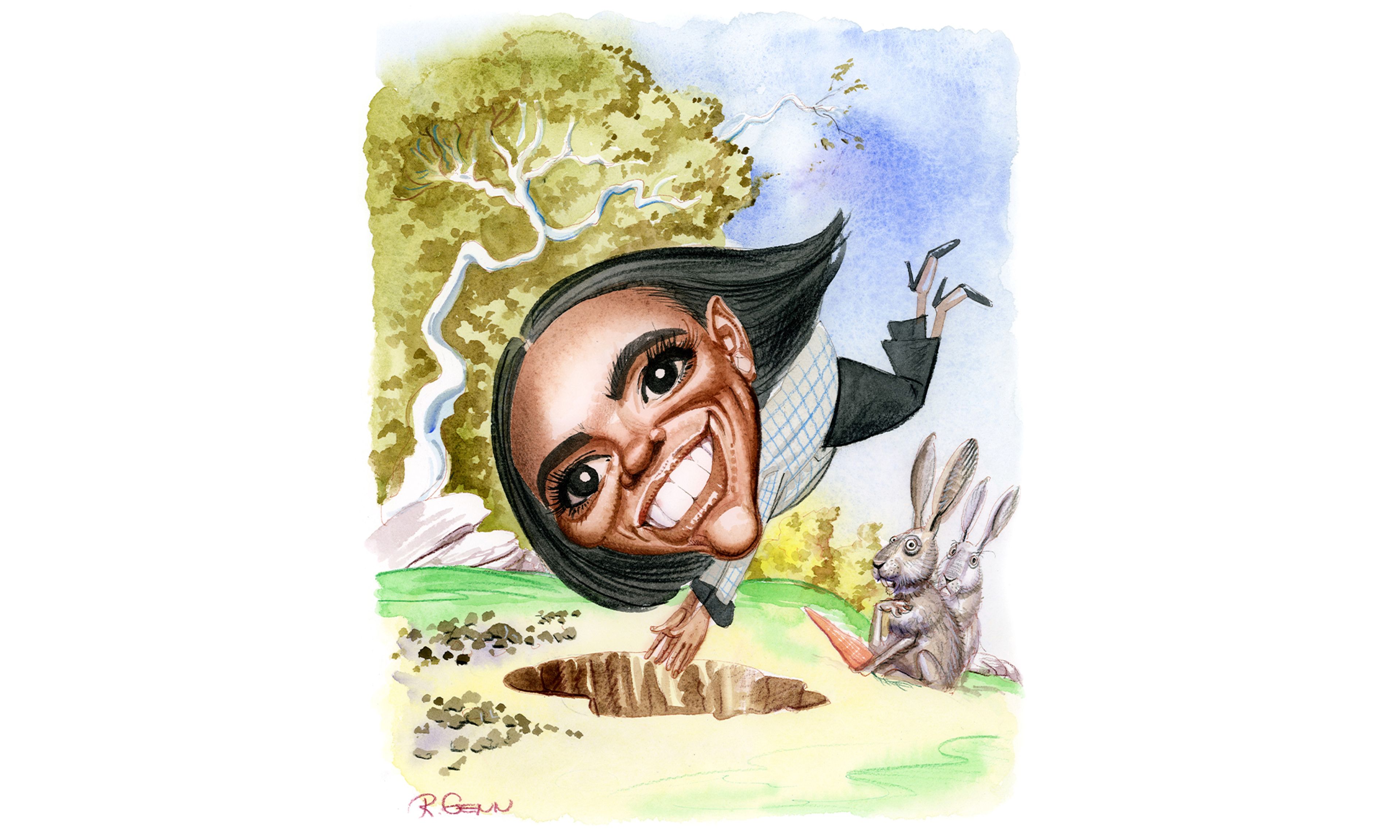
• Ms. Wiles, you have our phone number, right?
• A relentless campaign focus on “affordability” helped little-known State Assemblyman Zohran Mamdani become mayor-elect of New York City. Nationwide, Americans grade the economy as poor and lament the high cost of living. Unfortunately, President Donald Trump (hardly a role model for modest consumption) continues to respond by lecturing Americans that they want too many . . . pencils and dolls: “You know, you can give up certain products. You can give up pencils, because under the China policy, you know, every child can get 37 pencils. They only need one or two, you know, they don’t need that many. But you always need — you always need steel. You don’t need 37 dolls for your daughter. Two or three is nice, but you don’t need 37 dolls.” Trump made similar comments in May. It was a tone-deaf message then, and it is still one now. He also contended that the word “affordability” is a Democratic hoax. When asked to grade the economy during an interview, Trump answered, “A-plus-plus-plus-plus-plus.” If the president keeps this up, the Democrats may waltz to easy midterm victories in 2026.
• He is, however, also continuing to take positive steps on energy abundance. The Department of Energy extended a $1 billion loan to Constellation Energy, an electric utility, to restart the undamaged nuclear reactor at Three Mile Island. In 1979, the Pennsylvania facility was the site of the most infamous nuclear accident in U.S. history when one of its reactors partially melted down, releasing radioactive substances. Three Mile Island terrified the public. Regulators seized the opportunity to impose a blizzard of ever-shifting rules on nuclear energy, making the cost of plant construction virtually prohibitive. Yet these fears were never justified. The meltdown at Three Mile Island had no measurable health effects on either plant employees or surrounding residents. When properly operated, nuclear power stations remain remarkably safe. The Trump administration is right to switch Three Mile Island back on. Better still would be broad, industry-wide deregulation and permitting reform that could unleash the full potential of nuclear power.
• If Congress does not act by the end of the year, generous Obamacare subsidies that were passed under Joe Biden to mask the program’s true cost will expire. Democrats believe that they will be able to exploit the issue in 2026 as part of a broader case on affordability. Instead of extending the subsidies, however, Republicans could use this as an opportunity to explain why Obamacare is a costly failure and that there are better alternatives. Obamacare forces a relatively small number of young and healthy people to pay ever-escalating premiums for more comprehensive insurance than they need in order to offset the cost of covering older and sicker enrollees. A much better approach would be for the government to directly cover the costs of individuals with medical conditions that have made them uninsurable in a pure free market. Removing these individuals from the broader insurance pool would allow the market to offer significantly cheaper insurance to everybody else. In a free market, individuals would have the choice to purchase much cheaper insurance that, while less comprehensive, would still protect them against financial ruin in the event of an unexpected event — just like most insurance — and thereby also reduce the population that needs subsidies. Time and again, Republicans have failed to unite around an alternative on health care, and bad Democratic ideas have expanded by default. It’s time to break the cycle.
• Given the unusually fluid decision-making in this White House, the Trump administration’s new National Security Strategy (NSS) should be seen as a snapshot of current thinking rather than holy writ. Nevertheless, its contents merit serious consideration for their strengths, weaknesses, and consequences. (The NSS was read abroad.) The emphasis on the continued value of deterrence is welcome, as is the greater focus on the Western Hemisphere. No harm can come from the recognition that success internationally is ultimately conditional on success at home. When it comes to the economy, however, this should not be used as an excuse for industrial policy that extends beyond defense or defense-related sectors. The document’s principal flaws are a lack of precision on the nature of the U.S. support for its allies and partners, a (perhaps feigned) naïveté about our ability to work productively with Russia and China, and the invective directed at Europe that may often be deserved but is unhelpful at a delicate time. There is also no recognition of the geopolitical damage inflicted by our trade wars. America First should not become America Alone.
• Trump announced a deal with chipmaker Nvidia to allow the company to sell advanced AI semiconductors to Chinese firms, bypassing U.S. export controls on sensitive technologies. In exchange, the federal government will receive 25 percent of the revenue from the sales. This agreement builds upon an earlier deal, inked over the summer, that permitted the export of less-powerful chips to China on the condition that the government receive a 15 percent cut. But Nvidia wasn’t satisfied. It lobbied the Trump administration to approve exports of its second-most-advanced model, the H200, built to enable frontier-scale AI such as large language models. The president acquiesced once he secured a piece of the action for the Treasury. The U.S. government will now profit from supporting a Chinese AI industry that is racing to defeat our own. If the export of advanced chips to China never actually threatened the United States, Trump has extorted Nvidia, using the power of the state to constrain the company’s business until it handed over a few billion dollars. If the export controls did serve vital U.S. interests, however, the president has sold out national security.
• A new Trump policy will give $12 billion to farmers injured by his global trade war, which has simultaneously driven crop prices down and input prices up. Before this year, approximately one-quarter of soybeans produced in the U.S. went to China. That number went to zero as China retaliated against Trump’s tariffs. In the fall, Trump claimed to have struck a trade deal with China. Just as in Trump’s first term, however, China has utterly failed to uphold its side of the bargain, and so soybean prices have fallen again since the deal was announced. As crimped export markets have caused a glut of corn and soybeans, tariffs have also raised the prices of fertilizer and machinery. The average tariff rate on such agricultural inputs has risen from less than 1 percent at the beginning of the year to 9.4 percent. The proper solution to farmers’ financial woes remains ending the tariffs, not bailing out some of their victims.
• A divided Fed cut the policy interest rate by another 25 basis points. While some governors had understandable concerns about the labor market, the decision was a mistake. Rather than moving toward the Fed’s supposed target rate of 2 percent, inflation seems to be stuck at around 3 percent. And if the central bank signals that this is acceptable, that will put upward pressure on interest rates. Lenders, including the investors who buy Treasuries, put prices — market interest rates — on their money, and they seek protection from the way that inflation erodes the value of the dollars they have lent to the country. If they come to believe that our highly indebted government is more worried about its ability to pay its interest bills than protecting the value of the greenback, then they will start to demand higher rates. The Fed should beat inflation first.
• Republicans lost a high-profile round in the gerrymandering wars. By a vote of 31–19, the Indiana State Senate rejected a bid for mid-decade redistricting that the Trump White House had heavily backed to stave off losing the tenuous House majority in 2026. There wasn’t much blood to be squeezed from the stone in Indiana: Republicans already hold seven of the state’s nine U.S. House seats, having packed a supermajority of Democratic voters into one of the other two districts. In a bad year for Republicans, they may be thankful for keeping the current map. In the final vote, 21 Republican state senators crossed the aisle, a major loss of support from prior whip counts. This followed a heavy-handed pressure campaign in which JD Vance traveled twice to Indianapolis to twist arms, and Heritage Action (in terms not entirely disavowed by the White House) warned: “President Trump has made it clear to Indiana leaders: if the Indiana Senate fails to pass the map, all federal funding will be stripped from the state. Roads will not be paved. Guard bases will close. Major projects will stop.” Trump responded on Truth Social that voters should “primary every single one” of those Indiana state senators. The ineffectiveness of these tactics should alarm the White House. Perhaps the president should focus instead on winning back the voters who picked him last year because of the cost of living.
• Long before Kamala Harris selected Tim Walz as her running mate in 2024, it was obvious to anyone who cared to look at his record that Walz was a poor governor of Minnesota. The largest scandal on his watch was the massive theft of pandemic-relief funds by members of Minnesota’s Feeding Our Future program. The nonprofit reportedly used a quarter of a billion dollars in federal funds to purchase luxury cars, houses, jewelry, and coastal resort property abroad. Most of those charged in the case are members of Minnesota’s Somali immigrant community, and the scandals just keep coming. At a recent cabinet meeting, Trump raged, “Somalians ripped off that state for billions of dollars, billions. Every year, billions of dollars and they contribute nothing. The welfare is like 88 percent. They contribute nothing. I don’t want them in our country.” Democrats are eager to shift the discussion to Trump’s blanket, and thus unjust, demonization of Somali immigrants. But it’s also true that a fear, among government officials, of being accused of racism is one of the reasons that these fraud schemes flourished for so long.
• In the months since the assassination of Charlie Kirk, Candace Owens has dedicated her podcast to promoting conspiracy theories about his murder on almost a daily basis without offering any credible evidence to back up her wild claims. It’s hard to think of a more straightforward murder case than the one against accused assassin Tyler Robinson, which is supported by forensic evidence, text messages, and video surveillance. But no amount of evidence has stopped Owens from “just asking questions” about the shooting and making a bizarre set of claims implicating Israel, Jewish donors, and the staff of the Turning Point USA organization that Kirk founded. Erika Kirk and the organization (which she now leads) tried ignoring it, but because Owens is one of the leading podcasters in America, her claims were gaining constant attention. So Mrs. Kirk broke her silence with an emotional plea to Owens to stop smearing the staff. Her anger is justified, and we fear that her recent sit-down with Owens was futile. Her turning her malicious speculations to MAGA figures has led many right-wing influencers and podcasters to speak out against Owens and the damaging consequences of conspiratorial thinking. It’s never too late to stand up for rationality and truth.
• Health and Human Services Secretary Robert F. Kennedy Jr. is bound to receive criticism for the ongoing measles outbreak in Spartanburg County, S.C. But Kennedy was only sworn in on February 13. The parents of most of the 138 South Carolinians who have the measles now had made their decisions about vaccination years ago. That said, Kennedy has spent years as a high-profile opponent of vaccines, even relying on studies that had already been exposed as fraudulent. In 2019, Kennedy appeared at rallies to oppose the requirement that students attending school in the State of Washington receive the combined measles, mumps, and rubella vaccine. That year, he filed a lawsuit arguing that the State of New York did not have a “compelling state interest” in ensuring that every student is vaccinated against measles. The good news is that, since he assumed his new position, Kennedy has become a fan of the measles vaccine. The bad news is that damage has already been done.
• The Manhattan Institute released a survey of about 3,000 Republican voters that extensively sampled the voters who make up Trump’s “multi-ethnic, working-class” coalition. A group the report classifies as “new entrants” brought with them an affection for conspiracy theories, including the notions that George W. Bush played some role in the 9/11 attacks and that the Holocaust did not happen “as historians describe.” They have also imported their affinity for progressive policies, including their openness to higher taxes, gender-transition surgeries, and DEI-related discrimination. Most of the new entrants were Democratic voters before 2016. A measurable number of them were Democratic voters before 2024. Parties should appeal to new voters but also try to bring them around to good sense — as Republicans have done with previous waves of newcomers. Yet the 60 percent of the party that is composed of stalwart Republican voters who are inclined toward conservative principles have too often been told that they should simply defer to these latest entrants. Nothing is expected of the newbies; everything is demanded of their hosts. The Republican Party is increasingly and rightly vocal about the need for assimilation in American society, but it evinces none of that civilizational self-confidence regarding its own identity.
• The bedrock of the Constitution’s remarkable longevity is the separation of powers. Recently, the Supreme Court has struck major blows in support of the Constitution’s original design. Next on the chopping block is the concept of “independent” agencies that exercise executive power outside of executive control and accountability. How can the president exercise “the executive power of the United States,” vested in him by Article II, if he cannot fire people who exercise executive power in ways opposed to his policies? How can he carry out his duty to “take Care that the Laws be faithfully executed” if others are free to disregard those laws he aims to enforce? To whom can the people complain if the executive job is not done, or done badly, if not the executive? These were the questions before the Court as it heard arguments in Trump v. Slaughter. The case comes to the Court because of Trump’s effort to fire a member of the Federal Trade Commission. The removal protections were upheld by the Court in Humphrey’s Executor v. United States (1935), which has been under fire for decades. Now, Trump is rightly asking the Court to overrule Humphrey’s Executor outright. The justices appear ready to do so. Overruling Humphrey’s Executor would strike an important blow for having one president at a time, while encouraging Congress and the courts not to let their own powers fall into his hands. To borrow Harry Truman’s phrase, as Chief Justice John Roberts has been fond of doing in prior cases, the buck has to stop somewhere — and the people should know where.
• The Kilmar Abrego Garcia saga has a new, astounding twist. Abrego Garcia is an illegal alien who the government suspects is a member of the MS-13 gang. In 2019, the first Trump DOJ tried to deport Abrego Garcia, but an immigration judge credited his dubious fear-of-persecution claim and ordered that he could not be removed to his native El Salvador. The DOJ failed to appeal or deport him elsewhere, allowing him to live and work in Maryland. Six years later, in its effort to mass-deport illegal aliens, the new Trump administration arrested him without notice and deported him to El Salvador — the one country to which his removal was forbidden. For reasons unexplained, he was detained in a notorious counterterrorism prison, where he says he was tortured. The Supreme Court ordered the administration to facilitate his return to the U.S., which the administration delayed doing until it could indict him in Tennessee on dubious immigrant-smuggling charges. While one judge mulls dismissing that case for vindictive prosecution, another has discovered — after months of DOJ stonewalling — that there never was a formal removal order in 2019. That means there was no legal basis to arrest Abrego Garcia in the first place. Nor, apparently, has the Trump administration sought such an order since then. Perhaps all this could have been avoided if the government had simply followed the law.
• Politicized law enforcement makes for weak cases erratically prosecuted. Such is the story of the lawfare campaign against Trump enemies James Comey and Letitia James. Trump pushed out interim Virginia U.S. Attorney Erik Siebert for declining to indict Comey, the former FBI director of Russiagate infamy, and James, the Democratic New York attorney general who brought a bogus civil fraud case against Trump and his business empire. Trump then directed Pam Bondi, his obeisant attorney general, to replace Siebert with Lindsey Halligan, a former insurance lawyer and Trump White House staffer who had never prosecuted a case. Halligan promptly indicted Comey and James on incoherently pled charges. The indictments were thrown out by a federal judge because Halligan was not statutorily qualified to serve, as the DOJ must have known. In the aftermath, reindictment efforts have stalled. In Comey’s case, prosecutorial misconduct caused the suppression of privileged attorney-client communications on which Halligan relied as key evidence. In James’s case, two grand juries have refused to reindict mortgage-fraud allegations that seem to involve trifling sums far below normal DOJ prosecution standards. But the boss wants the cases pursued, so expect Bondi to keep trying.
• Yet another Black Lives Matter executive has been indicted for allegedly treating donor funds as a personal expense account. Tashella Sheri Amore Dickerson, executive director of Black Lives Matter Oklahoma City, was charged with 20 counts of wire fraud and five counts of money laundering. Dickerson, who took over the organization in 2016, has allegedly raised $5.6 million since 2020 for what donors believed was a national bail fund. According to the indictment, however, $3.15 million of that money was instead used to bail out her lifestyle. The indictment alleges that the funds were spent on grocery and food delivery services and personal trips to the Dominican Republic and Jamaica, as well as a personal vehicle and real estate. This is a familiar pattern for Black Lives Matter–affiliated leaders. Patrisse Cullors, who led the Black Lives Matter Global Network Foundation from its founding in 2013 until 2021, drew scrutiny for directing millions to friends and family through job contracts and purchasing multiple million-dollar homes. She resigned in 2021 while denying wrongdoing. More recently, BLM activist Monica Cannon-Grant pled guilty to multiple counts of wire fraud after diverting $185,000 in donations to her nonprofit, Violence in Boston, and to pay for rent, shopping sprees, hotels, car rentals, auto repairs, meal deliveries, and a summer vacation trip to Maryland. It seems that financial mismanagement is a job requirement for BLM leaders.
• Representative Marjorie Taylor Greene (R., Ga.) announced that she will resign, effective January 5. She hasn’t been a credit to Congress, and her sudden exit — to avoid a likely Trump-endorsed primary challenge, provoked by her pushing the administration to release the so-called Epstein files — is par for the course. She could simply have not run for another term. Instead, she’s quitting on the people of Georgia who elected her. Her rapid flameout shows that Trump still runs the MAGA movement. Could Greene have pursued a new political identity by combining a good-government pitch with her conspiratorial obsessions and fierce anti-Zionism? Mercifully, we might never know. Judging by her recent TV appearances, The View seems to suit her better than the U.S. House. As for the voters in her district, it’s hard to imagine that they can do worse.
• After months of indecision, Representative Jasmine Crockett (D., Texas) officially launched her campaign for the U.S. Senate. But Axios reported that Crockett’s Democratic colleagues are “enraged” by her decision. One Democratic representative astutely observed that although Crockett’s notoriety — which she achieved for being a vulgar, loudmouthed firebrand, even by House Democrats’ current standards — might be enough to win her the primary, she has no chance of winning a statewide general election in Texas. But there are also people who are cheering her entrance into the race. They’re mostly Republicans.
• As of this writing, the death toll of Trump’s unauthorized campaign of missile strikes against boats he suspects of transporting illicit drugs in the Caribbean has reached 95. While 25 vessels have been destroyed, the first attack on September 2 continues to stoke the most controversy — two of the eleven-member crew survived the initial strike, and as they struggled, shipwrecked and out of combat, a second strike was ordered, killing them. Anonymous sources told the Washington Post that Defense Secretary Pete Hegseth had ordered that all boat operators be killed. When the commander of the U.S. Special Operations Command, Admiral Frank M. Bradley, briefed Congress, sources reported that the military has a target list — apparently similar to lists of al-Qaeda terrorists targeted for drone strikes in the years after 9/11. Back then, of course, al-Qaeda had just killed nearly 3,000 Americans, leading President George W. Bush to seek, and receive, a congressional authorization to use military force. Trump has no such authorization; he is attacking unilaterally and lethally, rationalizing that drug traffickers are enemy combatants and their cocaine packages are weapons of mass destruction. Under federal law, however, drug-trafficking is a crime prosecuted in court. Either the administration is pursuing regime change or it is insisting on making an overused metaphor — the “war” on drugs — into a reality, or both. Whatever the rationale, it should get approval from Congress first.
• Judicious deployment of the presidential pardon power has never been one of Trump’s strengths. Even by his standards, however, the pardon of former Honduran President Juan Orlando Hernández is hard to defend with a straight face. Hernández was convicted of drug-trafficking in 2024 and sentenced to 45 years in federal prison. Trump is painting that conviction as lawfare and “a Biden setup.” In doing so, he is stepping on his administration’s public argument that drug-trafficking is equivalent to terrorism. He’s also throwing under the bus Emil Bove, the prosecutor who did much to build the case and required significant Trump White House muscle to get confirmed this summer as an appeals court judge. A pardon such as Hernández’s might be a necessary evil as an act of state if it serves our foreign interests. So far, however, it has provoked Honduras to issue its own arrest warrant for Hernández and given its leftist president a pretext to complain of American interference in its elections. A simpler explanation than diplomatic 5-D chess is that Hernández’s case was championed by Roger Stone, a Trump whisperer and lobbyist who once received his own undeserved Trump pardon.
• Chile just became the latest South American country to give a party of the right a chance to govern, by electing José Antonio Kast and his Republican Party of Chile (founded in 2019). This is the first time in 35 years of post-Pinochet democracy that the country has broken its alternation between leftism and centrist accommodation. It wasn’t close. Kast routed Communist Party leader Jeannette Jara, 58 percent to 42 percent, in a runoff election dominated by concerns about crime and immigration in a country that has recently absorbed half a million Venezuelan refugees. He has pledged to crack down on violent criminals, deport illegal immigrants, build a wall across Chile’s northern border with Peru and Bolivia, and revive the economy. He also withstood attacks from skeptics who argued that the devoutly Catholic Kast needed to abandon his opposition to abortion and same-sex marriage. Kast has been met with skepticism in past election bids because of his family’s history — he’s the son of immigrants from Nazi-era Bavaria and the brother of a Pinochet minister — but his platform is attuned to Chile’s present, not its past.
• Ukraine has a corruption problem. Ukrainians, including those who serve in the highest echelons of government, will be the first to admit it. Rooting out graft has been one of Kyiv’s national objectives for years, largely as part of its efforts to meet the conditions for membership in the European Union. Indeed, the only reason the world knows about the scandal surrounding an alleged $100 million embezzlement scheme within Volodymyr Zelensky’s government, which led to the resignation of his powerful chief of staff, is that Ukrainian investigators uncovered it. The immense political fallout from that scandal risked undermining the integrity of the Zelensky government. That’s what you might expect from a fledgling democracy aspiring to the transparency and good government expected of a Western-oriented state. But in its efforts to muscle Kyiv into a peace agreement that favors Russian strategic objectives, the Trump administration leveraged the Ukrainian political crisis to force Zelensky to surrender territory the government still controls. That push seems to have backfired, inducing a rallying effect around Zelensky’s embattled government, even among his critics. After a year of trying, and without adapting its tactics, the Trump administration is no closer to a peace deal in Europe. Perhaps doing the same thing and expecting different results isn’t the most productive approach.
• The EU Commission has imposed a fine of $140 million on X for breaches of its Digital Services Act. Though X can appeal the decision, the fine is wildly disproportionate and represents the next stage in an EU campaign to bully X into more strictly censoring content. If X does not apply Brussels rules to intra-American online chat, it will probably have to offer a more heavily censored version of the site in the EU. That would be sad, but it would at least serve as another reminder that free speech is not a “European value.”
• Hong Kong’s drawn-out show trial of Jimmy Lai — which is, of course, really a Beijing production — has now resulted in a guilty verdict that the businessman and democracy advocate should wear as a badge of honor. Lai was charged with colluding with foreign powers under Hong Kong’s purposely vague National Security Law. Lai’s real crime was publishing Apple Daily, the city’s largest newspaper, which sought to hold Beijing to account for its promises to respect Hong Kong’s traditional freedoms. He has been kept in inhumane conditions, especially for a 78-year-old diabetic. His daughter reports that his health is failing. The U.S. has sought Lai’s freedom in talks with China. The U.K. has, in contrast, been shockingly indolent about the plight of a British citizen. There may now be, however, a new opportunity to press for his freedom. By persecuting Lai, Beijing has made its point about the price of dissidence in Hong Kong. Let it now deport Lai to live the rest of his days in peace in a free country.
• Japanese Prime Minister Sanae Takaichi angered her Chinese counterparts when she said the prospect of a Chinese attack on Taiwan represented “an existential threat for Japan.” Beijing responded with indignation and ultimatums, but Japan would not back down. Indeed, Takaichi flirted with the possibility of intervening in such a conflict in coordination with the U.S. to defend Taiwanese sovereignty. Bilateral tensions reached a new level when Chinese fighter planes locked radars on Japanese aircraft, forcing Tokyo to scramble its own jets. The Takaichi government has tried to lower the temperature since that incident. At China’s request, the Japanese foreign minister recently restated Japan’s position on Taiwan, which is consistent with a 1972 joint communiqué by Beijing and Tokyo on Taiwan’s status that established normal bilateral relations between them. The Japanese foreign minister did, however, leave out part of that communiqué that recognizes “that Taiwan is an inalienable part of the territory of the People’s Republic of China.” The Chinese Communist Party is unlikely to be mollified by the gesture.
• Hollywood director Rob Reiner and his wife were found stabbed to death in their home. Their son, Nick, has been charged with two counts of first-degree murder. For Americans long raised on the greatness of his run of films in the Eighties, Reiner was more than just “Meathead” from All in the Family. He directed a remarkable number of classics, including the coming-of-age tales Stand by Me and The Sure Thing, the narratively sophisticated fantasy romp The Princess Bride, and the delightful rom-com When Harry Met Sally. For Donald Trump, however, Reiner remained always and forever one thing alone: a Trump critic. Trump reacted to the terrible news by announcing on Truth Social that Reiner’s “Trump Derangement Syndrome” led to his death. The smallness of Trump’s soul is notable, if only because he grotesquely forced himself into a tragedy unrelated to him. As for the rest of us, we can celebrate Reiner’s legacy — a directorial career that began with the iconic This Is Spinal Tap — and some of its eternal wisdom: “There is a fine line between stupid and clever.”
• Tomáš Sträussler fled with his parents from Czechoslovakia to Singapore, a step ahead of Hitler. While his father remained in Singapore, where he was killed by the Japanese, Tomáš, his brother, and his mother fled to India. There, she met and married Major Kenneth Stoppard, who adopted her children. Tom spent the rest of his life in England, joining Vladimir Nabokov and Joseph Conrad as an adoptive master of the language. His many plays and screenplays were verbal cat’s cradles, so intricate that that was all they seemed to be. Yet the century that he survived ever left its mark. The double farce Dogg’s Hamlet, Cahoot’s Macbeth was a tribute to the Czech dissident Václav Havel; the trilogy The Coast of Utopia explored the backstory of communism. His most famous monologue, from The Real Thing, compared good writing to a cricket bat — “several pieces of particular wood cunningly put together in a certain way, so that the whole thing is sprung, like a dance floor.” It was a plea for precision and beauty against political correctness. His last play, Leopoldstadt, sprang from the revelation late in his life that his parents were Jews, which his mother had never let on. It depicted encroaching antisemitism in the 1930s, eerily timely in the 2020s. Dead at 88. R.I.P.
• Frank Gehry possessed one of the most ruthlessly independent minds in American architecture. Born in Canada in 1929, he acquired a passion for design from his family. His parents encouraged him to take an interest in art, while visiting his grandfather’s hardware store helped him realize that basic materials could form incredible structures. After graduating from the University of Southern California’s School of Architecture in 1954, he worked in America and Paris before establishing his own firm in the 1960s. In the years and decades that followed, the true scope of his creativity revealed itself in the buildings he designed across the world. The Guggenheim Museum Bilbao, perhaps his most recognizable work, opened in Spain in 1997. A towering, angular creature of titanium, it helped transform the struggling industrial city into one of Spain’s most lucrative tourist destinations. Other acclaimed works followed, including the Walt Disney Concert Hall in Los Angeles, a similarly gleaming structure defined by its playful steel curves. In 2017, he commenced work on renovating a vacant art museum in Paris for Bernard Arnault. His Guggenheim Abu Dhabi, meanwhile, is expected to open next year. Times may change, but Gehry’s buildings will remain monuments to the power of imagination. Dead at 96. R.I.P.








Architect Frank Gehry attends the official groundbreaking of “The Grand,” a Frank Gehry-designed mixed-use development in downtown Los Angeles, Calif., February 11, 2019.
Mike Blake/Reuters
Politics
Antisemitism, Abroad and at Home
On the first night of Hanukkah, a father-and-son team of Islamist terrorists armed with rifles and IEDs attacked an outdoor celebration on Bondi Beach in Sydney, Australia. Fifteen Jews were killed, including two rabbis, a ten-year-old girl, and an 87-year-old Holocaust survivor. One of the murderers was disarmed by a bystander who bravely snuck up on him. Also, the attackers’ IEDs remained unexploded, else the toll of victims would have been far higher. Police killed one killer; the other is in custody.
Can we finally say that the international wave of demonstrations and acts of violence ostensibly protesting Israel’s war in Gaza since Hamas’s October 7, 2023, attack is directed at Jews, not Israel? No, and yes.
No, because Gaza is the scene, and Israel the alleged villain, that sets the moral and psychological machinery in motion. Oppression is a sin, fighting it is a virtue. Gazans, starved (by Hamas hoarding and skimming aid) and bombed (by Israel hunting terrorists shielding behind them) are the sufferers; Israel then is cast as the tormentor. The end of Israel will be the day of liberation. This is the mythic script, like a Hollywood western or a medieval morality play.
But yes, we can say the worldwide anti-Israel campaign is anti-Jewish, because Jews in Israel and everywhere else melt for it into one evil mass. Jews around the world visit Israel, have relatives and friends there, and support it in all kinds of ways. Even if they don’t, who knows when they might? The most religious, and the most openly Zionist, make the most obvious targets beyond Israel’s borders, but all are understood by the mad and the evil to be fair game.
Two sorts of zealot wage this antisemitic struggle. Islamists, like the Bondi Beach murderers, are at open war. The left, here and abroad, supplies them with shouts and marchers. And not the left only. Large elements of the post-conservative right are spewing Jew-hatred. Nick Fuentes is a garden gnome boosted by foreign bots. Candace Owens spots Israeli agents offing Charlie Kirk and gunning for her. Tucker Carlson, once the evening star of Fox News, melds love of Russia with hatred of Israel. Foreign money waters both streams of antisemitism, the hard and the less hard. Iran is a steady supplier, now joined by Qatar. Carlson, showing his colors, has bought an apartment in beautiful downtown Doha.
How to combat this? Immigration restriction is a necessary step. Good men and women live everywhere; the hero who jumped the Bondi Beach gunman was a fruit stand owner from Syria. But as Ayaan Hirsi Ali, herself a refugee from Somalia, warned, immigrants have to be vetted and culled. Moving to a free Christian or secular society? Live free, or stay home.
Police and intelligence work is the daily task. The FBI reportedly broke up a holiday plot in Los Angeles. That is why it is important to have the best people in counterterrorism slots.
The great need is to know the enemy, for Jews are only the first victims. Iran helpfully calls the United States and Israel the Great and Little Satan. George Washington assured the Hebrew congregation at Newport, R.I., that all might live here, each under his own vine and fig tree. No wonder Jews’ enemies hate all of us.
In Memoriam
Norman Podhoretz, R.I.P.
Born, as he described in Making It, in a Jewish slum in Brooklyn, Norman Podhoretz blazed through Columbia and Cambridge, where he impressed first Lionel Trilling then F. R. Leavis (talk about the anxiety of influence), then became editor of Commentary magazine at age 30. When he took the reins, Commentary was a learned, sedate monthly publication of the American Jewish Committee, committed to postwar, liberal anti-communism. A friend of Norman Mailer and Paul Goodman, Podhoretz initially nudged it in a countercultural direction. But then he swung right.
How they hated him for it — they being the unpersuaded members of the New York family of intellectuals, almost all Jewish, all to one degree or another on the left. Podhoretz hoped to swing them with him, and he succeeded with many. But the larger remainder remained, and never ever forgave him. Apply the rhetorical Geiger counter to reviews of his late books in mainstream publications. The animus pushes the needle out of the dial.
Podhoretz gave as good as he got. He was a fighter. One of his late books was devoted to friends he had broken with, titled Ex-Friends (the cover displayed a huge red X). The discarded included Mailer, Columbia contemporary Allen Ginsberg, and Lillian Hellman.
He fought zealously because the stakes were high. He agreed that liberals pursued social policies that had proven to be feckless, though that was an insight more central to his comrades in defection, Irving Kristol and (to a lesser degree) Daniel Bell. What animated Podhoretz most was the threat to the United States and to Israel posed by the Soviet Union, and by the left here and abroad generally. It was to combat this threat that he ghost-wrote Daniel Patrick Moynihan’s speech condemning the U.N.’s resolution labeling Zionism as racism. It was to combat this that Commentary under his leadership published hawks like Jeane Kirkpatrick.
He was not all politics. His undergraduate and postgraduate education stuck with him. In an essay blasting Ezra Pound’s fascism and antisemitism, Podhoretz paused to say, in a footnote, that his stylistic suggestions to a middle-aged William Butler Yeats were even more decisive than his editing of The Waste Land by T. S. Eliot. He loved classical music, especially when played on his state-of-the-art, immersive sound system.
The eye could twinkle. During the Iraq War, Bill Buckley greeted him at a dinner at the Union League Club by saying that he, Podhoretz, had not written him any critical letters recently (Bill had begun to cool on war). Podhoretz said, “I’ve been blocked.” At other times his intensity weighed on him. When our colleague Rick Brookhiser had lunch with him after finishing a book on four Adamses — John, John Quincy, Charles Francis, and Henry — he remarked that in order to write an essay on Henry he not only read all of Henry Adams’s books, but the six fat volumes of his published correspondence!
He was devoted to his wife Midge Decter (d. 2022) and to their children, grandchildren, and great-grandchildren. Commentary is now in the capable hands of his son John. Dead at 95, R.I.P. — though the next time you see lightning it may be Podhoretz dissecting something by Mailer.
The Stat
67.1 percent — the employment rate for mothers in the U.S. in 2021, according to the OECD.
Many more American mothers work than stay home with their children. That’s typical for rich countries. As countries get richer, jobs get better, and the decline in gender stereotyping means that more higher-paying jobs are available to women than in the past. It’s more common for mothers with higher levels of education to work than those with lower levels. This suggests that for many women, it isn’t that hardship induces them to work but rather that they choose to work. Even though public spending on family support as a share of GDP is lower in the U.S. than in every European country, the employment rate for American mothers is much lower than in countries that spend more. In Sweden, the Netherlands, and Denmark, over 80 percent of mothers work. This is partly due to differences in how countries collect data. The Organization for Economic Cooperation and Development reports maternal employment for most countries among mothers with children up to age 14, but for the U.S., it’s up to age 17. But even when one zeroes in on mothers with children up to two years old, that specific U.S. maternal employment rate (58.8 percent) is lower than in Finland, Germany, France, the U.K., Hungary, Ireland, Switzerland, Belgium, Denmark, and Sweden, among others. If you think mothers should stay home with their children, you should be interested to know that the U.S. has more mothers who do that than most other rich countries. But it’s also the case that most U.S. mothers work, most likely because they’ve decided it’s good for their families and themselves.
by Dominic Pino









Comments