Recently I was in the city of Hassakeh, Syria, sitting and making small talk with two Syrians, one Kurdish and the other Syriac Christian. The Christian said he would like to invite me to his house but, because he lives in the government-controlled area of the city, he couldn’t. He’d previously had a guest from another Arab country, and the government’s security service immediately knocked on his door, asking who the guest was. As an American journalist without a Syrian visa, I would not be welcome in the government-held part of the city. (Hassakeh is currently divided between the majority of the city that falls under the control of the Kurdish-led Syrian Democratic Forces and a small section that falls under the control of the Syrian government.) The Kurd sitting with us immediately piped in, saying that it was for the people’s benefit that the government kept such a close watch on the security situation. That was why Syria was so safe before the war. The Christian enthusiastically agreed.
The conversation was remarkable only in that I have a similar one almost every day in northeastern Syria. A great nostalgia has taken hold for iyyam ad-dawleh, the days when the government was in charge. I hear it from Christians, Kurds, and Arabs. While I would posit that the nostalgia comes with a healthy dose of selective memory loss about the worst behaviors of the Syrian regime, it nonetheless also carries an obvious truth: You don’t know what you’ve got until it’s gone. “We were living in a dream, and now we’ve woken up,” an Assyrian Christian in his twenties told me. While there are obviously many who disagree, a large share of Syrians I talk to would rewind the clock to 2010 if they could and do everything possible to prevent the anti-Assad protests from starting. That sentiment is most pronounced among Christians, and much of that community never left the Assad government’s side throughout the conflict.
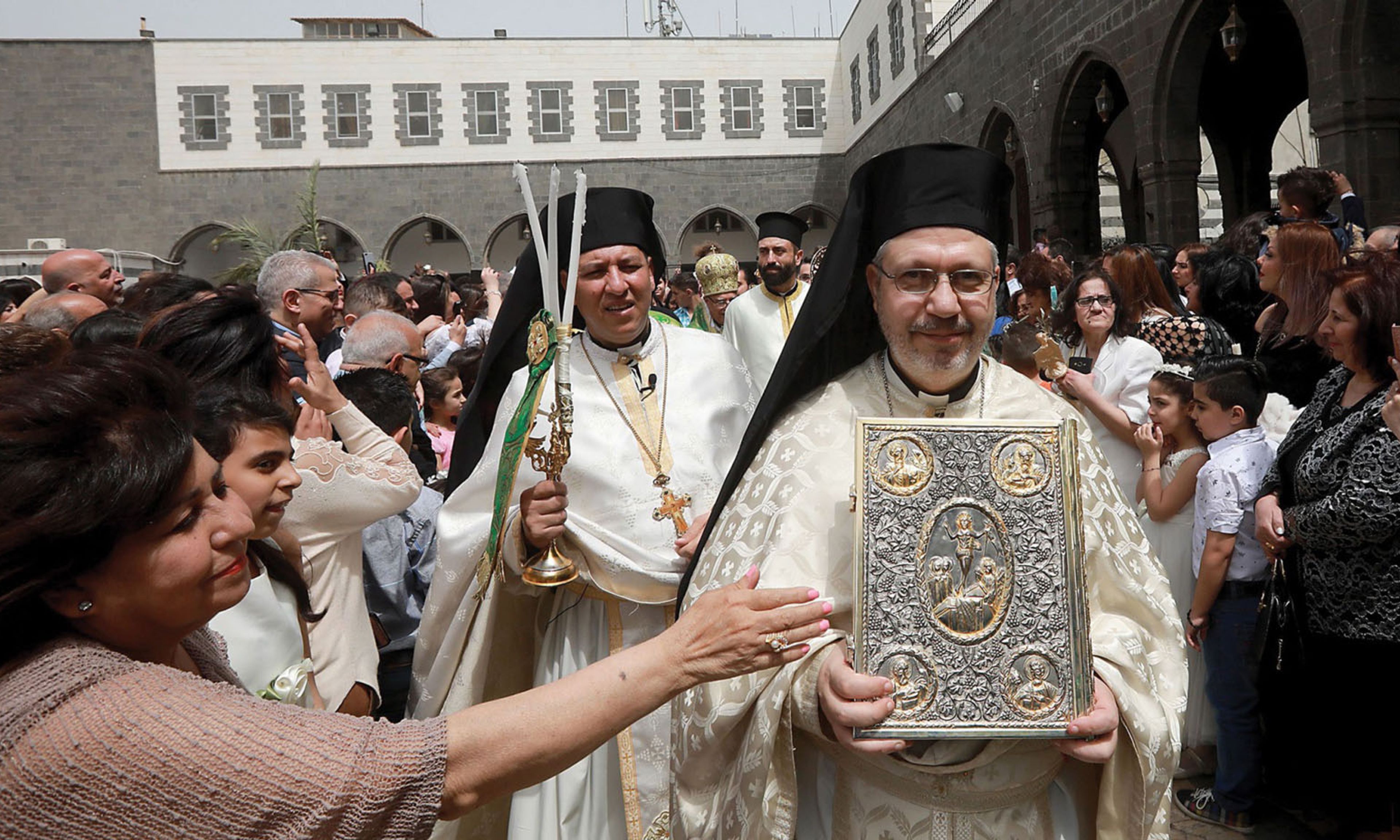
The Christian attachment to Bashar al-Assad and his regime is an oft-misunderstood aspect of the Syrian civil war. The Catholic and Orthodox churches in particular have been morally condemned, from many corners, over their ties to the Assad government. The journalist Idrees Ahmad tweeted, during the visit of a Vatican delegation to Damascus in July 2019, that “the two people disgracing themselves while Idlib is being decimated by Assad’s bombs are Cardinal Peter Turkson of Ghana, head of the Vatican’s department for Promoting Integral Human Development, and Italian Cardinal Mario Zenari, the [pope’s] ambassador in Syria.” Charles Lister, a prominent Syria commentator at the Middle East Institute in Washington, D.C., tweeted a photo of the same visit with the tongue-in-cheek comment, “The Catholic Church never disappoints, does it? All smiles in Damascus, visiting Assad today.” Middle Eastern churches have been even more closely associated with Assad and his regime. The patriarchs of the Syriac Orthodox, Antiochian (Greek) Orthodox, and Melkite (Greek) Catholic churches are all based in Damascus, and all regularly appear smiling in photo ops with Assad.
It would be easy to dismiss the churches’ relationship with Assad as a pragmatic one based in their desire to protect their flocks, which are largely in areas controlled by Assad’s government. Indeed, for Western Christians, pragmatism often seems the key factor in the approach to Assad. They don’t love Assad but feel an obligation to Christians in Syria and therefore strive to maintain a relationship with the government that is primarily responsible for them and that has largely protected them. Such a pragmatic reading, however, ignores the fact that many Syrian Christians have great and genuine affection for Assad and don’t see him as merely the least bad option. An Armenian friend from Aleppo told me in 2013 that the day Hafez al-Assad died in 2000 was the saddest day of her life.
This view is firmly rooted in the notion among many Christians that any of the political alternatives within Syria would not bring about positive change for Christians. As this same Armenian friend pointed out, her grandparents survived the Armenian genocide and came as orphans to Syria. Her father grew up in poverty, but within a generation the family had rebuilt its wealth and become extremely successful. What more could a community devastated by genocide ask for in their new home? I found the argument convincing. Less convincing was her assertion that Syria was not a dictatorship because she herself had never been prevented from saying something she wanted to say.
A specific conundrum besets the advance of democracy in the Middle East: Many people in the region don’t see democracy as viable in their society. That sentiment is particularly widespread in Syria’s Christian community, but it’s certainly not unique to Christians. Can you impose a system that is meant to give power to the people if they don’t want that power? I was recently driving with a Christian in northeastern Syria when a man riding a motorcycle cut us off. In an SUV, we were not in danger, but the man and his wife and infant on the motorcycle certainly were. He didn’t seem even to notice that we had almost crushed him and his family. “And these people want freedom?” my companion chuckled. “When Arabs say they want freedom, they mean chaos.”
I’ve heard variations on this theme countless times. Most news coverage of protests against the Assad government missed this substantial segment of the population, the cautious supporters of the regime who feared the alternative more than they had ever feared the government. While this sentiment has grown during the last decade of civil war, it was certainly present leading up to the war as well. In June 2010, before the Arab Spring was even a thought, Reuters reported on Christians in Syria who were worried about developments in neighboring Arab countries. The article’s title summed up the sentiment: “Christians view Syria as haven in unstable region.” Their worst fear, that the chaos then beginning to take over the region would come to Syria, came true. The conflict probably ended the Christian presence for good in certain parts of Syria, particularly those that came under ISIS or opposition and Turkish control. Elsewhere, migration rates have skyrocketed, threatening the long-term viability of the Christian community.
To understand the Christians’ attachment to the Assad regime, it’s important to understand the community’s history in the region, both distant and more recent. Many Christians think that Muslim society as a whole is hostile to them and that therefore security and stability are their first priority. Similarly, they believe that Christians have little realistic chance of obtaining political power in an Islamic society and that a democratic system would therefore not necessarily help Christians.
Christian supporters of the Syrian revolution, in trying to undermine their community’s support for the Assad regime, have pointed out that the standing Syrian constitution — supposedly a secular bulwark against Islamist domination — prevents a non-Muslim from becoming president. Most Christians would respond with an obvious truth: A democratic system would probably reduce rather than increase the likelihood of a Christian leader in Syria. When Islam arrived in Syria in the seventh century, Christian political power came to an abrupt end, resuming only briefly in the Crusader states (which were run by European, not Middle Eastern, Christians).
Under Islam, Christianity’s fortunes ebbed and flowed. Islam granted Christians, along with Jews, a protective status known as “dhimmitude” (from dhimmiyyah in Arabic). It was protection in exchange for loyalty. By today’s standards, we would say they were treated as second-class citizens. They were not expected to wage jihad against Islam’s enemies. Instead, they paid a tax, the jizya, and were granted — in theory — protection by the Islamic caliphate. In practice, their status depended mostly on internal and external political dynamics. There was no conception of citizenship as we understand it today, or of the rights and responsibilities that come with it. Instead, there was only power and fealty, and Christians never had hopes for power, so fealty was their only option.
In the late Ottoman Empire, it seemed that the situation could change. A series of reforms led to the enactment of a constitution governing the empire’s affairs, which came into effect in 1876. The constitution was a major step forward for Christians in the Ottoman Empire, giving them almost equal status as citizens. “All subjects of the empire are called ‘Ottomans,’ without distinction, whatever faith they profess,” the constitution read. While it still defined Islam as the empire’s official religion, it affirmed the principle of freedom of religion, stating that “the state will protect the free exercise of faiths professed in the Empire.” It would be tempting to see this as a step in the right direction, but the move toward a more national empire, rather than a religious one, ultimately led to the Armenian genocide (which also targeted other, non-Armenian Christians), effectively ending the Christian presence in what is now Turkey. Many Christians learned a valuable lesson from the experience: Promises of political change and equality were not likely to improve the situation of their community.
The Christian community in Syria is essentially made up of two groups. The first, who mostly identify as ethnic Arabs, inhabit the western portion of the country, in cities such as Damascus, Homs, Latakia, and Aleppo. These Christians are primarily Greek Orthodox and Catholic, and their history in Syria is long. Following the genocide in Turkey, Syria’s Christian community was boosted by a second group, newcomers fleeing the Ottoman government and the Kurdish tribes that had largely carried out the genocide. These Christians spoke Armenian, Turkish, Kurdish, Syriac, and in some cases Arabic. They belonged to the Armenian Orthodox, Armenian Catholic, Syriac Orthodox, Syriac Catholic, and Chaldean Catholic churches and to the Assyrian Church of the East. In some cases, they joined the existing Christian community in the western part of the country, particularly in the city of Aleppo, but a large number of them went to Syria’s northeast, known as the Jazeera region. The French government, in charge of Syria after World War I, gave them land and privileges, and the Christians became the backbone of cities such as Qamishli and Hassakeh.
The memory of the genocide, exacerbated by Turkey’s refusal to acknowledge it, remains deeply ingrained in the Armenian, Syriac, and Assyrian communities of Syria. They became extremely suspicious of outsiders and close-knit, in many cases continuing to speak the Syriac and Armenian languages they had used in Turkey. The role of Kurdish tribes in carrying out the genocide also created a widespread Christian suspicion of Kurds, helping to push the Christians in the northeast toward the Assad government. Christians who have backed the Kurdish-led Syrian Democratic Forces have struggled greatly to convince their brethren to overcome this historical suspicion.
In addition, Arabic-speaking Greek Orthodox and Catholics have long remembered anti-Christian violence such as what occurred in 1860, when sectarian conflict in Mount Lebanon spilled over into Damascus. As tensions escalated, Ottoman troops withdrew from the Christian quarters of Damascus’s old city, allowing a Muslim mob to destroy all the neighborhood’s churches and kill at least 5,000 of the 22,000 Christians then living there. This left Christians in the region with an enduring suspicion of their Muslim neighbors, though it’s less potent than that fostered by the memories of genocide in Turkey.
In light of this history, the Christian attachment to Bashar al-Assad’s government can be better understood. Assad offered the Christians the same deal that Islamic leaders had offered in the past — namely, protection in exchange for loyalty. For most Syrian Christians, this has been a better bargain than any promises of equal rights, which they wouldn’t expect to be honored. In 2019, I was interviewing a Christian from the city of Raqqa, which became ISIS’s de facto capital when the group controlled large swaths of Syria’s northeast. I asked him whether he was surprised that the group had been able to take over the city. He told me he was not surprised, and that the people of the city had been waiting, expecting a group like ISIS to show their true colors. Agree or disagree, this perception has largely fueled the Christian attachment to Assad.
Some Christians have rejected the notion that their community’s fate is inseparably tied to the fate of the Assad regime. A few, such as Michel Kilo, were prominent in the pre-2011 opposition movement, and others rose to prominence during the revolution. These individuals, however, remained mostly at the periphery of their community.
Another anti-Assad movement has gained traction within the Christian community of the northeast — namely, the various Christian parties tied to the Kurdish-led, American-backed Syrian Democratic Forces. The appeal of this movement is primarily a result of the unique makeup of the Christian community in the country’s northeast. In most of Syria, Christians identify as ethnically Arab and speak Arabic as their primary language. In the northeast, however, Syriac and Assyrian Christians have used the chaos since 2011 to assert their non-Arab identity. The Syriac Union Party in particular has gained legitimate popular support.
The crux of their movement is the rejection of the nationalist ideology of the ruling Baath Party, which asserts Arab identity as the only ethnic identity of Syria. Aligning with the Kurdish movement has helped the Aramaic-speaking Syriac and Assyrian peoples of the region break free of the Arab-nationalist ideology that rejected them as a separate people with a unique history and ethnic identity. Corruption and sectarianism within the Autonomous Administration, which governs areas under the control of the U.S.-backed Syrian Democratic Forces, has not helped the effort to overcome Christian suspicion of the movement.
The story of Faris al-Khoury provides a good summary of the political prospects of Syria’s Christian community in the modern era. Al-Khoury became prime minister in 1944, while the French mandate was still in place during World War II. He is the highest-ranking Christian in Syria’s modern political history. Even in his day, however, it was understood that his Christian background limited his rise. A quote attributed to Palestinian writer Mohammad Ali al-Taher, perhaps apocryphal since I can find it only secondhand, says that had al-Khoury’s last name been “al-Joury” or “al-Houry,” he would have been president of Syria. The joke relies on the fact that in Arabic the letters kh, j, and h all have the same shape, but kh has a dot above, j a dot below, and h no dot. “Khoury,” meaning priest in Arabic, is one of the most common Christian family names in the Levant. If his name had had a dot below, or no dot, he might have been mistaken for a Muslim and his political rise would have been assured.
The constitutional prohibition of a non-Muslim president merely reflects the attitudes of a large portion of the population toward Christians. A few Christians saw a prospect for change in Syria and joined the anti-Assad protest movement in 2011. A larger number see the prospect for positive change in the northeast and have thrown in their lot with the Kurdish movement there, hoping that a political opening is possible as non-Arab peoples in the region are recognized.
For most Syrian Christians, however, Assad remains the preferred option. Many have a genuine love for the man, while others simply fear the unknown or recognize the unfortunate reality that, for their community, he may be the lesser of two evils. Because Assad has carried out atrocities against his own people, Christians’ attachment to him has confused many. One need not agree with their political choice, however, to understand that their attachment did not emerge in a vacuum. If the past ten years of war have not been enough to shake their support for Assad, it seems unlikely to change as Assad consolidates his victory and looks to reemerge on the international stage. His protection of the Christian community will certainly be a large part of his case for reacceptance, and no doubt there will be many Syrian Christians willing to help him argue that Syria’s political isolation should come to an end.











Comments