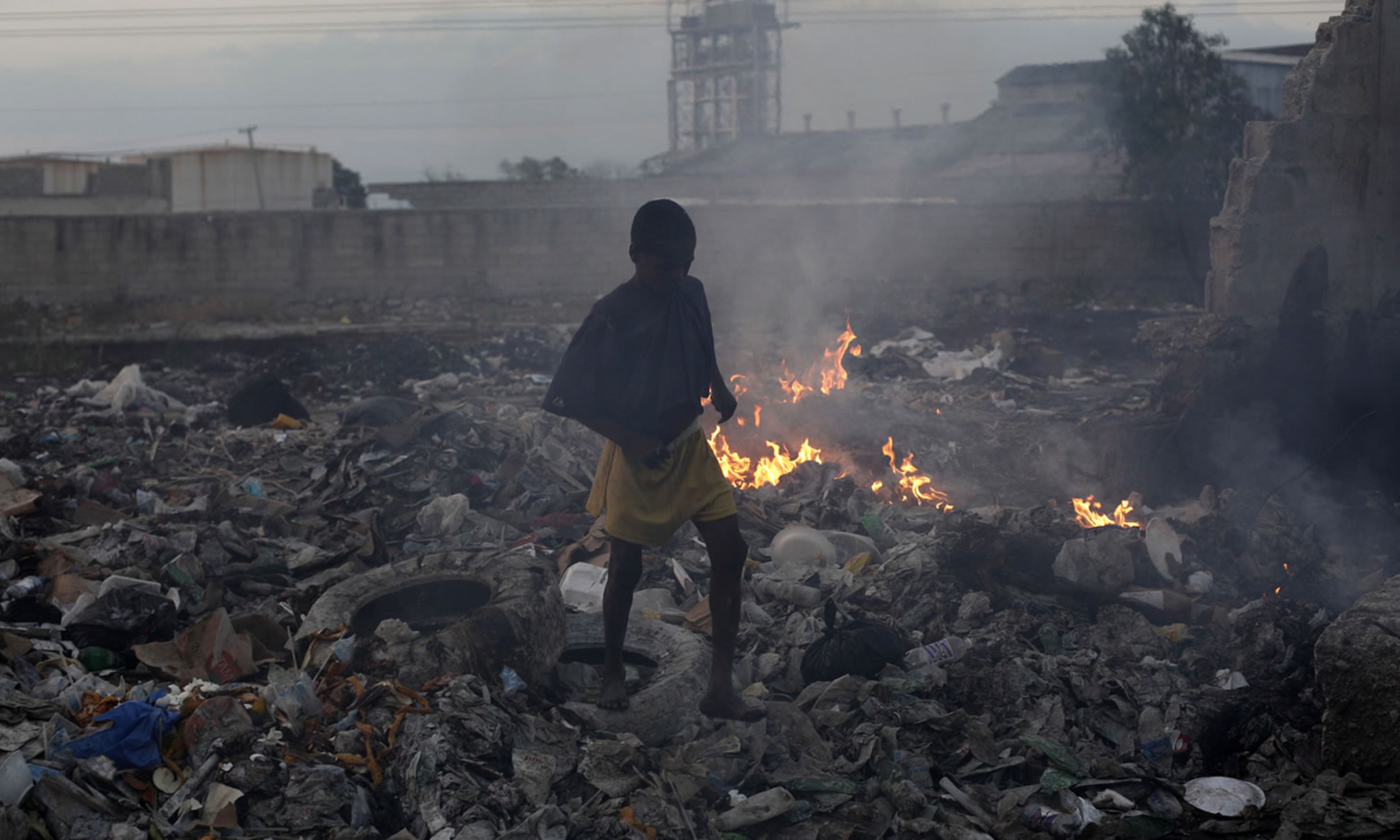
The tragic images we have all seen coming out of Haiti remind us that earthquakes give no respect to political power or reputation. The presidential palace and the U.N. mission tumbled just as surely as one-room shacks; being rich was no protection against nature’s whim. But if there is one thing we do know about natural disasters, it is that a generally wealthier society is more resilient. Unfortunately, the United Nations continues to ignore basic facts about resiliency in favor of politically correct shibboleths.
The Haitian earthquake is certainly among the ten deadliest earthquakes on record. If the death toll tops 255,000, it will overtake the Tangshan, China, earthquake of 1976 as the second-deadliest ever. (It is unlikely to rate higher than the 1556 quake in Shaanxi, China, which killed close to a million people.) Compare those death tolls with that of the great San Francisco quake of 1906, which killed just 3,000, and you will begin to realize that even when quakes of similar magnitude strike similarly large population centers, there is some factor besides earthquake strength and population size affecting the fatality level. That factor is resiliency, and it protects against all natural disasters.
Resiliency is tied closely to wealth. A good example of resiliency in action can be seen in the tale of two hurricanes that struck the Yucatán Peninsula in Mexico. Fifty years ago, Hurricane Janet slammed into the Yucatán and killed 500 people. In 2007, Hurricane Dean hit the Yucatán and killed no one. The hurricanes were identical in speed and intensity. What was different was that in 2007 Mexico had grown richer and invested in institutions to protect its population.
One insurance firm found that when Hurricane Katrina hit, the places that had implemented simple hurricane-loss-prevention methods such as special building codes, improved forecasting, and wetlands protection suffered one-eighth the losses of those that had not done so. By spending $2.5 million, these communities avoided $500 million in damage.
The last hundred years saw a significant investment by humanity worldwide in the institutions of resiliency. That is why, contra the claims of alarmist environmentalists, the death toll from natural disasters fell significantly over that century. One can see this pattern in the United States: The 1906 San Francisco earthquake killed 3,000, but a similar quake there in 1989 killed just 63.
So what are the institutions of resiliency? A 2005 report from the Sustainable Development Network (SDN), prepared for the U.N.’s World Conference on Disaster Reduction, does a good job of listing them. “Disasters and Development,” available at www.policynetwork.net, emphasizes the following.
In general, wealth correlates with greater resiliency. This claim is backed up by data from the Tyndall Centre for Climate Change Research, of all places, which finds a strong correlation between overall poverty and vulnerability to natural disasters (Haiti placed 17th in terms of risk). As people grow richer, they demand more security over uncertainty. They therefore demand insurance, and companies respond by competing for business and making insurance cheaper, meaning a virtuous circle of insurance develops (although this can be broken by government subsidies’ encouraging risky behavior such as building in flood zones). Wealthier people are also more able to help their neighbors via charitable networks (although, again, these can be disrupted by government’s taking over charitable roles).
Further, the institutions that encourage wealth and the development of insurance markets and charitable networks are similar across the globe. Property rights resolve competing claims over resources; poor countries almost universally lack well-defined, readily enforceable property rights. Contracts underpin the functioning of markets and are an essential part of freedom of association. The rule of law guarantees transactions and keeps contracts free from political interference. Open trade encourages competition, fosters innovation, and enables people to convert the wealth represented by their property into capital. Good governance, enabled by transparency and accountability among officials, is also crucial.
Corruption can undermine or even eliminate all of these institutions. In fact, there is a very strong correlation between countries’ vulnerability to natural disaster and their ratings on Transparency International’s annual Corruption Perception Index. Its 2009 survey found only seven countries out of 180 with a worse corruption score than Haiti’s.
As the SDN report concluded, “the ‘solution’ proposed by some politicians in rich and poor countries — more foreign aid — is unlikely to actually improve the situation.” The 2005 conference mentioned above produced something called the “Hyogo Framework for Action 2005–2015,” a 21-page document that includes all the buzzwords about helping to build resiliency but avoids discussing the institutions required for this or even mentioning corruption. Instead, it emphasizes such important factors as that “a gender perspective should be integrated into all disaster risk management policies, plans and decision-making processes.”
This is perhaps to be expected. A less obvious but more pertinent example of how the U.N. approach misses the mark is the prominence given in the SDN report to information management and exchange. Information exchange is indeed critical in the avoidance of damage, but the U.N. report simply ignores the reality of information in poor and corrupt countries, failing to analyze the underlying reasons that information exchange is such a problem in them. As Barun Mitra of the Liberty Institute in India noted when discussing the role of information in the 2004 tsunami:
Centralizing information flow, as most governments in India have tended to do, more often than not defeats the very purpose of that information. In fact, at the end it leaves even the government in a blind. It is no coincidence that even 48 hours after the sea surges, no information was available from many parts of the affected areas, and consequently, speedy relief did not reach these areas.
Simply put, governments that do not foster the institutions of resiliency, and that tolerate or encourage corruption, will not be able to facilitate the free flow of important information. It takes a truly open society to do that. But the U.N. refuses to acknowledge these facts because doing so would elevate Anglosphere values over others, and that is something that the U.N. cannot do.
Bearing this in mind, it should come as no surprise that while the United Nations has supposedly been overseeing the reconstruction of Haiti since 1993, precious little has been achieved in the reduction of corruption or the building of an open society. Much has been made of the lack of enforced building codes in Haiti (as earthquake researchers put it, quakes don’t kill people, buildings kill people). In the absence of good governance and the rule of law, however, a building code means nothing, because an inspector sees permits as a source of income and a builder sees them as a tax to be avoided.
If the poorest nations are to be saved from their vicious cycle of corruption, poverty, and disaster, someone has to take the lead from the U.N. and actually promote the institutions of resiliency. In the absence of anyone else willing to do it (the British Commonwealth would have been well placed, had British politicians not decided to let it wither on the vine), that someone should be America. Congress can instruct USAID and the administration to make resiliency the focus of its overseas aid and disaster-prevention efforts. It could do this by tying aid to the building of the institutions of resiliency and providing frank advice where they are lacking. This may not be a politically correct approach, but it will result in a wealthier, healthier world, and that will be a geopolitical earthquake of a beneficial kind.












Comments