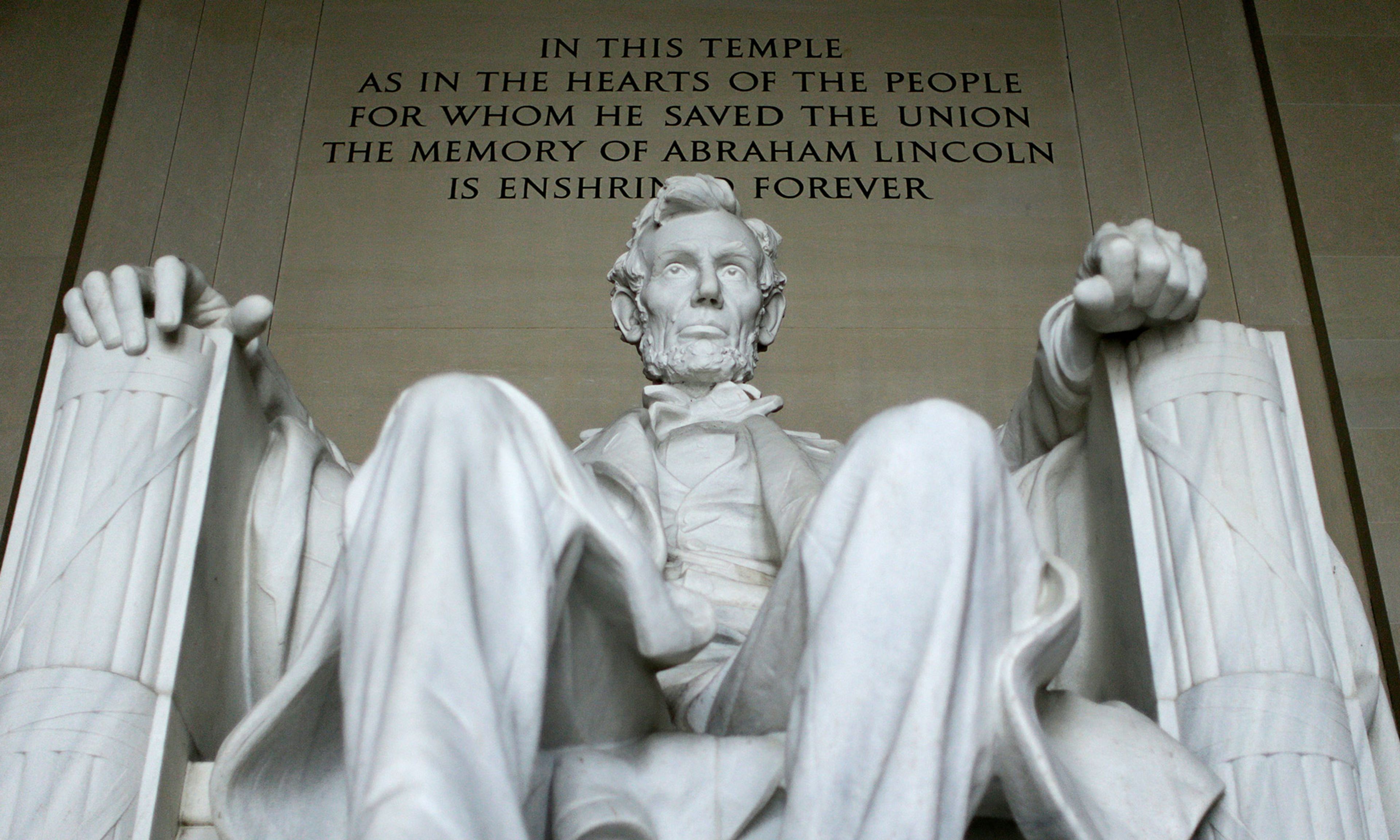
In early February 1861, President-elect Abraham Lincoln sat down in his Springfield law office to write his inaugural address. Since his election the previous November, seven states had seceded from the union, and he knew that nobody would care about his administration’s plans for internal improvements or tariff reform; all the nation wanted to know was what he would do about the rebellion.
The logical first step was to explain why secession was illegal, but as Penn State professor Mark E. Neely Jr. writes in his engrossing new book: “He obtained a copy of the Constitution from his law partner. When he examined it, he discovered, perhaps to his surprise and certainly to his dismay, that it offered no straightforward solution. Even the feeble Articles of Confederation had said at least that the Union was perpetual . . . [but] nothing in the Constitution explicitly declared the Union perpetual.”
Faced with the possibility of asking Americans to die for a principle he had to scratch his head over to explain, Lincoln, ever the resourceful lawyer, came up with several justifications of varying soundness. First, he said, the union’s perpetuity was implicit. Second, since all the states had agreed to create the union, all would have to agree to dissolve it. Third, the Constitution had created a “more perfect union” than the Articles, and how could an impermanent union be more perfect than a permanent one? And fourth, a union that allowed for secession would be absurd on its face, since it could never last. Debatable, to be sure — though, a month after Lincoln delivered his address, Confederate batteries fired on Fort Sumter, making the point academic.
Secession was not the most controversial constitutional question to arise during the Civil War, just the first. The best-known such issue was habeas corpus. In the chaotic spring of 1861, Lincoln suspended the right to habeas in certain areas of Maryland where pro-Confederate sentiment was active, and began arresting suspected insurrectionists. He did so without authorization from Congress, which the Constitution seems to require (Congress, which was not in session at the time, finally gave him the power in March 1863).
Judges, legal scholars, and Lincoln himself supplied learned reasoning to justify the suspension, all of which boiled down to saying: The founders cannot possibly have meant to forbid this, therefore they didn’t. Lincoln was a subtle and eloquent political theorist, but above all a practical man, and he had a war to win. Most of his supporters fell into line, though some turned against the president as he expanded the suspension beyond battle zones and active acts of insurrection and used it throughout the country against merely “disloyal” speech and writings. Before long, newspaper editors, anti-war legislators, and uncooperative judges were being held without charges; in at least one case, an army officer arrested a judge who had arrested army officers who had arrested civilians.
For all the high-profile cases involving purported sedition, though, habeas was most often invoked on behalf of soldiers seeking discharge from the army because they had signed up while still minors. In a number of these cases, the question arose: Did the president have the power to overrule a habeas writ issued by a state judge? It turned out that, with delicious irony, the administration could cite a clear-cut precedent, Ableman v. Booth (1859), in which a state court’s habeas writ for a federal prisoner was quashed — only, in that case, the prisoner was a Wisconsin abolitionist who had helped free a fugitive slave. Wisconsin’s supreme court had ordered the prisoner freed and declared the Fugitive Slave Act, under which he was being held, unconstitutional. The U.S. Supreme Court nullified the writ. So a decision intended to entrench slavery was invoked to support the army that would end it.
Better yet, the Ableman decision had been written by Supreme Court chief justice Roger Taney, of Dred Scott infamy. Until his death in 1864, Taney missed no chance to advance his severe states’-rights views: He wrote one of the first decisions invalidating Lincoln’s suspension of habeas corpus (Lincoln ignored it), and when the army’s right to conscript soldiers was contested, he drew up rulings against the practice, ready for use when a suitable case came before him, though fortunately none did. (In general, Neely notes, the civil rights of soldiers got little attention during the war: Suspected deserters were stripped naked and subjected to an intense spray of cold water, sharp enough in some cases to break the skin, until they confessed.)
Other constitutional issues covered in the book include the shaky legal status of the Emancipation Proclamation (even Lincoln had doubts), the ramifications of the lack of a congressional declaration of war (not very great, it turned out), and the validity of the first-ever federal issuance of fiat money (confirmed on the ground that it was necessary for the war effort and thus for the nation’s survival). A welcome inclusion is the book’s treatment of southern constitutional thought, which was debated in considerable depth before and during the Confederacy’s brief existence. For example, Neely explores Confederate citizens’ uneasy reaction, in a land that had twice rebelled against an overweening central government, when Jefferson Davis suspended habeas corpus in Richmond and began arresting dissidents.
Overall, Neely credits the South with maintaining a genuinely egalitarian democracy (for white males only, of course), an open and spirited debate over secession, and a sincere belief in states’ rights that was not merely a cover for justifying slavery. This last point, as others have noted, was a handicap in building the strong central government needed to prosecute a war: Confederate judges taxed their ingenuity to justify conscription by the central government when states were being left defenseless against Yankee invaders.
At several points Neely takes up the question, much discussed nowadays in historical circles, of whether nationalism inevitably leads to authoritarianism. He answers in the negative, even feeling compelled to point out that “in the middle of the nineteenth century, nationalism was not pathological.” He also dismisses the assertion that southern institutions in all areas of life were designed to mimic the master-slave relationship, another thesis that has recently been fashionable on college campuses.
A more important question for most of us is how the Constitution held up under the strains of wartime. Did it emerge from the conflict stronger because it had been clarified — with the “compact theory” discredited, secession and nullification put to rest, and necessary amendments added? Or did war make the Constitution weaker, because so much fudging had been needed to get around its awkward parts?
The case for stronger: War reinforces the Constitution by focusing attention and discussion upon it, reminding unworldly theorists of down-to-earth realities, bringing open questions before courts for resolution, and inspiring the development of new interpretations and the discarding of old doctrines (the transcontinental railroad could not have been built until secession removed southern constitutional objections). Moreover, the Civil War proved that a constitutional republic could hold together under stress, after mixed experiences globally in that regard in the first half of the 19th century.
The case for weaker, by contrast, is more a case for lost innocence, a realization of the fallacy of thinking that (as Daniel Webster put it during the debate over the Compromise of 1850) “what is right may be distinguished from what is wrong with the precision of an algebraic equation.” The document once thought to be an impenetrable bulwark against invasions of fundamental rights turns out in a crisis to be full of holes — and if the government can get away with violating it during a war, the argument goes, it can do so anytime.
But it doesn’t — and that’s the key. The Civil War’s aftermath, which, tragically, had to take place without Lincoln’s guiding hand, unfolded like the aftermath of many American wars: The grossest violations of civil rights disappeared when the crisis was over, as did (for a while) such unwelcome wartime innovations as federal conscription, paper money, and eventually the income tax; but the overall expansion of federal power at the states’ expense remained. It would be easy for conservatives to decry this, but considering that southern state governments had allowed the enslavement of a large part of their population and led their people into a suicidal war, it’s hard to argue that the shift was all bad.
In addition, while federal power tends to expand following a war, so does nationalism — or, as conservatives would call it, patriotism. This gives liberals something to gripe about too. As always, however, we should be wary of generalizing from past wars to current ones; among other differences, past wars usually had an end.
In the final analysis, most constitutional debates boil down to a question of rules vs. tools. The first of these approaches sees the Constitution as a set of rules that must be followed scrupulously and exactly, however odd or quaint they seem, until they are changed. The latter views the Constitution as a box of tools that can be wielded to achieve a desired result, and if you have to use a chisel as a screwdriver and drive nails with a pair of pliers, it’s okay so long as you don’t need too much duct tape to hold it together. The unique stresses of war test and refine our principles regarding how strictly we follow the rules and how far we allow the repurposing of tools.
As Robert VerBruggen wrote in these pages (Nov. 15, 2010), discussing Brown v. Board of Education: “In its fight against racism, America has used highly questionable means at key junctures — means that were legitimate only because of the extreme severity of the wrong they sought to remedy.” Fiddling with the Constitution must occur only in response to a great emergency or a severe long-term problem where every other avenue has been exhausted, not as a shortcut for impatient reformers. If we always apply this severe criterion before we reluctantly resort to bending the Constitution, we will be assured of still having a Constitution to bend.












Comments