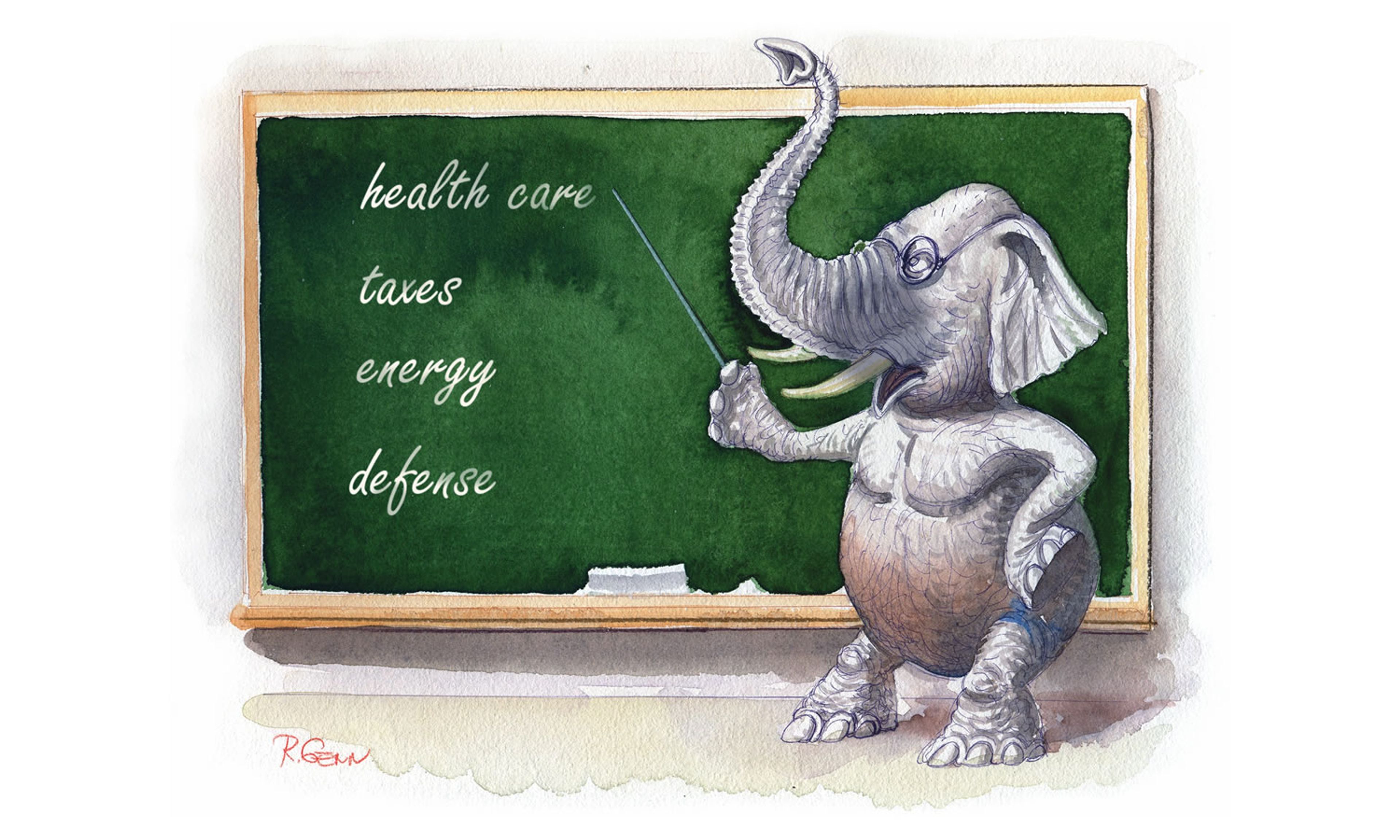
Republicans can look forward to going into opposition under President Biden with equanimity and even optimism. They have dealt with Democratic presidents twice during the last 40 years, and both spells in opposition can reasonably be judged to have been successful.
After two years of Bill Clinton in the White House, Republicans had a majority in both houses of Congress for the first time in 40 years. When his presidency ended, they still had a majority in Congress, and regained the presidency. They made big gains in state legislatures and governorships, as well.
Their experience during Barack Obama’s presidency was similar. They took the House and made gains in the Senate in the first midterm, and finished his presidency with a majority in both chambers and a Republican replacement for him. State races went very well for them, too.
At the start of those two previous Democratic presidencies, Republicans engaged in some ruminations about whether their party had a future. Both because they know how those chapters in American politics ended and because they think Donald Trump lost the election for reasons peculiar to himself, they are less motivated to do any rethinking now.
The obvious lesson for Republicans is to dust off the old British political maxim that “the duty of an opposition is to oppose.” Oppose Biden’s tax increases. Oppose his environmental regulations. Oppose his health-care program. Oppose his judicial nominees. Oppose his immigration proposals. Oppose him on almost every point.
Defeat Biden on some of these issues, and it will demoralize Democratic voters while invigorating Republican ones. Put up a strong but losing fight, and his victories will make Democratic voters complacent while enraging Republican ones. Cooperate with Biden, on the other hand, and you make him look moderate, give him a success, and annoy some of your own supporters.
The basic electoral logic of this oppositional stance is hard to dispute, which is why both Republicans and Democrats in our polarized era have increasingly adopted it when out of the White House. It will serve Republicans well given that most, and probably the vast majority, of Biden’s agenda will deserve rejection.
It does, however, create some hazards. It is a better fit for the British than for the American political system, which gives the head of government much less power over the legislature. Every incoming president in the era of polarization has had a Senate majority of his own party, which has made it possible to staff the cabinet without too much difficulty. If a president comes to power without a friendly Senate majority, a default of opposition could create executive dysfunction.
Opposition parties can also be tempted to decide that opposing is enough: that they can dispense with having agendas of their own besides winning elections. Republicans are more likely to run without policy agendas than Democrats. The party of government never lacks ideas on how to spend other people’s money or boss them around. Conservatives spent years honing their suspicion of “constructive Republican alternative proposals” (note the acronym) that tried to offer voters a little more welfare state on the cheap.
But both parties sometimes have reasons to choose silence. Whether to answer a particular proposal with a counterproposal is, of course, a political decision that depends on the circumstances of the case. In 2005, congressional Democrats, led then as now by Nancy Pelosi, made a conscious decision not to respond to President George W. Bush’s proposal to reform Social Security with alternative ideas of their own. They instead denied that there was any need to act.
It was the right call from the standpoint of Democratic political interests, if not that of the public fisc. It let them concentrate their fire on the drawbacks, real and alleged, of the Republican proposal, instead of having to compare the pros and cons of two different ideas. It blocked any possibility of compromise that Republicans could have called a victory or even a partial victory.
Republicans took a similar tack in 2009, when President Obama and congressional Democrats were trying to overhaul the health-care system. House Republicans advanced a very limited proposal that would have done little, even on the most optimistic projections, to enable people who lacked health insurance to get it. After Obamacare passed, Republicans pledged to repeal and replace it but never united behind a proposal to do so. Most of them never backed any specific plan.
Keeping the replacement at the level of a slogan had several advantages. Republicans avoided the attacks that an actual plan would have drawn and kept the political debate focused on the defects of Obamacare. They didn’t have to resolve their differences of opinion about how high a priority it should be to ensure high levels of insurance coverage, or think through the vexing question of alternative ways to protect people with preexisting conditions. They left room for the eventual Republican presidential candidate to advance a plan of his own.
The immediate disadvantages were that Democrats (and the press) could either point out, accurately, that the Republicans had no plan or fill in the blanks themselves with a nightmare version of a Republican plan. But Republican election victories during the Obama administration appeared to vindicate the party’s strategy.
Until, that is, Republicans swept the 2016 elections and found that people expected them to make good on their promises. Then their failure to think through health policy in opposition cost them. They ended up with legislation that was unpopular, that couldn’t command a wide consensus within the party, and that couldn’t pass. The years 2017 and 2018 were the only two between 2006 and 2025 with unified Republican government, and the party wasted much of its opportunity.
The Republicans were less policy-oriented in opposition to Obama than they had been in opposition to Clinton — remember the Contract with America? — and that trend continued even while they held power. The lesson Republicans took from the health-care fiasco was to run further away from policy agendas. They enacted one major piece of legislation (the tax reform of 2017) and several minor ones, but by 2018 they were running to keep their majorities without telling voters that they would use them for any purpose.
And this evasion went far beyond health care. Immigration has become an issue of increasing importance for Republicans, especially during their time under Trump’s leadership. But Trump moved from calling for major cuts to legal immigration to calling for more legal immigration than ever, and never made it clear whether requiring employers to check the legal status of hires was a priority of his. The party as a whole was hardly more coherent on the subject.
The Republican turn away from policy may also have contributed to how sour and unproductive our political life has gradually turned. A party that is not focused on specific goals will not easily be able to judge that a compromise is acceptable; it doesn’t know what it wants in the first place. Its leaders will never be able to demonstrate success, even partial success, if it has no picture of what success would look like.
So there is a solid case, rooted in political self-interest, for Republicans, as they oppose Biden this time, to say not just what is wrong about his policies but what they would do differently: not answering each Biden proposal with one of their own, necessarily, but laying out the most important changes they want to see in what government does. And there is an additional reason to engage in this work. If those of us who are not progressives don’t have a different sense of how our country should be governed, and aren’t willing to put our thinking into effect, then why are we engaged in politics in the first place?











Comments