A postcard from Upgraded America, our new and improved country where everything that used to be simple has become as overcomplicated as possible . . .
It began with reading glasses. I needed stronger ones but my old independent optician had retired so I made an appointment at a regional chain. The first thing they asked for was an insurance card. I did a double-take; in my world you pay your optician the way you pay your dentist — i.e., you pay them. I said I was self-pay. Next, they asked for two picture IDs, and finally my “D.O.B.” to prove I was not an identity thief or a terrorist. If you rattle off the month, day, and year of your birth rotely, without thinking, it must be yours. (P.S. Using it in reverse as the password for a bank account can slow you up.)
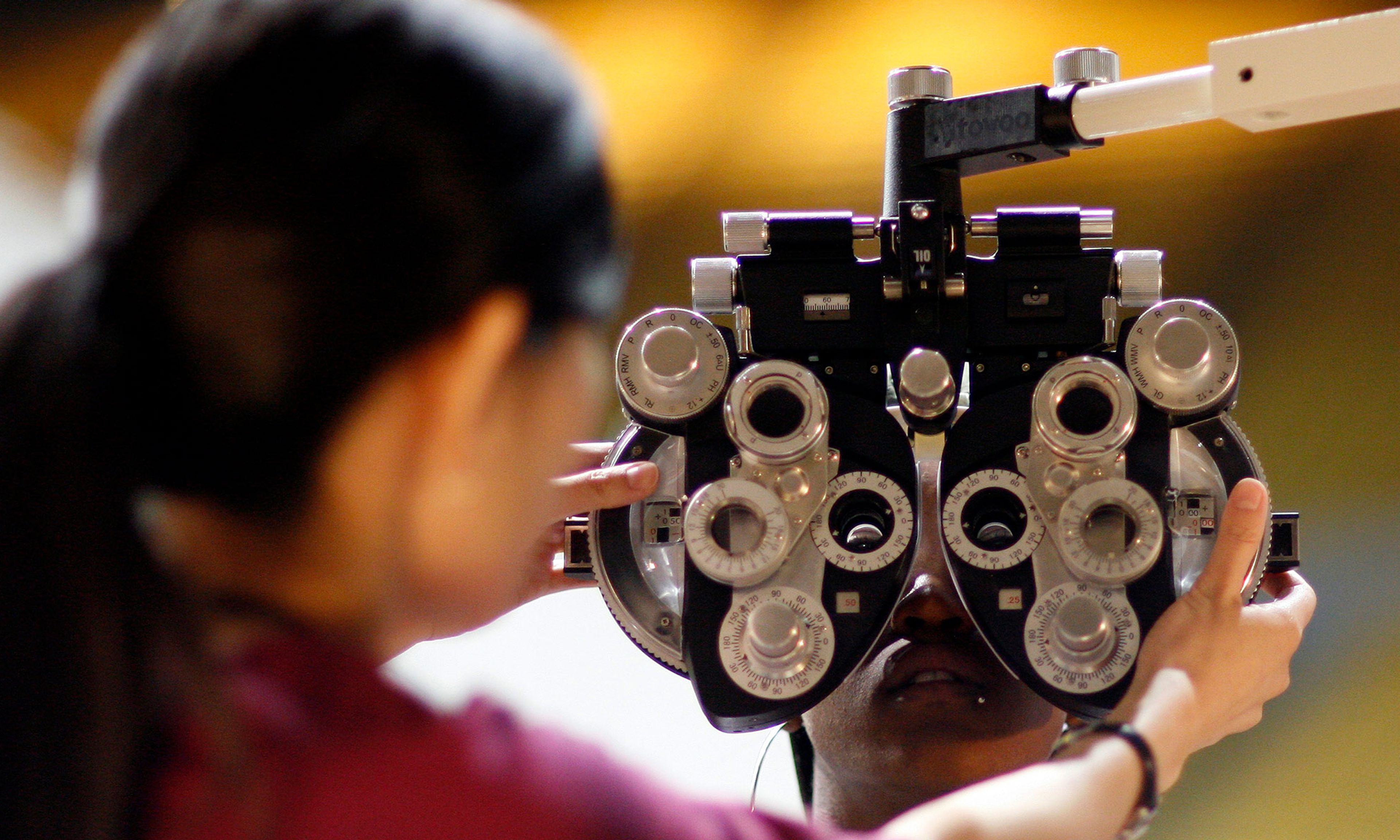
Every eye exam I’ve ever had consisted of the wall chart, the cover-one-eye test, the set of which-is-better lenses, and the puff-of-air test for glaucoma. This new exam was taking longer; more machines and boxes to look through, and the examiner kept putting drops in my eyes. “We’re testing for cataracts,” she explained.
I already knew I had mild cataracts; my regular man had said they were a common problem of advancing age. I told the new examiner the only test I had expected was the puff-of-air, but she brought out her royal “we” again: “We don’t do that now.” Presently she said, “You have cataracts” and went into an upbeat sales pitch. When she uttered the word “surgeons” I exploded. “I came here for reading glasses, not Lasik surgery!”
Before storming out I got a big discount on the cost of the exam for paying cash in full. Outside, I saw a sign I hadn’t noticed before or I wouldn’t have gone in: BOTOX. I bet they were going to pitch serial facelifts too.
I tried another, recommended place. The first phone call went well: no eyedrops, just “the camera,” and no Lasik pitch. I made an appointment, but the next day a second woman called to remind me to bring “a list of the medications you are taking.” The drift into white-coatish doctordom set me off again. Why did they need to know this? She talked in general terms about allergies, side effects, and drops. Finally she answered my main question: “I don’t know of any ‘opticians’ who just do glasses anymore. The field of optometry is so advanced now.” I broke the appointment.
Today’s latest white-collar sin is “résumé padding” but what I ran into is the far more widespread “image padding.” Designed to make a service-job future palatable in a Horatio Alger nation, image padding calls a clerk a “sales associate” and a bookkeeper an “economic-resources overseer,” and guarantees that a secretary will never be just-a-secretary. America’s only title is “Doctor,” so medical analogies are especially popular with image padders, hence the swarm of “interns” in every field all training to enter a “profession.” If they need extra training to qualify for a padded image they can take a two-year course leading to a certificate at one of the many new “Centers” and “Institutes” that used to be called “trade schools” until they padded their own image.
Stressed out by my safari through the advanced field of optometry, I decided to put glasses on hold for a while and learn the new, improved Windows 7 operating system on my new laptop.
I don’t care how much they “improve” the bells and whistles I never use, but I am totally dependent on WordPad. I have used it through three versions now and it was always the same: complete toolbar at the top with every icon and every printed command in view at all times — you could do everything on one screen.
Now it takes three screens, or “ribbons.” You have to switch back and forth to do various tasks; cut and paste on one ribbon, size and font on another, Save and Save As here, italic and bold there. It’s the Microsoft version of putting away their underwear. Instead of dumping it all in one bureau drawer, they put the jockeys in one bureau and the boxers in another. Then they separate the jockeys into regular and bikini and the boxers by whether they have little hearts or little teddy bears on them. On it goes, until they have beaucoup bureaux housing one simple garment.
The software field already has the gold standard of images so we are overrun with “software engineers,” all seeking great careers with job security. They find them by making sure that everything that ain’t broke gets fixed anyway. The Computer Mafia knows it can make more money by discontinuing popular programs. They don’t just discontinue them, either; they go at them as Rome went at Carthage: tear it down brick by brick, stone by stone, and sow every acre with salt. Then they immediately rebuild it with new bricks, new stones, sow every acre with horses**t, and call it “new and improved.”
I went into a blue funk. Usually I get mad but this time I got depressed. There was only one cure, and so, squinting a little, I reread it: John Galsworthy’s essay “Quality.” It’s about a bootmaker in a shabby shop who simply drew an outline of a customer’s foot with pencil and paper and measured his leathers with an old piece of string, yet his boots “fit so perfectly that the wearer might have thought he had forgotten to put them on.” He refused to advertise, insisting that the quality of his boots was self-evident. So was the quality of his character: At the slightest complaint, he refunded the entire price and made another pair free. In the end, he’s driven out of business by advertisers and dies of slow starvation.
In his day, had he made eyeglasses, he would have been called a “lens grinder.” I wish he were here.












Comments