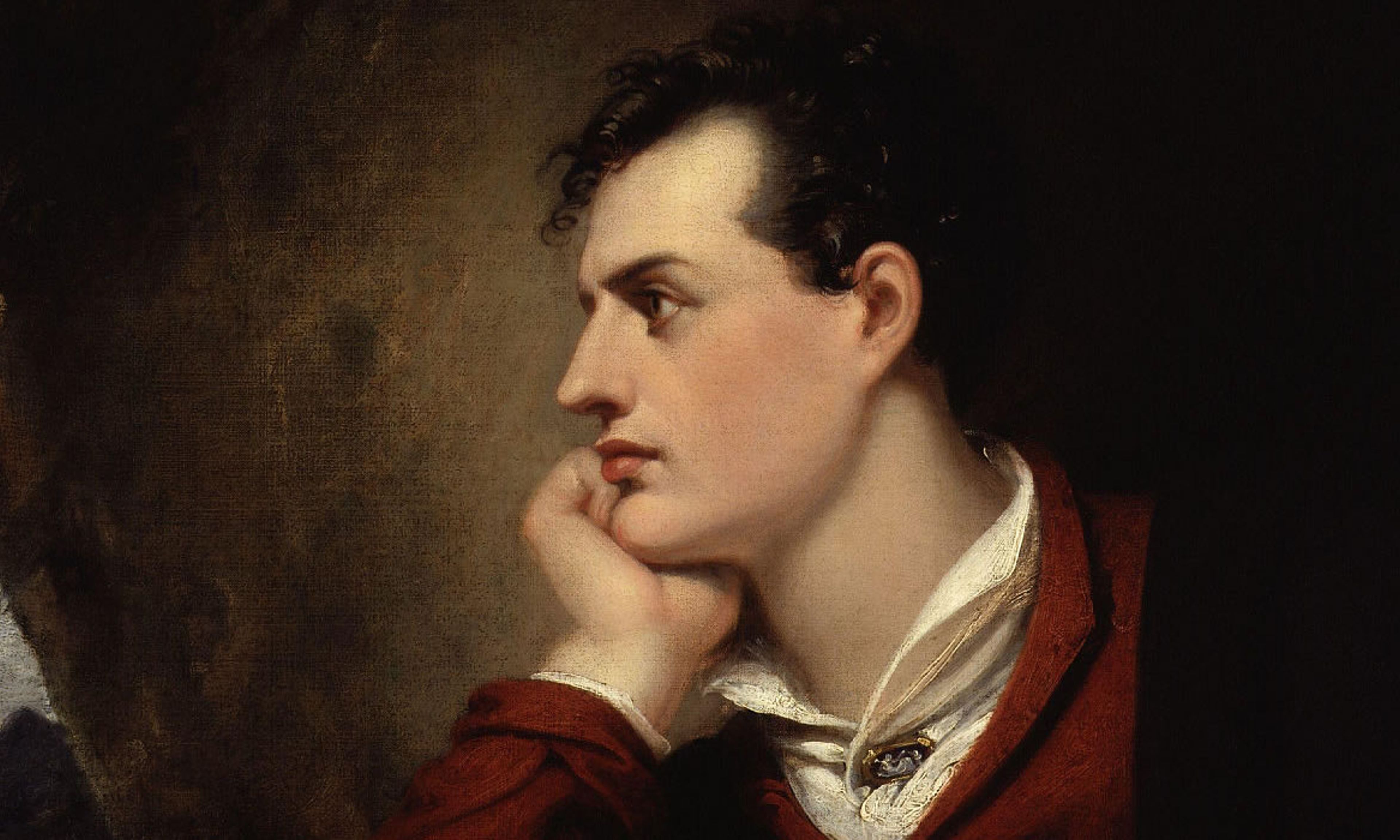
Byron has his memorial among the honored national poets in Westminster Abbey. How this would horrify him! He mocked fame and society, and accused everyone respectable or ordinary of cant and hypocrisy. A cynic through and through, he particularly loathed enthusiasm of any kind, or “entusymusy,” as he called it. It amused him to think of poetry as “poeshie” or even “brain-money,” and he downgraded Don Juan, his masterpiece, into “Donny Jonny.” Southey, the poet laureate of the day, was the butt of Byron’s satire at its most savage; Keats, he thought, wrote “piss-a-bed” stuff; and “Turdsworth” was his name for Wordsworth. His own life was short, dissolute, and ultimately broken — a cautionary tale of how not to live. Yet to read him is still to be struck by the ease of his writing, its conversational tone and immediacy, the unexpected and unforced rhyming of his poetry, and the brilliance — no other word is right — of his enormous correspondence. Indisputably this casual monster had his share of genius.
There was one thing he took seriously, however, and that was his rank. In letters to anyone who might be mistaken on the matter, the profession “peer of England” appeared under his signature. A capital B with a coronet adorned his bed. Byron assembled a group of friends with whom he kept in touch all his life, and one of them was John Cam Hobhouse. When these two went on their travels in 1809, Hobhouse reported, Byron “gave me a lecture about not caring enough for the English nobility.”
It was Byron’s good fortune to have been born in 1788, at a moment when England was on the threshold of riches and imperial power, and a British peer could take for granted the respect of the rest of the world. Byron was ten when he inherited his title, as well as Newstead Abbey, a huge but dilapidated house and 3,000 acres near Nottingham, and a property in Lancashire with valuable coal mines. The outward show was misleading: The Byrons had “bad blood,” in a phrase of the era. The previous Lord Byron, the poet’s great-uncle, had murdered his neighbor at Newstead in the course of a quarrel about how to hang game. The poet’s father married for money, destroyed his wife’s fortune, and died alone in poverty and exile. Byron never knew his father, and was brought up by a fond, feckless, and financially ruined mother.
Another in the group of close friends was the Irish poet Tom Moore, and he wrote the first biography, deliberately out to romanticize whatever had gone wrong. Reviewing it in 1831, Macaulay, the historian, wrestled with the paradox that a man as gifted as Byron should have had “so dark and sad a story. . . . He was truly a spoiled child, not merely the spoiled child of his parent, but the spoiled child of nature, the spoiled child of fortune, the spoiled child of fame, the spoiled child of society.” Intellectual power and moral depravity combined in him to produce a system of ethics, Macaulay judged, “in which the two great commandments were, to hate your neighbor and love your neighbor’s wife.”
This spoiled Byron never questioned his privilege to do as he pleased, and everyone he encountered was to defer to him. He resisted formal education, learning at Cambridge only how to strike a pose, for instance by having a tame bear as a pet. At the time he could write, “I consider myself as destined never to be happy, although in some instances fortunate. I am an isolated Being on the Earth, without a Tie to attach me to life.” Here was the self-dramatization characteristic of the whole Romantic movement then captivating Europe. His adult life was to prove an obsessive sexual experiment with men and women. “I am tolerably sick of vice, which I have tried in its agreeable varieties,” he was to confide in one of his letters. At age 23, he could inform Hobhouse that he had already, on his travels, “had a number of Greek and Turkish women, and I believe the rest of the English were equally lucky, for we were all clapped.”
London society and the press were soon to resound with the scandal gathering around him. “I will never live in England if I can avoid it. Why — that must remain a secret,” he wrote to his man of business. According to modern biographers, all this hints at a homosexual relationship with a choirboy in the university whom Byron claimed to have met there every day. A suggestive letter to a friend mentions that he was writing a treatise titled “Sodomy simplified or Paederasty proved to be praiseworthy from ancient authors and modern practice.” A good-looking page, Robert Rushton, accompanied him on a number of journeys, and in Greece at the end of his life Byron spoke and wrote of his unrequited love for a 15-year-old Greek boy to whom he was to bequeath money.
Childe Harold’s Pilgrimage, published in 1812, was the long poem inspired by Byron’s journeying in the Ottoman Empire, especially Greece. Byron recorded that he awoke to find himself famous. One line in it, “I have not loved the world, nor the world me,” again summarizes Romanticism, and Byron himself affirmed that “the poem hit the taste of the age.” In 1814, his new long poem The Corsair sold 10,000 copies in a single day, and seven editions in four weeks. The blend of melancholy, bravado, and exotic storytelling gave Byron the sort of international celebrity that film stars and pop musicians enjoy today. Madame de Staël in Switzerland, Pushkin in Moscow, the Frenchmen Stendhal and Lamartine — all read him with admiration. Schumann was to burst into tears at a reading of one of Byron’s later plays. Mazzini acknowledged his genius. “Byronic” became an adjective recognizable internationally. In Weimar, Goethe, the most eminent literary man of the period, was almost alone in singling out critically Byron’s political radicalism: “Lord Byron is only great as a poet; as soon as he reflects he is a child.”
Suddenly London was full of hostesses inviting Byron, and young women throwing themselves in paroxysms at his feet. Among the latter was Lady Caroline Lamb, the wife of William Lamb, later Lord Melbourne and prime minister. Passionate and unbalanced enough to stab herself with a penknife and to send Byron some of her pubic hair, she nonetheless earned immortality with her description of him as “mad — bad — and dangerous to know.”
While coping with Lady Caroline, he was having an affair with Augusta, his half-sister four years older than he. The daughter of Byron’s father by a previous marriage, she was the wife of a somewhat colorless Colonel Leigh. Long after Byron and Augusta were both dead, her daughter, Medora Leigh, continued to assert that Byron was her real father. As though his love life were not complicated enough, Byron decided to marry yet another young woman, Annabella Milbanke. Far from courting her, he seems to have been brutally inconsiderate. The story goes that he did not speak to her in the carriage taking them on their honeymoon, and that he ravished her on a sofa and then told her to find another bedroom as he did not want her to see his deformed foot. A few days after his wedding, he could write to his confidante Lady Melbourne — the mother-in-law of the now-rejected Lady Caroline, and also a relation of Annabella — “I got a wife and a cold on the same day — but have got rid of the last pretty speedily.”
A year or so of marriage, and the birth of a child, was enough for Annabella, who walked out without warning, the first person ever to stand up to Byron. For the rest of their lives, Augusta and Annabella obfuscated whatever had really happened, but it was generally believed that Byron had committed incest with Augusta and had forcibly sodomized Annabella, which explained her leaving him so abruptly. Ostracized, condemned where previously he had been applauded, he tried to recover by writing his memoirs, and these were presumably confessional. His friends, including Tom Moore, Hobhouse, and the publisher John Murray, are known to have read them. In a notorious act of literary vandalism that points to a conspiracy to protect Byron, they burned the manuscript. Edna O’Brien, the novelist, is the latest author to examine the available evidence, in her new and objective book, Byron in Love: A Short Daring Life (Norton, 256 pp., $24.95); and her conclusion is also that the charges of incest and forcible sodomy are justified.
“I was born for opposition,” Byron said and may well have believed, but he was standing on the privilege of being an English peer only to pose as though he were no such thing. His radical politics were all of a piece with his sexual license. Living through the French Revolution and the Napoleonic Wars that followed it, he declared himself a Jacobin and sighed for a republic. He took advantage of his hereditary seat in the House of Lords to speak for men so frightened of the Industrial Revolution that they were engaged in breaking machinery — an ignorant mob, of course, rather than real rebels. In poems and epigrams, he incessantly ridiculed favorite hate-figures of his, such as the Prince Regent and the foreign minister, Lord Castlereagh. The “freedom” for which he was agitating so strongly remained conveniently abstract, a mere slogan. Bertrand Russell, of all philosophers, pointed out that Byron’s concept of freedom was the same as that of a German prince or a Cherokee chief: the pleasure of doing as one pleases and not having to account for it.
In the course of the prolonged struggle between the nations, Napoleon could have destroyed conservative England, and this was Byron’s wish. In the days leading up to the decisive battle of Waterloo, Byron was writing of Napoleon, “All seems against him; but I believe and hope he will win.” British victory then made Byron “damned sorry.” Don Juan has a sarcastic couplet addressed to the Duke of Wellington, victor in that battle: “And I shall be delighted to learn who, / Save you and yours, have gained by Waterloo?” That poem characteristically makes fun of Wellington’s nose as the hook on which to hang the whole of Europe. Wellington, the archetypal high Tory, repaid Byron with some finality: “There never existed a more worthless set than Byron and his friends, for example — poets praise fine sentiments and never practice them.” Revealingly, Byron ordered a copy of Napoleon’s traveling coach, costing £500, an immense sum at the time. Adopting the name Noel for financial reasons, he took to signing himself “NB,” the initials he shared with his hero.
In 1816, Byron left England in a swirl of gossip, controversy, and disgrace; and he was never to return. First in Switzerland, then in Italy, he played the Milord on a permanent Grand Tour. At times, debauchery appeared his sole purpose. One of the women who threw themselves at him was Claire Clairmont, of whom he wrote: “A man is a man — & if a girl of eighteen comes prancing to you at all hours — there is but one way. . . . The next question is, is the brat mine?” In two years in Venice, he confided to a friend, he had spent £5,000, more than half of it laid out on women: “I have had plenty for the money, that’s certain — I think at least two hundred of one sort or another — perhaps more, for I have not lately kept the recount.” “In Italia mille tre” was the boast of Mozart’s Don Giovanni.
Reassembling on the Continent, the set of friends now included Shelley, a genuine rebel. Admiring Byron, he also observed in him the “canker of aristocracy,” evident in the daily circus of Byron’s numerous servants, his ten horses, and his menagerie of dogs, cats, and birds. Building a boat in emulation of Byron, Shelley set sail in a storm and was drowned, paying the price, like so many others, for having been caught up in Byron’s life. In a scene that ever after symbolized the Romantic age, a funeral pyre was lit on the beach for Shelley’s washed-up corpse, whereupon Byron wandered away and swam out to his own yacht, in the water for so long that he became sunburned. His mistress saved a piece of his blistered skin.
In Italy, Byron was one day introduced (though in French) to Countess Teresa Guiccioli as “a peer of England and its greatest poet.” She was yet another neighbor’s wife to be seduced and she too was unable to hold him. Revolution against Austrian occupation and Bourbon local rulers was in the air. Imagining that his idea of freedom was coming true, he went out riding in the woods with loaded pistols and a sword, met up there with would-be revolutionaries, offered them money, and arranged for them to stack arms in the country house of Teresa and her husband. The despised authorities had no trouble dispersing these amateurs and moving Byron away.
Back in London, the Greek Committee was established to fight for Greece’s independence from the Ottomans. Here was a more rewarding cause than anything in Italy or South America, where Byron also thought of venturing. Several of his friends were members of this committee, and they arranged for him to be their official agent in Greece, well aware of the publicity he was bound to attract. He spent a fortune on specially designed helmets and uniforms, and on the costs of the voyage. Eventually he established himself on the Greek mainland at Missolonghi, more a mud-patch than a proper town.
There he subsidized Greeks and wild Albanians, irregulars who valued his money far more than freedom. He imagined himself at the head of Byron’s Brigade, leading a charge and driving the Turks out. Reality overtook this fantasy when he caught some sort of fever and suffered mysterious and fatal convulsions. A lonely and untimely death followed; he was only 36.
The Greek Committee and his friends were quick to build the legend that Byron had sacrificed himself in the cause of Greek independence, a hero and a martyr for the sacred ideal of freedom. So he entered history. Nationalists everywhere have perceived him as a model. A Communist leader in the Spanish Civil War asked for a poet as famous as Byron to come forward and volunteer to die for that cause.
Successive generations ever since have accepted the Byronic myth in full. Byron opened the way for men and women everywhere to indulge in whatever they like without moral judgment or acceptance of responsibility. Conduct that was once offensive has become commonplace. The outrage and destructiveness that surged around Byron have long dissolved into a sense that his poetry is a full and complete justification of the man. Radical politics like his have become a standard intellectual property, and transgression in personal relations and matters of art is considered perfectly normal, altogether in the order of things. Where once this singular English peer staggered the world by abusing the privileges of his class and his times, now innumerable demotic copycat Byrons feel born to opposition of their society, and they too have no idea that they are spoiled, abusing the very things that have protected them and made them what they are.












Comments