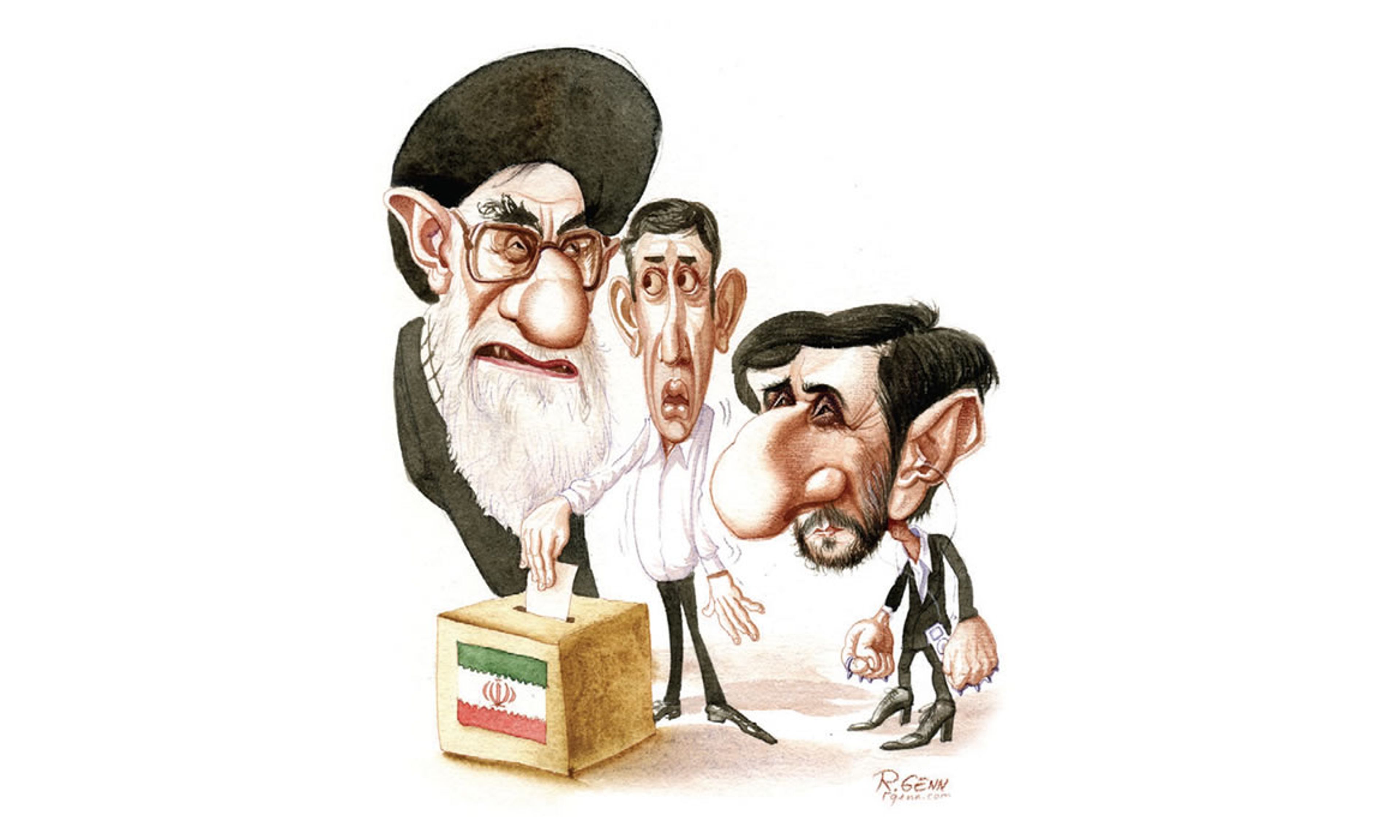
The rigging of an election requires a subtle mix of expertise and effrontery, and Iran has just shown what it can do in that respect. The regime is truly a master of deception, and way ahead of everyone else when it comes to adopting the air of injured innocence in response to reproach. Reelected, like every previous president of the Islamic Republic since 1981, Mahmoud Ahmadinejad is due to be in office for another four years. At press conferences characteristic of the man, he has been taking the line that all this talk about rigging is a conspiracy on the part of Western media and other “oppressors” (now who would they be?); meanwhile he will be preparing for the return of the Hidden Imam, and of course getting on with the business dearest to him: completing the country’s nuclear program and destroying Israel.
The regime’s structure of power has been designed to create and maintain a totalitarian state. Iran is in the hands of a one-man ruler: Ayatollah Ali Khamenei, designated the “supreme leader.” His will is absolute, and the president is merely the official responsible for putting into practice his policies and decisions. Somewhat disguised under clerical robes and turbans, this is an Islamic version of precedents such as Nazi Germany or the Soviet Union — not so powerful, of course, but equally assertive that whatever means it adopts are justified by ideological ends. Law and order is therefore a matter for the state’s special units, the Revolutionary Guards and the paramilitary basij, comparable to the Gestapo and the Soviet KGB.
Ayatollah Khamenei evidently believed that the maneuver for electing the president could be carried out as usual to give him the preordained result. Khamenei may even believe that he is popular, respected, and infallible. So an election with the superficial air of a contest was arranged. As many as 475 candidates put their names forward (42 of them women, naturally all rejected), only to be whittled down to Ahmadinejad and three senior members of the establishment, each with impeccable Islamic credentials. On the day President Obama delivered his speech in Cairo calling for a new beginning in the relations of the United States and the Muslim world, Khamenei took the opportunity to say that the main criterion of change would be the attitude of the United States toward Israel, which he chose to describe as “the cancerous growth in the heart of the Middle East.”
Khamenei and Ahmadinejad were evidently confident of coasting to victory on all fronts. When Obama then said of the coming election, “Whoever ends up winning, the fact that there has been a robust debate hopefully will advance our ability to engage them in new ways,” he can only have reassured them further.
Yet an election, even in controlled circumstances, can have unforeseen twists and turns, and this one was such a case. One of the three selected elders, Mir-Hossein Mousavi, is a former prime minister. Held responsible for ordering the killing of Iraqi prisoners during the war with Saddam Hussein, he is no sort of liberal. Quite unexpectedly, he turned out to be able and willing to criticize Ahmadinejad and, by implication, the power structure. It was a striking novelty that his wife, Zahra Rahnavard, campaigned for him with humor and as much feminism as circumstances allowed. Probably not much more than 10 or 15 percent of the 43 million voters support the supreme leader and Ahmadinejad. About as many Iranians resolutely oppose them, and Mousavi found himself their spokesman. Suddenly two blocs had formed, one consisting of people without the education to question what Ahmadinejad was telling them and the other a vehicle for those who understand that the regime’s domestic policy is incompetent and oppressive, and that its foreign policy is placing their lives in danger. The level of distress and anger thrust the role of reformer onto Mousavi, perhaps to his surprise.
Amnesty International is only one among several authoritative sources to report that Iran has “a backdrop of discrimination, worsening repression of dissent and violent unrest. . . . The country has witnessed the arbitrary arrest and harassment of activists and members of minority communities, censorship, armed attacks and suicide bombings.” One such minority community is the Baluchis, who, as Sunnis, consider themselves persecuted by the Shiite majority. Recently a Baluchi group, the People’s Resistance Movement of Iran, launched a suicide-bomb attack on a mosque in Zahedan, the provincial capital of Sistan-Baluchestan, killing as many as 25 and wounding dozens more. Less than 48 hours later, three men were captured and “confessed” to the deed, whereupon they were instantly hanged in public near the site of the attack. This led to more unrest, with ten people killed and dozens arrested.
In May, a woman by the name of Delara Darabi was hanged. She was 22. Some years previously, while still a minor, she and her boyfriend supposedly murdered a cousin of her father’s and stole some jewelry. In prison, Delara Darabi became known nationally as a poet and painter. Before executing her, the prison governor telephoned her mother to gloat that there was nothing she could do and nobody to appeal to. The boyfriend was sentenced to ten years in prison. This case caused widespread outrage. Very few countries now have the death penalty for juveniles, but, again according to Amnesty, there are at least 135 minors on death row in Iran.
The list of injustices is long and lengthening. Mobilizing the many people with assorted grievances and fears, Mousavi became the head of a so-called “green movement” — green for Islam rather than environmentalism — analogous to the “velvet” and “orange” revolutions that have democratized what was Soviet Europe. The political chief of the Revolutionary Guards lost no time warning that he would crush any revolution against the Islamic system on the part of Mousavi’s green movement. In an analogy with how protest once evolved in the Soviet Union, “Islamism with a Human Face” began to appear a possibility.
A totalitarian regime can be overthrown by war, as Hitler’s Germany was. In the case of Iran, this option is almost unimaginable, though the American invasion of Iraq in 2003 evidently alarmed the supreme leader enough to cause him to suspend the nuclear program temporarily. A more realistic alternative is collapse from within, as happened in the Soviet Union. Elections were the cause of it. Mikhail Gorbachev took it for granted that the party’s control was so absolute that Boris Yeltsin could be allowed to run against it. But as soon as Yeltsin was in a position to criticize the party and offer an alternative, Gorbachev’s precautions proved useless, and power drained away from him. Finally, the decision not to repress Yeltsin led with irresistible political logic to the downfall of the Soviet Union and everything it had stood for.
The supreme leader and his apparatchik Ahmadinejad took precautions. Ahmadinejad accused Mousavi of Hitler-style smears and falsification, and of having Zionist links. The Iranian ballot is not secret; voters can be identified and punished if need be. Huge numbers of blank ballot papers were available to the authorities, while websites, suspect publications, and communications systems were closed down. Foreign monitors were forbidden. When the votes were counted, Ahmadinejad was found to have about 63 percent, with a majority in every sector — ethnic minorities, women, students, and so on. Mousavi received about 33 percent; although he is an Azeri, he was declared to have been outvoted in his own Azeri-dominated province, confirming the zeal of those who arranged Ahmadinejad’s landslide. What happened, Mousavi rightly said, was a “dangerous charade.” He may have to pay, with his freedom or perhaps his life, for opening the way to “Islamism with a Human Face.”
Thousands of Mousavi supporters have taken to the streets, setting fire to tires and trash. This is fury at the level witnessed when the shah was overthrown 30 years ago and the Islamic Republic was installed in his place. The basij have been operating, as usual, in pairs, one driving a motorcycle and the other on the pillion seat swinging a baton, while plainclothes secret policemen assault demonstrators and drag them off under arrest. So a country governed according to Islamic principles, which supposedly are peaceful by definition, proves to be a police state like any other.
The supreme leader and Ahmadinejad are caught in the dilemma that confronted Gorbachev and confronts all totalitarian rulers who have to deal with anyone demanding change, obliged to pick their between a hard line and concessions. They have declared electoral victory but are widely disbelieved and discredited for it. They have banned Mousavi supporters from demonstrating, but thousands are defying authority and gathering on successive days in central Tehran. The two rival blocs created by the election are facing off. Will the basij remain loyal? Already a handful of people have been killed on the streets. If given the order, would they or the Revolutionary Guards open fire on the demonstrators on a Tiananman Square scale? Is it conceivable to rerun the election openly and honestly? And, in the event of a different outcome, what would be the response of the supreme leader?
At the very least, this election has revealed that Iranians are divided, and that a substantial number implacably oppose the Islamist ideology imposed upon them. That is great good news for the world in general, and a particular piece of undeserved luck for President Obama. What he imagined to be a robust debate in fact concealed genuine opposition: Even if the mullahs succeed in their crackdown and continue the nuclear program as before, they plainly do not have a united Iran behind them.












Comments