‘On this, the 15th of April, in the year 1840, I hereby call this meeting to order. Today, the body will hear a lecture on politics by Mr. Emerson.”
A gavel sounds. Ladies’ skirts rustle against the rough-sewn plank flooring. Children rush to find lines of sight that accommodate their small stature. Men with wiry beards unbutton their jackets as they shift in their seats.
Mr. Ralph Waldo Emerson takes the lectern. A generously proportioned nose, offset by elegant sideburns, undergirds his bright eyes. With the habits of a preacher, he delivers his lecture like a sermon — entreating his captive audience to contemplate higher things.
Henry David Thoreau, a gangly, bookish fellow — recently graduated from Harvard College — takes notes as the group’s secretary. Leaning over fresh pages, Thoreau jots down minutes in slanted cursive.
The April evening air in Massachusetts still bears the chill of winter’s ire. But, with nearly a hundred and fifty guests squeezed into the closed room, few complain of the cold. All are gathered in the upper story of the town’s red-brick Masonic temple, a humble structure that doubles as the central schoolhouse.
This multipurpose venue will hear the first drafts of Emerson’s most famous essays. The poet’s writings and lectures will kick off the Transcendentalist movement — the first major American intellectual movement since the nation’s founding.
What is this strange yet fervent meeting of merchants and poets, farmers and preachers, tanners and scholars?
A lyceum.
The word “lyceum” originated in Athens, as the name of the place near the temple of Apollo Lyceus where Aristotle taught his pupils. Over time, the term came to refer to institutions that offered education for all through a pedagogical model that was, in whole or in part, mutual or conversational.
Established in 1828, the Concord Lyceum constitutionalized its mission in 1829:
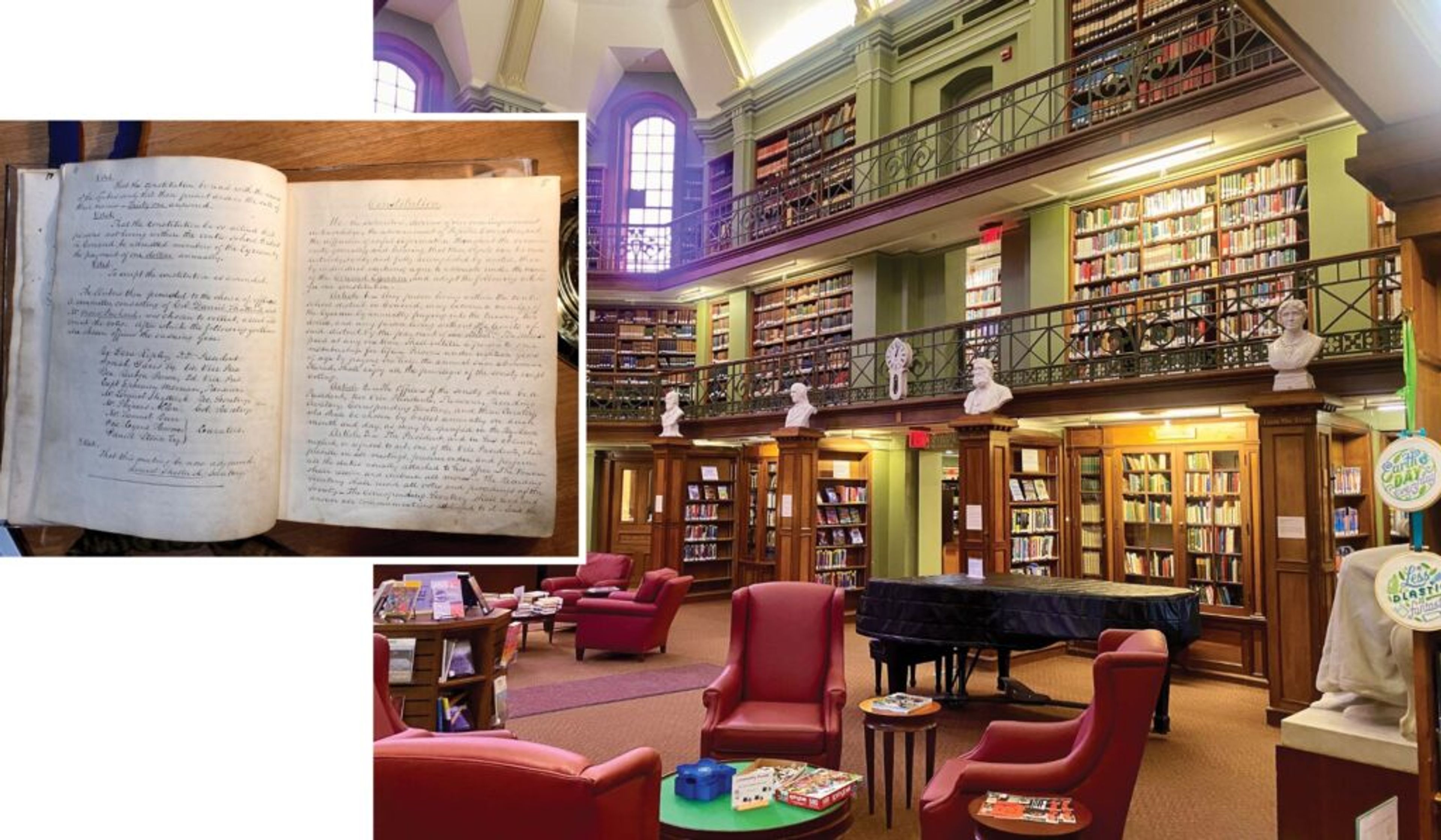
We, the subscribers, desirous of our own improvement in knowledge, the advancement of Popular Education, and the diffusion of useful information throughout the community generally; and believing that these objects can be more certainly, easily, and fully accomplished by united, than by individual exertions; agree to associate under the name of the Concord Lyceum.
Those gathered discussed an array of topics, ranging from government policy and practice to the latest in scientific knowledge to the history of philosophy. The notes from these meetings are well preserved and accessible in the collections of the Concord Free Public Library.
The lyceum’s governing committee often hired traveling scholars to speak, as with “The Reformation in the Times of Luther,” a lecture by a visiting scholar at Cambridge College. Other times, men of the town simply took to the stand to teach about a particular interest; local minister Daniel Starr Southmayd, for instance, gave a talk on Hebrew poetry. In the 1840s, Emerson gave lectures on topics including “The Present Age,” “Politics,” “Private Life,” “Reform,” “Education,” and “Tendencies.”
The Concord Lyceum also hosted debates. On March 4, 1829, its participants discussed the question “Would it be expedient for the State to construct a Rail Road from Boston to the Hudson River near Albany?” The secretary noted that, “after a long discussion, the Lyceum decided the question in the affirmative.”
Every male citizen of the town could attend the gatherings for an annual subscription fee of two dollars. Those who lived in the surrounding farmlands could subscribe for one dollar, given the burden of travel. While women could not be official members of the group, they sometimes outnumbered the men, each of whom could bring two guests.
Concord, site of “the shot heard ’round the world,” offers a vision of a self-governing, localized republic — the town has flourished thanks to the civic commitment of its citizens, and the town hall stands as the symbol of civic life. Since the founding of the Concord Lyceum in 1829, the town’s central square has changed little. The architecture of its buildings proudly displays American ideals — religious, judicial, and democratic temples surround the center green, and stone monuments to Minutemen, World War II veterans, and town benefactors dot the grassy island.
A successful republic requires each person to better himself and rise to the demands of citizenship. The Transcendentalists of Concord were particularly eloquent advocates of “Self-Culture” — in which every person strives to become his own teacher. Emerson taught that each individual possesses a “divine spark,” an intellect, a soul. Quoting the Parable of the Talents, found in the Gospel of Matthew, Emerson argued that each person — no matter how little or how great his share of natural gifts — can grow in knowledge and character.
This spirit permeated lyceums across the country. In the heyday of the Lyceum movement, roughly 1830–50, hundreds of lyceums met regularly in American towns and cities. The movement gained traction especially in the Northeast and Midwest, where Whig politics reigned and the ethos of the self-reliant gentleman farmer held great sway.
The Concord Lyceum is of particular note because of the intellectual heavyweights the group attracted — Bronson Alcott was a regular, in addition to Emerson and Thoreau — but its procedures, mission, and topics of discussion were commonplace in similar gatherings throughout the young nation. Alexis de Tocqueville — the keenest observer of life in the new republic — dedicated a chapter of Democracy in America to the impressive landscape of civil associations covering the young nation. He described America as the only country “in the world where the continual exercise of the right of association has been introduced into civil life, and where all the advantages which civilization can confer are procured by means of it.” Tocqueville saw that the plethora of civil associations strengthened American political life — without civil associations, political associations stood in danger of becoming brittle and frail.
William John Cooper, the eighth United States commissioner of education, understood the potential of the lyceum model to invigorate American civic life. To this end, he directed the Office of Education to publish a history of the American lyceum in 1931.
Cooper introduced his project as follows:
The American Lyceum provides an excellent illustration of the old American habit of getting together voluntarily to do a piece of community work. Especially in these days when many are inclined to look to Government to perform functions formerly regarded as non-Governmental and to attempt the solution of problems by passing statutes, a short history of the American Lyceum may serve to call our attention to a “good old American custom” in attacking community problems.
Those words still ring true, nearly 100 years later. “Sheepification” of the masses is a particular danger in a democracy. The loss of original individual thinking makes a people vulnerable to the wiles of demagogues and charlatans — a disease to which neither political party is immune.
The Lyceum movement viewed civic education as necessary for all Americans. Its Socratic format encouraged members to participate and to think for themselves. In this way, the lyceums modeled the goal of education in a democratic republic: to teach citizens not just how to make a living, but how to live as free individuals. This vision of education is a necessary contribution to the current conversation about higher education and civic formation.
The good news is that there are many citizens laboring to revivify the Lyceum movement today. In just the last decade, a surge of new lyceums has expanded access to pedagogical environments and texts that foster freethinking people.
At Arizona State University, the School of Civic and Economic Thought and Leadership (SCETL) opened its doors to students in 2017. The school — operating as an independent department within ASU — was chartered by the Arizona legislature, making it the first program of its kind to be instituted by state government.
Paul Carrese, the founding director of the SCETL program at Arizona State, now serves as senior fellow for civic thought and leadership at the Jack Miller Center. He describes it as calling for “a reestablishment of higher-order civics education appropriate to the university setting, and in that sense, a mandate to restore what was the original purpose of state universities going back to 1789, when the nation’s first public university was founded.”
The programming at SCETL, Carrese says, “combines a classical liberal-arts curriculum with intensive learning experiences,” readying students “for careers in government, law, business, and civil society.” The center “is dedicated to fostering a culture of intellectual diversity to facilitate the open and free contest of ideas that are a foundation to a healthy constitutional democracy.” SCETL’s curriculum offers courses such as Faith and Reason: The Trial of Galileo; American Constitution I: Structures; and Classical Political Philosophy and Statesmanship.
The SCETL model has already been replicated in eight other states and on 13 public-university campuses. These modern lyceums include the Hamilton Center at the University of Florida and the School of Civic Life and Leadership at UNC Chapel Hill. The State of Ohio is currently building five such centers.
The movement is also gaining momentum outside of universities. National organizations such as Braver Angels and the Albertus Magnus Institute, along with the aptly named Lyceum movement — which operates primarily in the Midwest — all seek to revive this kind of learning.
Zena Hitz, a tutor at St. John’s College in Annapolis and the author of Lost in Thought (2020), has written extensively on the importance of “para-academic” learning — learning that happens outside the formal structures of a university setting. For the 2023–24 academic year, Hitz has been on sabbatical at Princeton, studying the value of learning for its own sake. Amid the challenges of teaching online during Covid-19, she realized that Zoom had a unique capacity to bring a small group of readers together to tackle great texts. Contemporary technology, in spite of its drawbacks, allows for a new kind of virtual lyceum. When Hitz used Twitter to gauge interest in such a group, her notifications exploded.
Soon, the Catherine Project was born. Its mission is simple: to “build communities of learning based on conversation and hospitality.” The organization offers reading groups and tutorials on texts from authors including Plato, Aristotle, Thucydides, Shakespeare, Nietzsche, and Flannery O’Connor. Most sessions are held over Zoom, with a trained volunteer leading seminar-like conversations.
While the project is not political, it still carries implications for civic life. Through serious reading and thinking, the Catherine Project helps foster “a community of people who think things through for themselves.”
“There’s a deep tension between that and an expert knowledge,” Hitz acknowledges. “People are going to use their freedom badly. That’s just the way freedom works — but it’s better than not having freedom.” Ultimately, the Catherine Project seeks to promote a love of learning — learning that, in turn, cultivates “the habits of mind of a free people.”
This is the core of the Lyceum movement, then and now. Aided by a uniquely American spirit of self-determination — combined with the rich intellectual tradition of human freedom — lyceums of all kinds supply a necessary forum for serious thinking.
By sharpening the individual through the community — and vice versa — lyceums model the ideal civic life of a democratic republic. As our institutions falter, and our social fabric tears, let us hope that the Lyceum movement reminds us of who we are as Americans — and who we yet can be.












Comments