• A longtime editor at NPR zzzzzzzzzzz . . .
• Donald Trump said he thinks abortion policy should be decided state by state: a respectable position in itself, and one taken by many conservatives. But he expressed no view on how states should decide it, except that they should include exceptions for rape and incest. When various pro-lifers disagreed with him, he dug in, slamming them and saying he would veto any federal restriction on abortion. Trump is reflecting a Republican fear of the issue that is out of proportion to any of the evidence of its political impact: No pro-life senator or governor has lost an office during the past two years of a supposedly seismic pro-choice backlash. There are many things Republicans can and should do to protect unborn children in a politically sustainable way. Instead, Republicans are not so much beating a strategic retreat as deciding to call cowardice a strategy.
• Look to Arizona, for example. The state’s supreme court upheld an abortion ban that makes an exception only to save the life of the mother. It has been in every version of the Arizona criminal code since first enacted by the territorial legislature in 1864. Arizona voters will likely vote this November on a referendum that would deem abortion a “fundamental right” up to 24 weeks. A hard lesson for pro-lifers since Dobbs: Voters do not endorse philosophical consistency on life, even if they respect that consistency in public officials. The pro-abortion side has won seven straight ballot questions in other states, even as pro-life governors and senators have been roundly reelected. The Arizona law is legally, philosophically, and morally defensible but politically indefensible in a swing state in 2024. It will lose at the ballot box if Republicans cannot convince the state’s voters that rejecting the referendum will result in legislative compromise. At the same time, the referendum will also pass if Republicans do not defend an alternative. That may mean allowing abortion for as long as 15 weeks; it surely means exceptions for rape, incest, and at least some instances of grave physical maternal injury. But finding a sustainable consensus would take leadership. Republicans were decapitated in statewide races in 2022, and the leading loser, Kari Lake, is now the likely nominee for the Senate and running away from the state-level abortion question. Republican legislators have blocked a Democratic effort for wholesale repeal of the current law but have offered no alternative of their own as the spring legislative session winds down. Again, cowardice is not a strategy.
• President Biden’s continued intransigence on student loans is yet again facing legal battles. A Kansas-led lawsuit and a Missouri-led lawsuit are challenging the administration’s SAVE plan to “forgive” student debt. Given that the Supreme Court last time around objected to the executive’s unilateral enactment of policies costing hundreds of billions of dollars, the latest effort, which would be at least as large and likely larger, should also be struck down. The White House announcement repeatedly hedges with phrases such as “if implemented” and “if finalized as proposed,” suggesting that even the administration knows that its plans have little chance of passing legal muster. Biden wants to portray himself as the guardian of democratic norms. If he ever wonders why many voters don’t take that line of argument too seriously, he has nobody to blame but himself.
• The Senate is considering a House-passed bill to force Chinese tech giant ByteDance to sell the social-media service TikTok. The bill’s outcome will show how serious American politicians are about dealing with the threat posed by China. The Senate needs to advance toward a final vote, if necessary entertaining amendments offered in good faith, before the campaign season begins in earnest. ByteDance is peddling talking points about the bill’s purported threat to free speech. ByteDance boosters are also pushing the claim that the bill would allow Biden to go after X (formerly Twitter). These disingenuous arguments come up short because the bill only forces a sale of TikTok to a company based in a non-adversarial country. No one aware of ByteDance’s total allegiance to Beijing can defend the company’s continued control of a platform used by tens of millions of Americans. We will know soon enough whether the Senate is serious about steeling America for prolonged confrontation with the Chinese Communist Party.
• The House passed a two-year reauthorization of the government’s statutory foreign-surveillance authority: Section 702 of the Foreign Intelligence Surveillance Act. Some leftist, libertarian, and MAGA lawmakers oppose the renewal, demanding that intelligence agencies seek warrants before accessing the database of intercepted communications — never mind that the authority to intercept in the first place requires court approval (that’s what Section 702 mandates) and that the FBI already must get a court order based on probable cause before querying the database to search for evidence of a crime (as opposed to searching for foreign-intelligence information). Trump careened into this debate, urging the House to “KILL FISA” because the FBI had spied on his campaign. But the FISA provision at issue is the government’s authority to monitor non-Americans outside the United States, not the domestic FISA procedure abused by the FBI in Russiagate. Speaker Mike Johnson (R., La.) ended up cobbling together a compromise measure, which secured a majority by slashing the reauthorization to two years, not the usual five, with no additional warrant mandate. With global threats to national security intensifying, it would be reckless to blind our spy agencies. The Senate is expected to approve the measure with less drama.
• As the season of spring and summer offensives approaches, Ukraine faces the possibility — still, one hopes, distant — of collapse. Putin has stepped up the bombardment of Kharkiv. His failure to hold it in the early days of his invasion was a bright moment in Ukraine’s war of survival. Now he is intent to destroy what he could not conquer. On other points of the war’s eastern front, he has been making incremental gains using “meat assaults” — human waves, reminiscent of the Communist Chinese in the Korean War. They are costly, but Putin has more human meat at his disposal than his victim nations do. Advanced weaponry could blunt such attacks, but after President Biden slow-walked resupply, House Republicans have continued to stall it as of this writing. Mike Turner (Ohio) and Michael McCaul (Texas), chairmen of the House intelligence and foreign-affairs committees, respectively, have flagged “pro-Russia messages” and “Russian propaganda” infecting the GOP caucus. They named no names, but tovarish Republicans are not shy: Marjorie Taylor Greene (Ga.) has been calling Ukrainians Nazis, a prime Kremlin talking point, for years. When it comes to bad ideas, MAGA likes imports all too well.
• Representative Greene also said that Russia is “not attacking Christianity” in Ukraine. “As a matter of fact, they seem to be protecting it.” In fact, there are Christians on both sides of the war, something with which Lincoln would be familiar. But, just as in the Civil War, that does not mean the two sides are equally good. Southern Baptists Daniel Darling and Richard Land joined with Ukrainian Baptists Yaroslav Pyzh and Valerii Antoniu to write a letter to Speaker Johnson about the persecution Baptists and other Evangelical Christians are facing from the Russian invaders. Ukraine is a hub for Evangelical Christianity in Eastern Europe, with the largest Baptist population in Europe. It had, and still has, freedom of religion in territory controlled by Ukraine but faces especially intense persecution in the Russian-occupied territories. In some cases, it is worse than what Baptists faced when Ukraine was part of the Soviet Union. The letter tells of a pastor whose church members were interrogated and tortured in Melitopol, a city in which no Baptist churches remain. Baptists know which side in the war supports religious freedom for Christians. It isn’t Russia. Whoever has ears, let him hear.
• Senator Richard Blumenthal (Conn.) and other Senate Democrats are broaching an uncomfortable suggestion: Sonia Sotomayor should retire while the party still has the White House and 51 senators. They have a point, if a coldly calculating one: Sotomayor, who will turn 70 in June, may not be that old, but she requires a nurse to travel with her, and it could be years before Democrats have both the presidency and the Senate majority again. If Republicans were to replace Sotomayor with a conservative, they’d have a seven-justice bloc that could take a very long time to flip back to majority-liberal. But Supreme Court justices do not like to be told what to do, and identity politics is impeding Machiavellianism. Representative Nydia Velázquez (D., N.Y.), for example, railed against “forcing the only Latina on the Court to retire.” Pressure from the White House is unlikely because it would require Joe Biden’s team to acknowledge his vulnerability in this election — and the actuarial tables.
• The rate of inflation stopped falling in June 2023. Every month since then, the year-over-year change in the consumer-price index has been between 3 and 3.8 percent. It should be 2 percent, and really it should be lower than 2 percent for a while to compensate for the past two years. But getting down to 2 percent is a must. Core inflation (which excludes energy and food prices, which are volatile) is higher than overall inflation, so right now the inflation-target misses aren’t due to energy markets. But with more conflict in the Middle East, energy prices could increase again. It’s rare for inflation to spike once and return to a low, stable level. In the past, more than one spike or stagflation has been the norm. Before cutting rates, the Fed needs to see evidence that those last few percentage points of excess inflation are disappearing. One thing that would help: spending cuts. Fiscal policy is highly expansionary, working against monetary policy with a $2 trillion deficit. Congress must stop making the Fed’s job harder than it needs to be.
• Cutting waste, fraud, and abuse has long been a promise of politicians. Oftentimes nowadays, it’s a diversion from the true drivers of the debt: entitlements and interest. But waste, fraud, and abuse are nonetheless real, and damaging. The Government Accountability Office estimated that federal agencies made $236 billion in improper payments last year, and that’s an underestimate because not every federal agency provided information to the GAO. If errors were random, we would expect to see roughly the same amount of overpayments as underpayments. But 74 percent of improper payments last year were overpayments. Only 5 percent were underpayments. The rest were other kinds of errors. It’s a pretty good sign that the federal government is too big when it can make mistakes worth six times more than the Department of Justice’s annual budget and most people don’t bat an eye.
• There is plenty the federal government should do to help Maryland after the collapse of the Francis Scott Key Bridge in Baltimore. But it should help, not fund the entire replacement, and it should do so with deregulation and money already available, not with additional spending. Less than three years ago, the federal government authorized $1.1 trillion in infrastructure spending, most of which remains unspent. Any federal aid for the project should be pulled from that pot of money. The bridge is owned and operated by the State of Maryland, which is in good fiscal health and can tax, borrow, and spend on its own. Most highway spending is from the states already, and it should be the long-term goal of federal policy to have states entirely fund their own highways. The federal government can also save Maryland money by waiving environmental and labor regulations. None of this requires Congress to authorize a penny of additional spending. Representatives should resist pressure from the Biden administration to do so.
• “Solyndra” is one of those proper nouns that have become political terms of art. It is a synonym for “boondoggle.” The Obama administration gave the solar-panel firm over $500 million as part of its economic-stimulus program in 2009. It went bankrupt only two years later. Opponents of further corporate welfare have warned of potential Solyndras in the CHIPS Act, the industrial-policy semiconductor law passed in 2022. Aside from the problems that inevitably arise when the government directs capital, there’s another connection between Solyndra and CHIPS: Brian Harrison, Solyndra’s CEO in 2010 and 2011, is now the president of TSMC Arizona, the U.S. subsidiary of the Taiwanese semiconductor firm that was recently awarded $6.6 billion through the CHIPS Act. Repeating a theme is one thing, but with the same cast?
• Like the Pentagon, California’s vast array of homelessness agencies and programs has become un-auditable. That was the astonishing conclusion reached by state auditor Grant Parks in a new report. Parks was able to determine that the state has spent $24 billion over the past five years to address the problem of homelessness, but as to where that money went, and whether it’s making any difference, Parks’s guess is as good as the next guy’s. “The State lacks current information on the ongoing costs and outcomes of its homelessness programs, because Cal ICH [the California Interagency Council on Homelessness] has not consistently tracked and evaluated the State’s efforts to prevent and end homelessness,” he wrote. Over the five-year period covered by his audit, California’s homeless population grew by about 20 percent, from 151,278 in 2019 to 181,399 in 2023. Roughly 30 percent of the country’s entire homeless population is now clustered in California. Rather than helping people get back on their feet, California’s unaccountable homeless–industrial complex — comprising nine state agencies and more than 30 individual programs — appears to be subsidizing an ever-growing population of dependents.
• 60 Minutes, the Insider (a Russian-focused news website), and Der Spiegel jointly presented new evidence regarding “Havana syndrome”: the debilitating set of symptoms suffered by U.S. diplomats and spies posted around the world. The reports support the thesis that a hit squad from Russia’s GRU intelligence service has carried out attacks using weapons that direct microwaves at their targets. Last year, an unclassified summary by the American intelligence community stated that “most agencies have concluded it is ‘very unlikely’ a foreign adversary is responsible.” But the reports present compelling, albeit not conclusive, evidence linking Russian operatives to a few of the attacks. They also show that the deputy commander of a GRU cell was promoted after his team furnished the Kremlin with proof that he had conducted research on just the sorts of weapons that would be involved. Senator J. D. Vance (R., Ohio) mocked the reports as signs of anti-Russian paranoia. Such paranoia exists; so does Russian enmity. If GRU involvement is more conclusively proved, it will demand a strong U.S. response.
• Hong Kong’s government, which has become an arm of the Chinese Communist Party, just turbocharged its program of authoritarian repression with the passage of a new security law. These new national-security measures, under Article 23 of Hong Kong’s Basic Law, grant the authorities expansive new powers to crack down on what they characterize as sedition, espionage, foreign interference, theft of state secrets, and more. It goes beyond the infamous national-security law imposed by Beijing in 2020. The Article 23 measures grant the Beijing-controlled leaders of the city another legal tool through which they can manipulate the system to destroy any remaining pockets of dissent, no matter how small or insignificant. Washington should impose new sanctions targeting Hong Kong’s fake judicial system and shut down the city’s specialized diplomatic offices across America. Instead, Secretary of State Antony Blinken responded with a statement tut-tutting the new law. Projecting weakness is not something the Biden administration does only to Iran.
• Iranians are routinely tortured and killed by the regime that rules them. In recent months, this has been especially true of young women who have risen up in protest against the regime. Let us note one of the dead. Last November, Sara Tabrizi was arrested and imprisoned in the notorious Evin Prison. Tortured, of course. She was released in January, but still under threat. On March 23, she was summoned by the Ministry of Intelligence. The next day, she was returned to her father’s house, a corpse. Sara Tabrizi was 20.
• In March of last year, an organization composed of roughly 2,000 elderly Swiss women embarked on a long-shot effort to brand their country a human-rights abuser. They claimed that the effects of climate change were so onerous that failing to address them to their subjective satisfaction constituted gross mistreatment of the human species. Sadly enough (or hilariously enough, depending on your perspective), the European Court of Human Rights agreed. It found that, by failing to impose arbitrary caps on heat-trapping emissions, the Swiss government had violated its citizens’ basic standards of decency. Given “the serious adverse effects of climate change on lives, health, well-being and quality of life,” an ECHR statement read, the petitioners deserved redress. And that was that. “There is no right of appeal and the judgment is legally binding,” CNN reported of the ruling in Strasbourg. Thus Bern has been branded a rogue regime by the same tribunal that has condemned Moscow, Tehran, and Damascus. It’s ridiculous, but we would care more about it if we believed that the European Court of Human Rights actually had jurisdiction over anything.
• Since 2001, when the Netherlands became the first country to legalize euthanasia, about ten other countries have normalized, in some form, what is euphemistically called “assistance in dying.” Critics of the Dutch law, which limited eligibility to patients whose conditions are “hopeless and unbearable,” argued that the criteria it outlined were subjective and prone to gradual loosening. Now among those scheduled to die is a 28-year-old woman with autism, depression, and borderline personality disorder whose symptoms, her psychiatrist concluded, will never improve. In neighboring Belgium, the president of a health-insurance fund suggested that euthanasia should be made available to elderly persons who would like to relieve the state of the burden of their care. The clinical provision of death perverts the patient–physician relationship and the medical vocation, whose purposes are curative and palliative. Killing is neither.
• Over the past 15 years, the number of children seen annually at the Gender Identity Development Service of NHS England has increased from 50 to 5,000. In the past, most of the patients were boys. In recent years, most have been girls. The new clinical approach of “gender affirmation” placed gender-distressed young people on a conveyor-belt pathway of irreversible hormone treatments and surgeries. In 2020, in response to mounting controversy, NHS England commissioned an independent review by Hilary Cass, a senior pediatrician. On April 10 she submitted her final report, a blow to the “gender affirmation” model. Cass concluded that the gender-affirmation approach is “built on shaky foundations” and “remarkably weak evidence.” Given that there is “no reliable evidence base” to support medically altering the sex characteristics of gender-confused youth, “for most young people, a medical pathway will not be the best way to manage their gender-related distress.” She also noted that “social transition” (treating children as if they really were the sex with which they identify) is “not a neutral act” and called for greater investigation into the links between gender dysphoria and “the consumption of online pornography.” The report is good news for British children, and an example for American medicine.
• J. K. Rowling challenged the Scottish police to arrest her. On April Fools’ Day, when a new hate-crime law went into effect, Rowling posted a series of tweets describing various trans-identifying men as men and accusing Scottish lawmakers of placing a “higher value on the feelings of men performing their idea of females” than on “the rights and freedoms of actual women and girls.” Many complaints were then filed against Rowling, but the police declined to arrest her, stating that her comments were “not assessed to be criminal.” Really? The law appears to make any comment perceived as offensive to those who identify as transgender, or belong to other protected identity groups, a potential crime punishable by up to seven years’ imprisonment. The trans activists who reported Rowling were certainly under that impression, as are any citizens still fearful of expressing themselves freely. The law relies on subjective and arbitrary judgments. No specific victim is required. Third-party reporting is encouraged. The law prohibits “stirring up hatred” against some characteristics (transgenderism) while neglecting others (sex). To add insult to injury, Scotland’s leader, Humza Yousaf, who introduced the legislation, announced that a separate bill to protect women and girls from “misogyny” will also protect “trans women.” How ironic that a bill to outlaw “misogyny” will inevitably be used against women who dare to identify men as men.
• “We are culturally a Christian country,” Richard Dawkins said in a recent interview with the British media company LBC. “I call myself a cultural Christian.” The Oxford evolutionary biologist, better known as a freelance preacher of atheism, which he propounded in The God Delusion (2006), distinguishes between personal belief and religion as a matrix of cultural and moral values. He feels “at home” with the “Christian ethos.” The substitution of “any alternative religion” would be “dreadful.” He delivers his warm words for Christianity, “a fundamentally decent religion,” in the context of denouncing Islam, whose “doctrines” and “holy books” promote “hostility to women.” Dawkins joins the ranks of Jürgen Habermas and Marcello Pera, European thinkers who in dialogue with Pope Benedict XVI helped to cultivate the plot of common ground between secularism and religion in the West. They also serve who only stand outside houses of worship and lightly bless them. Professor Dawkins, the doors are open.
• Uri Berliner worked as an editor for NPR for 25 years. He wrote a piece for the Free Press about the transition of the public-media organization to one-sided progressivism. NPR suspended him, and then he resigned. That’s probably to be expected for writing a huge article about why your employer is failing at its mission, but it’s clear that NPR has learned nothing from Berliner’s thoughts. The organization’s new CEO, Katherine Maher, has no experience in journalism but plenty in progressivism. The former Wikimedia executive has a seemingly unlimited supply of past social-media posts and recorded remarks delivered in perfect progressive-speak with little to no discernible content behind them — think of a more corporate Kamala Harris. If NPR were an entirely private organization, it would be well within its rights to operate as a hyper-progressive outlet. But if the U.S. is going to have public radio — it should not, but let’s grant for the sake of argument that it does — it should strive for evenhandedness. All things considered, taxpayer funding for NPR should go to zero.
• At Pomona College in California, students rushed into an administrative building to “occupy” it. The building houses the office of the president, who since 2017 has been Gabrielle Starr. She made an announcement to the crowd: “If you do not leave within the next ten minutes, every student in this building is immediately suspended from this institution — if you are from Pomona. If you are from elsewhere, you immediately will be banned from this campus. Is that clear? Ten minutes.” And she followed through. Mirabile dictu, as WFB would say.
• Harvard University has announced that it is reinstating SAT/ACT test requirements for applicants to the class of 2029 and onward. Alongside peer Ivy League schools Dartmouth and Yale, Harvard made standardized testing optional for admissions in June 2020, during the height of the Covid lockdowns. All three universities continued the policy long after the stated rationale for it had faded away, suggesting that ideological impulses were the real reason. And all three have turned on a dime over the past two months, after assessing four years of accumulated data on student quality. One marvels at the folly of Columbia University, which eagerly joined this bandwagon in March of last year only to see its peers suddenly leap off.
• For the first time since 1997, the federal government is changing how it classifies Americans by race and ethnicity. Ideally, a government founded on the principle that “all men are created equal” would not classify its citizens by race and ethnicity at all. That so many Americans struggle to fit themselves into the assigned racial boxes says much about the endeavor. The government proposes — properly, if one assumes the premise of the question — that more than one right answer can be given, and that our binary categories of “white or black” and “Hispanic or not” do nothing for people who locate their heritage in the new “Middle Eastern and North African” category, which itself remains a vague agglomeration of Arabs, Persians, Afghans, and people of other backgrounds. If anything good comes from the new classifications, it will not be the creation of ever more boutique categories of grievance. It will, instead, be the reminder that America’s true diversity is so multifarious that we should celebrate its uncategorizability, not use it to create more bureaucracy.
• In Dignitas Infinita, a declaration released by the Vatican on April 8, the Catholic Church reasserts the natural rights and inherent dignity of the human person. Human dignity, the church insists, is neither based on a person’s “gifts or qualities” nor granted by others. The authors invoke Dignitatis Humanae, the Vatican II document on religious freedom, and quote Pope Francis as recommending “the simple yet clear formulation contained in the Universal Declaration of Human Rights, whose seventy-fifth anniversary we recently celebrated.” Even if unintended, echoes of the preamble to the United States Declaration of Independence also abound in Dignitas Infinita. Some commentators have expressed surprise that gender theory and sex-change interventions are included in its list of “grave violations of human dignity,” as if the church’s affirmation of sexual complementarity were news. Much of the public has misread Francis’s emphasis that the church also teaches that those whose sexual identity or desires conflict with the Catholic understanding of natural law are, in the words of the Catechism, due “respect” and “sensitivity.” Dignitas Infinita serves to correct popular misperceptions as it illustrates the fullness of Catholic social teaching.
• Federal prosecutors have issued a 37-page criminal complaint against Shohei Ohtani’s interpreter, Ippei Mizuhara, charging him with bank fraud and theft of $16 million from Ohtani’s account. E. Martin Estrada, the U.S. attorney for the Central District of California, emphasized that “Mr. Ohtani is considered a victim in this case.” An initial news report was unclear as to whether the MLB superstar was involved in sports betting, but that now appears to have been based on false information that Mizuhara had given to an Ohtani spokesman. Prosecutors say that Mizuhara, who has been fired, drew on Ohtani’s bank account to place thousands of bets. They describe recordings in which he impersonated Ohtani in conversations with bank officials seeking to verify large withdrawals. Mizuhara deposited winnings into his own account but withdrew from Ohtani’s to cover losses. Lies and suspicions about Ohtani traveled around the world with the velocity of a fastball, but prosecutors and the IRS agent assisting them have sorted through much confusion to uncover facts that exonerate the Japanese slugger and pitching ace. Testing the long arm of the law, Mizuhara got caught stealing.
• PBS made William F. Buckley Jr. the subject of the latest installment of its American Masters documentary series. There is much to recommend the film, which spans WFB’s well-lived life from beginning to end, covers the major episodes in his career from his time as a student at Yale to the fall of the Soviet empire, and aptly situates him within the context of his times. There is extensive archival footage of WFB, capturing his wit, eloquence, gentlemanliness, and joyous mischievousness. But the film paints an incomplete picture of his views on questions of tolerance and equality. And it ends on a tendentious and discordant note. It veers abruptly into a montage of the events of January 6, 2021, and gives a platform to critics of conservatism to argue that Buckley’s philosophy contained dark and menacing elements that laid the groundwork for the Capitol riot. It’s clearly absurd to connect Buckley to an event that took place more than a dozen years after his death and that everything in his decades of public advocacy suggests he would have wholeheartedly condemned. We’re glad that PBS felt compelled to feature Buckley in its series, but it should have resisted the temptation to distort his legacy for its own ideological purposes.
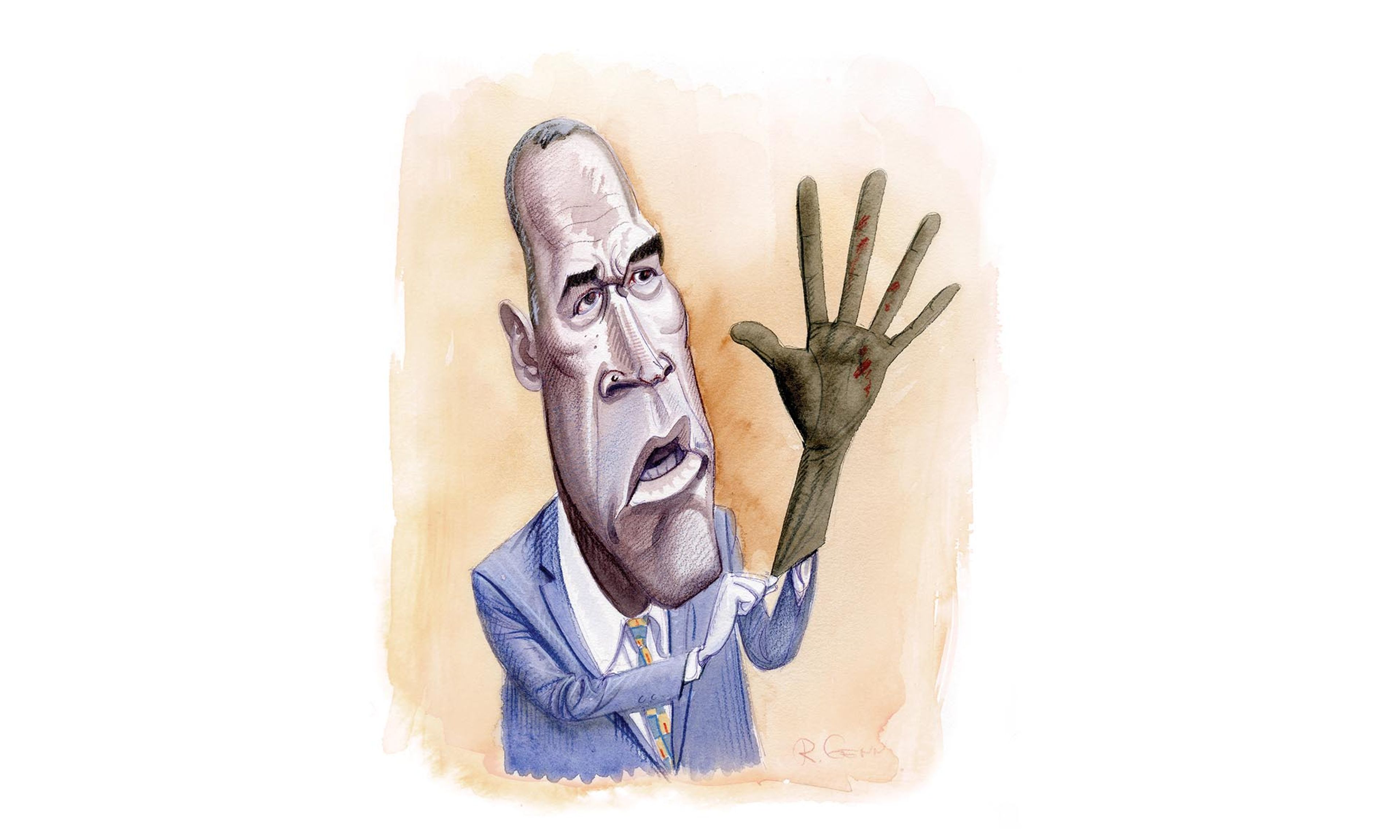
• Orenthal James Simpson, a.k.a. “O.J.,” a.k.a. “Juice,” overcame a childhood case of rickets and a youthful stint in a street gang to become a star running back for USC and the Buffalo Bills and an engaging star of movies and television commercials (he ran to pick up his car from Hertz). So it came as a shock when, in 1994, he was arrested for brutally stabbing to death his second wife, Nicole Brown, and her friend Ron Goldman. There followed an eleven-month-long circus of a trial marred by prosecutorial errors and racism. The majority-black jury viewed Simpson as a victim of the Man, and his acquittal was greeted by many blacks like Juneteenth. Yet nemesis pursued him. In 1998 a civil jury found him liable for the wrongful death of Goldman and ordered him to pay $33.5 million; although he auctioned his football trophies, he paid only a fraction of what he owed. In 2007 Simpson and a posse of thugs broke into the Las Vegas hotel room of a sports-memorabilia collector to steal Simpson’s old Super Bowl rings. He was convicted of kidnapping, assault, and robbery, and served almost nine years before being paroled. Props to comic Norm Macdonald for joking about Simpson’s guilt as relentlessly as he himself denied it. Dead at 76.
• In early 2013, researchers at the world’s largest experimental laboratory, in Geneva, announced the discovery of a subatomic particle they identified as the “Higgs boson.” Its namesake, the British physicist Peter Higgs, had proposed the particle’s existence nearly half a century before. A few months later, he was awarded the 2013 Nobel Prize in Physics. Higgs was involved in a nuclear-disarmament organization in the U.K. until it began opposing nuclear energy, too. He similarly resigned his Greenpeace membership when that group began opposing genetically modified crops. Professor Higgs was the chairman of the theoretical-physics department at the University of Edinburgh from 1980 to 1996. Roxburgh Street, near the old town and campus, features a plaque celebrating his legacy. Dead at 94, R.I.P.
• In the 1980s, Bennett Braun was widely renowned as an expert in his field of psychotherapy, a pioneer in the practice of recovering repressed memories of trauma in order to treat “multiple-personality disorder.” In a Chicago hospital, he oversaw a unit dedicated to such treatment; in dozens of cases, he said, his patients recovered memories of suffering from and in some cases participating in satanic rituals, depraved sexual acts, and torture at the hands of cults supposedly widespread in the United States. He published research and gave seminars on what he dubbed “SRA” — “satanic ritual abuse.” The media, in fanning the flames of what became a full-blown panic, cited him as an authority. By the early ’90s, when a comprehensive FBI report and an extensive survey from the National Center on Child Abuse and Neglect debunked the notion of SRA as a collective phantasm, much real and irreparable harm had been done — to both the falsely accused and the purported victims of lurid imagined crimes. Braun was sued by former patients and had his medical license suspended. He never publicly admitted wrongdoing. Dead at 83; R.I.P.
• Ralph Puckett Jr., of Tifton, Ga., graduated from West Point in 1949. He was then sent to Korea, where he was the commander of the Eighth Army Ranger Company. On November 25, 1950, his unit took a hill and then defeated five Chinese counterattacks in four hours, outnumbered ten to one, but was overrun by the sixth. Severely wounded, Puckett was rescued by fellow Rangers despite their having been ordered to leave him. He refused a medical discharge and was deployed again in Vietnam in 1967. “He feared no man, he feared no situation and he feared no enemy,” said retired general Jay Hendrix of Puckett. Dead at 97, Puckett was the last surviving Medal of Honor recipient from the Korean War. R.I.P.
• On December 7, 1941, a date which lives in infamy, Japanese forces destroyed the USS Arizona at Pearl Harbor in a sneak attack. They killed 1,177 of our sailors. Ninety-three aboard the ship survived. One of them was Lou Conter, a quartermaster, who tended to the wounded and, in days to follow, recovered bodies. He went on to fly 200 combat missions in the Pacific. In the next war, the Korean War, he flew 29 combat missions and served as an intelligence officer. He retired from the Navy in 1967, living in the Los Angeles area and working in real estate. He was born in Ojibwa, Wis., in 1921. He has now died at 102, the last survivor of the Arizona. R.I.P. God bless them all.
Israel Confronts Iran
An Israeli Air Force strike inside Syria neutralized two Islamic Revolutionary Guard Corps generals, including one of the architects of the October 7 massacre. Iran spent several days telegraphing its intention to attack Israel directly in response. Then it launched over 300 suicide drones and missiles, both ballistic and cruise, toward Israel.
Almost all the ordnance Iran launched failed or was intercepted before it could penetrate Israeli airspace. Jerusalem was aided in that spectacular operation by its Western allies, the U.S., the U.K., and France among them, and by its Middle Eastern partners, including Jordan and Saudi Arabia. The coalition arrayed in Israel’s defense is almost as wondrous as the Iranian regime and its terrorist proxies are threatening. Nevertheless, the direct attack on Israel from Iranian territory was unprecedented. Until we hear otherwise from either party to this conflict, a state of war exists today between Israel and the Islamic Republic of Iran. The Jewish state is obliged to reestablish deterrence to stave off future similar attacks.
That prospect does not sit well with Israel’s Western allies. President Joe Biden reportedly told Israeli prime minister Benjamin Netanyahu to “take the win” and stand down. British foreign secretary David Cameron agreed. “I think this is a time to think with head as well as heart and to be smart as well as tough,” he advised. “We’re advising them to take a breath before responding,” an unnamed U.S. official told Politico. Indeed, the whole point of the West’s intervention on Israel’s behalf was to relieve pressure on Jerusalem so that it would not feel “compelled to come back with another overwhelming response and we can de-escalate and be done,” another official told Politico.















An Israeli Air Force F-15 Eagle at an air base, said to be following an interception mission of an Iranian drone and missile attack on Israel, in a handout image released April 14, 2024. Image blurred at source.
Israel Defense Forces/Handout via Reuters
It’s unlikely the Israelis believe they are so secure that they can afford to all but ignore this brazen act of war. Indeed, it’s difficult to imagine a polity anywhere on earth that would take a similar attack in stride. To advance the notion that Jerusalem can afford to brush off this assault — which, one U.S. official told Semafor, was designed to culminate in “mass casualties and infrastructure damage” — media outlets have cited military experts who claim Iran’s attack was “designed to fail.” It is highly unlikely that the Iranian mullahs expended all this ordnance only so that their regime would be humiliated on the world stage. In all likelihood, this attack was intended to overwhelm Israeli air defenses and kill as many Jews as possible, thereby advancing the objectives Iran’s terrorist proxies have feverishly pursued since October 7.
Israel cannot allow direct Iranian missile strikes on Israeli territory to become background noise. It will have to impose consequences on Iran to deter similar attacks in the future — attacks that may be far more successful next time. That might frustrate Israel’s Western partners, but their national survival is not on the line. Israel’s is.
The Stat
47 percent — the proportion of aid to state governments under the American Rescue Plan Act that has not been spent yet, according to the Government Accountability Office (GAO).
The American Rescue Plan Act, enacted by Democrats in March 2021, included $350 billion for the State and Local Fiscal Recovery Fund. This allocation was made almost a year after the Covid recession had ended in May 2020, and after it was already known that state budgets were doing well post-Covid. Nearly every state saw increased tax collections and ran a budget surplus on its own before receiving any aid. Since they didn’t really need the money in the first place, many states are struggling to figure out how to spend it. In a report from April 10, the GAO found that as of September 30, 2023, only 53 percent of the money awarded to state governments had been spent. The proportion spent varied widely by state. Eight states have spent less than 25 percent of their awards: Florida, Mississippi, Missouri, Montana, Oklahoma, South Carolina, South Dakota, and Tennessee. Eight states have spent 75 percent or more of their awards: Alaska, California, Hawaii, Illinois, Maryland, Minnesota, Pennsylvania, and Washington. All eight of the low spenders voted for Trump in the 2020 election and currently have Republican governors. Seven of the eight high spenders voted for Biden in the 2020 election and currently have Democratic governors. The State and Local Fiscal Recovery Fund never made sense as a pandemic-relief program. It seems to have worked out as a blue-state relief program.
by Dominic Pino












Comments