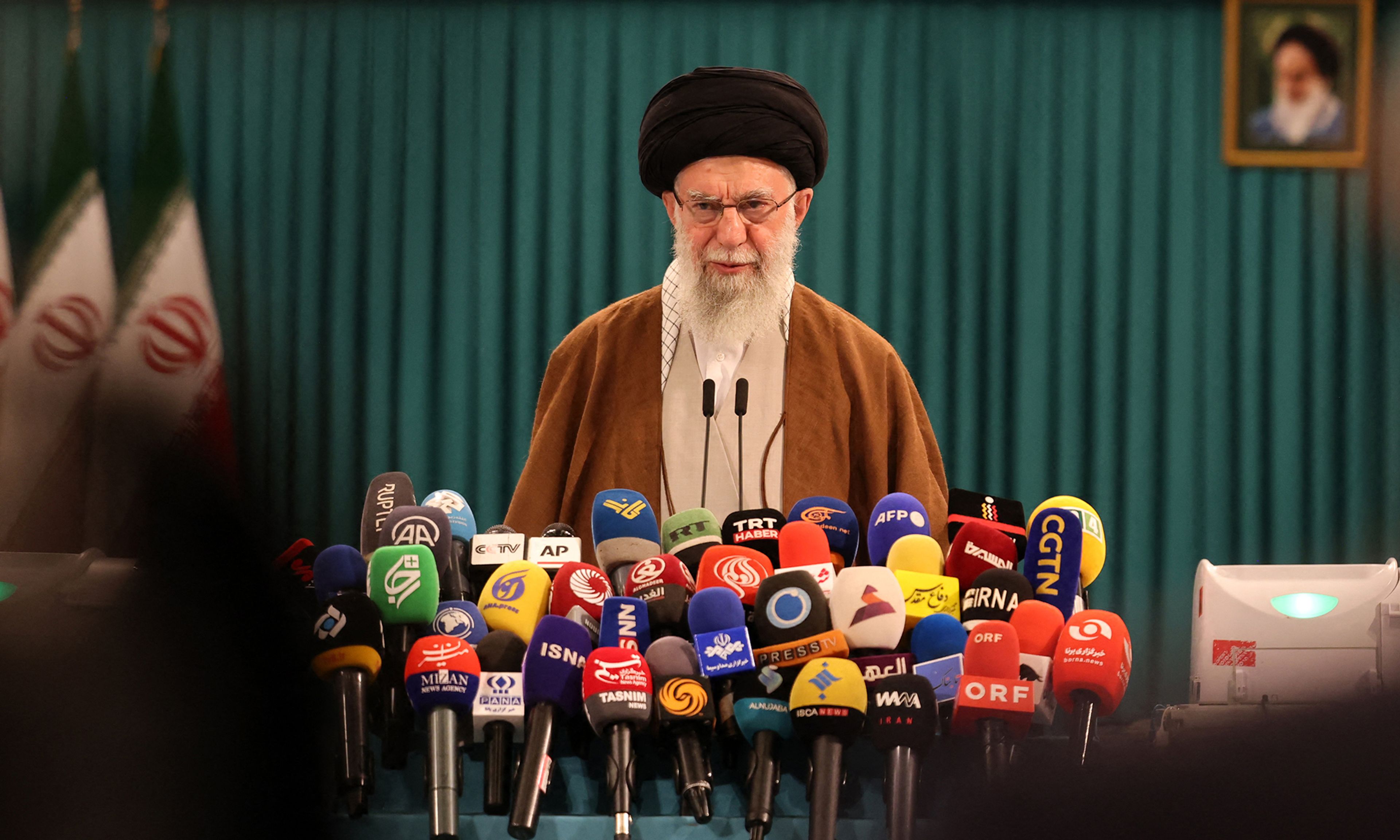
For too long, Americans have looked at Iran’s nuclear program as primarily a military question. Separately, they look at political trends, wondering where the regime is headed. That misses the point. The nuclear program is the crown jewel of Iran’s foreign policy, which itself is an outgrowth of domestic trends. For the past two decades, the state has compensated for losing its ideological footing at home by becoming more extreme in its foreign policy. Today, it finds itself at a critical point: With recent foreign policy setbacks having put it on the back foot abroad, a very secular polity, and irrecoverable economic conditions, the state needs nuclear weapons not just for deterrence but especially to persuade its supporters that the Islamic Republic is still worth defending.
This is not immediately evident to Americans because they underestimate the power of ideology and thereby fail to accept the static structure of the Islamic Republic — a folly that has been deforming American policy in the Middle East. In 1979, months after the foundation of the Islamic Republic, Jeane Kirkpatrick explained this distinction in her seminal essay “Dictatorship and Double Standards.” A traditional autocracy can evolve because its authority lies in the customs and traditions of its polity, which are fluid. Unlike traditional autocracies, ideological totalitarians have no room for evolution and little for compromise. The Islamic Republic is a revolutionary, ideological, totalitarian regime. With a mandate from Allah, it seeks to penetrate every layer of the polity and indoctrinate everyone within. The revolution is perpetual, and perpetual revolution requires perpetual war.











Comments