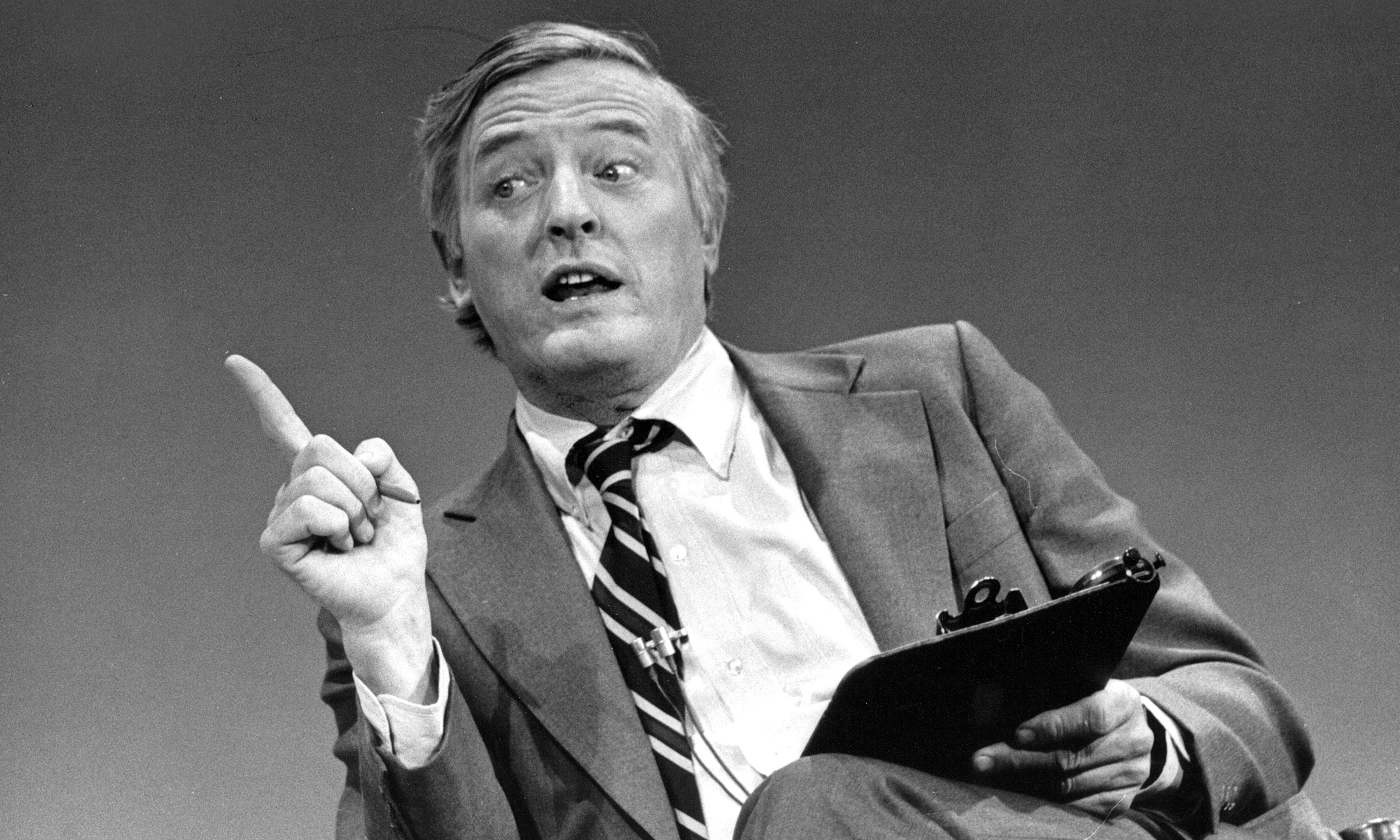
Richard Brookhiser in the late 1960s was a clever young student in upstate New York, unconventional only in being somewhat more conservative and more bookish than his peers, when he unexpectedly entered history by mailing to National Review a drily skeptical essay on a student protest at his high school. He lived in a pleasant suburb of Rochester. His parents were respectable, law-abiding, and dutiful middle-class Americans. They demonstrated this most flamboyantly by voting Republican. Rick himself was conscious of belonging to no minority, visible or invisible. He was clever and therefore on the escalator of post-war American meritocracy. Otherwise, no distinguishing marks.
The young Rick must have looked destined to end up as one of those Men in Gray Flannel Suits who, according to the social theories of the time, lived lives of quiet suburban desperation (though the television series Mad Men paints a much livelier picture of them). None of this predicted Rick’s actual future, however. To begin with, the times changed. The conformist Man in the Gray Flannel Suit disappeared soon after he was theorized into existence, as the Sixties revolution either recruited him or drove him to an angry defense of himself. The WASP majority, to which Rick belonged and which he later categorized in his book The Way of the WASP, suddenly became first a minority, and then an embattled one in a sea of diversity.
Rick changed too — or, rather, emerged from his high-school chrysalis. Early on he exhibited the flamboyant-cum-subversive tendencies of a dandy, carrying a silver-topped cane and wearing gray flannel only as background for the mauve and orange colors of his ties, jackets, pants, and shoes. He married “out” to a Jewish Freudian psychoanalyst, Jeanne Safer (who, I must confess, has always struck me as too vital for her profession — can there really be such a person as a bubbly Freudian psychoanalyst?). Finally, in early middle age he began a brilliant new career as a historian by writing a biography of George Washington that was subversive precisely because it was an admiring account of a WASP hero.
It is necessary to underline these things because an inattentive reader of Right Time, Right Place might be misled into seeing its author as a modest, retiring sort of fellow to whom things happen. Passivity does play a part in the story, and Rick does not hold back from admitting the fact. But if he begins as a Crouchback reacting to events shaped by others, he ends as a Waugh shaping them. In both cases, of course, the events are mainly words.
For what happened to Rick between sending off that fateful high-school essay and writing the Washington biography was National Review. His freshman essay became a full-blown NR cover story on the campus revolution. He served as an NR summer intern. He met and bonded with William F. Buckley Jr. He was hired as a full-time NR staffer. He was given more cover stories to write, apparently as tests for Bill to judge. And one day in 1978, just as he was preparing to leave NR for law school, Rick was taken out for lunch to a high place (a.k.a. Paone’s Restaurant on 34th Street), shown the kingdoms of the world, and offered the editorship of NR and all the stock of the magazine on Bill’s eventual retirement. Meanwhile, he would immediately become a senior editor and later the managing editor.
This was an extraordinary offer even from Bill, who had a long track record of searching out, hiring, encouraging, and promoting young writing talent. Rick was 23, relatively inexperienced in life if not letters, wry and modest in manner, and not the most obvious executive type even in NR’s fantastical gallery of eccentric wordsmiths. But he was young, precocious, calmly sane amid a crowd of volatile geniuses, had a distinctive and even quirky writing style, and had graduated from Yale — in other words, he was the nearest thing to Bill on 35th Street in 1978. That list does not exhaust Rick’s virtues, of course, since was also a good judge of writing, a fertile source of strong editorial ideas, and (like Bill) an excellent talent scout. But it helps explain why Bill warmed to Rick to the extent of deciding in 1978 that Rick would make his ideal successor in 1990.
Even if post-dated, this was a check that no one could refuse to cash, as I well know. It was accompanied in Rick’s case by additional signs of a deeper friendship. Bill took him on a trip through Mexico — a first installment on the world — and began to give him progressively more editorial authority. For the next eight years, Rick was a senior figure on the magazine that from 1981 onwards was known to be the favorite reading of the president of the United States. He traveled to other kingdoms of the world — Taiwan rather than Rome, admittedly; Angola before the Riviera, alas — and enjoyed the feeling of being very near the center of world-historical events.
His account of these glorious years for NR is a highly entertaining one. It is full of good jokes, almost all new to me, such as David Brooks’s reply to Rick’s admission that he couldn’t recall meeting the famously reclusive Wall Street Journal editorial-page editor Robert Bartley: “Then you spoke to him.” Full of good secrets too — late at night in an empty office Rick seems to have overheard Bill discussing with Sen. Daniel Patrick Moynihan the possibility of throwing NR’s 1980 endorsement to him rather than to Reagan. (Fortunately for everyone, Moynihan never ran and, as Midge Decter said when plumping for Reagan, you can’t support someone who won’t support himself.) Thirty years after its founding, NR was a magazine worth serious courting by conservatives in both parties.
Yet, as Rick’s sharp but friendly pen-portraits of colleagues such as Joe Sobran, Jeff Hart, and Keith Mano demonstrate well and often hilariously, NR was a magazine staffed by outsiders and natural rebels, albeit brilliant ones. Initially the Reagan administration too was staffed by outsiders and natural rebels. The two were a good match. Rick even encouraged younger conservatives to head for the Beltway rather than the world of small magazines if they wanted to determine immediate policy. But he was always cold-eyed about politics. He was distressed when Bill allowed himself and the magazine to be “stroked” by a Reagan emissary on legislation hiking taxes. As the Eighties wore on, the Reagan administration gradually fell under the sway of more pliable and conventional apparatchiks. It drifted farther away from Rick’s and NR’s variety of conservatism. And Rick began to heed his own warning that “intellectuals are the Kleenex of administrations — used, then discarded.” Though he didn’t quite realize it yet, he was tempted to move into different writing terrain — longer-term, more detached, less topical.
That may also help explain two otherwise odd developments in this period. Rick resisted Bill’s suggestions that he take a bolder line in ordering NR’s editorial content — though “resisted” is the wrong word: He simply never followed through on his intentions to do so. Why? Well, NR was Bill’s creation; Rick concedes that he shrank piously from making it his own. On the other hand, Rick was not passive when passivity would have been diplomatically advisable. He said frankly that any talk of a presidential bid by Bill was simply not “serious.” And he withheld praise from one of Bill’s novels when his boss was seeking his approval.
One need not be a Freudian psychoanalyst, even a bubbly one, to suggest that these contradictory attitudes reflect ambivalent feelings toward a father figure. In family life, these contradictions are usually resolved by the son’s establishing his independence and then constructing a new relationship on a more equal footing. In this case, the father figure thrust independence — an independence that was not consciously wanted — on the son, after which establishing an equal friendship took much longer.
Out of the blue, one day in 1987, Rick received a letter from Bill that began discouragingly: “It is by now plain to me that you are not suited to serve as editor-in-chief of NR after my retirement.” It did not get less discouraging. Bill made it clear that his decision was based on Rick’s alleged lack of executive ability, that his true gifts lay in the writing of books, and that the decision was irrevocable. Such candor would be hard to take in a love letter. It was impossible to take in a notice of dismissal. Rick was hurt, angry, and upset on several grounds: the shock, the withdrawal of Bill’s confidence, what he felt was the cheese-paring “peonage” of the financial settlement Bill offered, and much else. But the deepest wound was his insight that this was a breach between two mental states: his own substitute-father fixation and what he now intuited as Bill’s narcissistic projection.
He summarizes Bill’s letter in a parody of Bill’s style: “It is now plain to me that the evidence of your name is indicative of a larger truth. You are not, in fact, me.” Ouch! as the saying goes, but Rick’s fist hurt too.
Reader, I was the innocent beneficiary of this psychological Armageddon. About a year later, Bill telephoned me in London to offer me the editorship of NR more or less immediately, the arrangement to be confirmed by both sides as permanent after six months. In July 1988 I arrived in New York to edit the magazine and to be introduced to people at a series of dinners attended by, among others, Rick and Jeanne.
Rick certainly possesses an iron discretion. I knew from friends that he had been disappointed in his legitimate hopes at NR. I expected a scowl at the very least. In the book he confirms that he was seething with hurt and envy. Not on the surface. A few conversations with him persuaded me that he had overcome any feelings of bitterness, even of annoyance. And, as he also confirms in the book, that surface soon developed depths. We established first a good professional cooperation and later a firm friendship, which, at a later crisis in my private affairs, gave me great comfort.
Rick is very generous about my editorship and observes in particular that I carried through some of the reforms of NR to make it livelier, from which he had shrunk. This review is not about me, but a quick explanation may fit into it. I was an old journalistic hand in 1988, having worked in five media organizations by then. If everyone has a novel in him, every journalist has a magazine in place of the novel. So far I have edited the same magazine under four different names — NR was the third in line. Above all, I liked and admired WFB from Day One, but I did not hero-worship him. I had already used up my reserves of hero-worship on Colin Welch and Peter Utley, when I worked with them on the Daily Telegraph. So I had a rough idea of what to do when I arrived at NR and no (relevant) psychological hang-ups about doing it. That gave me a great advantage over an NR “lifer” like Rick.
But I could not have changed (and, let us hope, improved) the magazine as I did if I had not enjoyed the help and support of Rick and other NR colleagues such as Linda Bridges, Mark Cunningham, Dorothy McCartney, and, in due course, the current editor. Fortified by that, I went on to enjoy nine very happy and productive years at NR until, eventually, I too came home to find an unexpected letter from Bill. But that is another story.
Rick too has benefited in the end from his disappointment. He reestablished a firm and decently rewarded position at NR. He built up a strong and respected freelance career independent of the magazine. He strengthened his relationship with his actual (and somewhat neglected) father, whose qualities of fortitude and diligence he came to respect. He became a successful historian and biographer of the Founding Fathers. And, after a few missteps and overtures from Bill and Pat Buckley, he and Bill became good friends again — but this time on a more equal and less fraught footing.
Some critics may argue that this is a bitter book. That would be quite untrue. Rick is very candid about the bitterness he felt at points toward Bill. But he is equally candid about his own adolescent responsibility for those feelings. And he makes it clear that he eventually overcame that bitterness. His final emotion is, at worst, bitterness recollected in tranquility.
Rick’s picture of Bill will inevitably upset or annoy those who would like to recall Bill solely in one of his great public roles — as the witty debater of Firing Line, the juggling wordsmith of “Notes & Asides,” or the dragon-slayer of liberaldom. But even worldly saints don’t exist this side of paradise. And Bill had his faults. He was sometimes arbitrary, inattentive, curt to admirers, and snobbish. He had an excessive respect for the merely rich. But he was also kind, generous, charming, inventive, witty, and hard-working. And he was quietly charitable to those in trouble. The world was lucky to have him as a public figure, and his friends were fortunate to enjoy him as a private one.
Rick shows both sides of the man. I decided not to read Chris Buckley’s new book until finishing this review. But, so far, this is the best all-round depiction of Bill — warts and all, but not only warts — that I have read. It is also written with an easy grace and wit that Bill could cite as evidence that his estimate of Rick’s talents has proved to be a correct one.
Still, I have one serious complaint. On page 206 Rick delivers a judgment that generously flatters my literary tastes but gravely mistakes my moral character. I probably won’t sue.











Comments