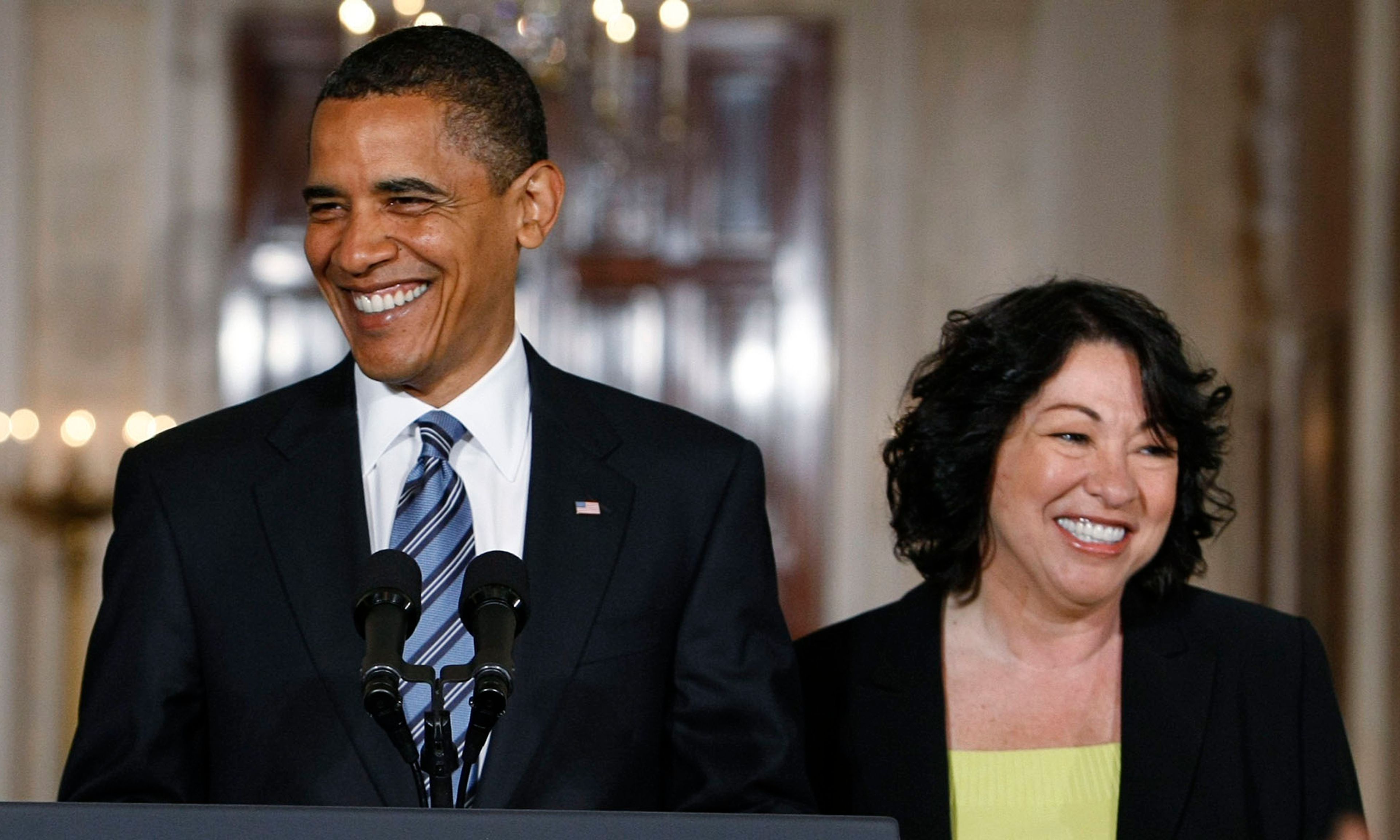
I don’t know if you’ve heard, but Judge Sonia Sotomayor, President Obama’s nominee to the Supreme Court, is Hispanic. She’d be the first to tell you. Though she might say “Latina,” as in “wise Latina” — her apparent self-description. National Review’s Richard Brookhiser pointed out that a truly wise Latina would never call herself that.
If you doubt the judge’s extreme racial-ethnic self-identification, read her famous, or infamous, 2001 speech at Berkeley. It was published in the Berkeley La Raza Law Journal (cumbersome name). “La Raza,” of course, means The Race. This lets you know what mindset is in play.
On every page of its website, the journal has a logo: a painting showing a march, with a banner at the front: “El pueblo unido jamás será vencido” — The People United Will Never Be Defeated. This is an old Allende-ist slogan and song. All of this is, again, redolent of a mindset, and it seems to be one that Sotomayor heartily shares.
In her speech, she talks about her “Latina soul,” and her “Latina voice,” and her “Latina identity” — over and over. She ends with the statement that she is “a Latina voice on the bench” — a statement that will leave you dizzy, if you think about it for long. What is a Latina voice on the bench, or a Dutch voice, or a Japanese voice, or an Irish voice? What does ancestry or ethnicity have to do with one’s reading of the law? Justice is supposed to wear a blindfold; in the Sotomayorian worldview, it wears more a tribal symbol.
In the middle of her speech, Sotomayor takes an inventory — of female and Hispanic judges in various courts. She does this with the doggedness and specificity of old South Africa. “We have only 10 out of 147 active Circuit Court judges and 30 out of 587 active district court judges.” She is speaking of “Latino representation,” as she calls it. And she says that “we are waiting” for the appointment of “a second minority, male or female, preferably Hispanic, to the Supreme Court.”
The speech is full of naked racialism, and nowhere does it get more naked than when Sotomayor goes “physiological”: “Whether born from experience or inherent physiological or cultural differences . . . our gender and national origins may and will make a difference in our judging.”
“Racialism” is the word, by the way — defined by a dictionary as “An emphasis on race or racial considerations, as in determining policy or interpreting events.” That is not only Sotomayor’s emphasis, it is also the emphasis of great swaths of America.
Leave Sotomayor to consider America’s racial-ethnic gymnastics more generally. And begin with the words “Hispanic” and “Latino.” They are critically important to all too many people. Basically, “Hispanic” refers to Spain, and the Spanish-speaking peoples worldwide. “Latino” refers to Latin Americans, only. The before-quoted dictionary has a usage note, which informs us that a “sociopolitical rift” has opened up “between Latino and Hispanic in American usage.” Uh-oh.
For a certain segment of the Spanish-speaking population, Latino is a term of ethnic pride and Hispanic a label that borders on the offensive. According to this view, Hispanic lacks the authenticity and cultural resonance of Latino, with its Spanish sound and its ability to show the feminine form Latina when used of women. Furthermore, Hispanic — the term used by the U.S. Census Bureau and other government agencies — is said to bear the stamp of an Anglo establishment far removed from the concerns of the Spanish-speaking community.
Great, great. If you want to get deeper into the weeds, you can deal with “Chicano,” which is used “only of Mexican Americans.” And it is a word “with strong political associations” — i.e., you are probably a separatist, or at least not too hot on assimilation, if you call yourself that.
Indeed, “Hispanic,” “Latino,” and “Chicano” are not so much states of fact as states of mind. They have to do with the way you think, more than they do with objective conditions. If you value E pluribus unum, the melting pot, and Americanism at large, you can probably do without the ethnic labels. If you’re more inclined to “diversity,” “multiculturalism,” and victimhood, well, those labels are for you. Some Americans have no use for a racial spoils system, or for race-consciousness at all. Other Americans sing of race with their every step. A middle group of Americans wants some measure of race-consciousness: They’re just unsure how far to go.
Linda Chavez, the writer, is an old-fashioned liberal — and present-day conservative. She is a steadfast opponent of groupthink, and advocate of One America. For her troubles, she has had coconuts thrown at her. Get it? Brown on the outside, white on the inside. That is extreme abuse, practiced only by a few nuts (so to speak). But Chavez has had symbolic coconuts thrown at her too, as her critics have called her a false Hispanic, because of her views. In any case, she is not a Hispanic (or Chicana!) about whom one has to be “careful,” much less “exceedingly careful.”
Those are the words of Robert Gibbs, President Obama’s press secretary, who said, “I think it is probably important for anybody involved in this debate to be exceedingly careful with the way in which they’ve decided to describe different aspects of this impending confirmation.” And “confirmation” is the word — Judge Sotomayor will probably breeze up to the High Court. Similarly, Charles Schumer, the Democrat from New York, warned Republicans that they would “oppose her at their peril”: You don’t mess with Hispanics and their aspirations.
Funny, but there was nothing politically perilous about opposing Miguel Estrada. He was the brilliant young lawyer whom President Bush nominated for the D.C. Court of Appeals in 2001. Estrada had come to this country from Honduras at 17. Spoke barely a word of English. Seconds later, he was magna cum laude from Columbia, and seconds after that he was magna cum laude from Harvard Law. Had a sparkling career, impressing one and all. But the Democrats filibustered him, denying him a confirmation vote. They made him slink off in defeat.
Schumer said that Estrada was “like a stealth missile — with a nose cone — coming out of the right wing’s deepest silo.” If politics had been friendlier toward him, Estrada might one day have been the first Hispanic on the Supreme Court. But that honor will go to someone purer — someone lefter: Sonia Sotomayor. Was Estrada Hispanic at all? Or just a conservative, or assimilationist — or lawyer?
It is a mental thing. A few years ago, we learned something interesting from an affirmative-action case involving the University of Michigan Law School. According to court documents, a question had arisen in the school’s admissions office: Should Cuban Americans count as Hispanics? An official said, “But don’t they vote Republican?”
The same phenomenon hovers over black Americans, of course. In 1991, Judge Clarence Thomas was nominated to replace Justice Thurgood Marshall at the Supreme Court. Marshall had come from the “black bourgeoisie” in Baltimore; some of his family were so light, they could pass. Thomas had come from Pin Point, Ga.: no running water or electricity, Gullah instead of English, etc., etc. But was Thomas “black” enough to replace Marshall? A disturbing number of people, black and white — because black liberals had given white liberals permission — said no.
I have a strong memory of a mayoral race in Detroit. It pitted Dennis Archer, a black Democrat, against Sharon McPhail, another black Democrat. McPhail was light-skinned, with freckles: and she essentially campaigned as the “blacker” candidate, stressing and damning Archer’s acceptability to whites. In Newark, Mayor Sharpe James mocked his opponent, Cory Booker, as “neo-black”: like Thomas, Colin Powell, and Condoleezza Rice, he said.
Speaking of Powell and Rice, one forgets that George W. Bush had only black secretaries of state. Race went almost entirely unremarked (making for a nice change). And, in Rice, you had a two-fer usually prized by liberals: a black woman. As former Maryland governor Robert Ehrlich once said to me in an interview, “If Condi Rice were a liberal Democrat, they’d have parades down Fifth Avenue for her, and she’d be on the cover of Time magazine every week.”
Rice herself said something memorable at the 2000 Republican convention: that she was glad to belong to a party that “sees me as an individual, not as part of a group.” Do Democrats ever say this? Would they like to?
Return to the Sotomayor speech for a moment: You may have noticed that she used the word “minority.” Who are minorities? Jewish Americans, Korean Americans, Indian Americans (as in South Asia, not the rez)? In common parlance, no. “Minorities” is almost strictly a euphemism for blacks and Hispanics. You also often hear the phrase “minorities and women” — Sotomayor uses it herself in that speech. But must those women be left-minded, to be really and truly women? In last year’s presidential campaign, there was a bumper sticker: She’s Not a Woman, She’s a Republican. The woman in question was Gov. Sarah Palin.
And I am reminded of a man in my hometown of Ann Arbor, Mich. — a very “progressive,” and thus very race-soaked, place. While attending orchestral concerts, he toted up the blacks and women in the orchestra. Woe to you if there were too few. Could he not just listen to the music?
Americans, many of them, are great toters-up. I have written before about an illustrative moment in late 1992, during the presidential transition. A Clinton official dropped by the National Endowment for the Humanities, bearing a clipboard. His purpose was to check out the agency’s female employees with Hispanic surnames. He wanted to ascertain whether they themselves were Hispanic or merely married to Hispanic men. But appearances can be deceiving — should he have insisted on blood samples, for DNA analysis?
Race is America’s burden, and some people long to shuck it off — and believe that it can be shucked off, over time. But others work hard at keeping it firmly in place. Arthur Schlesinger Jr. had a melancholy phrase: “the disuniting of America,” the title of one of his books. Now, he hated the Republican party as much as anyone could — as much as the National Council of La Raza possibly can. But he knew the dangers of disuniting, and the value of E pluribus unum.
The racialist mindset is bad enough in a banker, a golfer, or a waiter. In a Supreme Court justice?












Comments