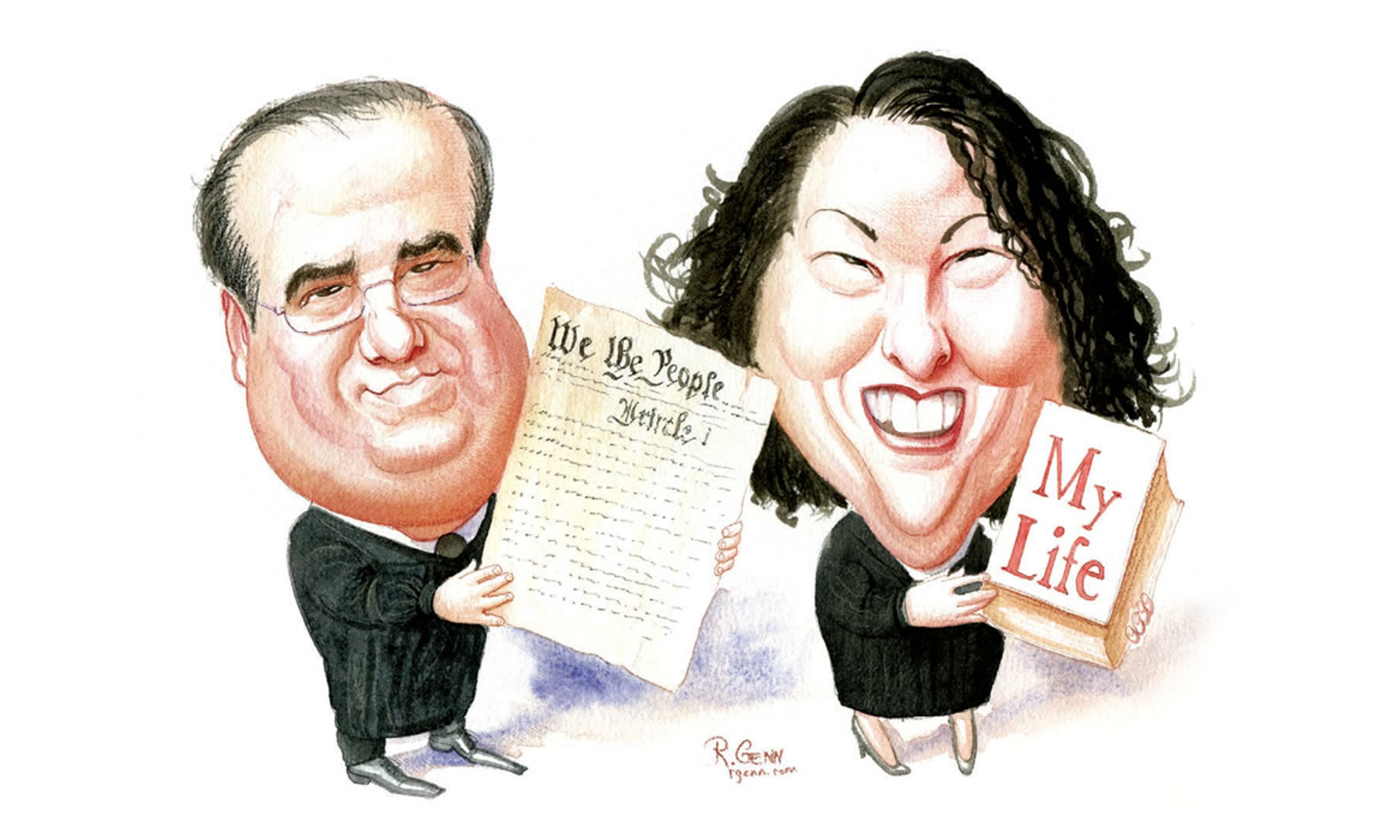
Sonia Sotomayor was delivering the keynote address at a 2001 academic conference when she said, “Personal experiences affect the facts that judges choose to see.” The speech has become infamous in the days since Pres. Barack Obama nominated her to replace retiring justice David Souter on the United States Supreme Court.
That infamy does not stem, as it should, from Sotomayor’s matter-of-fact acknowledgment that she and many other judges “choose to see” some facts, and to disregard others, based on their “personal experiences” — which, given the prism through which Sotomayor chooses to view the world, means race and ethnicity. Instead, the speech is notorious because Sotomayor, in comparing the merits of jurists from different racial and ethnic backgrounds, declared that “a wise Latina woman, with the richness of her experiences, would more often than not reach a better conclusion than a white male who hasn’t lived that life.” That’s a lightning rod of a claim: Had a white man contended that the richness of his experience rendered him a better judge than a Latina woman, his career would be over. Appreciating the volatility of this sort of rhetoric, leading Democrats are now insisting either that Sotomayor misspoke (the take offered by President Obama) or that her statement has been — all together now! — “taken out of context.” That’s the preferred spin of Senate Democrats, who will try to carry Sotomayor over the finish line.
These interpretations are indefensible. Sotomayor was not speaking off the cuff. She was delivering a lecture at a Berkeley law-school event attended by a slew of academic and judicial notables. The speech was for publication, in the Berkeley La Raza Law Journal, which titled the symposium “Raising the Bar: Latino and Latina Presence in the Judiciary and the Struggle for Representation.” While there was some disagreement with Sotomayor, her views could scarcely have surprised anyone. As the American Bar Association noted in a 2000 profile, Sotomayor has been affiliated with the Puerto Rican Bar Association, the Hispanic National Bar Association, the Association of Judges of Hispanic Heritage, and the National Council of La Raza.
In context, moreover, Sotomayor’s speech was worse than the explosive “wise Latina woman” comment suggests in isolation. “The focus of my speech,” she proclaimed, was “to discuss with you what it all will mean to have more women and people of color on the bench.” A self-described “Nuyorican” (the 55-year-old Sotomayor was born in the Bronx, of Puerto Rican parents), she complained about America’s “deeply confused image of itself,” a state of “perpetual tension” between the the desire to “take pride in our ethnic diversity” while we “insist that we can and must function and live in a race- and color-blind way that ignores these very differences that, in other contexts, we laud.”
Sotomayor pointedly rejected the ideal “that judges must transcend their personal sympathies and prejudices and aspire to achieve a greater degree of fairness and integrity based on the reason of law,” calling that a mere “aspiration” that is not achievable “in most cases.” Everything is relative, she argued, quoting a Yale Law classmate’s declaration that “there is no objective stance, but only a series of perspectives.” In forming those perspectives, she maintained, “women or men of color” have “basic differences in logic and reasoning.” Necessarily, this “will make a difference in the process of judging” as more people of color assume more influential roles on the federal bench. “What the difference will be in my judging,” Sotomayor claimed she could not say. But she was certain that “there will be some, based on my gender and my Latina heritage.”
Sotomayor’s obsession with racial and ethnic identity politics was not taken out of context: It was the context. And we needn’t speculate about whether it would infect her judging. As promised in the Berkeley lecture, it has already affected her judging profoundly — and in a manner that could complicate her confirmation hearings.
Sometime in the next four weeks, the Supreme Court will decide Ricci v. DiStefano. It is an affirmative-action case involving 20 Connecticut firefighters (19 white, one Hispanic) who were denied promotions because New Haven’s exam, despite being rigorously vetted to ensure racial and ethnic neutrality, resulted in the qualification for promotion of too many whites and not enough minority candidates. The lead plaintiff, who was dyslexic, had gone to the extraordinary length of having the test materials audio-recorded, at his own considerable expense, so that he could master them. When the disappointed firefighters sued, a federal district court attempted to whitewash their constitutional equal-protection claims in an unpublished order granting summary judgment to city officials, despite conceding the existence of evidence that they “were motivated by a concern that too many whites and not enough minorities would be promoted.”
On appeal, this barefaced violation of the Fourteenth Amendment was a fact that Judge Sotomayor chose not to see. Notwithstanding the obvious significance of the proceeding — which commanded unusually lengthy briefs from the parties, amicus briefs, an 1,800-page record, and an hour of oral argument, all well beyond the norm — Sotomayor and two other judges tried to bury the case in an unpublished order that summarily affirmed the district court. When the other circuit judges got wind of what had happened, the panel’s legerdemain drew a withering rebuke from Judge José Cabranes, a highly respected jurist who, like Sotomayor, is both Hispanic and a Clinton appointee. Dissenting from the circuit’s refusal (by a 7–6 vote) to have Sotomayor’s decision reviewed by the entire court, Cabranes lamented the panel’s shoddy treatment of
significant constitutional and statutory claims of first impression . . . in an opinion that lacks a clear statement of either the claims raised by the plaintiffs or the issues on appeal. Indeed, the opinion contains no reference whatsoever to the constitutional claims at the core of this case, and a casual reader of the opinion could be excused for wondering whether a learning disability played at least as much a role in this case as the alleged racial discrimination. . . . This perfunctory disposition rests uneasily with the weighty issues presented by this appeal.
There is one logical explanation for Sotomayor’s underhandedness: Her empathy did not encompass the white firefighters, and therefore she sought to deep-six a worthy case in a way that evaded Supreme Court review. No doubt swayed by Cabranes’s expressed “hope that the Supreme Court will resolve the issues of great significance raised by this case,” the High Court accepted it for review. If the tenor of the oral argument several weeks ago is any indication, the ruling could be an embarrassment for Obama’s nominee on the eve of her confirmation hearings.
A reversal on Ricci would be far from the first for Sotomayor. Though the justices have not reviewed many of her cases, she has been reversed at an alarming rate in those that have been scrutinized. Earlier this term, the Supreme Court rejected her ruling that the Clean Water Act barred the EPA from using reasonable cost-benefit analyses, rather than a prohibitively costly alternative, in regulating power plants. Last term, the Court reached the same result as Sotomayor in a tax case, but Chief Justice Roberts’s unanimous opinion faulted her for adopting a reading of the relevant law that “flies in the face of the statutory language.” In 2006, the justices unanimously reversed her ruling that federal securities law had not preempted various state-law claims. In two 2001 cases, the Court rejected both an interpretation of copyright law she had espoused as a district judge and her ruling that the Court’s 1971 Bivens case, which created a private civil action for money damages against federal officers alleged to have violated constitutional rights, should be extended to permit suits against government contractors.
This is not to suggest that Judge Sotomayor’s rulings, as opposed to her rhetoric, have been either radical or outside the legal mainstream — which is leftist and activist. Gun owners are justifiably dismayed by her recent undermining of the Supreme Court’s holding in Heller that the Second Amendment preserves a personal right to have a weapon in the home. But she is generally respectful of precedent — even in the Second Amendment case, she relied on an 1886 Supreme Court ruling that the amendment did not apply to the states. And in Ricci, she was plainly more a sneak than a crusader for affirmative action. While apparently pro-abortion, she has upheld both the right of anti-abortion protesters to sue police for using excessive force and the power of the government to favor “the anti-abortion position over the pro-choice position” in dispensing public funds (though she would no doubt uphold the opposite government choice as well). A left-leaning former prosecutor, she is sympathetic to criminal defendants and intolerant of alleged overreach by police, but she is not irrationally soft on crime; though solicitous of some prisoner abuse claims, her record on search-and-seizure issues is run-of-the-mill, and, as demonstrated in a thoughtful 2008 opinion, she has strongly defended federal sentencing guidelines.
In sum: As a judge, Sotomayor has been unremarkable. But Obama did not choose her because she is remarkable. He chose her because he wanted to appoint the first Hispanic to the Supreme Court. On that tribunal, she would not likely prove unremarkable. She would be untethered from the bonds of precedent that have kept her imperious instincts in check. Worse, she would be armed with an empathy license to pick winners and losers — in accordance not with the law, but with whatever facts she chose to see. She would be the Sonia Sotomayor of the Berkeley speech. And that would be lawless — just ask the New Haven firefighters.












Comments