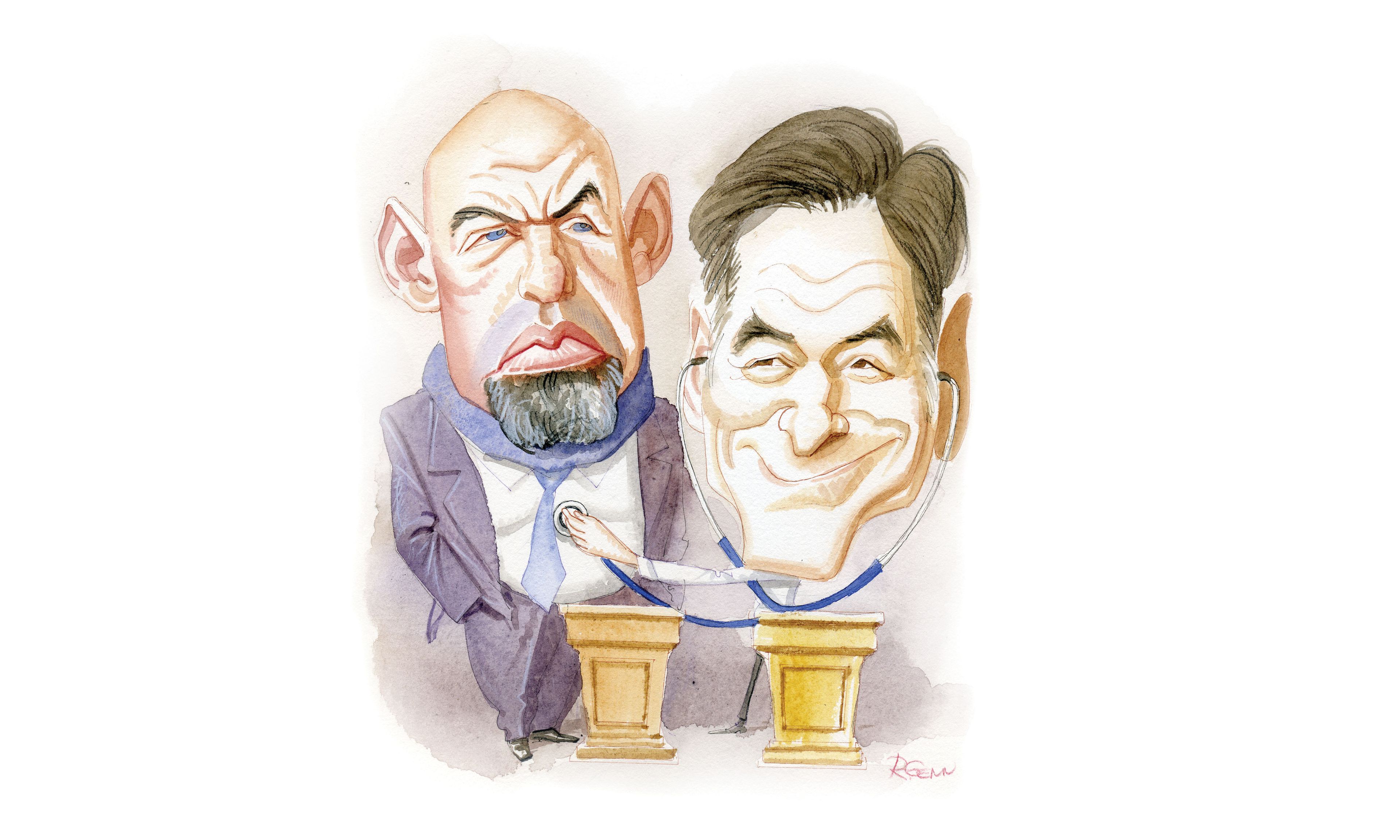
• Chesa Boudin must be proud: He’s the first member of the family to get off with time served.
• The atrocity in Uvalde, Texas, has shifted Congress’s focus to the question of gun control. The impetus is understandable — what happened at Robb Elementary School was horrific — but the details remain as thorny as ever. There is no strong case for new federal laws in this area. Extending background checks to private transfers is beyond Washington’s authority and does not intersect with the problem. Banning so-called assault weapons would be vague (it is impossible to determine in law precisely what an “assault weapon” is), largely ineffectual (most mass shooters use handguns), and unconstitutional (the AR-15, most people’s idea of an “assault weapon,” is the most commonly owned rifle platform in America and could not be prohibited without gutting the Second Amendment). And there is no need for more federal funding, either. The case for state-led initiatives is stronger. Many mass shooters are between 18 and 20, below the age for purchasing handguns; states may raise the age for purchasing rifles as well. Likewise, states are well placed to experiment with carefully delineated “red flag” laws that would permit local authorities to temporarily remove firearms from those who make true threats or exhibit clear signs of dangerous mental illness. Ultimately, though, this remains an extremely tough problem, and one that will be diminished by slow and steady work, not quick and flashy gestures.
• President Biden unveiled his plan to fight inflation, or at least to minimize its political cost to him, in an op-ed for the Wall Street Journal. Even making allowances for the limited power of any president over the economy, it was pitiful. He had three ideas: He would leave the Fed alone to do its job, make running a household more affordable through means such as green-energy tax credits, and cool down the economy through tax increases on high earners. If all of this sounds like what he was doing a year ago, while his administration was insisting that inflation was no big deal, that’s not an accident. Biden’s actual plan is to hope for the best as inflation devours his presidency.
• Pennsylvania Republicans now have a Senate candidate, the controversial doctor best known for hanging out on Oprah’s couch, Mehmet Oz. In early June, we learned that Oz’s Democratic opponent, John Fetterman, has experience dismissing doctors who tell him things he doesn’t want to hear. Fetterman suffered a stroke on May 13 and issued a statement declaring that he’d had a pacemaker implanted. His wife, on primary night, characterized her husband as having had “a little hiccup.” But publications including the New York Times and the Philadelphia Inquirer consulted cardiologists who determined the explanation didn’t add up, which suggested that Fetterman suffered from a more serious problem. After two weeks with no public appearances, Fetterman issued a new statement declaring that he “almost died” after his recent stroke, and the Washington Post reported that his “ability to have conversations rapidly has not fully recovered, though he is improving and doctors still predict a full recovery.” Fetterman’s cardiologist said that in 2017 he diagnosed Fetterman with atrial fibrillation and decreased pumping efficiency, prescribed medications — and did not receive a visit from Fetterman again for five years. The man is lucky to be alive. We hope Fetterman lives to a ripe old age and enjoys good health for the rest of his days. But the Senate candidate, his wife, his doctors, and the Pennsylvania Democratic Party should have an honest conversation about whether it is in his and their best interest for him to continue as the nominee.
• San Franciscans voted to recall left-wing scion Chesa Boudin from his position as district attorney. Boudin had scrupulously avoided going after property crimes and many drug offenders, including fentanyl dealers. His office helped San Francisco go from mere Dickensian excess to urban anarchy. Mayor London Breed’s ambition to turn the city around from her failed Defund the Police agenda requires a prosecutor’s office willing to prosecute crimes. Boudin was left impotently protesting the influence of nameless Silicon Valley billionaires who funded the campaign against him. The losing billionaire was George Soros, whose money had helped inflict Boudin on San Francisco, and a rash of permissive prosecutors on cities across the country. This recall was a good start.
• The Biden administration has repeatedly said that it is not inhibiting domestic energy production and that the high gas prices Americans face right now are a product of events out of its control. It is certainly true that oil is traded on a global market experiencing numerous geopolitical disruptions, and the president does not control the price of gasoline. But the administration does have control over how federal lands are used, and it seems intent on pleasing environmentalist groups rather than boosting energy production. As a result of activist litigation, the Department of the Interior will have to redo environmental reviews on nearly all of the oil and gas leases granted in Wyoming from 2015 to 2020. Tying up drilling in litigation and regulation is a great way to get less energy into production and discourage investment for the future. The Casper Star-Tribune reported that environmentalists see the leasing decisions as “the Biden administration’s chance to follow through on its climate commitments.” We see it as the Biden administration’s chance to stand up to a heckler’s veto on meeting the energy needs of 330 million citizens.
• The Securities and Exchange Commission is also discouraging energy production. It has put forward a proposal that, if implemented, would force public companies to make certain climate-related disclosures, including disclosures of “material” climate-related risks to their business. That should not be necessary (public companies are already required to disclose material risks), but it reveals that the agency’s real interest is, one way or another, to force companies to comply with the administration’s climate objectives, something that will harm the very investors the SEC is meant to protect. In a letter to Gary Gensler, the commission’s chairman, 16 Republican governors have called on the SEC to withdraw the proposed rule. As the governors highlighted, this is an area outside the agency’s authority — and, for that matter, competence.
• The Michigan baby-formula plant that closed down in mid February has reopened. Abbott Labs voluntarily ceased operations at the facility and recalled formula that came from it after several infants developed bacterial infections and the FDA began an investigation. FDA inspectors found health and safety violations in the plant, but they were unable to link the bacterial infections to them conclusively. The Department of Health and Human Services’ inspector general announced an investigation into the FDA’s foot-dragging. We’re afraid it is going to take more than a federal investigation for the FDA to mend its ways. As David Gortler wrote for NR Capital Matters, the FDA’s processes for everything it regulates, not just baby formula, are outdated and unreliable. As numerous regulatory economists have emphasized for years, the FDA is too risk-averse, which costs lives by denying access to safe treatments out of an overabundance of caution. Add in standard-issue bureaucratic malaise, and the FDA often becomes an obstacle rather than an aid to health and nutrition. Congress shouldn’t have to drag the commissioner in for testimony to get the FDA to do its job expeditiously. And FDA incompetence only strengthens the case for allowing Americans easier access to baby formula from friendly peer countries with high health standards, so that families aren’t dependent on the speed of bureaucracy to feed their babies.
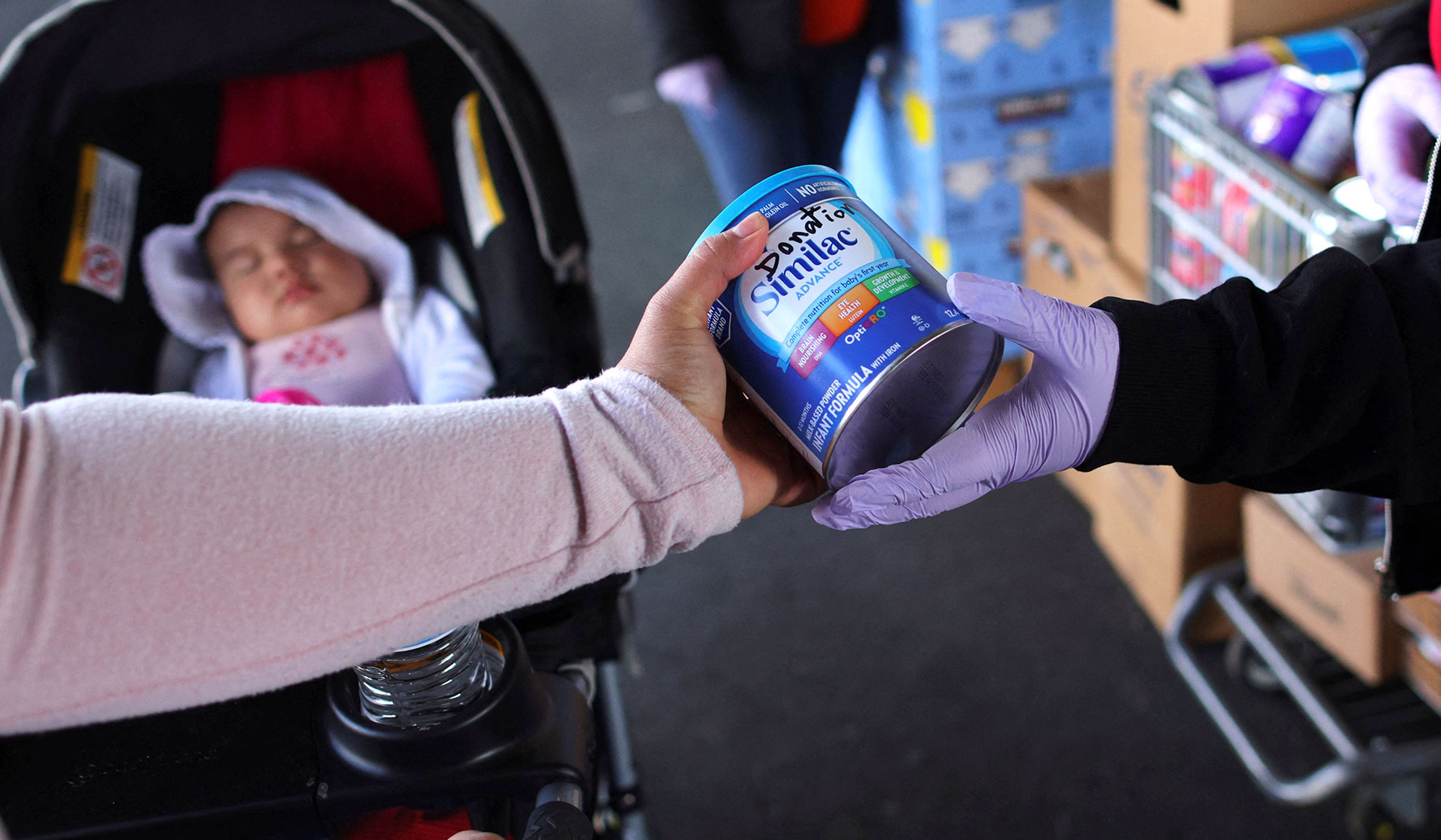









Four month-old Alaia Sandoval sleeps while her mother receives free baby formula amid continuing nationwide shortages in infant and toddler formula at a food pantry run by La Colaborativa in Chelsea, Mass., May 18, 2022.
Brian Snyder/Reuters
• President Biden issued five presidential memoranda invoking Section 303 of the Defense Production Act (DPA) to encourage the production of various materials used for “green energy.” In so doing, he stepped far beyond his presidential powers and undermined the rule of law in the market economy. Section 303 allows the government to make purchase commitments for the resources named, directly subsidize the production of them, and install and purchase equipment used for that production in either government or privately owned facilities. That considerable power usually comes with a financial cap: Projects costing over $50 million require congressional approval. But Biden waived that requirement as well, meaning the executive branch now has the power to spend and subsidize as much as it wants without the approval of Congress. The DPA is intended for wartime, and so Biden had to contort himself into saying, for example, that insulation is “essential to the national defense.” His nonsense orders come after the failure of the Build Back Better Act, which would have subsidized green energy — as if Biden could misuse his powers under the DPA to get what Congress had expressly denied him. Similar executive overreach and circumvention of Congress occurred under Trump and Obama. Congress should reform the DPA to prevent such abuse in the future: Presidents can no longer be trusted with the sorts of discretion that the law provides.
• Colinford Mattis and Urooj Rahman were 30ish white-shoe lawyers when, in May 2020, Rahman was caught on tape throwing a Molotov cocktail into an unoccupied police car and Mattis was arrested with more such improvised explosives in his car and videotaped trying to hand them out to others. These are gravely serious crimes, more so than those committed by all but a tiny handful (at most) of the people charged for January 6. An unapologetic Rahman told reporters later, “The only way they hear us is through violence.” The Biden administration acted shamefully by retroactively reducing their plea-bargained sentences. This is a pattern: The riots and protests of summer 2020 left more than a dozen people dead and more than a billion dollars in damages, yet Democratic federal, state, and local prosecutors have gone scandalously soft on rioters out of misplaced sympathy for their cause. Mattis and Rahman pleaded guilty last year to charges carrying up to ten years in prison. Federal prosecutors sought to charge more-serious offenses for distribution, but in a shocking reversal they have now agreed to recommend a prison sentence of 18 to 24 months. Justice that plays political favorites is not justice at all.
• The Associated Press reported that “the San Francisco Unified School District will no longer use the word ‘chief’ in job titles because of concerns from Native Americans.” “Chief” is a very old word, running through Latin, Middle English, and Anglo-French. It relates to “head.” Think of a chef, in a kitchen. And “Hail to the Chief” and a thousand other things. Native Americans have many greater, and legitimate, concerns, and so does San Francisco.
• The Dobbs leak investigation seems to be getting serious, or, at any rate, its seriousness is now public. CNN’s Joan Biskupic reported that law clerks, still the likeliest suspects, are being asked “to provide cellphone records and sign affidavits,” sufficiently alarming them that some are considering lawyering up. The Court is right to take aggressive steps to find the culprit. The clerks, as at-will employees holding career-making jobs, would be wise to cooperate; if they care about the institution, they should want to. Seeking counsel from a lawyer is never a bad idea in an investigation, and the clerks might prudently ask for written assurances of limits on the use of information provided voluntarily, but it will be a telling sign if the left-wing clerks close ranks and refuse to cooperate. You can tell whom the commentariat actually believes to be the likely leaker by what it says. Conservatives are out demanding heads and talking about criminal liability for people who file false affidavits, while progressives are expressing hostility to the whole investigation. Time for the Court to do justice inside its halls.
• Attacks on churches and crisis pregnancy centers across the country have escalated since that leak. On May 27, a 19th-century tabernacle estimated to be worth $2 million was stolen from St. Augustine Catholic Church in Brooklyn. In addition to the theft, the burglars scattered the hosts of the Eucharist, which Catholics believe to be the Body of Christ, all over the floor of the church. They also decapitated the two stone angels that flank the tabernacle and stole components of the church’s security-camera system. While the burglars at St. Augustine left no explicit indication that the attack was related to the church’s condemnation of abortion, the June 3 vandalism of the Capitol Hill Crisis Pregnancy Center tells a different story. Perpetrators egged the center’s windows, splashed red paint on the front door, and spray-painted “Jane Says Revenge” on the outer wall in an apparent reference to Jane Roe, the pseudonym of Norma McCorvey, plaintiff in Roe v. Wade. The same group, which calls itself Jane’s Revenge, claimed responsibility for firebombing CompassCare, a pro-life health clinic in Buffalo. The attackers also spray-painted “Jane Was Here” on the building’s remains. At the time of this writing, none of the three attacks has seen its perpetrators brought to justice. These apparently politically motivated attacks have been roundly denounced by the pro-life movement, but pro-choicers, including President Joe Biden, have mostly been silent about what appears for all the world to be a lawless campaign of political intimidation.
• The social-media age promised a new, more democratic marketplace of ideas: An ordinary citizen without a printing press or a TV station could be heard by a mass audience through platforms run by private companies. Yet social-media giants have earned the public’s mistrust through politically biased and often arbitrary use of their power to censor or promote content. This caprice predictably produced a political backlash. States such as Florida and Texas passed laws constraining the platforms’ liberty to discriminate against political viewpoints. We would like to see the platforms adopt clear, even-handed policies, but they are still private actors with First Amendment rights of their own. The Supreme Court has long protected newspapers and cable-TV channels from compulsion to print or air content with which they disagree. The U.S. Court of Appeals for the Eleventh Circuit accordingly struck down most of Florida’s law, finding that it invaded the platforms’ right to decide what to publish. The Supreme Court then reinstated, by a 5–4 vote, a preliminary injunction against the Texas law. The Court should hear one or both of these cases on the merits at the first opportunity and properly apply the First Amendment, which ought to leave little of either law standing. Government has historically regulated common carriers in transportation, such as railroads, and public accommodations, such as hotels, in a way that effectively compels them to take all comers. The government should not be able to turn an industry into a common carrier in order to evade the Bill of Rights.
• A consensus has emerged that China is our geopolitical adversary, but U.S. trade policy hasn’t caught up. President Biden announced the Indo-Pacific Economic Framework for Prosperity (IPEF), a deal between the U.S. and twelve other countries in the region that excludes China and seeks to strengthen ties between its members. One problem: It doesn’t actually do anything. IPEF doesn’t reduce tariffs or guarantee more market access, and it has no security guarantees, either. It does include green-energy commitments, though, so take heart. Meanwhile, China has been creating its own trade bloc in the Indo-Pacific and increasing its military investment throughout the region. The countries that were going to be in the Trans-Pacific Partnership before the U.S. withdrew under President Trump have pressed on with their own trade deal, but without American participation it’s much less valuable. If the U.S. wants to counter China, it needs to be serious about forging commercial and security relationships in the Indo-Pacific. That means actual trade deals, not photo ops for heads of state.
• For the first time in 17 years, a U.N. human-rights commissioner visited China. This was Michelle Bachelet, a former president of Chile. A flavor of her can be had in what she said about Fidel Castro when he died in 2016: He was “a leader for dignity and social justice.” In China, she had official meetings and went on chaperoned tours. Afterward, she made a few sympathetic noises about Uyghurs, Tibetans, and others, but human-rights activists tended to be dismayed by her trip while the Chinese government made propagandistic hay out of it — which indicates the final score.
• Sri Lanka had been an economic success story. The island nation of 22 million, off the eastern coast of India, had seen major improvements in quality of life since the conclusion of its long civil war in 2009. Its largest city, Colombo, had become a tourist destination. But a blend of poor leadership and worsening global economic conditions has now forced Sri Lanka to default on its debts. The country had been on a spending spree financed by money-printing and international borrowing, and was partially depending on tourism revenues to recover. Its first- and third-largest tourism markets, though, were Russia and Ukraine. On top of that, the pandemic reduced foreign remittances, energy-market turmoil has led to gas lines, and a disastrous decision to “go green” by banning chemical fertilizer threatens to make food even more scarce than it already is. Sri Lanka had the disadvantages of poor leadership, but it won’t be the last developing country to face crisis in a global environment of higher inflation and rising interest rates.
• In November 2019 (“Bloody November”), fuel prices spiked in Iran. People took to the streets in protest, and those protests turned “political” as well as economic. People called for the overthrow of the regime, in power since 1979. It is happening again. This time, food prices are through the roof, and people have taken to the streets all over the country, crying for an end at last to this cruel regime — a regime that has kept Iranians down and made their country a pariah in much of the world. One day, Iranians will send Khomeini’s heirs packing. The United States, and other democracies, should do all that can feasibly and wisely be done to help them.
• In Canada, Justin Trudeau’s government has responded to the Uvalde mass shooting by essentially banning guns. Under new legislation, which is expected to pass the parliament, Canada will ban the purchase, sale, import, or transfer of all handguns. Most long guns must be turned in for destruction, with compensation (if any) to come later. The only firearms that Canadians are to have will be bolt-action hunting rifles, which are difficult to obtain and slow to refire. When asked about the ban, Trudeau said rather curtly: “Other than using firearms for sport shooting and hunting, there is no reason anyone in Canada should need guns in their everyday lives.” Canadians who would prefer to have their right to self-defense are encouraged to apply for asylum.
• Boris Johnson did not so much win a vote of no confidence from Conservative MPs as survive it. To be sure, under Tory rules, a year has to pass before another vote, but he can expect continued sniping, a spectacle that will delight Labour. Johnson is fortunate that the next general election is over two years away. He also has two other things going for him: the lack of an obvious successor, and his own proven ability to appeal to the new coalition between traditional Conservatives and former Labour voters on which a Conservative majority depends. There is still time for him to win back much of that. But to do so he will have to end his government’s leftward drift, which, more than his handling of a scandal involving pandemic-era partying, is the cause of his current woes.
• Four jubilee days celebrated Queen Elizabeth’s 70 years on the throne. She knows how to play to perfection the ceremonial role of a constitutional monarch. Elegantly dressed, with a diamond brooch to catch the eye, she gives the impression that she cherishes even the most repetitive of her duties. She, her husband — the duke of Edinburgh, who died in April 2021 after 74 years of marriage — and their children are treated as some sort of imaginary national family. For the elders, the jubilee had the traditional pageantry of Trooping the Colour and a service of thanksgiving at St. Paul’s Cathedral. Well-known pop stars then performed for the young. Choosing the final moment, the queen and her son, grandson, and great-grandson, all of them possible successors, appeared on the famous balcony of Buckingham Palace, from which they waved to the cheering crowds below. A final march-past of thousands of men and women from countries associated with Britain lasted four hours. According to the media, a billion people around the globe were watching.
• The American film industry has in recent years accepted a Faustian bargain with the Chinese Communist Party, removing content to which the CCP objects to gain access to the huge market it controls. The trailer for Top Gun: Maverick seemed to be another chapter in this tale of self-interested cravenness. In the original Top Gun, released in 1986, Tom Cruise’s Maverick wears a jacket with the Taiwanese flag (among others) stitched onto it. The jacket also appears in the sequel, but in the first trailer for Top Gun: Maverick, that flag had gone missing. Reportedly it was expunged at the behest of Chinese media giant Tencent, originally a financing partner for Top Gun: Maverick, and which was fearful the CCP would accept nothing less. But somewhere along the way, Tencent balked; the finished film was, apparently, too pro-American even with the Taiwanese flag removed, the company withdrew from the project, and the flag was restored. Next time, Hollywood should rebuff Chinese Communist demands from the start.
• Ricky Gervais became the latest comedian to face backlash after mocking transgenderism. In his Netflix comedy special SuperNature, Gervais distinguished between “the old-fashioned women, the ones with wombs” and the “new women . . . the ones with beards” and, um, other things. He told his audience: “The worst thing you can say today is ‘Women don’t have penises’. . . Now no one saw that coming.” A writer for Vox echoed the ire of activists when she called Gervais’s special “rife with transphobic . . . ideology.” Just weeks earlier, Bill Maher had angered many of the same people in a monologue in which he said: “If kids knew what they wanted to be at age eight, the world would be filled with cowboys and princesses. I wanted to be a pirate. Thank God, nobody took me seriously and scheduled me for eye removal and peg-leg surgery.” You can see why supporters of trans ideology consider it so important to forbid any mockery of it.
• The Washington Post has a silly motto (“Democracy Dies in Darkness”), some silly columnists (Jennifer Rubin, Dana Milbank), and a clear and obvious bias toward the Democratic Party, yet most would agree that it is a serious newspaper. That’s all changing; these days, thanks to its aging editors’ fear of Millennial wokeness, it has a pre-K feel, with staffers taking running leaps at one another and their supposed betters indulging the chaos. After reporter Dave Weigel retweeted a sexist joke, for which he apologized yet was still extravagantly punished with a month’s unpaid suspension, fellow reporters Taylor Lorenz, Felicia Sonmez, and Jose Del Real engaged in an often-vicious and very public Twitter dispute that was still raging five days after Weigel’s transgression. Considerable merriment among onlookers ensued as the paper embarrassed itself with each tasty new accusation. After editor Sally Buzbee, who is to leadership what Vladimir Putin is to mercy, finally issued a statement Tuesday telling her staff to knock it off, reporters began issuing a hilarious series of obviously coordinated tweets signaling fealty in nearly identical language about how the paper supposedly exemplified “collegiality.” Our respect for the WaPo before these incidents was limited, but Buzbee’s weak and indecisive discipline is making it a laughingstock of journalism.
• A new article published by the American Medical Association refers to embryos as “pregnancy tissue.” The article suggests that doctors prescribe abortifacient medication to skirt legislation that restricts abortion. “Pregnancy tissue” obscures the existence of a human being distinct from its mother. Abraham Lincoln once asked how many legs a dog has, if you call a tail a leg. The answer: Four, because calling a tail a leg doesn’t make it one.
• A Virginia jury ruled mostly in favor of Johnny Depp in a trial that dragged on for more than six weeks, finding that his ex-wife, Amber Heard, defamed him in a Washington Post op-ed (ghostwritten for her by the ACLU) that reinforced her previous branding of him as a wife-beater. Heard was awarded a small fraction of the claimed damages in her countersuit; she should end up owing Depp $10 million when the two verdicts are offset. Depp, whose film career was wrecked by the allegations, won significant vindication in the court of public opinion, although, like the jury, many observers saw him less as an innocent victim than as the lesser culprit in a complicated and mutually abusive relationship. Still, the trial showed the upside, even for a figure as flawed as Depp, in fighting to clear one’s good name. While too many media observers simply fall back on “believe all women” generalities, juries have to consider the actual evidence, the facts it supports or fails to, and the flawed men and women behind them. Our system of law and our cultures of celebrity, true-crime television, and public moral judgment are not perfect, but they reflect (in different measures) experience, reason, and the sensibilities of the American people. As we have seen repeatedly over the past few years, the jury system is still a crucial safeguard, because in a courtroom facts and individuals still matter more than identity groups.
• Michael Avenatti has been sentenced to four years in prison for “aggravated identity fraud and wire fraud” after being found guilty of defrauding Stormy Daniels of a book advance. Avenatti grabbed national attention in 2018 as the attorney for Daniels, a pornographic performer who claimed to have had an affair with Donald Trump before he was elected president. The disgraced lawyer is already incarcerated for attempting to extort money from Nike. The new sentence will run partially concurrently with that one, for a total of five years. Avenatti wanted to take down Trump, but somehow managed to make him look good by comparison.
• Georgetown’s law school finally reinstated Ilya Shapiro after a five-month investigation of a single tweet. Shapiro had tweeted that by imposing a demographic litmus test on his Supreme Court nominee, Joe Biden had excluded the candidate Shapiro considered most qualified, making it inevitable that the nod would instead go to a “lesser black woman.” Woke zealots intentionally misconstrued this into a claim that all black women were “lesser.” Georgetown waited until students had gone home for the summer to conclude that Shapiro had sent the tweet days before his job started and so was not subject to disciplinary action, a preposterous technicality that should not have required months of “investigation.” The process was the punishment. Georgetown Law’s dean, William Treanor, then strongly implied that he would lie in wait for Shapiro to say something that could justify a firing. It was a victory for outside counter-pressure by many friends of Shapiro and of free speech that Georgetown did not feel at liberty to fire him, but it also showed the limits of academic freedom; only someone as prominent and respected as Shapiro would have avoided immediate termination, and Georgetown managed to bludgeon his reputation anyway. The university’s cowardly disregard of free speech is a dire sign, especially when combined with Georgetown’s proud tolerance of provocative speech by progressive faculty that shows contempt for their conservative students. Shapiro is no fool, and rather than work under such conditions, he resigned, citing a “hostile work environment.” We suspect Georgetown has not heard the last of him.
• “Man bites dog” makes the news. “Dog bites man” does not — except when it does. A recent headline read, “Mets’ Max Scherzer suffers dog-bite injury on pitching hand.” The great hurler will be okay. His dog Rafi had a bad moment, is all. In a tweet, Scherzer said, “This is literally a non-story.” Ah, Max, you need to let editors decide about that one.
• There was a time when the blue spires on the orange roofs were ubiquitous across America, alerting motorists to a Howard Johnson’s restaurant along the way (the children in the car knew there would be 30 flavors of ice cream available within). The chain was founded in the 1920s by a young Mr. Johnson, who had previously gone straight from elementary school to his father’s failed cigar business. His first sit-down restaurant, in Quincy, Mass., boomed when Eugene O’Neill’s Strange Interlude, banned in Boston, opened in Quincy (the four-hour drama had a dinner break). Iconic sameness, dependability, and ice cream took the concept regional, then national. Howard Johnson’s became a staple for middle-class middle America, able, post-World War II, to pack up the family car and travel. But over time other chains, notably McDonald’s, ate into Howard Johnson’s business. The last cones were served over Memorial Day weekend in Lake George, N.Y. History-of-food buffs may buy the building for ten dollars.
• In 1962, Kenichi Horie became the first person to cross the Pacific in a solo, nonstop sailing voyage. Now, 60 years later, he has done it again. We will pause while you blink and assess. Mr. Horie, of Japan, is now 83. Feats of body, mind, and spirit are a pleasure to behold and contemplate.
Still Bleeding
Sun Tzu advised strategists to know the mind of the enemy. What is in the minds of Putin and his general staff when they look at Ukraine?
Their original hope, for a quick strike met with little opposition, or even with welcome, was dispelled immediately by Ukrainian resistance. Plan B, an advance in force on multiple fronts simultaneously (really an extension of the expected occupation), collapsed under the weight of poor equipment, incompetence, and a resilient Ukrainian defense bolstered by advanced Western weapons.
Russia now has pivoted to a sustained campaign in the east, in order to secure a land bridge embracing and extending its conquests in 2014 (Crimea and the Donbas puppet “republics”). The Russians have created a cauldron, or large pincers, around the city of Sievierodonetsk, which Volodymyr Zelensky calls a “dead city.” Ukrainians are attempting a counterattack to the south, toward Kherson, at the mouth of the Dnipro River.
If Russia feels confident of its gains, it could signal willingness for a cease-fire. This would relieve a world shocked by the humanitarian carnage and give an opening to voices in NATO and our country calling for peace. French president Emmanuel Macron, bolstered by his recent election victory over outright Russophiles, is eager to pivot to the role of a diplomatic broker. Henry Kissinger, following the great-power politics he has studied and practiced for 70 years, has called for Russia not to be humiliated.
Too late for Boris Bondarev, a 41-year-old Russian diplomat serving at the U.N. who resigned from his country’s service. “Never have I been so ashamed of my country,” he wrote, calling the invasion a crime not only against Ukraine but “against the people of Russia, with a bold letter Z crossing out all hopes and prospects for a prosperous and free society.”
Russia continues to bleed senior officers; Russian media and the Ukrainian military both announced the death of Major General Roman Kutuzov (an ironic surname, given his fate). Russia’s operations continue to be marked by the barbarity of indiscipline and ethnic resentment, as Ukrainian civilians are murdered and raped, and children kidnapped and removed to Russia.
The U.S. has an interest in Ukrainian sovereignty, in a Russian defeat, and in a resumption of peace. We have much less interest in Ukrainian recapture of every square foot it has lost. That’s realism. So is this: Calls for Ukrainian concessions to secure a quick peace will encounter the justified skepticism of the Ukrainian people. This war is not a fight over territory, à la the contests of Frederick the Great, but a war of devastation, like the Thirty Years’ War, but fueled more by Putin’s ambition and great-power nostalgia than religion.
To ask Ukraine to submit to such a yoke is craven. To see it slowly pulverized is monstrous. To intervene openly in its behalf is insupportably risky. The bad options are many, the possible good ones fewer and fewer.











Comments