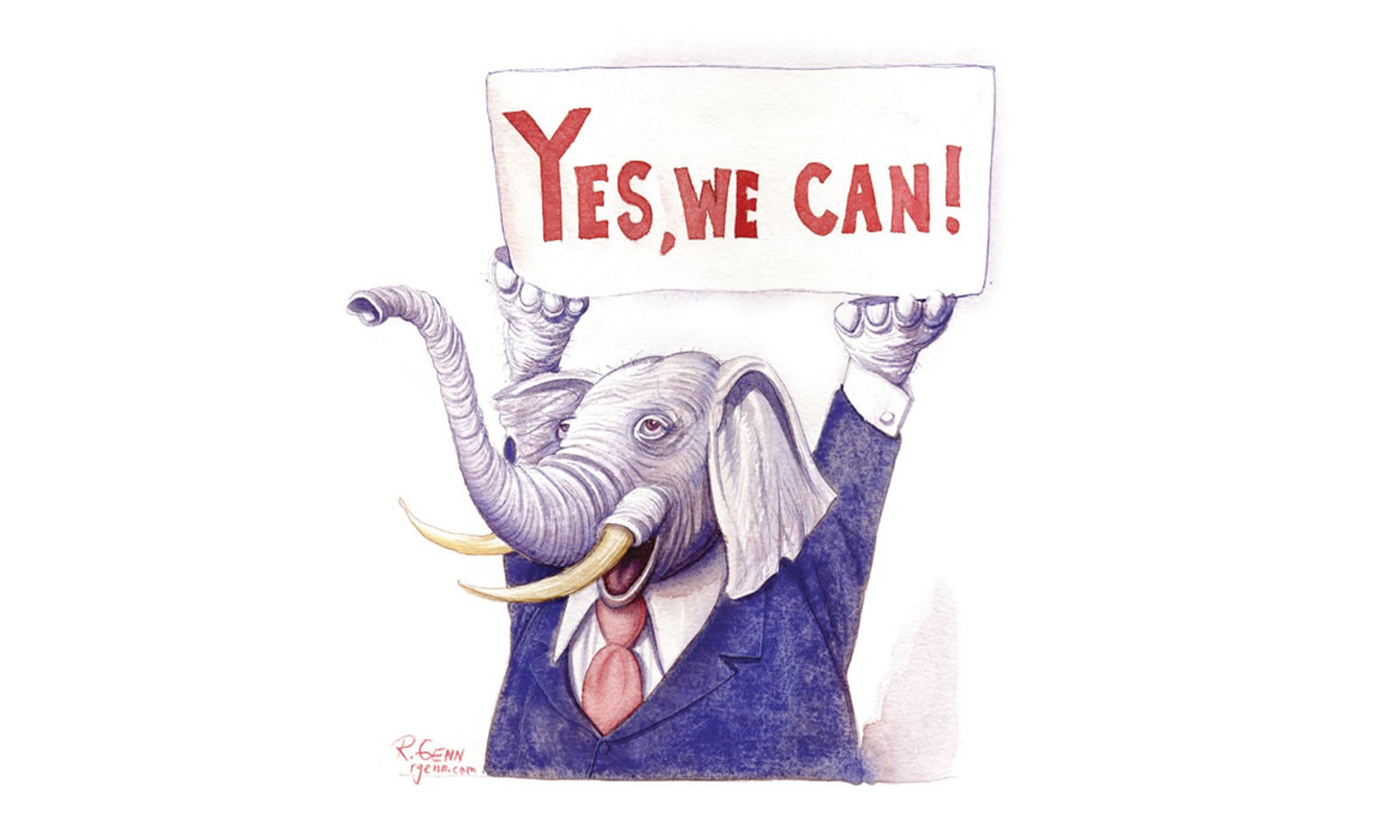
Liberals want to paint Republicans as the party of “no,” and conservatives want Republicans actually to be the party of “no.” With President Obama pursuing a domestic agenda that would make LBJ blush, “no” is the appropriate word. But it obviously can’t be the party’s entire vocabulary.
The Republican congressional leadership understands this point and is trying to hash out a broad policy agenda. Eric Cantor’s National Council for a New America, the famous “listening tour,” is a tentative step in this direction. Upon its announcement, it immediately ran into a buzzsaw of criticism on talk radio and in the blogosphere as a redundant exercise — or a prelude to a pandering sell-out — because it’s already evident what the Republican agenda should be: limiting government, plain and simple.
Actually, there is very little that is plain and simple, let alone easy, about limiting government. Too often the task is reduced to just limiting federal spending. But overspending is only one of the ways that government exceeds its proper scope, and it is not always the most damaging way. Federal spending has contributed a great deal to the problems in our health-care markets, for example, but probably not as much as state regulation and federal tax law have.
Very few voters are interested in limiting government for its own sake. They can be persuaded to limit government as a means of improving their lives and their country, but only if conservatives make a concrete case that it will have those effects. A precondition to making that case is devising a program — a set of practical steps conservatives will take once in power — that both respects the proper limits of government and addresses public concerns. Those concerns vary from place to place and year to year. Income-tax rates were a bigger problem for more people in the late 1970s than they are today. That’s why conservatives, like any other political movement, need to listen to voters. The foot knows best where the shoe pinches.
Conservatives have adopted a narrow focus on federal spending because of a misinterpretation of Republican defeats in 2006 and 2008. By 2006, congressional Republicans had mostly quit trying to reform the federal government to enable middle-class aspirations. The last time Republicans ran on a domestic agenda was 2000. After that point they coasted on pork and national security. In 2006, though, we were losing in Iraq, and Republicans couldn’t admit it. Pork, meanwhile, had led to a spectacular series of cases of corruption. Republicans lost less because of pork projects than because of what had caused them: They had grown more interested in power than in the public good.
Out of power, Republicans should start anew. They need a reform agenda that helps ordinary Americans — better, helps them help themselves — and that can be seen as such. That agenda should center, unapologetically, on the middle class. For as long as today’s two major parties have competed, Republicans have been inclined to think in terms of the national interest more than the interest of the nation’s subsets. But middle-class families are the country’s backbone, not one of its interest groups.
Without a thriving middle class, America will not be a strong country and will certainly not be a country interested in limited government. Republicans should of course pursue policies that enhance the welfare of the poor and even the rich as well as the middle class. But if a policy does not advance middle-class values and interests, it should not be at or near the top of the Republican agenda.
Spending restraint should be part of that agenda. The Obama blowout, and the Republican overspending that preceded it, threaten to crush taxpayers, and not just rich ones, in the years to come. But spending restraint is not enough.
Below we sketch out a few other areas of domestic policy where Republicans, and maybe even some moderate Democrats, could begin to build a new center-right majority. We don’t try to be all-encompassing, and we leave aside several key issues, such as financial regulation, where Republicans need to have answers (and can find some in the splendid work of Kevin D. Williamson and Stephen Spruiell in these pages). We offer our suggestions humbly. There is still much rethinking to be done on the right, and what the political landscape will look like even six months from now is unpredictable. As the Japanese proverb goes, an inch ahead is darkness.
That said, it is clear that pocketbook concerns are going to remain the bread and butter of politics for some time to come. Republicans should focus on easing the cost of living for middle-class families; they should vigorously advocate reforms to address practical anxieties about the health-care system; they should connect their cultural agenda — particularly their emphasis on the importance of marriage — to economic aspiration; they should think hard about mundane quality-of-life issues such as traffic; and they should tap into the populism of the moment by championing democratic accountability.
The party would then have adopted a contemporary version of the kind of populist, middle-class-oriented politics that has been central to Republican successes in the past, including those of Ronald Reagan in 1980 and Newt Gingrich in 1994.
Cost of living. Republicans have to win the tax issue in order to prevail on pocketbook politics. To do so the party desperately needs to move to a post-Bush agenda. Bush’s tax cuts on dividends, capital gains, and high incomes will soon expire. Restoring them would be economically beneficial. But Republicans ought to go further. Middle-class families need tax relief too. The chief federal tax they pay is the payroll tax. When parents make the financial sacrifices necessary to raise children, they lighten the payroll-tax burden that Medicare and Social Security place on everyone else. An expanded per-child tax credit, applicable against payroll and income taxes, would recognize that contribution and ease the strain on middle-class budgets.
The cost of college is another source of great anxiety for families and young adults. Policymakers can reduce that anxiety by simplifying financial-aid formulas, by replacing subsidized loans with direct grants as much as possible, and by expanding tax breaks for college savings. A lot of people would benefit, too, if government spending on higher education were redirected from four-year liberal-arts programs to vocational education and two-year community colleges. And we can reasonably ask for more financial transparency from college administrations. The party of the faculty lounge isn’t going to volunteer for these assignments.
Opposition to President Obama’s cap-and-trade proposal must be part of the Republican message on pocketbook issues: It will impose serious costs throughout the economy in order to reduce environmental risks only modestly (as Jim Manzi explains elsewhere in this issue). Republicans should favor cheap and abundant energy now, and research toward technological breakthroughs that can mitigate the harms of global warming, should they materialize, later.
Also, we suspect that in 2010 and onward it will also be both right and advantageous for Republicans to stand for hard money; why not prepare the ground before inflation gets under way?
Health care. The rising cost of health care has eaten into middle-class wages even as health coverage has gotten less secure. A government takeover of the health-care system, even one in which the private sector was tasked with doing the government’s bidding, would probably result first in escalating costs and then in deteriorating care. By replacing existing health-insurance policies, it would add to people’s insecurities about their health care and the financing of it. Republicans should instead stand for lower cost, greater stability, and more individual control.
Existing federal policy penalizes individually owned health insurance with higher taxes, and waives state regulation only for insurance provided by large employers. Republicans should propose to move gradually to build a larger, freer market in individually owned insurance. They should promise to end the tax penalty, starting with people who cannot get employer-provided insurance. They should favor letting people in the individual market, too, escape onerous state regulations. Insurance would be cheaper and more accessible, and the majority of people who are satisfied with their existing arrangements could keep them — a promise that Obama also makes but does not deliver on.
Economic aspiration and its cultural basis. The child credit discussed above would, among other things, put money where the party’s mouth is. Republicans talk a good game about family values, but have paid insufficient attention to the economic basis of family life. Familial stability is a crucial precondition for economic mobility, but it is a diminishing resource. There is not much that governments can do directly to promote it, or at least not much that many people would have the stomach for. But conservatives need at least to make the case for traditionalism and marriage in practical as well as moral terms.
The restoration of a marriage culture would be particularly good for people in the lower middle class and people striving to ascend to it. Republicans are not much exercised by inequality per se, nor should they be. But they should care about whether people can climb the economic ladder. Speaking of which: Some enterprising governor could do a lot of good by taking on the absurdly elaborate licensure rules that restrict entry into many occupations.
Quality of life. Sometimes politics throws up issues that aren’t the least bit sexy and that conservatives have very little interest in. For example: traffic. Republicans have suffered in state after state from failing to attend to public concerns about traffic congestion. The most market-friendly solution to the problem — congestion pricing on private roads — tends to be popular once implemented, but road pricing is extremely unpopular to propose. Yet technology has made progress possible here. Replacing existing toll booths with flexible electronic-collection methods ought to be popular, since it speeds up traffic without raising costs overall. East Coast Republicans, in particular, ought to take note. If new systems work, they could quickly spread.
Small-d democracy. Promoting the middle-class basis of American democracy will be a hollow victory if democratic norms have themselves eroded. Democratic accountability is threatened by the continued liberal instinct for judicial rule, as on same-sex marriage. The use of unelected agencies to impose sweeping regulatory regimes, as the EPA threatens to do with respect to global warming, is another affront to popular rule. Nor should we ignore the rapid development of an anomalous “TARP state” in which executive-branch officials have vast discretion in governing much of our economic life. Republicans should oppose “Bailout Nation” as much in the name of democracy as in the name of markets. The fight for American sovereignty is also a fight for democracy: A principal reason to fear supranational government, even in small increments, is that there is no international public to hold it to account.
As this discussion should make clear, a new Republican agenda geared to the middle class would have both negative and positive sides. In practice most of the party’s time will be spent resisting Obama initiatives — on taxes, health care, judges, global warming — that threaten middle-class interests and values. In some of these cases effective resistance will require the presentation of attractive alternatives. In other cases, Republicans will have to devise conservative policies that address new public sentiments.
We have only sketched a start along this path. The challenge is to connect longstanding conservative principles to the needs and desires of a changing electorate. The middle class, and the political center, is too important to be left to Joe Biden and Chuck Schumer.












Comments