After the Democrats’ triumphs in two consecutive elections, left-wing pundits have returned to an old meme: The party’s majority will be enduring. In a report published by the Center for American Progress, liberal author Ruy Teixeira boldly proclaimed: “A new progressive America has emerged with a new demography, a new geography, and a new agenda. . . . All this adds up to big change that is reshaping our country in a fundamentally progressive direction. . . . These trends will continue.” Other liberals — most notably John Judis of The New Republic and Alan Abramowitz of Emory University — have similarly argued that Obama’s election ushered in a new, enduring Democratic majority.
This essay will rebut some of the claims made by advocates of this idea. It will also offer a broader perspective on how to understand the 2008 election, and what it means for the Republican party and conservatives in the future.
What makes this task difficult is that it’s hard to nail down exactly what the phrase “enduring Democratic majority” is supposed to mean. Which “progressive” policies will be passed? How much control over the government will Democrats have? For how long they will have it? Just how enduring will it be? These questions are typically left unanswered. Recently Judis commented to the Huffington Post: “The only circumstances that could bring back the Republicans is Obama’s failure to stem the recession.” This, of course, would make it indistinguishable from just about every majority in the country’s history.
If this sounds like an unfalsifiable hypothesis to you, you’re not alone. Judis and Teixeira floated a version of the same argument in their book The Emerging Democratic Majority in 2002, just a few months before the Republicans regained control of the Senate and increased their majority in the House. After the 2006 midterm election, they resurrected their thesis in an article for The American Prospect titled “Back to the Future” and subtitled “The re-emergence of the emerging Democratic majority.” To explain away the years of GOP dominance, they invented a new psychological concept — “de-arrangement.” What this means, they explained, is that
the focus on the war on terror not only distracted erstwhile Democrats and independents but appeared to transform, or de-arrange, their political worldview. They temporarily became more sympathetic to a whole range of conservative assumptions and approaches.
This is a textbook case of special pleading. If creating an ad hoc concept out of whole cloth is the only way to salvage a theory, it’s time to find a new theory. The concept is not particularly helpful to them, either. After all, couldn’t conservatives explain away 2006 and especially 2008 with “de-arrangement”? Perhaps our cool, ultra-liberal president bewitched true Republicans with his post-partisan campaign gibberish, and these voters will soon see the error of their ways.
Ultimately, engaging with the advocates of the “enduring Democratic majority” hypothesis is like punching sand. The rules of the game are set up so that the majority is considered enduring even if a recession terminates it or it is interrupted by years of Republican governance. In other words: Heads they win, tails you lose.
It is fairly easy to get away with this kind of unrigorous thinking when you are preaching to the liberal choir. However, this argument has found its way into conservative circles, usually among pundits who blame the party’s decline on a lack of attention to their favorite issue. That’s misguided, because while the party has been in tough spots before, it has bounced back pretty quickly. Every time the party has suffered a setback, like 1992, it was not long before a comeback, like 1994. Even after Franklin Roosevelt swept the Democrats into office in the 1932 elections, and extended Democratic gains in 1934 and 1936, Republicans came bouncing back in 1938, returning to Capitol Hill with enough numbers to block New Deal legislation with the first of many bipartisan conservative coalitions.
Nevertheless, I sense that many conservatives think the current period in the wilderness will actually last 40 years. This feeling of dread is not a huge surprise, given the attention the “enduring Democratic majority” hypothesis has received from the iron triangle of the mainstream media, the Democratic party, and left-wing interest groups. What follows should help conservatives see that there is a lot more sizzle than steak to this idea.
As we go through the details, it’s important to keep the big picture in mind. Analysts like to talk about the movement of this or that group in the last election, but the context is of crucial importance. Voters cast their ballots last fall amid an economy that was shrinking at a 6.3 percent annual rate. This was a dramatic contraction, precipitated by a financial calamity that had struck just weeks before. Additionally, President Bush’s job approval had fallen to less than 30 percent due to largely non-ideological concerns like his handling of Iraq and Hurricane Katrina. That’s an unwinnable environment for any party. When you’re losing, you’re losing. Nothing in the data looks particularly good, but this does not mean the data are always going to look bad. The course of politics is not a straight line, and liberal analysts are simply wrong to assume that subsequent elections will look like the previous one.
One point often cited by proponents of the enduring-majority hypothesis is the voting preference of young Americans. There is no doubt that President Obama scored a huge victory among young voters, winning 66 percent of those under 30. Proponents think this group of voters will be important to the party’s continuing success.
Perhaps — but this is the same argument we might have heard in 1972, when George McGovern lost the popular vote by 23 points but won voters aged 18 to 24 by a point. In 1976, now aged 22 to 28, this cohort voted for Jimmy Carter roughly in line with the whole country. They went slightly for Ronald Reagan in 1980, and in 1984 and 1988 the GOP had a breakthrough, as they voted for Reagan and then for George H. W. Bush at the same rate as the whole country. By 2008, these voters — most of them now in their late 50s — went for Obama by a point. Given that the whole country voted for Obama by 7 points, we’d have to conclude that they now have a Republican tilt. In other words, though this cohort of voters looked quite Democratic when they were young, the GOP won them over later, when the political pendulum swung its way again.
It’s like your financial analyst’s disclaimer: Past performance is no guarantee of future results. As young voters age, their lives change, and so can their politics. One big source of change is marriage. Typically, committed conservatives vote Republican and committed liberals vote Democratic, regardless of marital status. But for moderates and the non-ideological, marriage makes a big difference. In 2000 and 2004, George W. Bush did better than Al Gore and John Kerry among moderate voters of nearly all ages if they were married. The big question for the future, which advocates of the enduring-majority view cannot yet answer, is: Will young, unmarried voters follow the older cohorts and trend to the GOP after they marry, or will they stay with the Democrats? None of this is meant to minimize the significance of Obama’s accomplishment in bringing young voters to his side, or the work that conservatives will have to do to win over the so-called Millennial Generation. The point is that one cannot simply extrapolate from the 2008 results.
Then there are the “professionals.” This is the rather tendentious term typically applied to anybody with a graduate degree. The idea here is that these voters — driving hybrids, shopping at co-ops, hyphenating their last names, and so on — are more sympathetic to progressive views, and are solid Democrats.
Indeed they are. But so what? First of all, the fraction of “professionals” has held fairly constant since 1988, making up 16 to 18 percent of the electorate. They have consistently voted 3 to 7 more points Democratic than the rest of the nation. Given their relatively small size, they have not been decisive. They have not stopped the GOP from winning three of the last six presidential elections, or holding the House of Representatives for twelve years in a row.
It’s hard to argue that there’s been much of a shift along educational lines. Of all college-educated voters who voted for one of the two major parties, Obama won 53 percent. Ditto non-college voters. In 1992, Bill Clinton performed about the same across education groups, after factoring out the Perot vote: He won 53 percent of college grads and 55 percent of non-college grads. So in 16 years, not much has changed.
Those who expect an enduring Democratic majority also make much of the fact that, in a few decades, the United States will be a minority-majority nation, with whites making up less than half the population. Whether or not this is true, I can say that they tend to overstate the consequences of the underlying trend.
Let’s start with black voters. There is no doubt Obama performed very well with them. Typically, the GOP wins about 10 percent of the black vote. In 2008, John McCain won just 4 percent. Obama also brought an unprecedented number of black Americans to the polls. Last year, blacks actually constituted a larger share of the electorate than they do of the population as a whole.
The critical question, as yet unanswerable, is whether these numbers can be sustained. Is this a “personal” vote for Obama, or the beginning of a new trend? It is too soon to say. Nevertheless, we can say that the GOP’s performance with blacks has been horrible. George W. Bush won only 26 percent of self-identified conservative blacks in 2004. In other words, black Americans who are ideologically sympathetic to the GOP still vote heavily Democratic. The Republicans need to work on this. Minimally, they should strive to make black conservatives comfortable voting for the conservative party.
Hispanics are another matter, though you can’t tell that to most advocates of the enduring-majority hypothesis. In a recent article, Abramowitz — arguing that demographic trends will favor the Democrats for decades — allocated white conservatives to the GOP and white liberals to the Democrats, and predicted that white moderates would be swing voters. He then allocated all ethnic and racial minorities to the Democrats. This must have come as a shock to the 3.67 million Hispanics who voted for McCain last year. They are a testament to the fact that Hispanic voters cannot be viewed through the same lens as black voters. In fact, they have recently behaved more like white voters, breaking for the party that is closer to their ideology. George W. Bush won 69 percent of Hispanic conservatives and 41 percent of Hispanic moderates in 2004. He did better than any previous Republican by winning about 40 percent of all Hispanics.
Hispanics swung against McCain in 2008, but the Arizona senator still won the same share as George H. W. Bush did in 1988, even though the latter ran in a much more favorable political climate. Additionally, McCain did better than Gerald Ford in 1976 and Bob Dole in 1996. In other words, Hispanics have slowly become more Republican in recent cycles. To place them in the Democratic column so confidently is to ignore this, as well as Bush’s breakthrough in 2004. But maybe these deviations can be chalked up to de-arrangement, too.
Nevertheless, conservatives must make outreach to Hispanics a priority — especially if they want to win states such as Nevada, Colorado, and New Mexico. Even though Bush did better with Hispanic conservatives than with black conservatives, too many still “defected” to Kerry. Obama probably won many more Hispanic conservatives, so there is a lot of work to be done. Abramowitz and other Democrats might be content to overlook Bush’s performance among Hispanics, but conservatives should not overlook Obama’s.
Finally, any discussion about the burgeoning minority vote favoring the Democrats must acknowledge that the GOP has done better with white voters in recent decades. No Democrat has won a majority of whites since Lyndon Johnson in 1964, although Jimmy Carter came close in 1976. Bill Clinton nearly won a plurality in 1992 and 1996. Yet Al Gore lost the white vote to George W. Bush by twelve points in 2000, and Bush improved among whites in 2004, winning 58 percent despite a tough war in Iraq and weak job growth after the 2001 recession. This was about the same share his father pulled in 1988, though the elder Bush had the benefit of running on years of peace and job-creating prosperity.
John McCain won 55 percent of the white vote, the largest share ever to go to a losing presidential candidate, even though President Bush was hugely unpopular and the country was plummeting into a deep recession. Part of McCain’s success with whites was probably due to hesitation among some to vote for a black candidate; just as Obama may have won some votes because of his race, he may have lost others. Still, the 2008 result fits with a trend we have seen for 40 years. Whereas Carter and Clinton won Arkansas, Kentucky, Louisiana, Tennessee, and West Virginia thanks to strong showings among white voters, those voters have since flocked to the Republican party, pushing these states out of reach for the Democrats, even in years that favor their party as heavily as 2008 did.
This migration of whites to the GOP has helped counter the advantage the Democrats might otherwise have enjoyed from demographic changes. The net effect of all this has been imperceptible to date. Compare the election of 2008 with the last time the Democrats took the White House, in 1992. That year, the Democrats nominated a fresh-faced, 40-something governor promising change amid a weak economy and an unpopular incumbent named Bush. He won 53.5 percent of the two-party vote and 370 Electoral College votes. In 2008, they nominated a fresh-faced, 40-something senator promising change amid a weak economy and an unpopular incumbent named Bush. He won 53.7 percent of the two-party vote and 365 Electoral College votes.
Ultimately, the increasing share of non-whites in the population might tip the scales to the Democrats, as proponents of the enduring-majority hypothesis suggest. But that claim rests on the assumption that the GOP will not match their gains with equal improvements among whites and Hispanics. In other words, those partial to the “enduring Democratic majority” hypothesis are arguing for the continuation of some recent trends but against the continuation of others.
The comparison between 1992 and 2008 is instructive. From a certain perspective, they are extremely similar: a weak economy, an unpopular incumbent, and so on. The top-line numbers look identical — but underneath them are dramatically different voting coalitions. What conclusions can we draw from this?
First, voting coalitions are in flux. This is the principal reason to question the “enduring Democratic majority” hypothesis — it rests on the false assumption that the parties’ electorates are static. Voting coalitions change because the parties work to change them. In 2000 Governor Bush surveyed President Clinton’s voting coalition and realized that it was vulnerable in several spots. He exploited those vulnerabilities in his race against Clinton’s vice president, Al Gore. Eight years later, Senator Obama found weaknesses in Bush’s coalition that he could exploit in his race against Senator McCain. This process is not unique. Each successful challenger finds marginal voters on the other side who can be persuaded to switch. The fact that Obama did this does not mean that the 200-year process is somehow at an end. It means that it is continuing.
This is precisely what we should expect from two broad-based political parties whose objective is to acquire power in our diverse republic: The losers will adapt to the new environment, and the winners will have trouble keeping their voters in the fold. Governing coalitions are stitched together around limited, common goals, and as politicians achieve those goals the coalitions unravel. How was it, for instance, that high earners voted Democratic in 2008? One reason was the GOP’s 1980s cuts in tax rates. Those tax cuts have long since come to be taken for granted, removing an issue for the party and thus making it a victim of its own success.
Defeating the party of an unpopular incumbent is the easy part. The hard part is governing to the satisfaction of a majority coalition — which the Democrats have not yet done. Holding his coalition together could be real trouble for Obama. It remains to be seen whether the people who voted for him can be united around some positive goals, or whether they simply voted against Bush and the recession. Candidate Obama was adept at obfuscation during the campaign, trying hard to be all things to all people, but you can’t do that when you’re actually running the government; you have to decide who wins and who loses.
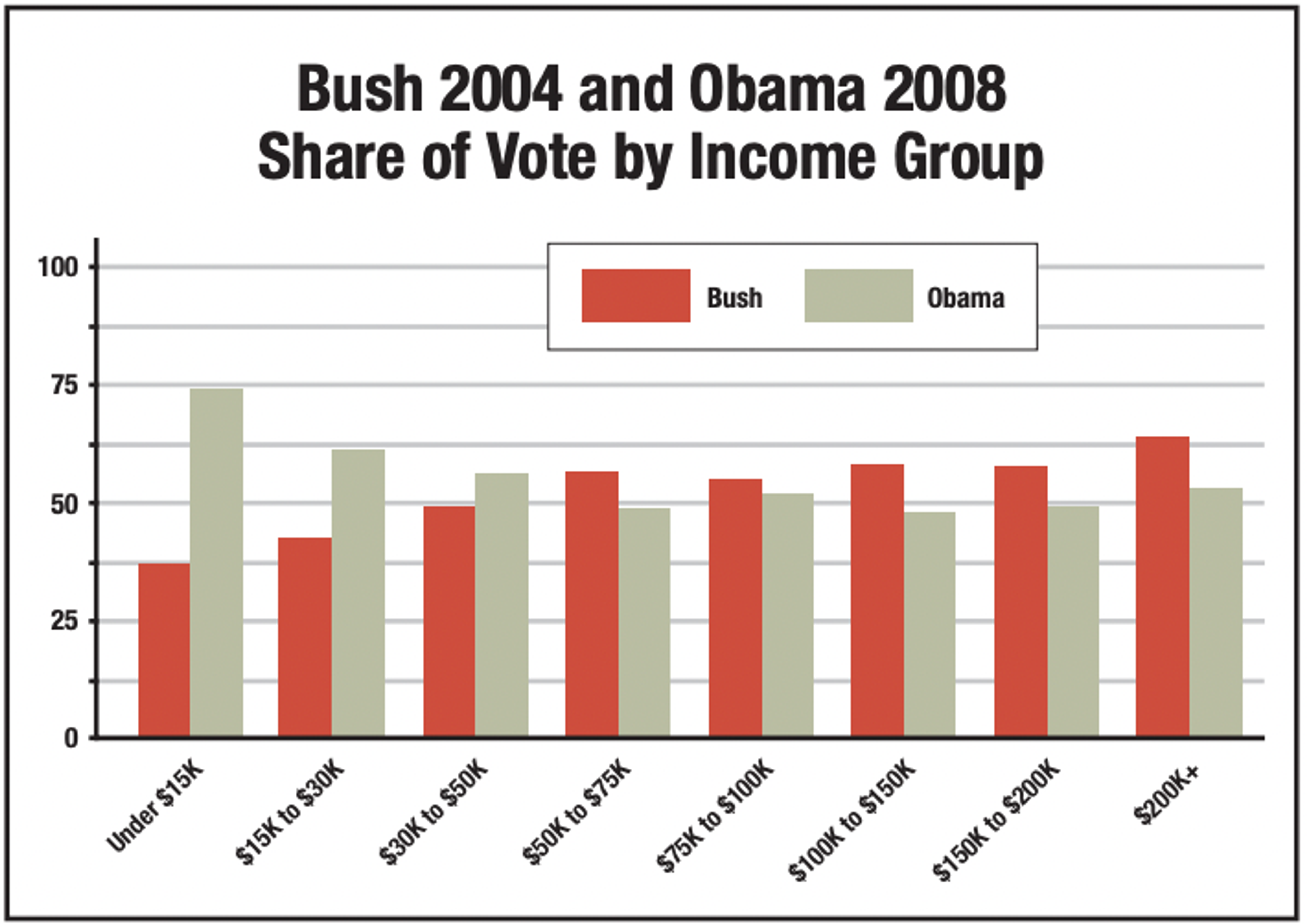
Michael Barone has noted that Obama has a top-bottom voting coalition, which could be unstable. The accompanying chart makes that clear.
The core of Bush’s support came from middle earners, with a tilt toward the upper end. Obama’s electorate, on the other hand, samples heavily from the poles. This presents an obvious policy problem. The president is promising large increases in government benefits, which will go mostly to lower-income voters. How to pay for it? Heavy tax increases on high earners will damage him among his upper-income voters. If he raises taxes too many times, the wealthy suburbs around Philadelphia and D.C. will suddenly start trending red again. So what to do? It seems the president’s solution is $1 trillion budget deficits from here to eternity. Will the middle tolerate that? Those who earn between $50,000 and $100,000 per year were not terribly partial to Obama last November — and their incomes are such that they are already sacrificing important goals as they balance their family budgets. How will they react when they see Obama abandoning the last pretenses of fiscal discipline?
In the final analysis, I’d suggest that the “enduring Democratic majority” theory consists of a few good ideas surrounded by a lot of wind. The liberals who offer it are honest and well intentioned, but their enthusiasm has gotten the best of them. Their thesis appears to be impervious to falsifying evidence. Its empirical claims are overstated and offered without appropriate context. It fails to take into account American electoral history, in particular how and why the parties have shared power over time and why we can expect that to continue into the future. Conservatives should focus on finding a way back to the majority, and ignore those who say it can’t be done.











Comments