• This vice-president, by nature, cannot be in an undisclosed location.
• Dick Cheney is the madwoman in the attic, the crazy voice that Republicans ought to stifle. So says the press, and indeed he must seem mad to them: He doesn’t think waterboarding was torture — he thinks it yielded essential information from top al-Qaeda captives, and he wants to publicize CIA documents that he believes would make his case. Cheney’s argument does not concern the direction of the Republican party: He has reached the end of his career. He is defending the Bush administration against the smears of its enemies, including its successors. No one in the press, outside Rightworld, will push back, and no one else from the Bush administration, it seems, wants to. Cheney is performing a lonely and necessary function. Bring it on.
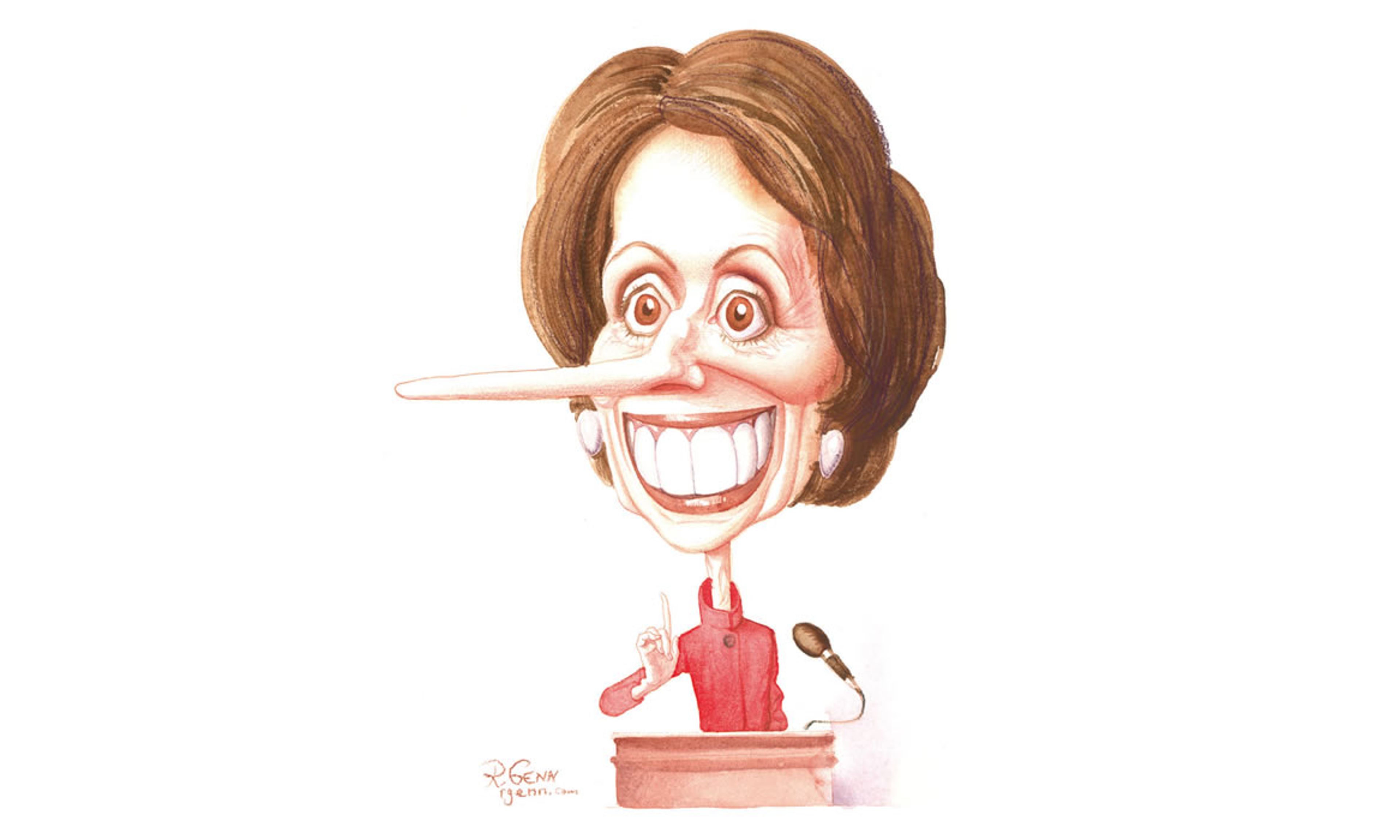
• The word “liar” is thrown around too much in our politics, but it is difficult to conclude that the term does not fit Nancy Pelosi. Pelosi took an aggressive line on national-security questions after 9/11 but followed her party in reversing course when the Iraq War grew unpopular. She eventually came to denounce American intelligence efforts as torture, and now protests that she did not know that al-Qaeda captives were being waterboarded. CIA records show that Pelosi was briefed on interrogation techniques in September 2002. There is no record of her having protested then what she now calls “torture.” Others present at Pelosi’s briefing confirm that the CIA made it clear what techniques were being used. Pelosi first explained that she had been told the CIA considered waterboarding legal but not that it had been used. She then claimed that the CIA had denied using waterboarding — that it had deliberately misled her. The current CIA chief, Leon Panetta, a Democrat and former congressional colleague of Pelosi, indignantly dismisses the speaker’s charge. Pelosi claims to want the CIA’s records of the briefings made public. The agency should oblige her.
• President Obama gave the commencement speech, and accepted an honorary degree, at Notre Dame. The university flouted the Catholic bishops’ instruction that Catholic schools should not honor officials who deny justice to the unborn. Its president, the Rev. John Jenkins, maintained that the university remains committed to the pro-life cause, not that he spent a nanosecond of the big day making the case for life. Obama, for his part, used the occasion to continue to reach out to Catholics, including those who disagree with him on abortion. He has long recognized that his party’s support for an unlimited abortion license is a political liability, and worked to reduce that liability without reducing that support. At Notre Dame Obama’s tack was to call for civility, open-mindedness, and tolerance. He was smart enough not to add: Live and let live.
• Over the last 15 years, pollsters have found that the number of Americans who consider themselves “pro-life” rather than “pro-choice” has been slowly increasing. The spread of sonogram technology, the attention to partial-birth abortion, and the decline of anti-abortion violence all appear to have contributed to this shift. Now pollsters are finding a sudden additional increase in the number of pro-lifers. Gallup finds that 51 percent of Americans apply that label to themselves, while Fox News finds a 49–43 split in pro-lifers’ favor. (Fox also finds that 51 percent of independent voters consider themselves pro-life.) Our best guess is that people who are ambivalent about abortion are more likely to count themselves as pro-life when the other side holds as much power as they do now. These numbers ought to be a warning sign to the Obama administration — and to those Republicans who fantasize that they will recover as soon as they ditch the social issues.
• Since Barack Obama did not have much time to learn before becoming president, he must of necessity learn on the job. On the advice of Defense Secretary Robert Gates, he is taking legal action to block the release of photos of prisoner abuse by American soldiers in Iraq and Afghanistan, reversing an earlier decision to go along with lower-court rulings that favored exposure. Releasing the pictures, Obama now says, would “further inflame anti-American opinion” and “put our troops in greater danger.” Jihadists would use the pictures to energize mobs and recruits, and defeatists at home would use them to make the case that America is incapable of defending itself honorably, and should not try. We salute the new realism, and hope it is more than a passing mood.
• It is becoming a Friday ritual — the weekly announcement of the embarrassing news that yet another Bush national-security policy labeled a war crime or a rule-of-law violation by the Obama campaign has been adopted by the Obama administration. Thus did the president announce that military commissions aren’t so bad after all. The administration will be resuming them for, at least, the worst al-Qaeda detainees, such as Khalid Sheikh Mohammed. Such dramatic reversals are routinely accompanied by face-saving claims that the Bush policy is being adopted only after an “overhaul” that renders it consistent with “our values.” But the “overhaul” turns out to be an inconsequential tweak or two. (On the military commissions, for example, detainees who have enjoyed their pick among legions of volunteer lawyers from white-shoe firms will now somehow have “more latitude” in choosing counsel.) The commissions join a growing list of Bush policies — military detention, rendition, aggressive surveillance, state-secrets-doctrine assertions, withholding of classified information (such as prisoner-abuse photos), the operation of Guantanamo Bay, etc. — that Obama has continued notwithstanding his MoveOn election rhetoric. “Our values” are turning out to be rather protean.
• President Obama cashiered his commanding general in Afghanistan, a stunning move and welcome break from the excessive deference President Bush showed his generals until near the end of his presidency. By all accounts, the departing general, David McKiernan, is a good man who was just not creative enough in applying the principles of counterinsurgency to the circumstances of Afghanistan. His replacement is Lt. Gen. Stanley McChrystal, a brilliant confidant of CENTCOM chief David Petraeus. We now have assembled a top-notch military and diplomatic team in Afghanistan, which will require every ounce of its talent.
• Wanda Sykes, yukking it up at the White House Correspondents’ Dinner, said that Rush Limbaugh’s kidneys should fail, and that he needed “a little waterboarding.” President Obama, sitting to her right, squeezed out a laugh. As a man, he should be given the benefit of the doubt: We all laugh at things we know we should not; queasiness can express itself as laughter. As president, he must surrender that benefit: The rules of the job are that every moment, outside the bedroom and the bathroom, is lived in public view. (In eight years, President Washington laughed in public only once — at a joke at his own expense.) In the meantime, can we put the White House Correspondents’ Dinner out of its misery? Yes, NR goes year after year, because everyone else does — but what a concatenation of self-love, fawning, and ogling the occasion is. In future ages, it will join bear-baiting and royal levees among the unseemly rites of the past.
• Next year’s Senate elections won’t be easy for Republicans. Already battered by the two previous cycles, they have retirements in Missouri, New Hampshire, and Ohio, and vulnerable incumbents in Kentucky, Louisiana, and North Carolina. So it makes sense that the National Republican Senatorial Committee, led by Texas senator John Cornyn, would want to secure Florida, a competitive state for both parties, as early as possible. When Gov. Charlie Crist announced that he would try to succeed retiring senator Mel Martinez, the NRSC wasted no time in issuing its endorsement. In doing so, however, it backed a liberal Republican over a viable, conservative alternative: Marco Rubio, the former speaker of Florida’s house of representatives, who is also in the race. The NRSC’s argument is that nobody can beat Crist. If so, he hardly needs the NRSC’s support 15 months before the primary. Sometimes the GOP must recruit moderates in order to win, especially in a state such as Delaware, where Rep. Mike Castle — who has not declared his Senate candidacy — is probably the only Republican capable of capturing the seat recently occupied by Vice President Biden. Florida is another matter. Conservatives can win there. Rather than try to clear the field of promising young talents such as Rubio, the NRSC should devote its resources to defeating Democrats.
The Littlest Totalitarian
‘Helping Dad become a better man: priceless.”
That’s the closing line of a new MasterCard commercial. You know those commercials; they’ve been out for nearly a decade. A typical one goes something like this: “Bric-a-brac: 17 dollars. White elephant: 28 dollars. Getting your wife to remove the restraining order: priceless.”
Only this one has a little boy tailing his father — a man who looks like a perpetually adolescent extra from the old sitcom Friends — through a home-improvement store pointing out ways the carbon-profligate old man can reduce his footprint. The boy replaces the usual narrator as well.
“Energy-saving bulb: four dollars,” quoth the child. “Reusable bag: two dollars. Helping Dad become a better man: priceless.”
There are two kinds of folks in this world: those who find this sort of thing creepy, and pod people. Okay, maybe that’s a bit too strong. But how anyone could fail to find this commercial one of the more disturbing convergences of corporate power, advertising, and progressive groupthink is beyond me.
If you can’t see why, maybe it will help to look a few spaces ahead of where we are. In Britain, an electric utility launched a website for kids that teaches them how to become “climate cops.” Their duty is to keep a “watchful eye” and monitor the “energy crimes” of their family and neighbors, with the ultimate goal of building a “climate-crime case file.” Beware that Johnson kid with the clipboard going through your recyclables.
If you still can’t see why this kiddie Gestapo stuff is offensive, change the issue from environmentalism to eating habits (you know that’s coming, by the way), or religion, or just about any subject where you don’t think a six-year-old should be scolding you for weakness of character or informing on you to the authorities.
Now, it’s not that I think kids shouldn’t be encouraged to be civic-minded. And while I find today’s climate obsessions to be suffused with religious hysteria, I don’t see anything terrible in encouraging kids, or anyone else, to conserve resources. But that’s not the issue here. Nor is environmentalism per se.
It’s the kids.
There is something evil about recruiting children to lobby their parents on political causes. Okay, it’s not always evil; sometimes it can be funny, like the time in 1965 when Soupy Sales told the children watching his TV show to sneak into their parents’ bedrooms and take the “green pieces of paper” from their wallets and send them to him.
Sales apologized for cracking a joke that a few kids took seriously. But no apologies are forthcoming from MasterCard for broadcasting something in earnest that in a healthy society would be seen as a joke. The idea of enlisting children to the Cause is as fashionable today as it was under Robespierre. To crack the bunker walls of the family and seduce the children has always been a top priority of totalitarians, hard and soft. Progressives love to elevate the sagacity of children — Hillary Clinton says some of the best theologians she’s ever met have been five-year-olds — because doing so gives children all the more authority when they parrot the talking points of the latest progressive fad.
James Lileks asks about the MasterCard ad: “If the kid didn’t learn these steps to righteousness at home, where did he get them?” Precisely. It’s not as if normal, uncoached six-year-olds talk about making their fathers “better men.”
If the man in the ad were a better father, he would have scolded his kid for the disrespect and demanded to know who was teaching him such crap.
— JONAH GOLDBERG
• Michael Steele, chairman of the Republican National Committee, has opposed a resolution, scheduled for a vote by RNC members as we went to press, that calls on the Democrats to rename themselves the Democrat Socialist Party. Steele told David Gregory on Meet the Press: “I’ve been very clear that I don’t think that that is an appropriate way to express our views on the issues of the day.” We agree. While conservatives are right to point to the similarities between the Democratic program and European social democracy, this resolution is quite literally name-calling — the kind of unforced error that Republicans and conservatives must avoid if they want to focus the public’s attention on what’s really important.
• Utah governor Jon Huntsman, a Republican, will be Obama’s ambassador to China. He is a good choice: a capable politician who speaks Mandarin fluently and has diplomatic experience. His appointment set off a flurry of commentary to the effect that Obama had taken the great moderate hope for the Republican party off the board for 2012. Huntsman was in fact always a long shot for 2012, especially given the likely presence of fellow Mormon Mitt Romney in the presidential race. Huntsman has signed bills cutting taxes, regulating abortion, and expanding school choice. Should he ever get the Republican nomination, we suspect that many of his current fans would start saying that he wants to bankrupt the government, throw women in jail, and end public education.
• The magic wand the White House plans on using to control health-care costs is showing signs of malfunction. Soon after President Obama announced an agreement with health-industry groups to reduce the growth of costs by a whopping $2 trillion, the groups denied his claims and distanced themselves from his ambitions. In a triumphal White House statement, accompanied by charts and graphs and the usual wonkish accoutrements, Obama said the associations of hospitals, insurers, and doctors had pledged to reduce the rate of growth of health-care costs (which is just over 6 percent per year now) by an astounding 1.5 percent each year for the next ten years. After a couple of days of frantic phone calls from their members, who were wondering how exactly they were expected to do that, the American Hospital Association released a statement saying Obama had misrepresented the agreement: The groups had not pledged to reduce the growth of health-care costs by 1.5 percent each year, but by a total of 1.5 percent over ten years — which would come nowhere near the savings Obama claimed. Moreover, the association clarified, “the A.H.A. did not commit to support the Obama health plan.” That’s good news, since the plan seems to be built on illusions.
• Democratic representative Henry Waxman, chairman of the House Energy and Commerce Committee, unveiled a bill that would create a cap-and-trade program for carbon emissions and require utility companies to generate 20 percent of their energy from renewable sources. These sources (the greens’ holy trinity of wind, solar, and biofuels) cannot compete commercially with fossil fuels, nor is there a commercially viable way to burn fossil fuels without emitting carbon dioxide. The goal of the bill is quite plainly to reduce the use of our cheapest and most abundant energy source by increasing its cost (for more on how that would happen, you may read Jim Manzi on page 36). If it were in effect today, our recession would be much worse. If it passes, our next one will be.
• The auto bailout keeps getting weirder: General Motors announced plans to sell itself to the government. The government will forgive the $15.4 billion in “emergency loans” GM has already received, and the new company will be offered a fresh line of credit. Meanwhile, a proposed partnership between bankrupt automaker Chrysler and the Italian company Fiat might also include the GM-owned Opel. GM is looking for someone to buy the struggling German subsidiary (presumably the U.S. government isn’t interested), and the German government is reportedly offering to subsidize the sale. Government Motors vs. Fiat-Opel-Chrysler: a new epic rivalry begins.
• California, its budget a sinkhole, has proposed the most modest of trims — $74 million from a program that subsidizes the wages of (unionized, of course) health-care workers who tend the sick in their homes. The Obama administration has responded in characteristically masterful fashion, threatening to withhold 92 times that amount, or $6.8 billion, in federal stimulus funds. Which is to say, every dollar’s worth of self-imposed fiscal responsibility will buy Californians nearly a C-note in punishment from Obama. Why? The home-health workers in question are Service Employees International Union members, who flooded the Obama campaign with money, manpower, and votes. California currently kicks in $12.10 an hour to boost their wages (that’s only part of their pay) and proposes to reduce its contribution to $10.10 an hour. As George Will points out, SEIU gathers $5 million a month from the union dues paid by these employees, some of which is sure to end up in Obama’s campaign coffers. If California cannot reform its spending, it will be a federal dependency forever. Which may be Obama’s plan.
• Gil Kerlikowske, the new drug czar, suggests abandoning the phrase “war on drugs.” “Regardless of how you try to explain to people it’s a ‘war on drugs,’” he said in his first interview on the job, they “see a war as a war on them. We’re not at war with people in this country.” Kerlikowske’s statement concerns rhetoric, which has been both an obsession and a distraction to this administration. But rhetoric also has consequences. We have waged a war on drugs for decades, at great cost and to slight effect. National Review concluded, more than a decade ago, that “the war on drugs is lost” (Feb. 12, 1996). If the political classes are truly willing to think new thoughts, they have a lot to consider: programs for treatment; choices between legalization, decriminalization, and controlled supply; ways to fight black marketeers. We have put the moment off many, many years. Better late than never.
• The Obama administration has announced that it intends to step up antitrust prosecutions, and the likely targets of opportunity are situated in Silicon Valley. This has the sweet savor of poetic justice, inasmuch as executives from Google and such were slavish in their support of Obama’s candidacy. But it’s also a setback for America: Antitrust enforcement has done very little for the American consumer, and very much to erode the competitiveness of American enterprise; today, it threatens to stifle innovation. Consider the case of Microsoft, which spent years and millions fending off an antitrust action launched against it because of its web-browser business at a time when the firm did not even enjoy a majority market share, much less a monopoly. Most of that case was dismissed, but the damage was substantial. As antitrust expert Dominick T. Armentano of the Independent Institute has argued, what American consumers need from the government is not better protection from monopoly, which is rare, but better protection from fraud, which is common. The feds should worry more about Bernie Madoff and Norman Hsu, and let Google and Yahoo duke it out in the marketplace.
• One of Obama’s few genuine non-defense budget cuts is a sharp reduction in funding for the agency that polices “embezzlement from labor organizations, extortionate picketing, deprivation of union members’ rights by force or violence, and fraud in union officer elections.” During the Bush administration, the agency’s budget increased by 50 percent, and it chalked up 929 convictions of corrupt union officials. Yet Obama’s Labor Department appointees say it does not have a big enough workload, so 9 percent of its $45 million budget should go to other agencies. A primary beneficiary will be the bureaucracy that makes sure “that contractors doing business with the Federal government do not discriminate and take affirmative action.” In the Age of Obama, quota enforcers are showered with money, while investigators of fraud, embezzlement, and strong-arming have to beg for spare change. It goes to show, yet again, that the interests of “labor” and the interests of workers are often antithetical.
• It is a good general rule that any congressional bill named after some victim of a crime or misfortune is a bad bill. The Matthew Shepard Hate Crimes Prevention Act, which has just been introduced on the floor of the U.S. Senate, is worse than most. It represents a triumph of politics over law, giving the federal government the power to appease powerful voting blocs by violating the ancient Anglo-Saxon legal antipathy to double jeopardy, an antipathy enshrined in the Fifth Amendment to our Constitution. A person goes to trial in state court on some charge that causes offense to some powerful voting bloc. He is acquitted by a jury of his peers. The powerful voting bloc is mad as hell and makes a fuss, so the feds step in to rearrest and retry the accused. Federal civil-rights laws are all too frequently used in this way — recall the case of the Rodney King police officers. If this bill becomes law, the feds will have another weapon in their armory with which to enforce double jeopardy against crimes they particularly dislike.
• President Obama and Israeli prime minister Benjamin Netanyahu came out of their White House meeting smiling and paying the usual compliments to each other — there was even lip service about a supposed “historic opportunity.” In spite of the hopes of some and the fears of others, the predicted clash did not materialize. For both men, the primary concern remains Iran’s efforts at deceptively developing a nuclear weapon that will endanger the regional and international orders. The unclenched hand that Obama has proffered to Iran runs the risk of ending in rebuff and humiliation, but he reassured Netanyahu that in the absence of any concessions from the mullahs his patience will be exhausted by the end of the year. That’s a timetable of sorts. Most Arab states are as alarmed as Israel by Iran’s open imperialism, and, to get them on board, Obama used this occasion to boost the fabled “two-state solution” whereby Palestinians and Israelis are to live amicably side by side. Since the Palestinians are ideologically split between secular nationalists and Islamists, they are more prone to wage civil war than to form a state. The “peace process” is descending into meaninglessness.
• Obama met with the presidents of Pakistan and Afghanistan, whose security problems are conjoined. The Taliban is at root a Pakistani phenomenon, one that was encouraged by that country’s military and intelligence establishment, but our ability to directly influence events in Islamabad is limited. The Pakistani president, Asif Ali Zardari, is a weak leader whose venality guides his sympathies toward the West. He nonetheless has been too accommodating of the Taliban during his short time in power, hoping until recently that they would more or less behave themselves in exchange for a greater degree of autonomy. That policy was an extension of the false hope of Pervez Musharraf, his predecessor, who took a similar line. So what can the United States do? The goal of our policy should be to change Islamabad’s perception of its interest, chiefly through a sustained display of power and resolve in Afghanistan. This would make it clear that the U.S. is and will continue to be the guarantor of the regional security order, and that Pakistan must calculate accordingly. The people of Pakistan do not, on the whole, care for Islamism; Pakistani civil society has some healthy elements; Pakistani economic interests lie in political openness and trade, via Afghanistan, with Central Asia. It is not outlandish to hope that these currents, over time, will wash the Taliban into a much-deserved oblivion. Until then, we can do little more than show our strength and reward those who trust in it.
• In the bloodstained history of terrorism, the Tamil Tigers will always have a place, alongside the IRA, the Taliban, the Chechens, and the PLO. They were the originators of suicide bombing by women as well as men, assassinating leading personalities in their native Sri Lanka and in India, and they conscripted child soldiers. To outsiders, the movement’s leader, Vellupillai Prabhakaran, seemed unmilitary, even uncharismatic, but for over a quarter of a century he brutalized and shattered Sri Lanka, turning the grievances of the Hindu Tamil minority into a cause against the Buddhist Sinhalese majority. Religion, nationalism, and ethnicity fused into diehard fanaticism. At moments, Prabhakaran controlled swathes of territory like the warlord he was. In savage fighting, amid massacres and reprisals, at least 70,000 people were killed, and over 200,000 became refugees. The Sinhalese president, Mahinda Rajapaksa, finally struck a deal whereby China was to arm his people with modern weaponry and aircraft, in return acquiring a harbor in Sri Lanka and so enlarging their presence in Asia. The Sri Lankan army gradually drove the Tigers into a killing ground, and claim to have identified the corpses of Prabhakaran and his colleagues. Fighting is over. A terrorist campaign has been defeated, and that too will enter the history books.
• Day after day, week after week, the lights go out in Venezuela. A recent headline read, “Last anti-Chávez TV station faces probe, shutdown.” At the Summit of the Americas, President Obama called Hugo Chávez his friend (“mi amigo”). Chávez is not the friend of any democrat. We should not let the dying of the light in Venezuela go unnoticed.
• Manmohan Singh and his ruling Congress party expanded their margin in India’s latest parliamentary elections, which means that the reform-minded economist should be able to liberate himself from the worst of the far-left coalition partners with which political necessity had saddled his government. During his time as India’s finance minister, Singh began giving India’s economy small injections of capitalism, and he has continued that work as prime minister. Many millions of Indians are freer and less poor because of those policies, and few politicians can boast of having done as much measurable good for their people. One of Pres. George W. Bush’s great unsung successes was refreshing U.S. relations with India, a natural ally on trade, democracy, and containing Islamist violence. Lamentably, India’s reformers have found little encouragement in the administration of Barack Obama, whose only notable public pronouncement on India so far has been to accuse Bangalore of stealing jobs from Buffalo. Obama might pause ever so briefly from glad-handing South American autocrats to attend to an ally that shares our values and our interests.
• For four months, Roxana Saberi, an Iranian American with dual citizenship, was held in Tehran’s notorious Evin Prison. She was accused, absurdly, of spying for the United States. That is always the accusation of such regimes. Saberi was, in effect, a hostage. On May 11, she was released — without explanation. The public does not know how that release was effected, or why it occurred. But the good news is: the release. There are a few more Americans in Iran still waiting for that result.
• Masaharu Nakagawa, the financial-affairs spokesman for Japan’s opposition Democratic party, elevated eyebrows by suggesting that Japan cease buying U.S. Treasury obligations unless they are “samurai bonds” — meaning those denominated in yen instead of dollars. Unlike more than a few of his U.S. counterparts, Mr. Nakagawa evinces an admirable command of arithmetic, and therefore fears the inflationary effects of the trillions of fresh dollars that are being unleashed into the economy through bank bailouts, stimulus largesse, and President Obama’s lordly ambitions. Inflation is the most convenient way for government debtors to rook those who lend to them, and Mr. Nakagawa does not wish to see the Bank of Japan left holding a bag of rapidly depreciating dollars. China, too, grows anxious that the greenbacks it holds soon may be worth much less than they are now. Predicting short-term fluctuations in currency-exchange rates is a tricky business — ask George Soros — but it is clear that Tokyo and Beijing are taking the long view and not much liking what they see. If Washington does not discipline its borrowing and spending, bond investors surely will do it for them, and the market will accomplish what politics has not.
• Nicholas Winton is a name that ought to be better known. He has been called the British Schindler. As the Nazis were dismembering Czechoslovakia and preparing for mass persecutions, he went to Prague and set up an office there. At the time, he was 29 and a stockbroker’s clerk, nobody special. It was a feat to organize eight trains that brought Jewish children to London — they all needed sponsors, complex paperwork, and funding. In all, Winton saved 667 children, though sometimes the figure is given as 669. The ninth train was due to leave on September 3, 1939, the day war was declared, so it was canceled. The 250 children who would have been on that train were soon murdered. There’s been some recognition. Books have been written about him, and films made. The Queen knighted him and the Czechs proposed him for the Nobel Peace Prize. Winton makes no claims for himself, merely saying, “I just saw what was going on and did what I could to help.” This admirable and modest man has just celebrated his 100th birthday.
• One of the most aggravating features of Communist life is the loudspeakers: the broadcasting of propaganda over loudspeakers in the streets. People from Communist countries all over the world have complained about this. This propaganda is ear-splitting and soul-bruising. In Vietnam, they blast the propaganda at dawn and at dusk, for 30 minutes a stretch. And a local official in Hanoi is proposing to do something about this: He has suggested that the government put the information — the propaganda — on the Internet. People should be allowed to “choose to listen rather than be forced to listen,” he says. To choose rather than to be forced: Were that principle to take hold, your country would cease to be Communist.
• Italian prime minister Silvio Berlusconi is going through an ugly divorce from his wife of 29 years. Signora Berlusconi claims to have suffered countless umilliazioni at the hands of her husband. The last straw was the prime minister’s doting attendance at the birthday party of 18-year-old lingerie model Noemi Letizia, to whom he gave a gold necklace and a diamond-studded pendant. Berlusconi had failed to attend his own children’s 18th-birthday parties, his wife complained. She further opined: “I can’t go on being with a man who consorts with minors. . . . He is not well.” While we have nothing but respect for the wronged lady and her opinions, it would seem from external evidence that Signore Berlusconi, at 72, is in robust good health.
• Among the 31 colleges of Cambridge University in England are three that admit only women. The oldest of the three is Newnham College, founded in 1871. In accordance with the ancient traditions of the university, Newnham students hear a Latin grace spoken before their college meals. The traditional grace offered thanks to Jesum Christum dominum nostrum. This has now been ruled too religious by the bluestockings of Newnham. A new grace has been established, declaring (in Latin, at least): “For food amidst hunger, for companionship amidst loneliness, for peace amidst violence, we express thanks.” What, no mention of global warming? Should other institutions be contemplating similar revisions, we beg them at least to consider a Latin grace that, notwithstanding a pedigree extending back to long before the age of multicultural sensitivities, remains wonderfully inoffensive: Benedictus benedicat — “May the Blessed One bless.” You see? It invokes the Blessed One without any dogmatic specification as to the nature of Him . . . or Her.
• Busy days in the world of poetry. Britain has acquired a new poet laureate, 53-year-old Carol Ann Duffy. Ms. Duffy’s themes, the British Council website tells us, “include language and the representation of reality; the construction of the self; gender issues; contemporary culture; and many different forms of alienation, oppression, and social inequality.” No daffodils, Grecian urns, or great military engagements, then. Duffy is a lesbian, as is Kay Ryan, the current U.S. poet laureate — the first instance of this particular conjunction, so far as we know. Presumably the shade of Sappho is smiling gleefully somewhere. Oxford University has also elected a new professor of poetry: Ruth Padel, a great-great-granddaughter of Charles Darwin, but not confessedly transgressive in any way. Padel’s election was soured — or, depending on how seriously you take these events, spiced — by the withdrawal from the race of the Caribbean-British poet (and Nobel Prize–winner) Derek Walcott, following circulation of stories about his having harassed female students. With women now holding all the high poetic offices, at least there will be no more danger of that!
• The faculty of Brown University voted to change the name of Columbus Day to something safe: “Fall Weekend.” They thereby effaced the name of a man who should be perfectly uncontroversial: an explorer, daring and great, whose actions helped launch this project called the United States — from which all of us, including the Brown faculty, have benefited. “Columbus” is not a name to be ashamed of, or to blacken, but one to esteem.
• In the late Seventies, Farrah Fawcett had the face that launched a thousand fantasies, as a crime-fighting babe in Charlie’s Angels and poster girl. She was recently the star of a very different show, Farrah’s Story, a two-hour documentary on her battle with cancer that drew 8.9 million viewers. Three centuries ago, we had rulers, though they were remote, and there were no media to speak of. We knew our neighbors, and their business; they knew ours. Mass communication and pop culture have created a community of 300 million, but it is asymmetrical: We know the stars and the president, but they do not know us. Scattered individuals, from Susan Boyle to serial killers, make the big time, and the Internet — Facebook, Twitter — lets ordinary people cast longer shadows, but the disparity remains — even in death. That is sociology. Pray for those in pain, those you know and those you don’t, and give thanks for those prayers when your time comes.
• New York Times columnist Maureen Dowd got caught lifting a sentence — with only one tiny change — from Josh Marshall’s left-wing blog, Talking Points Memo. (The stolen sentence argued that the Bush administration tortured al-Qaeda prisoners to extract evidence for invading Iraq.) Dowd will march on; after all, Doris Kearns Goodwin is still a successful writer. Meanwhile Marshall should rename his blog “Writing Points Memo.”
It’s All in Your Head
The most important asset that President Obama has in his effort to transform health-care policy is the consensus inside Washington that he will succeed. As long as the major interest groups believe that a liberal health-care bill is going to pass, they will work with its sponsors rather than incur their wrath. As long as Republicans believe a bill will pass, they will offer modest amendments instead of going all-out in opposition.
This consensus has not been conjured out of thin air. The Democrats have a large and mostly liberal congressional majority and a popular president. But the type of health-care policies they have in mind have serious political vulnerabilities. If opponents can exploit them to reduce public support for the Democrats’ plan, then wavering Republicans, moderate Democrats, and the interest groups will start to abandon it.
The public, for its part, wants reforms that address its concerns about health care but is not tied to any particular set of policies. Most people are satisfied with their insurance arrangements and standard of care — more so, indeed, than were in 1993, the last time Washington Democrats took up this issue. They are against rationing and against individual mandates. They are unwilling to see broad-based tax increases and worry about large increases in our already-huge deficits.
Here, then, is the basis in public opinion for a politically successful opposition to the Democrats’ health-care plans. Any liberal plan will either raise most people’s taxes or raise the deficit, possibly both. Any liberal plan will either impose rationing right away or set the stage for rationing in a few years. And almost any liberal plan will disrupt the existing health-care arrangements of millions of Americans and replace them with something that could well be worse. It could, for example, throw many millions of Americans out of their private insurance and into a public plan, where they might find that their doctors don’t want to see them anymore. (Some Democrats promise “Medicare for all,” but “Medicaid for all” is at least as likely.)
The selling point for health-care reform is supposed to be that it will make people more secure. Republicans must directly rebut that claim, and then argue that there are ways to make health insurance more secure, affordable, and accessible. Offering tax credits to individuals for whom employer-provided insurance is not available is a way to offer immediate relief to people locked out of the current system, and to move slowly toward a better one.
It’s worth noting, too, that more vulnerabilities are likely to emerge as the debate continues. As it becomes clear that the administration intends to expand abortion coverage through its reforms, for example, support will drop. The only question is by how much.
The campaign against Obamacare should be populist. It should say: So what if the health industry and politicians in D.C. are on the same page? Taxpayers and patients aren’t being consulted, and they’ll be hurt. Opponents should also contrast any bill to Obama’s campaign promises. He said he would not push for socialized medicine, and he savaged Republicans for proposing health reforms that would allegedly raise middle-class taxes and throw people off the insurance rolls.
We are willing to concede that the political line-up in Washington is daunting. A conservative reformation of health policy is out of the question. But preventing a federal takeover of health care is very possible. So is laying the groundwork for political change and a future health-care reform worthy of the label. But none of it will happen if Republicans play dead.











Comments