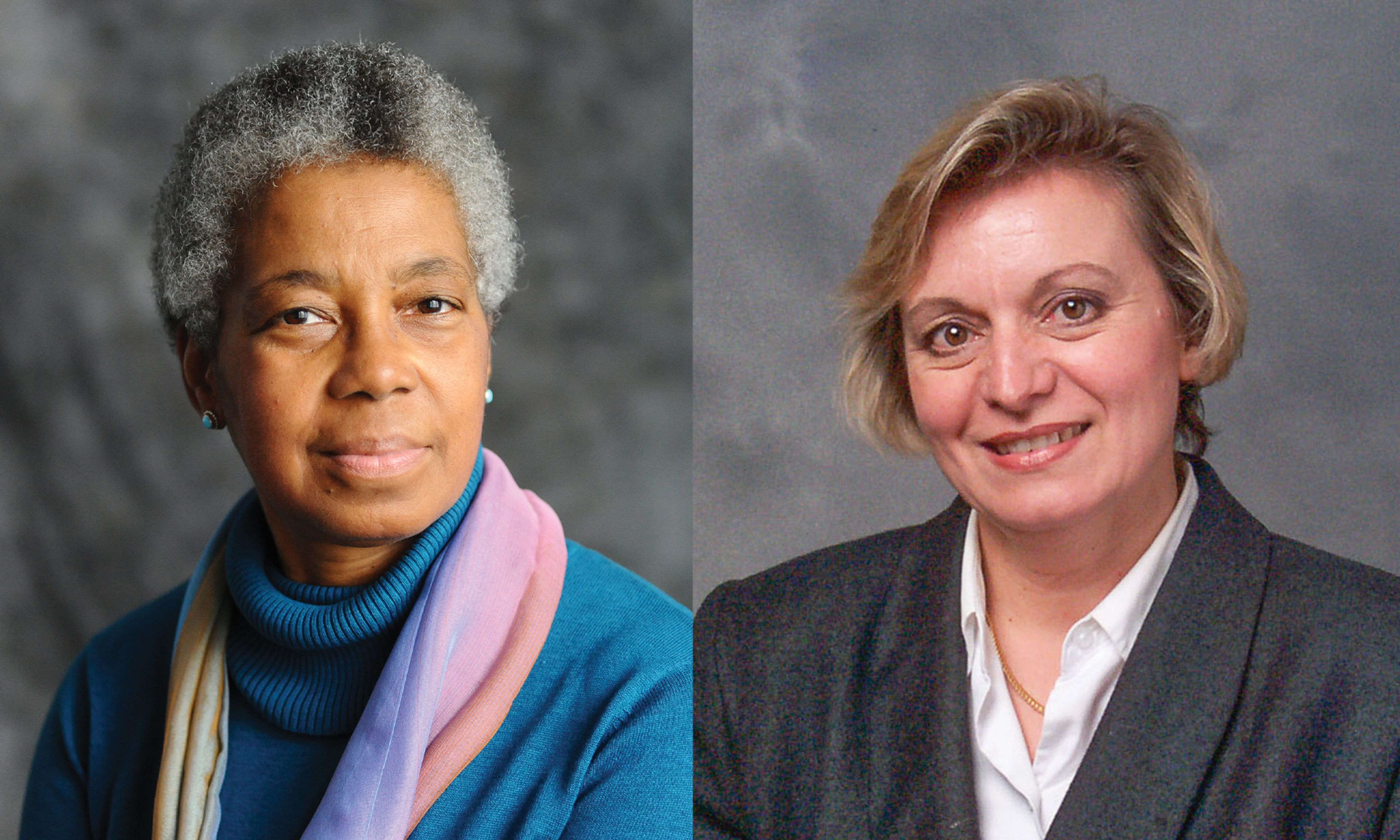
Zoom education is disastrous, we are told. Students need physical presence, and this is especially true of very young students. I’m sure this is correct. But Zoom education has a silver lining or two. It can open up opportunities, as it has for me.
Do you know that, in this pandemic year of 2021, I am being taught by two prized professors I had in my freshman year of college? I am.
I entered college in September 1982. My first class on my first day was “The History of the American South,” with Professor Barbara J. Fields. She exuded intelligence and authority — and warmth and humor and other good things. I was hooked, for life.
“BJF,” as some of us fans referred to her, was an up-and-comer. She had earned her Ph.D. at Yale under C. Vann Woodward. Before that, she was at Harvard, as an undergraduate. She had grown up in Washington, D.C., where she went to Western High School (same as my grandparents, generations before).
I took as many classes from her as I could. Many of the things she said and taught have never left me. A quick sample: “People say that, before Vietnam, Americans had never had the experience of losing a war. They forget white southerners.”
Her politics were to the left, and I was a budding conservative — sneaking peeks at National Review. (William Safire once said, “I have to go to the corner newsstand to buy a Hustler magazine, in order to have something respectable to hide my National Review in.”) Barbara Fields was ever patient with me. I haunted her office hours, talking with her as long as I could, until she had to throw me out. She teased me, challenged me, listened to me.
Somewhere along the way, she gave me a copy of Lanterns on the Levee, the autobiography of William Alexander Percy. There was a conservative, she said. I was grateful, but said I was more of a Reaganite and a Hayekian, really. “You and your market!” she would sometimes say to me, thereafter.
Listen, she’s plenty conservative herself, in many ways. I will count some of them.
She is a guardian of the English language. I know no one more serious about English and its wonders. She is a defender and champion of high culture — music, art, poetry, and all the rest. The vulgarization of our culture, she decries.
She writes in beautiful, tiny script, with fountain pens. To Barbara, a Bic is barbaric. She favors Japanese stationery. She must have been the last human being on earth to begin using email. It’s amazing she uses it now.
On our campus, she was just about the best dressed. We were schlubby, she was immaculate and stylish. Once, I was praising her with another history professor, an older gent. “And she’s a helluva clotheshorse!” he added.
BJF despises political correctness and has always assigned a wide variety of readings (too wide, for some tastes). Not long ago, I heard her go to town on the concept of “cultural appropriation,” and her students — I could see their faces on Zoom — grinned in amazement.
In 1987, she joined the faculty of Columbia University, in New York City. Three years later, she appeared in the Ken Burns documentary on the Civil War. Two years after that, she won a MacArthur “genius” grant. I like to think I knew her when.
We see each other in New York, and talk about matters both historical and contemporary. (They blend.) I quote her so often, I should pay her royalties. Occasionally, I’ll send her something I have written, usually on a cultural subject. Do you ever stop trying to please Teacher?
A couple of years ago, she invited me to attend a few of her lectures, in her survey of southern history. She knows I like to see the Confederates get their comeuppance. To her class, she said, “We have among us a student of mine from the previous century.” I gulped a little, in addition to smiling.
And now I can attend via Zoom — right from my living room. She invites her students to invite family and friends. Recently, she gave a lecture titled “The Invention of Race.” More than a hundred people attended: including a big-time reporter from a major American newspaper, and some scholars from Japan (for whom it was three in the morning).
Fields was commanding, as usual. Also original (in an age of much sameness). Did I nod in agreement to everything she said? No. Was I benefited by every word? Yes, indeed. Barbara Fields is not the type to tell you what to think. Rather, she helps you know how to think. She is a real teacher, and a great woman.
So is Maria Rosaria Vitti-Alexander. All those syllables! Wonderful syllables, some English at the end to mix with the Italian. She is, in fact, Italian, from the Ciociaria, southeast of Rome. She is a professor of Italian and Italian literature.
I almost want to say “professor of Italy.” Whenever she walked into our classroom, so did Italy. She represented the country, embodied it — in attitude, spirit, style. (Like Barbara, she dressed well, standing out in our schlubby environment.)
When you study a foreign language, you can acquire another culture, almost a second homeland. That is what Maria Rosaria has done for many of us.
I remember a million things, from those early days. I’ll give you something small — literally. Maria Rosaria was teaching suffixes. She had a little boy, Austin, or “Austino.” He did not have a “naso” but rather a “nasino” — a little nose. What would be the opposite? What did Jimmy Durante have? A “nasone.”
She drilled Italian into us. For all these years, I have thought of Maria Rosaria’s voice, when I have thought of Italian. Isaac Stern (the violinist) once said, “Heifetz was the sound we all had in our ear.” Maria Rosaria is the sound in my ear, when it comes to Italian.
As with Barbara, I took as many classes with her as I could. One day, you were saying, “Mi chiamo Jay” (“My name is Jay”). Not long after, you were reading Moravia, Calvino, and Pavese. You were also watching films of Fellini, De Sica, and Visconti. You were plunged into Italy.
It’s a cliché to say that a teacher makes a book “come alive,” but, I swear, that is exactly what Maria Rosaria Vitti-Alexander did. She virtually acted them out. Because she cared about them, you did. Her enthusiasm, her appreciation, you caught.
Like Barbara, she was a very young professor when the likes of me sat in her classroom. In 1989, she moved on to Nazareth College, in Rochester, N.Y. She not only chairs the department at Nazareth, she also directs the Casa Italiana — an oasis of Italy in upstate New York. She is both scholar and den mother.
In 2019, Maria Rosaria invited me to give a talk at the Casa to students being inducted into an Italian honor society. The title of my talk: “The Joys of Italian” (which borrowed from Leo Rosten’s 1968 classic, The Joys of Yiddish).
This year, Maria Rosaria is teaching via Zoom, like so many others, and she invited me to enroll in one of her classes. On the verge of acceptance, I said, “Madonna! Io sono diventato la Signora, ti ricordi?” (“For goodness’ sake, I’ve become la Signora, do you remember?”)
When I was a freshman or sophomore, we had in one of our classes a lovely, elderly lady, whom we called, respectfully, “la Signora.” One evening, toward the end of the semester, she invited all of us to her home for refreshments.
And now, in 2021, I was to be la Signora! But not really: It transpired that the class was not for credit, populated by undergraduates. It is offered through the Casa Italiana as an “enrichment course,” and it is populated by grown-ups (let’s say).
We are reading a recent novel, L’Arminuta, by Donatella Di Pietrantonio. Its English translation is titled “A Girl Returned.” It is touched by magic, this book, reflecting Italian literary traditions. A film of L’Arminuta is shortly to be released.
Today, “Austino” has two children of his own. And his mother, the professor, is exactly the same: vivid and compelling. I suppose I’m the same too, interrupting her, overeagerly, and peppering her with questions.
Also having the same old arguments. There are rules governing where you put the stress in a word, says Maria Rosaria. “No, there aren’t!” I protest. “There are so many ‘exceptions,’ these are hardly rules! It’s always a guessing game, where you put the darn stress. Might as well be studying Chinese characters!”
She smiles at me, indulgently, as always.
The other day, in private conversation, I asked her, “Have you never tired of teaching beginners, year after year? Starting from scratch, with ‘Mi chiamo whoever,’ telling people where to put the stress, word after word?” No, she never has. She is a born teacher, and a born evangelist for Italian, Italian literature, and Italian civilization. After she retires, she will continue to teach, as she is already planning.
I would not have written this little piece of mine without the permission of the two professors. Barbara, I wasn’t entirely sure about. She is a very private person. I wrote her a letter — an email — asking for her blessing. Let me compose a little valentine to you, I said, a little tribute. To my relief, she answered, “Who isn’t delighted to receive a valentine?”
Maria Rosaria’s answer, I will translate — being much better from Italian to English than the other way around: “It would be an honor, though I don’t think I deserve so much attention. After all, I’m just doing what I love to do more than anything.”
There is nothing good about the pandemic, and Zoom education is problematic, I know. But I must say, to be taught by these professors I had as a freshman, almost 40 years ago, is a gift from the blue.











Comments