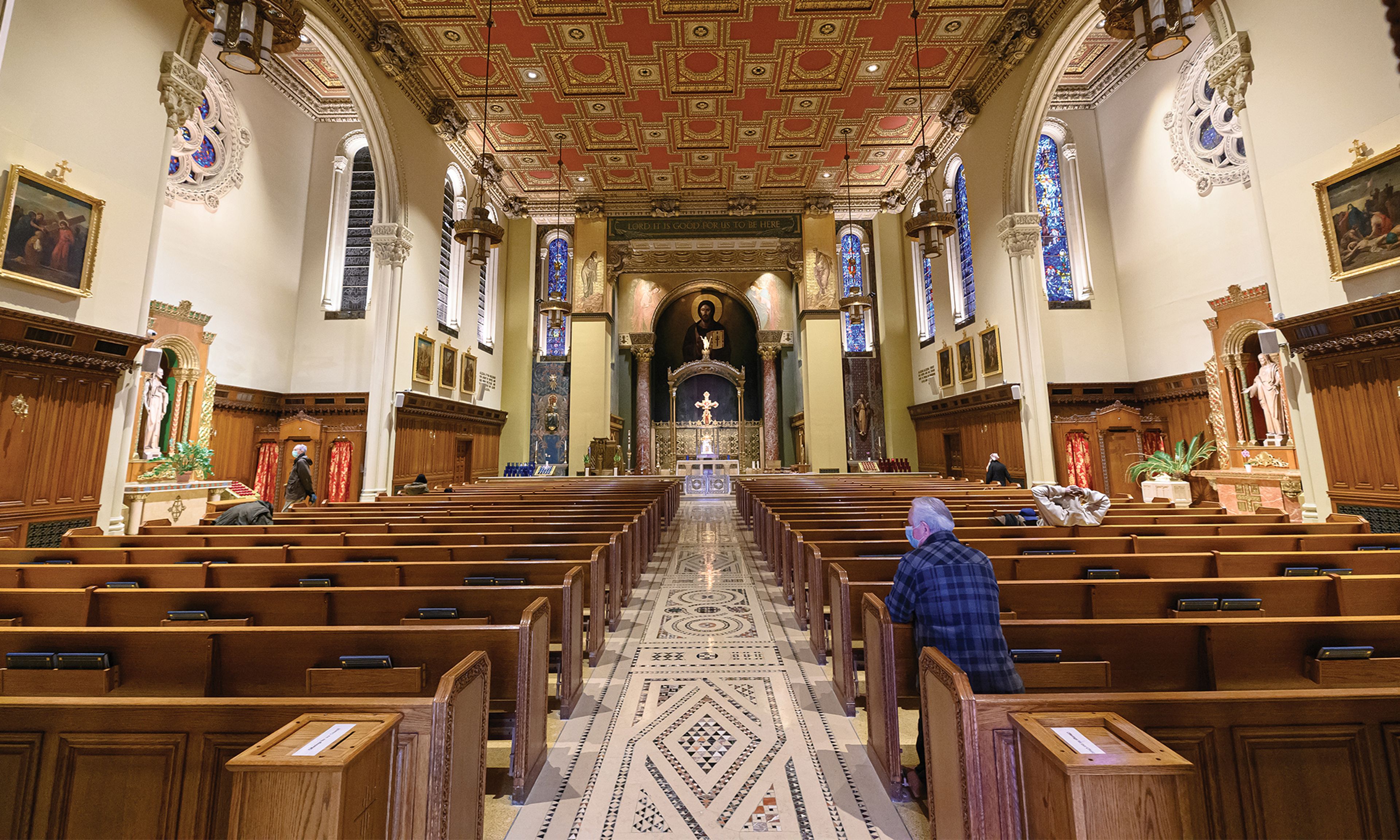
The Mass readings on this recent Sunday covered anxiety, the tension between the spiritual and the worldly, and Jesus teaching in the temple, where he exorcised a man possessed by a demon, who cried, “What do you want with us, Jesus of Nazareth? Have you come to destroy us? I know who you are: the Holy One of God.”
He left upon the Lord’s command: “Be quiet! Come out of him!” But the demon wasn’t all that quiet upon exiting: While people watched astonished, “the unclean spirit threw the man into convulsions and with a loud cry went out of him.”
Our deacon’s homily followed. It was a plainspoken and inspired consideration of the readings, cast against current difficulties. It was pretty good as sermons go, and stressed contemplation of God as the right alternative to obsessing about the world. Pray, and peace will follow. Anxiety, like the demon, will depart.
After these last many months and years of accumulating angst, political and cultural and religious (Catholics enduring ceaseless blows of institutional scandals), our deacon’s simple message — pray! — struck.
Too bad that it fell on few ears. The congregation totaled 30 (two being babies). This is the new normal. Since once-obligatory Mass attendance became optional (which followed an initial shuttering of churches, the archbishop accepting the governor’s pandemic diktats), Sundays have been a thing of lonely pews. COVID has claimed Worship.
Come the end of April, the congregation will be a memory. Our parish will close then, for good: doors closed, organ silenced. But truly, not for good. As the days dwindle down, our melancholy mounts, intensified by frustrations engineered by church and state: pandemic lockdowns, canceled holidays, lawless streets, pontifical confusions, and scandalizing bishops, to name but a few. Oh, and a “practicing Catholic” president who champions abortion rights.
Still, we believe. Our spiritual home is a thing of unappealing brown brick and mortar, sans stained glass, of barren, mid-’60s architecture. But more so it has been the assembly point of friendly hearts and good people. When we learned our fate, long before this virus made mincemeat of calendars, we expressed plans to end with something resembling a bang. They’ve dissolved to a whimper. Let’s hope we don’t test the boundaries of Jesus’s promise: When two or three are gathered in My Name . . .
Most of us realize why parishes such as ours are closing. Ordinations are scant. Vocations surely are not — God is the church, so He could not abandon it. But the Creator’s whispered hints to young men about the order of Melchizedek seem to be drowned out by our culture’s din.
An anecdote: One Sunday, years back, the priest ended Mass by asking the congregation to pray for vocations. Using the prop at hand, he pointed to where my son, the altar boy, was sitting, and concluded, “. . . so maybe one day Andy can be sitting here,” beckoning toward the priest’s throne-ish chair.
Someone in the congregation gasped. Loud. As if the priest had suggested a terrible thing. Who in their right mind could contemplate such for a teenage Catholic boy?!
If this is how Mass-attenders feel, Catholicism in America is in rough shape.
***
But other things, good things, otherworldly things, happened in this church, this holy place. Aren’t they all holy? Yes, but we contend ours is holier. It is, after all, the site of a miracle.
Our pastor, a beautiful and humble and kindly soul who is retiring (we cannot celebrate that, or his golden anniversary, or First Communions, courtesy of COVID cancel culture), may hail from the other side of the globe, but nevertheless embraces our state’s unofficial passion: cheering on the University of Connecticut’s women’s basketball team.
One Sunday a decade ago, the Lady Huskies were to play an afternoon NCAA tournament game against Georgetown. As the last morning Mass ended, Father, no jokester, went off script: “Go in peace to love and serve the Lord. Go Huskies!” All eyebrows lifted. The recessional hymn was sung through smiles.
They would not last. Midafternoon, the grapevine phones rang: Father was dying. The game had been close (unusual for UConn, which won). When it ended, he left the rectory. Had the tension been too much? A parishioner, by coincidence driving past, saw him collapse. Paramedics arrived within minutes. There was no response. Defibrillators were employed. He didn’t stand a prayer of a chance.
Or, did he?
Come 7:00 p.m., scores of parishioners, driven by some Christian instinct, by a desire to do something, assembled at the church — no meeting had been called — to do the only thing they could do. The doors were opened. In we went, for hours to pray and weep. The news got worse the next night, when even more assembled: Machines alone stood between Father’s life and death.
The next night, hundreds came to church to pray and hear even worse news: The doctors’ prognosis was no hope this side of a miracle. Yes, miracle. Father was being kept alive, so it was understood, until family could arrive and formalize his certain fate.
But from his home country came word from a sibling, a nun: One more night. Do not disconnect. And . . . pray.
Which is what happened. A church nearly full, parishioners on their knees, in prayer, fervent, moved by something mystical and transcendent and purposeful. Despair gave way to a confidence that the Son of Man, who wept at the death of his friend Lazarus, would hear, would heed, would agree to render a tender mercy.
The machines were turned off. Father lived. How? The stymied doctors did not know. But we did.
Most have heard of miracles. Many believe in them. But to participate in an honest-to-goodness one — that’s a rare thing. An inspiring and frightening thing too.
A decade after Father’s miracle, some in our parish remnant reflect and wonder: What was the point, now that we are forced to douse candles and lock doors as the flock disperses. And what of this church? Should we care? After all, it’s only a building.
Our parish closure may lack, well, closure, but there is a consolation. Yes, it is only a building, an unglamorous one at that. But within its walls, the power of prayer was proven. A miracle happened here.
It was what the doctor ordered. The deacon too. God too!
The end of our affair is at hand. On May’s cusp, we will worship one final time, and then disperse, to love and serve the Lord. We will each take with us solace of a faith, of memories, and an intimate knowledge of a great truth: There is always a prayer of a chance.










Comments