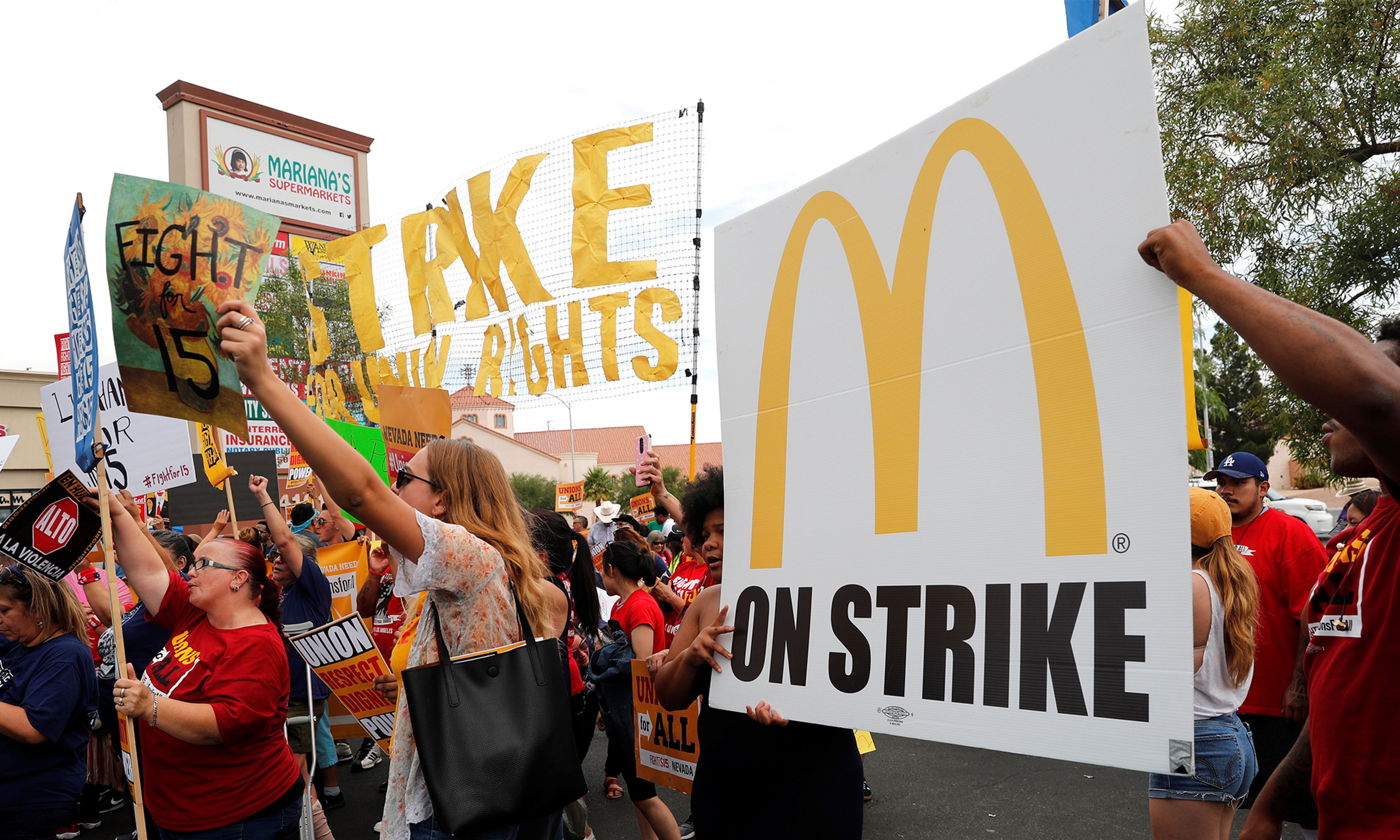
Democrats are moving fast to advance some of their biggest policy goals under the guise of COVID-19 relief. One of their most contentious proposals is to increase the minimum wage to $15 an hour by 2025, with the phase-in beginning this year.
That is an exceedingly risky idea. It could reduce employment by more than a million jobs. And the effects would reverberate well beyond the employment impact, because minimum-wage hikes have a variety of convoluted, poorly understood, and unpredictable knock-on effects. If we want higher wages at the bottom of the labor market, there are better ways to create them.
Let’s start with those employment effects, which are easily the most debated aspect of the minimum wage. Basic economics suggests that when the government dictates a price floor for something — in this case, an hour of labor — fewer people will want to buy it. Someone might be willing to hire extra workers or boost hours if he’s paying $10 an hour, but not if he’s paying $15, in which case he’d prefer to invest in something else, such as machines. Everyone agrees this will become a big problem at some point, which is why no one suggests a minimum wage of $100 an hour.
What’s disputed is exactly how strong this effect is at lower minimum-wage levels. Some studies suggest that minimum wages of half or even two-thirds of the median wage might not produce measurable employment drops. Even taking these findings at face value, however, we start to see some problems with a $15 minimum. The median wage in the U.S. was just $19.14 in 2019. In some states, to say nothing of rural counties, it was far lower: Mississippi had a median wage of $15 on the nose, meaning about half of workers would need raises to comply with a $15 minimum.
And we should not take those “no effect on employment” findings at face value, because they do not represent the academic literature as a whole. In a recent review, David Neumark and Peter Shirley gathered several decades’ worth of work and found “a clear preponderance of negative estimates,” especially in research that focused on teens, young adults, those with low education, and workers specifically affected by minimum-wage hikes. The Congressional Budget Office has arrived at the same conclusion, averaging the results of various studies to project that a $15 minimum wage would reduce employment by nearly 1 percent, or 1.4 million jobs.
Further, regardless of whether employment declines, someone has to pay the higher wages. On the question of exactly who pays, there’s even less consensus than there is on employment effects. But in a recent article, the economist Jeffrey Clemens took a tour of what we do know about how firms deal with the new expense.
The hope of minimum-wage advocates is that these wages will simply come out of profits, making the minimum wage a clean transfer from business owners to low-earning workers. To some extent this happens, especially in industries where businesses have few other margins on which to adjust — though if profits are slim to begin with, trying to absorb a wage increase could just mean going out of business. But lots of firms do have other options.
For one thing, about 30 percent of compensation in this country takes the form of benefits rather than wages and salaries. So when wages go up by government fiat, businesses can make benefits less generous to cancel out at least some of the mandatory raise. Businesses can also take away all sorts of perks and comforts to squeeze more value out of each hour of work they pay for: make schedules less flexible, supervise workers more closely and demand more effort, stop providing free snacks, cut investments in worker safety, etc., etc. There’s some evidence that employers do respond in such ways, but the topic hasn’t been studied nearly enough.
Oftentimes, businesses can also pass costs through to customers. (One exception is when the business competes with other companies that are not affected by the wage hike, and thus won’t be raising their prices as well.) Studies of the restaurant industry, including a recent analysis of McDonald’s establishments, find incredibly high pass-through rates.
This is troubling for two reasons. First, low-income households tend to spend a higher share of their income on low-wage industries such as fast food, so the higher prices are regressive. And second, many low-wage workers do not live in poor households and instead are, for instance, middle-class teens or secondary earners — meaning that some beneficiaries of a higher wage are better off than the folks paying the higher prices. As the CBO has calculated, “roughly 40 percent of workers directly affected by the $15 [minimum wage] in 2025 would be members of families with income more than three times the federal poverty threshold.” For reference, three times the poverty threshold is north of $75,000 today for a family of four.
Then there’s the matter of how much of a wage hike the beneficiaries would actually get to keep. Minimum-wage supporters often treat it as a selling point that low-wage workers can qualify for government benefits such as food stamps, cash welfare, housing subsidies, and the like, and that they’d rely on these benefits less if they were paid more. No conservative should celebrate reliance on government aid either, of course, but it must be said that these programs can be downright punitive toward workers who get raises.
In 2019, the Department of Health and Human Services estimated that households with children just above the poverty line tend to lose about half of any additional income to benefit cuts and taxes. More generally, those who make at least 75 percent of the poverty line normally lose at least a fifth of any new income, though people poorer than that can face lower or even negative tax rates thanks to the safety net’s work incentives. (As a benchmark, a 40-hour-a-week minimum-wage job will lift an individual over the poverty line this year and even keep a two-person household above the 75 percent mark.) This, too, complicates the question of whose money is being transferred to whom: The government is playing the game as well.
What happens when you put all these effects together? Well, these phenomena are all controversial individually, so it’s something of a fool’s errand to try. Nonetheless, Thomas MaCurdy ran some simulations in a 2015 study, calculating what would happen if businesses didn’t reduce employment but did pass the costs of a minimum-wage hike through to their customers. He found that this arrangement was basically a regressive tax that “allocates benefits as higher earnings nearly evenly across the income distribution” (because low-wage workers so often come from higher-income households), and that the government would take back about a quarter of the wage increases.
The Congressional Budget Office’s score of the Democrats’ bill is also helpful. It predicts that, from 2021 to 2031, higher wages would transfer $509 billion to the workers who benefited, but reduced employment would cost workers $175 billion. That’s more than a third of the benefit gone in raw dollar terms, and the damage takes the form of lost employment, which is an especially stressful way of losing money. The lost employment also complicates the picture for aid programs: People who get raises use them less, but the newly unemployed use them more. Over that same time frame, the government would spend $10 billion less on food stamps and $7 billion less on various tax credits, but $31 billion more on unemployment compensation and $16 billion more on Medicaid. On balance, including some other effects as well, such as higher wages and prices for the government itself, the deficit would actually increase by $54 billion.
“Employers have to pay workers at least $15 an hour” is a simple rule with complicated effects, with most of those effects chipping away at the policy’s benefits. Especially when the economy is still pulling out of its COVID slump, this is not a risk worth taking.
Nonetheless, a growing number of conservatives have been taking an interest in helping the working class, and the pitfalls of the minimum wage should not end the discussion entirely. One promising idea, advanced by Oren Cass and others, has been simply to subsidize wages. This policy would cost money, but it would be clear who was picking up the tab — taxpayers. The change wouldn’t cause reduced employment or higher prices, and it wouldn’t punish the employers and customers of low-wage workers.
Some worry that, just as employers can avoid absorbing the full cost of minimum-wage hikes, they also could capture some share of these subsidies; a couple of studies peg the number at about a quarter. (Workers will supply more labor at any given price if the government then kicks in extra, so the cost of labor to employers declines.) If we care about having work available to Americans with low skill levels, and if we want to make low-skill workers more attractive than robots in the near future, this might be an acceptable outcome. Alternatively, though, wage subsidies could be combined with other measures to offset employers’ gains. Neumark, for instance, has suggested pairing minimum-wage hikes with a tax credit for employers worth about half the rise in pay, meaning that employers would pay higher wages and taxpayers would partially reimburse them.
A conservative movement trying to make inroads with working-class voters can’t ignore the question of wages. And it can address the issue with policies far more attractive than a $15 minimum wage.









Comments