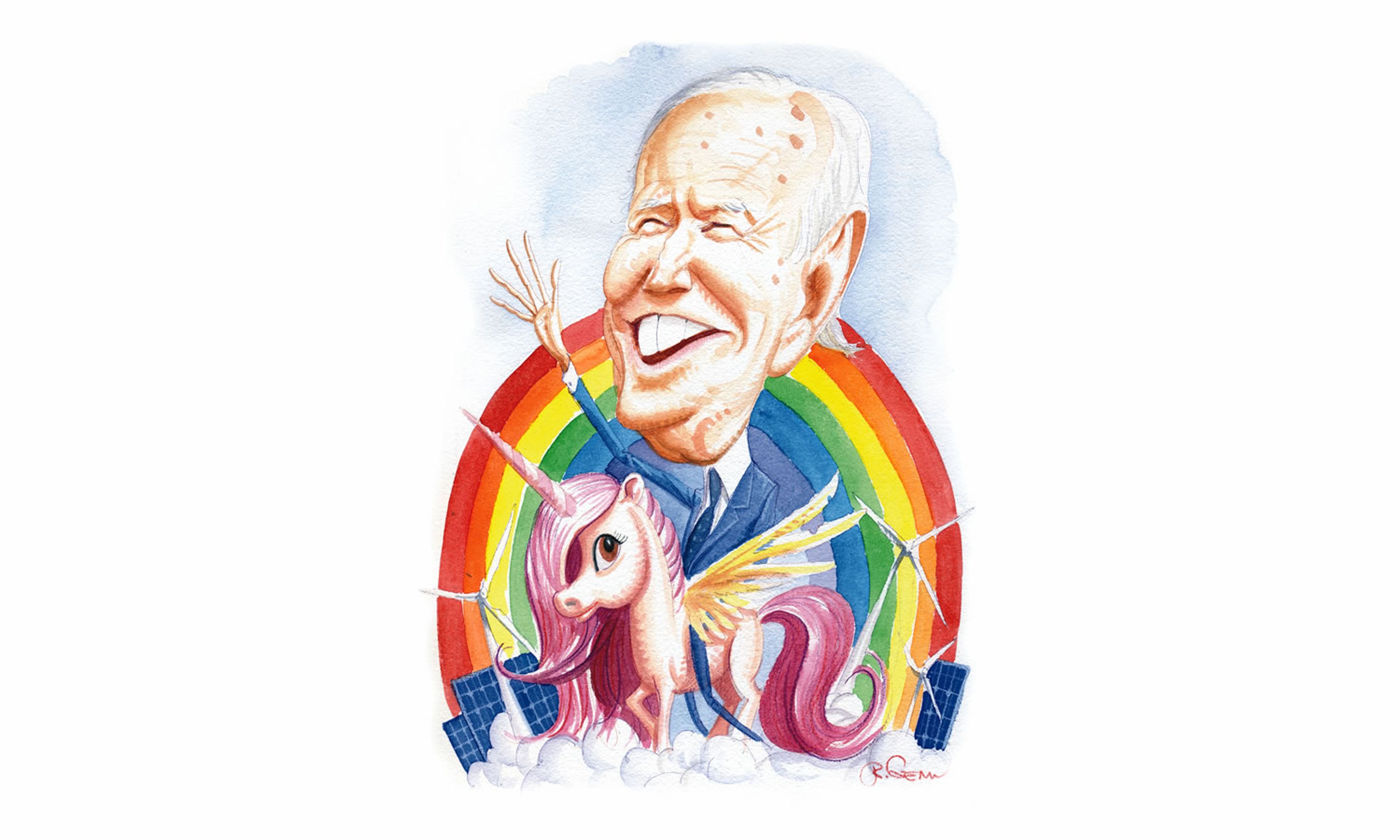
• Good news: The CDC says you can read this magazine without a mask.
• By the time you read this, upward of 150 million Americans will have received their first dose of vaccine. Caseloads and deaths are dropping. We could be doing better. The government briefly paused administration of the Johnson & Johnson vaccine to study a rare but dangerous side effect occurring in younger women. The caution was understandable, but the outcome may have been to spread exaggerated fear of the J&J vaccine, and of the others. The public-health world’s reluctance to tell people that the fully vaccinated are at very low risk of contracting or spreading the disease, especially in its worst forms, has also worked against the goal of raising vaccination rates. Speaking of which: Masking outdoors in open spaces has never had much of a rationale and has become ridiculous as vaccination rates rise; the Centers for Disease Control has finally said so, albeit with complicated and peculiar caveats. We could continue with the cavils and complaints: Biden’s going to take credit for our turning a corner, and the press will let him, even though our basic public-health policies have not changed since Trump left office. But turn a corner we have. The U.S., at last, is beating COVID.
• As Democrats disclaim responsibility for Major League Baseball’s pulling the All-Star Game out of Atlanta, it is clear that critics of the Georgia elections law got far out over their skis. A gathering of management from more than a hundred blue-chip companies reportedly discussed imposing collective sanctions on the state: a dramatic escalation of antidemocratic corporate bullying of questionable legality. The group’s resulting open letter was tepid, suggesting that some of its signatories may have thought twice about bare-knuckles partisanship. While many big corporate names signed, Georgia-based behemoths Coca-Cola and Delta Air Lines were noticeable by their absence, and Coke issued a conciliatory statement calling for “common ground.” Perhaps duly chastened by the repeated failure of critics to accurately describe the contents of the Georgia law, the open letter said nothing at all about any particular rule, nor did it even mention Georgia. It was so generic, we doubt that Georgia Republicans who supported the bill would have had trouble signing it themselves. “For American democracy to work, we must . . . defend the right to vote and to oppose any discriminatory legislation or measures that restrict or prevent any eligible voter from having an equal and fair opportunity to cast a ballot.” Who would disagree with that? This is simply empty virtue-signaling — which, we grant, is better than the alternative, and illustrates how badly the campaign against the law has misfired.
• On January 6, in the midst of the Capitol Hill riot, House minority leader Kevin McCarthy called President Trump, urging him to use his influence to stop it. McCarthy later repeated to several members of his caucus, including Representative Jaime Herrera Beutler, Trump’s initial comment: “Well Kevin, I guess these people are more upset about the election than you are.” Sarcastic, belittling, the president tried to wrong-foot a congressional ally about an attack on Congress. Three and a half months later, Fox host Chris Wallace asked McCarthy about the remark. “Is that what President Trump said to you?” McCarthy replied with generalities. But Wallace pressed him: “I’m asking you specifically, did he say to you, ‘I guess these people are more upset’?” “No, listen,” McCarthy answered, “my conversations with the president are my conversations with the president.” If Trump had told McCarthy no such thing, loyalty and honesty would unite and McCarthy would stoutly deny it. His evasion can only mean: Yup, Trump said it. Let the record show.
• The medical examiner for Washington, D.C., finally conceded that Capitol Police officer Brian Sicknick died of natural causes — succumbing a day after he suffered two strokes in the hours after the January 6 Capitol Hill riot. The press, led by the New York Times, initially reported that the rioters had killed Sicknick by bashing his head with a fire extinguisher, leading the 42-year-old officer to be rushed to the hospital and pronounced dead. But questions quickly arose about this reporting. It turned out that Sicknick had gone back to his office after the riot, bearing no signs of injury. He texted his brother that he was fine other than having been sprayed with some toxic substance. A police-union official informed his family that he appeared to have died from a stroke. Yet in their impeachment article against Trump, House Democrats alleged that Sicknick had been killed, and Democratic impeachment managers repeated that allegation a month later in a brief filed on the eve of the impeachment trial. This claim was not strictly necessary to their case, and was another unforced error they made while playing for the cheap seats. We are left unable to know, let alone prove, the precise relation between the riot and Sicknick’s death — and left wondering what took authorities so long to report their conclusions.
• Former president George W. Bush waded back into the immigration debate as he released a new book of paintings of immigrants. In the last two decades, Washington, D.C., has seen all-Democratic government, all-Republican government, and Republicans and Democrats at opposite ends of Pennsylvania Avenue. The “comprehensive immigration reform” Bush wants — combining stepped-up enforcement, increases in legal immigration, and legal status for millions of illegal immigrants — has not made it across the finish line under any of these configurations. This record of failure has not changed Bush’s mind that his is the right approach. But there are good reasons it has not worked: Even many of those Americans who are open to legalizing illegal immigrants who have put down roots here worry about whether enforcement will be as lackadaisical in the future as it has in the past, and it’s not clear what pressing national problem requires higher immigration levels. (Tight labor markets?) There is something admirable about Bush’s dogged determination, but it is starting to look like the famous definition of insanity.
• Biden flip-flopped with notable rapidity on increasing the refugee cap. Trump had set the cap at 15,000, a historic low. In February, Biden said that he would increase it to 125,000 next fiscal year and to 62,500 immediately. But the president reportedly got cold feet in light of the political reaction to the unspooling crisis on the border. The White House said in mid April that it would keep the Trump cap. A furor ensued on the left that Biden was able to withstand for all of a couple of hours, before the White House buckled and said it would announce an unspecified higher cap by May 15. The administration is already making it clear that any cap will be loose: It is treating many migrants at the border as if they were refugees, welcoming them into the country even though few of them have legitimate claims of persecution. Biden’s initial instinct to keep some limits was the right one.
• In an online petition, more than 200 employees of Simon & Schuster decried a litany of offenses — “anti-Blackness, xenophobia, misogyny, ableism,” etc. — and demanded that the publisher cancel its deal with Mike Pence, who is under contract for two books. CEO Jonathan Karp said no. “We come to work each day to publish, not cancel,” he wrote in a letter to staff, affirming that the company would keep its agreement with the former vice president. The publisher of recent books by Mary Trump, Bob Woodward, John Bolton, and others critical of former president Trump and his administration, Simon & Schuster has been the target of “outrage from both sides of the political divide and from different constituencies and groups,” Karp noted. “We don’t agree on which titles” are worthwhile, but “that tension — that push and pull — is a healthy part of the dialectic provided by classically liberal publishing companies.” Karp should be commended for the rare, if gentle, rebuke to woke staff at an elite cultural institution.
• On April 13, Paul Rossi, a teacher at Grace Church School in Manhattan, took a brave stand by writing an open letter titled “I Refuse to Stand By While My Students Are Indoctrinated.” Published on the Substack account of former New York Times opinion editor Bari Weiss, Rossi’s letter raised concerns about his school’s embrace of anti-racism training and pedagogy. The entire letter is worth reading and includes one galling detail after another. One such example is the response that Rossi received after questioning his school’s anti-racist orthodoxy during a “mandatory, whites-only student and faculty Zoom meeting.” Once his comments had been shared outside the forum, the head of the high school told him that he had caused “harm” to the students and, in doing so, failed to serve the “greater good and the higher truth.” Two days after Rossi’s publishing of the letter, George Davison, the head of the entire school (Grace also offers pre-high-school education), told him not to report for work the next day. On Sunday of that week, the school sent a letter to parents and staff informing them that Rossi had been relieved of his duties. To make matters even more distressing, in a recently released audiotape from a March 2 conversation between Rossi and Davison, Davison can be heard sharing Rossi’s concerns. “The fact is that I’m agreeing with you that there has been a demonization that we need to get our hands around. . . . We’re demonizing white people for being born,” he tells Rossi. Not to mention firing people for saying it openly.
• Howard University, the historically black institution in Washington, D.C., announced that its classics department, which has existed since the university’s founding in 1867, would be dissolved for reasons of “prioritization.” Writing in the Washington Post, Harvard professor Cornel West and standardized-test creator Jeremy Tate issued a powerful rebuke of the decision: “Academia’s continual campaign to disregard or neglect the classics is a sign of spiritual decay, moral decline and a deep intellectual narrowness running amok in American culture.” They pointed out that Frederick Douglass and Martin Luther King Jr., among others, were deeply formed by their study of Socrates, Cicero, and Cato. Douglass defied the law and risked his life to read the classics in secret as a slave. Enabling its students to gain that kind of liberating knowledge ought to be among Howard’s priorities.
• The city of Norfolk, Virginia, fired a police lieutenant after it emerged that he had donated money to the legal defense fund of Kyle Rittenhouse, the 17-year-old boy accused of killing two people during police-brutality protests in Wisconsin last summer. An initially anonymous $25 donation made through a Christian crowdfunding website was discovered to have been linked to Lieutenant William Kelly’s work email address. Appended to Kelly’s donation was the message “God bless. Thank you for your courage. Keep your head up. You’ve done nothing wrong.” It went on to say, “Every rank-and-file police officer supports you.” Three days after the provenance of the donation and the attached message were revealed, city officials announced that Kelly had been “relieved of duty” following an internal investigation. Chip Flier, the city manager, released a statement stressing that the “egregious comments erode the trust between the Norfolk police department and those they are sworn to serve” and that “the city of Norfolk has a standard of behavior for all employees, and we will hold staff accountable.” We suspect that the precise contours of this standard of behavior are about to be tested in court, as well they should be.
• President Biden’s climate summit was a step forward in a process that is likely to end up being a very good deal indeed for America’s most significant economic and strategic rivals, most significantly, but not exclusively, China. The idea that America will be able to lead by example is largely delusional; thus the summit saw no new pledges on fossil fuels from countries such as India and Russia to match Biden’s pledge of a 50 percent cut from our 2005 levels by 2030. China saw its opportunity, with its foreign minister linking cooperation over climate change to American noninterference in what he delicately referred to as China’s “internal affairs” (a term, incidentally, that in Beijing’s eyes includes Taiwan). There was and is an alternative to Biden’s course. The U.S. electricity-generating sector has significantly improved its greenhouse-gas profile in recent years thanks to fracking. Natural gas emits much less carbon than coal, and we have a lot of it. We could be exporting enormous quantities to the rest of the world, helping to displace coal power, a project that would offer strategic and environmental advantages and generate plenty of jobs too. It could also be the basis of achieving some sort of consensus on climate-change policies to come. Instead, the administration has adopted a policy of hairshirt and confrontation at home and unilateral concession abroad.
• Biden is sticking with his campaign plan to increase the top tax rate on long-term capital gains from 23.8 to 43.4 percent for those earning more than $1,000,000: a top rate higher, generally much higher, than anywhere in Europe. Taxpayers in the greediest blue states, such as California and New York, will be looking at a top rate in excess of 54 percent, and those in New York City at one over 58 percent. Quite a few of the wealthiest will not stay to enjoy the view, adding to the fiscal problems of places that have enough of them as it is. The problems will not be confined to the local level. Those who are subject to the tax won’t disregard its impact on post-tax returns and will either put a higher price on their capital or switch into safer or more tax-sheltered investments. Some would-be entrepreneurs, meanwhile, will decide not to give up their day jobs. None of this bodes well for the economy. Arguments that this increase will affect only the rich fail to address the case of someone who has spent a lifetime building up his or her small business and sells it for a price that, along with other income, takes him or her into the top bracket, a Croesus just for a year. The administration’s proposals would represent an increase in rates to a level that will be economically damaging, and almost impossible to justify other than as an exercise in class warfare.
• The Senate voted 94–1 for an “anti-Asian hate crimes” bill, a margin that serves as a clue that grandstanding is all that is happening. The bill would not criminalize anything previously legal or stiffen penalties for any crime. What it would mainly do is generate paperwork. The attorney general would have to establish guidelines for online reporting of hate crimes, and could give local law-enforcement agencies grants so that they could collect and analyze data on these crimes’ incidence. Grant recipients would have to issue reports. Senator Josh Hawley (R., Mo.) was right to object to this charade, which predictably won him a hostile editorial from the Kansas City Star that pretended he had voted against slowing down the “bloodshed in this nation.” If the murder rate drops by a tenth of a percentage point after this bill passes, it will be the sheerest coincidence.
• Republican interest in monetary help for parents is growing. Senators Marco Rubio and Mike Lee have argued for years that parents deserve more tax relief. A few months ago, Senator Mitt Romney proposed a “child allowance” of $4,200 per year per young child for nearly all households. Now Senator Hawley has a proposal of his own, for $6,000 for single-parent households and $12,000 for married-parent households. All of these plans involve difficult trade-offs. Hawley, unlike Romney, would require households to do some paid work before qualifying; Lee and Rubio would be the most generous for large middle-class families; Romney has specified how to establish his benefit without raising the deficit. We are sympathetic to the senators’ aims and look forward to their hashing out their differences. There’s another side of the equation, though, to consider: None of these proposals would look quite so urgent if the federal government did not transfer quite so much money from young families to the elderly.
• Homeless shelters can no longer be single-sex and receive federal funding, according to a new rule from the Department of Housing and Urban Development. The move, which overturns a Trump policy, mandates access to HUD-funded programs “regardless of sexual orientation or gender identity” and will likely make it harder to convince a woman on the streets to go to a shelter — cleanliness and safety issues are already frequent deterrents, and HUD now wants to make it a norm for men who identify as women to be present at what should be women’s shelters. It’s hard to imagine that men’s shelters will be welcoming for a woman who identifies as a man, either. Under this administration, ideology continues to matter more than the real needs of human beings — in this case, some of the most vulnerable among them.
• Laura Kelly of Kansas, a Democrat, is the latest governor to veto a bill to uphold the integrity of sex-exclusive sports. Kelly described the bill as “regressive” and said it could be harmful to the state’s economy. Kansas is one of more than 20 states that have considered laws protecting sex-exclusive sports. But these efforts have faced setbacks even in Republican states such as South Dakota, North Dakota, and Florida. Meanwhile, after four brave female athletes from Connecticut sued their state’s athletic conference for allowing boys (who identify as girls) to displace them in their athletic events, a federal district court ruled to dismiss their challenge. The girls’ attorneys at Alliance Defending Freedom have indicated that they will appeal this decision. Merely protecting women’s sports is becoming itself a test of endurance.
• In the New York Times, Planned Parenthood president Alexis McGill Johnson formally criticized the institution’s infamous founder, Margaret Sanger, for her association with white-supremacist groups and the eugenics movement. After about a century, and the last year of racial tension, the abortion provider is finally ready to admit what many of us have been saying for quite some time: Sanger was a leader in the U.S. eugenics and population-control movements, motivated especially by her animus toward the poor, the “unfit,” and the “feeble-minded.” Sanger’s repulsive sentiments should shine a harsh light on the present-day business model of her organization. Nearly 80 percent of its clinics are located within walking distance of neighborhoods occupied predominantly by black and Hispanic residents. While constituting only 13 percent of the female population, black women represent more than one-third of all abortions in the U.S. each year, and they are five times more likely than white women to obtain an abortion. In recent years in New York City, more black babies were aborted than were born alive. Some day, let’s hope, Planned Parenthood will be apologizing for more than just Sanger.
• Justice Amy Coney Barrett has inked a $2 million book deal, reportedly about how judges should set aside personal feelings and opinions when they don their robes. The advance would be the highest ever for a Supreme Court justice and was met with much gnashing of teeth. Dahlia Lithwick fumed that it seemed “more than a bit troll-y” and speculated that Barrett “doubtless wants to throw off the grotesquerie of her superspreader Rose Garden ceremony and the persistent stink of Donald Trump.” Charles Geyh of Indiana University’s Maurer School of Law fretted about the “optics” of Barrett’s signing such a deal (“problematic”). Justices Thomas, Sotomayor, Gorsuch, and Breyer have all published from the bench before, as did the late Justice Scalia, so we’re not sure what Barrett’s done wrong, other than make more money. Considering the seven kids she has to put through school, who can blame her?
• Last month, the Supreme Court heard arguments in Americans for Prosperity v. Rodriquez. At issue in the case was the State of California’s policy requiring that nonprofit organizations disclose their donors to state officials. The mandate, the state contended, allows for more “efficient” and more “effective” law enforcement. The litigants — along with an ideologically diverse array of nonprofit organizations that filed amici briefs — urged that such compulsion violates their free-speech and free-association rights. They’re right, and, in fact, the Court ruled as much in NAACP v. Alabama ex rel. Patterson (1958), which established that the First Amendment protects the privacy of a group’s members and supporters. The point of California’s policy is to enable harassment, which is essentially the same reason the Court ruled as it did back then.
• Donald Trump bragged during an interview with Sean Hannity that North Korea’s Kim Jong-un “writes me letters.” “I like him, he likes me, there’s nothing wrong with that,” the former president continued. Similarly, Trump boasted about getting along “great with [Russian] president [Vladimir] Putin.” “That’s a good thing, not a bad thing,” he insisted. Being able to navigate difficult relationships with difficult foreign leaders is no vice, but sending valentines to murderous thugs working against American interests is.
• President Biden seeks credit for drawing the curtain on America’s longest war. “I’m now the fourth United States president to preside over American troop presence in Afghanistan,” Biden said at the White House, pledging not to “pass this responsibility on to a fifth.” The public is weary after 20 years of conflict, 2,500 Americans killed, and $2 trillion spent. Still, the current phase of the war has focused on supporting the Afghans, not sending U.S. troops into battle: Since the scaling back of U.S. operations in 2015, we have lost 64 personnel in combat. Moreover, our involvement was always principally about preventing the Taliban’s return to power and the reemergence of a terrorist threat capable of killing Americans on U.S. soil, not about creating a liberal society in Central Asia. To strike al-Qaeda and perhaps even a resurgent ISIS post-withdrawal, American pilots, or drones, will soon have to fly very long distances, and it will be much more difficult to develop actionable intelligence without a presence on the ground. The withdrawal will likely only swap the unsatisfactory status quo for what we have been trying to stop from coming to pass in Afghanistan these two decades.












U.S. troops patrol at an Afghan National Army base in Logar Province, Afghanistan, in 2018.
Omar Sobhani / Reuters
• President Biden has recognized the early-20th-century slaughter of Armenians as genocide. Today designating a massacre as a genocide allows international sanctions of the perpetrators to kick in. For modern Armenians, acknowledging the century-old hecatomb is a matter of justice. Turkey maintains that Armenians allied with its Russian enemies in World War I, that in the breakup of the Ottoman Empire many Turks also perished, and that’s the end of the story. It is clear, however, that the Young Turks who then ran the empire conducted a campaign of ethnic cleansing in which hundreds of thousands of Armenian civilians were force-marched from villages they had inhabited for centuries, raped, and murdered. For decades American presidents hesitated to use the g-word because Turkey was a vital NATO ally. Erdogan has frayed that link. In one of history’s ironies, Kurds, who were among the most zealous harriers of Armenians, now harbor Christian and Yazidi refugees from ISIS.
• Members of Congress advanced two major legislative packages to overhaul U.S. strategy toward China. The Endless Frontier Act and the Strategic Competition Act have bipartisan support in both chambers. The former would direct $100 billion over five years to the National Science Foundation to boost development of artificial intelligence, biotechnology, and other advanced technology. The latter would provide support for competition with Beijing on international development and infrastructure financing, at international organizations, and in the realms of trade, technology, and finance. It’s difficult to overstate the monumental nature of the legislation under consideration. Together, the two proposals effectively codify an American political consensus about Beijing’s threat to peace, democracy, and international order and make a massive spending commitment to meet the challenge posed by the Chinese Communist Party. That the bills have received such widespread support is encouraging, and signals that Congress is serious about meeting this epochal challenge.
• A court in Hong Kong handed down sentences for nine advocates of democracy. What were they guilty of? Advocating democracy, essentially. And trying to hold the Chinese government to its signed guarantees concerning Hong Kong. One of the prisoners is Jimmy Lai, the businessman and democracy champion. He could have gone anywhere — flown off to the Caribbean — to avoid the wrath of the Chinese state. Instead, he stayed in Hong Kong to take a stand with his fellow citizens. Hong Kong is now the front line in a worldwide struggle between democracy and dictatorship, freedom and unfreedom. The United States should do everything it can — politically, commercially, diplomatically — to aid the people of Hong Kong. As the prisoners were led away, some in the courtroom called out, “Stay strong!”
• The European Union, as a bloc, wanted to issue a statement criticizing China’s new “national security” law for Hong Kong. In this, the EU would have joined the United States and Great Britain. But one member, Hungary, prevented the EU from doing this. The ties between Viktor Orbán’s government and Beijing are increasingly warm. Meanwhile, Apple Daily reported “several instances” in which German officials refused to recognize BN(O)s — British National (Overseas) passports — held by Hong Kongers. If the people of Hong Kong are to have a chance, they will need more help than they are getting.
• At this writing, Alexei Navalny, the Russian opposition leader, is still alive, which is an achievement for any Russian opposition leader. He is a prisoner at Penal Colony No. 2, in Pokrov, about 60 miles from Moscow. In defiance of the authorities, thousands of his fellow citizens took to the streets to protest the Kremlin’s treatment of him. Almost 2,000 of the protesters were arrested. The Russian state is set to label Navalny’s organizations “extremist,” which would carry severe penalties for those who participate in them — prison terms of up to ten years. The official who is leading this latest thrust against the Navalny network is Denis Popov. He has been exposed as laughably corrupt by Navalny’s Anti-Corruption Foundation. The director of this foundation, Ivan Zhdanov, said, “They are screaming out with this move: We are afraid of your activities, we are afraid of your rallies, we are afraid of smart voting.” Navalny himself wrote a poignant note to a journalist friend: “Everything will be all right. And, even if it isn’t, we’ll have the consolation of having lived honest lives.”
• Three Kims have ruled North Korea since 1948. Two Assads have ruled Syria since 1970. Two Castros have ruled Cuba since 1959. But now, Raúl Castro, at 89, is retiring. How long will the communist government outlast the Castros? That is a question that is consuming the Cuban people and their friends. In the speech announcing his retirement, Raúl Castro said, “I believe fervently in the strength and exemplary nature and comprehension of my compatriots.” Obviously, he and his fellow communists do not believe in them enough to allow a free press and free elections. An evil regime, too long in the saddle.
• When the residents of Tumbler Ridge, British Columbia, experienced a sudden Internet outage, their service provider quickly determined the cause: Vandals at numerous locations had dug three feet into the ground and then penetrated 4.5-inch-thick plastic conduit to reach the fiber-optic cables inside, which they cut loose and made off with. Who, in this remote village, would have the reason and the tools to commit such a crime? Leave it to beavers. A horde of the buck-toothed critters had evidently decided that strands of fiber-optic cable were just what they needed to finish off a dam they were building (photos of the dam show bits of wire inserted amid the sticks and mud). The strands serve no obvious purpose: Perhaps they are there for some obscure structural reason, or perhaps they are mainly decorative. We, however, suspect a simpler explanation: The wires were meant to carry data, but the beavers are still waiting for an appointment with the cable guy.
• Walter Mondale was a terminal moraine of New Deal liberalism. Spending and taxes were the hammer for every nail. His haggard faith allowed a few innovations: An anti-communist in his youth, he trended détentist as the Cold War lengthened; white male as they come, he tapped Geraldine Ferraro to be the first woman on a national ticket. To win the Democratic nomination in 1984, he held off two avatars of the future: Gary Hart, apostle of the (empty) slogan “New Ideas,” and Jesse Jackson, first face of what would come to be called intersectionality. He had a warm sense of humor: When Ronald Reagan, in their second debate, disposed of the age issue by saying he would not “hold my opponent’s youth and inexperience against him,” Mondale laughed, even though he had to know that the moment loosed the landslide that would bury him. Post-politics he served as a well-regarded ambassador to Japan. Dead at 93, R.I.P.
• There are some singers of whom other singers are in awe. Christa Ludwig, the German mezzo-soprano, was one such. She set a standard in both song and opera — songs of many types, operas of many types. Versatility was one of her calling cards. She had smarts, musicality, charisma — and voice. The kind of voice that is given to one in many millions. People who heard her live will never forget it. For the rest of us, there are ample recordings, which are a nice second-best. Many people fret over the future of song and singing. Ludwig did not. In a 2014 interview with our Jay Nordlinger, she said, “If something is worth staying on, it will stay on.” May it be so. Christa Ludwig, who was a legend decades before she died, is gone at 93. R.I.P.
• Tempest Storm (her stage name, then her legal name) was a burlesque performer whose peak fame in the Fifties just preceded the sexual revolution. She described her methods in an interview with Roger Ebert: “No matter what men may think, they don’t actually want to see a performer just come out and take off her clothes. There’s got to be communication, there’s got to be contact. In my act, although I eventually do get down to the legal minimum, I actually put on more clothes than I take off. . . . A performer who can communicate a feeling of modesty is sexier than one who just strips.” That was then. The life was rife with predictable travails, and triumphs of a kind: born Annie Blanche Banks to sharecroppers, molested by a stepfather, two quickie marriages in her teens, affairs with Elvis Presley and then-senator John Kennedy (both fondly remembered). A lengthy marriage produced a daughter from whom she was estranged. She last performed in 2010. Dead at 93, R.I.P.
• At night, under the tutelage of his illiterate grandmother, the provincial boy in Tabriz, Iran, devoured books, his means of transportation. “I knew England,” Vartan Gregorian explained. “I knew Germany.” Soon enough he was traveling abroad in the flesh, to study in Beirut and then in America, at Stanford. He spoke half a dozen languages, read everything, and taught history at the University of Pennsylvania, where he served as provost. He resigned in 1980 after the trustees passed him over in their search for a new president. Dejected and languishing in the general disrepair into which Gotham had fallen, the New York Public Library reached out to him: Might he be its president, to help manage the damage? Sure, but why so gloomy? Recognizing the institution’s treasure of manuscripts, rare books, and millions of volumes, he raised a ton of funds and restored the main branch, the jewel of Bryant Park. He made the NYPL cool again. In 1989 he moved to Brown University, where as president he more than doubled its endowment; in 1997, to the Carnegie Corporation, to work the other side of the charitable-giving street. Humanist, raconteur, patron saint of libraries — dead at 87. R.I.P.
Justice amid the Rage
Former police officer Derek Chauvin was convicted of two counts of murder and one of manslaughter in the killing of George Floyd. Seeing is believing: The video of Chauvin kneeling on Floyd’s neck and back — he had been arrested for passing a counterfeit bill — showed malignant disregard for Floyd’s life, and for standards instilled in cops. Perps complain as a matter of course that they cannot breathe. But if they are secured, they are to be eased out of their most confined hold (in Floyd’s case, rolled off his back onto his side); and if they indeed stop breathing, first aid is to be given and professional medical help immediately summoned. The three officers who were present at the scene will now go to trial for their possible collusion in Chauvin’s criminal misconduct.
Justice satisfied was overshadowed by the year-long din of the racial rage machine. Item: the demonstrations, country- and world-wide, hailing Floyd as a martyr to white supremacy. Item: the riots, costing lives and millions of dollars of property damage, that went hand in hand with the demonstrations. Item: the assumption, amounting to religious belief, that black men and women are targets of a racist system and culture that will stop at nothing to victimize them.
The rage machine risked infecting the process of justice itself. Representative Maxine Waters (who called for further street confrontations unless the jury returned a verdict of “guilty, guilty, guilty”) and President Biden (who announced that he was “praying” for a conviction) belong to the elective branches of government. Judge Peter Cahill acknowledged that Waters’s behavior might give Chauvin’s defense grounds to appeal for a mistrial. But Cahill himself endangered the judicial process by not granting a change of venue and not sequestering the jury. Trials must be discrete, stand-alone events to determine the guilt or innocence of an individual — not expressions of communal wrath, even righteous wrath.
Outrage politics went into overdrive the day the verdict was announced when a police officer in Columbus, Ohio, fatally shot Ma’Khia Bryant, a 16-year-old girl, while she was in the act of lunging at another girl with a knife. An innocent life saved or serious injury prevented, by a split-second decision. No matter: The death of the assailant was framed as one more wanton police killing.
America is a big country, which means that it has many police, and many criminals — and many more ordinary citizens, who need the first to protect them from the second. To ignore the overwhelming majority of cases in which cops do their duty, and fetishize the tiny number in which they betray it, is to drink poison.











Comments