For the first time in my adult life, I own a patch of dirt. So I am dreaming in green these days. In our first summer here, I had little more than crabgrass, clover, moss, and mud in our backyard. But not this year. I want it thick, lush, soft, and cool to the touch. And I’ve been willing to put in the work and the research.
It’s more conventional to do this kind of thing in the fall. But ever since that incident in a much more famous Garden, man’s lot is to sweat into the earth to impose order. And to that end, I spent ten hours of one Saturday this spring tilling and manually pulling away debris. Then came the hand leveling. I cut open the bag of seeds, and the aroma of hay and oats was suddenly in the air. My children raced with each other to take the seed from the wheelbarrow, put it into the Scotts “Wizz” Cordless Spreader, and spray it around into the dirt. My wife brought me iced tea and I grandly announced, “I’m an agrarian now!”
Not really, but I like overdoing things. And in the overdoing-it department, I sent some of my dirt to a laboratory that afternoon. I await the near day when the results are loaded into an app and I discover precisely how much nitrogen, phosphorus, and potassium I need to be applying for the rest of this growing season. But I knew I needed some already, so I put about 54 ounces of nitrogen-rich black liquid into a backpack sprayer and made my first “application.” Finally, I placed a Rain Bird Phoenix, sitting on a heavy metal sled, into the middle of the yard, hooked it up to an electric pump to get sufficient pressure, and drenched that dirt patch. The glorious arc of water creates a rainbow in even modest daylight. And every day since “the great sowing,” I have been babying this crop. Grasses cover nearly 40 percent of the earth’s land surface, excluding Greenland and Antarctica, and I just want them to cover a tiny bit more. I want the kind of grass that makes people reach for the word “sward” to properly describe it.
Why? Well, because grass can be beautiful. But it’s also useful. Grass drains away rain through capillary action so that your land will not become a mud pit where mosquitos breed. The root system of well-kept turf keeps the soil healthy, feeding it more organic material than I could ever spray on it. Healthy grass is also its own defense against weeds. I want grass because it literally cools the space around your home, but mostly because I have three little kids and a dog who need more time outside in the spring, summer, and fall. Grass is an inviting surface for play. I want grass because I’m an American man.
Which is the problem.
Like Homo americanus, the lawn has enemies and critics. And we must distinguish these two. The critics are sometimes on your local message boards, and they can be constructive. Some of them like stone landscaping more than turf grass. Or they hate yard work but love gardening. Some just want you to know you have more options than a bag from Home Depot, or at least they want their local homeowners’ association to allow more options than what comes in a bag from Home Depot.
And that’s as it should be. Lawn and garden should live in creative tension and peace. Let the homeowner decide the balance between the two. There are patches of my own front lawn that should be a shade garden, and others where I’ll try an extremely low-maintenance sheep fescue that doesn’t stand up well to traffic but stops erosion and looks pretty. There are political battles between lawn critics and lawn enthusiasts. Often these are negotiations over the type and amount of chemical treatments that should be used, or the pure horrible volume of lawn equipment. Even I hate the two-stroke-motor-powered leaf blowers and hope my municipality will regulate them more. Critics may not like lawns as they are, but they engage with turf-lovers in a normal tussle about resources, manners, and neighborliness.
But the American lawn also has ideological enemies. For a certain type of progressive, the lawn is a symbol of the evils in our society. And so, as you would expect, the case against the lawn is just like the progressive case against everything else in our society: It combines a dash of Marxism for fertilizer with a splash of apocalyptic environmentalism and is now generously top-dressed by layers of moralizing “wokeness.” Your grass, they say, like everything else in this capitalist society, is destroying the planet. And, perhaps more urgently, lawns are really racist, in exactly the confusing way everything is now. Turf privilege is destroying us. Whiteness rests on greenness.
The enemies of lawns now emerge in the hectoring voice of explainer journalism. In popular form it speaks in television shows such as Adam Ruins Everything on TruTV, or viral YouTube imitators such as The Good Stuff. Americans spend billions growing a crop only to cut it and maintain it. Couldn’t those billions be used for something else? Lawns waste water, and people spill chemicals on them. Often these hot takes on the lawn contain wildly outdated factoids. “Did you know that Americans spill 17 million gallons of fuel into the environment just from refilling their lawn equipment? That’s more than the Exxon Valdez!” That little gem gets cited in new viral videos and is found in books such as Ted Steinberg’s American Green: The Obsessive Quest for the Perfect Lawn, which came out in 2006.
The reference to the Exxon Valdez spill, which took place in 1989, gives the origin away. It comes from an early-1990s FDA estimate of American clumsiness. This estimate was used in focus groups to judge how a public-information campaign could influence 1990s-era consumers to buy more electric lawn equipment. Yet it wasn’t the FDA’s scare tactics that moved American buyers, but the ingenuity of corporations that built electric tools that are now competitive on power and convenience. There are hundreds of little anti-lawn facts like the yearly Valdez spill that are still called upon to incriminate the lawn. On average over 200 people per day may be injured doing yard work in America, a number similar to the one for people injured by firearms. Maybe it’s time for some commonsense mower regulation.
The lawn haters cite the overall total of $99 billion spent yearly on lawns and gardens to shock you with the waste. All this for grass! But the number is not that shocking. A dozen American universities combined would have a greater operating budget than that of the 50 million acres of American lawn space. Even the industry’s own generous figures come out to an average spending of $503 per household on lawns and gardens together in 2019. By comparison, the average American household spent $511 on Christmas gifts and holiday gift cards in 2019. Per person, Americans between ages 25 and 65 spend $1,368 annually on their cellphones and cellphone service.
But this not-so-convincing economic case against the lawn is married to a culture-war argument that lawns are a symbol of reactionary, hidebound privilege and white supremacy. One viral tweet from 2020 put it this way: “Lawns are a part of settler colonialism, contributing to the destruction of natural biodiversity of a region, toxifying the ground, wasting water, and polluting waterways with harmful chemicals through runoff.”
The cultural referents change, but they are all equally problematic. Former Vox contributor David Roberts wrote recently that lawns were “meant to be a signal of wealth and security, to show that in America, every (white male) citizen is a feudal lord of his own estate.” Lawns emerged in imperial powers such as England and France and were carried into the world by those empires. And as technology and its oppressive power spread to more people in the modern age, privileged white men tore up the native agriculture and replaced it with a big, boring, green outdoor welcome mat.
But if the old empires and aristocracies aren’t sinister enough, how about mid-century America? Instead of the tyranny of the ancien régime, we have the tyranny of golfers. Steinberg’s book recounts the details of Levittown’s requirements for weekly mowing and concludes: “Lawn monoculture melded perfectly with the ethos of conformity so central to nineteen-fifties suburbia.”
So, lawns are a disgusting symbol of whiteness. But also, weirdly, just as in the wider culture war, there is a strain of nativism added to these arguments. It holds that lawn grasses are disgusting foreigners, brought here from Europe, the Eurasian Steppe, or East Asia. Lawns emerged in the cool, moist climate of the British Isles and northern France, so shouldn’t they just stay there? Aren’t you horticulturally appropriating sheep fescue from Turkey? Have we told you that your precious “Kentucky bluegrass” is actually from Europe and North Africa? Is your mind blown yet? A 2015 article in The Atlantic tut-tutted: “While the [non-native] grasses can certainly survive here, they will probably not, on their own, thrive.” The nativist argument, if followed logically, wouldn’t just replace your chewings fescue with butterfly weed; it would take the tomato away from Italians and filch the baguette from Vietnamese banh mi trucks.
But when the case against lawns isn’t just a substitute for nuking suburbia altogether, it often ends in the case for replacing lawn space with native meadows. Why not welcome biodiversity? In this almost utopian vision, the American front yard is replaced with something that requires no labor, heals the environment, and symbolizes diversity itself. New Socialist Man has become New Meadow Man, who communes with butterflies, harvests fungi, and treats grubs and moles as neighbors.
This, too, is a red herring. After hearing our lawns criticized as “monocultural” and “unnatural,” we are told not to just let the lawn die and be replaced by whatever comes afterward — usually ugly weeds, mud, and moss — but to plant native meadow-seed mixes. In reality, these require water to establish and weeding to maintain. Instead of having 18 varieties and mixes of grass seed across your suburban block, every home from Delaware to Quebec would have roughly the same 18 meadow plants that are easy to harvest for seeds. And homeowners would still have to contend with the animals these meadows can attract. You buy into the vision of making a pet- and kid-friendly play space, free of pesticides, only to find the kids and pets menaced by the pests, or in danger of toxic plants. Meadows can bring rodents closer to the family home, and in the American Northeast, taller meadows will be a haven for ticks carrying Lyme disease.
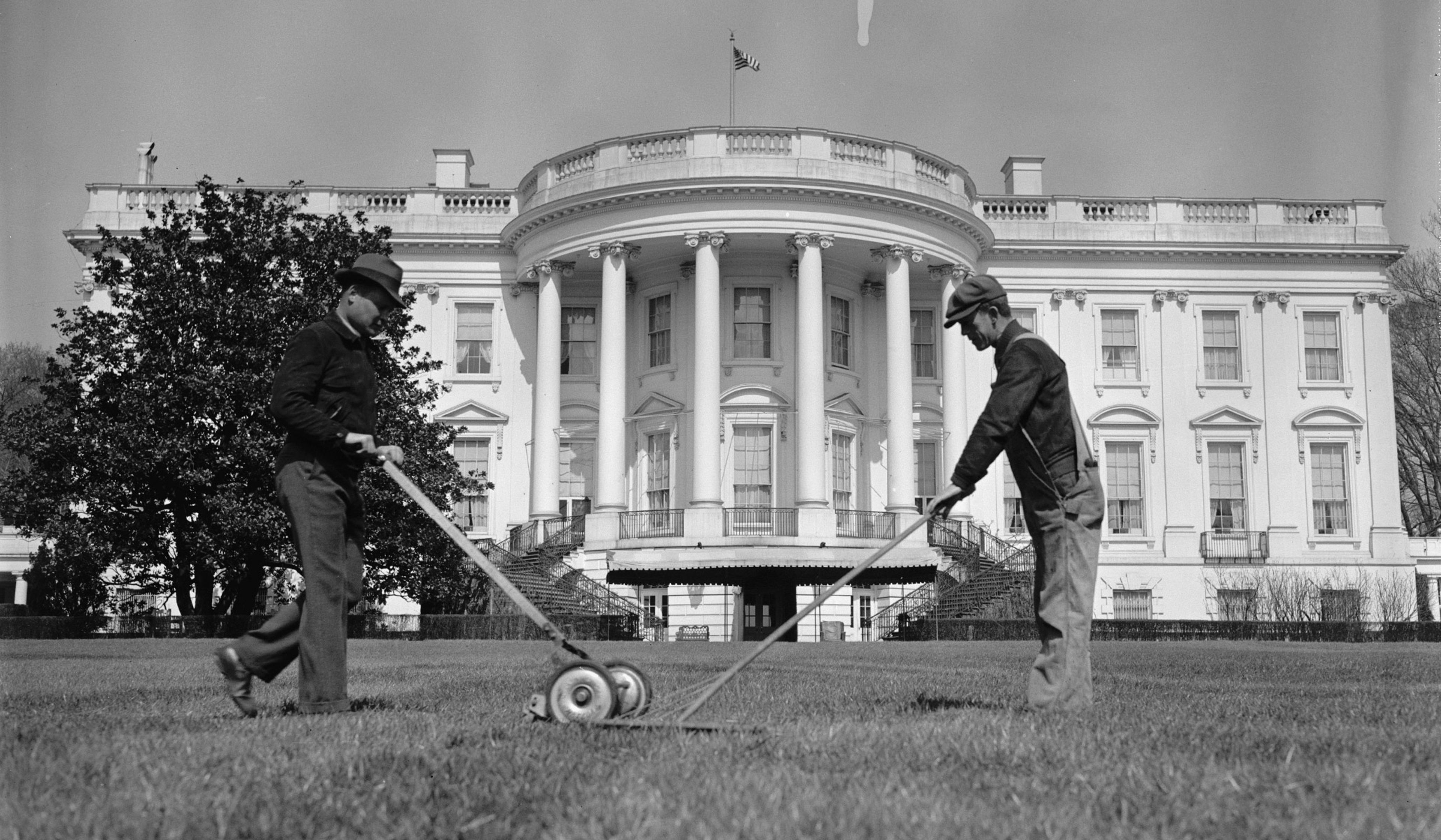
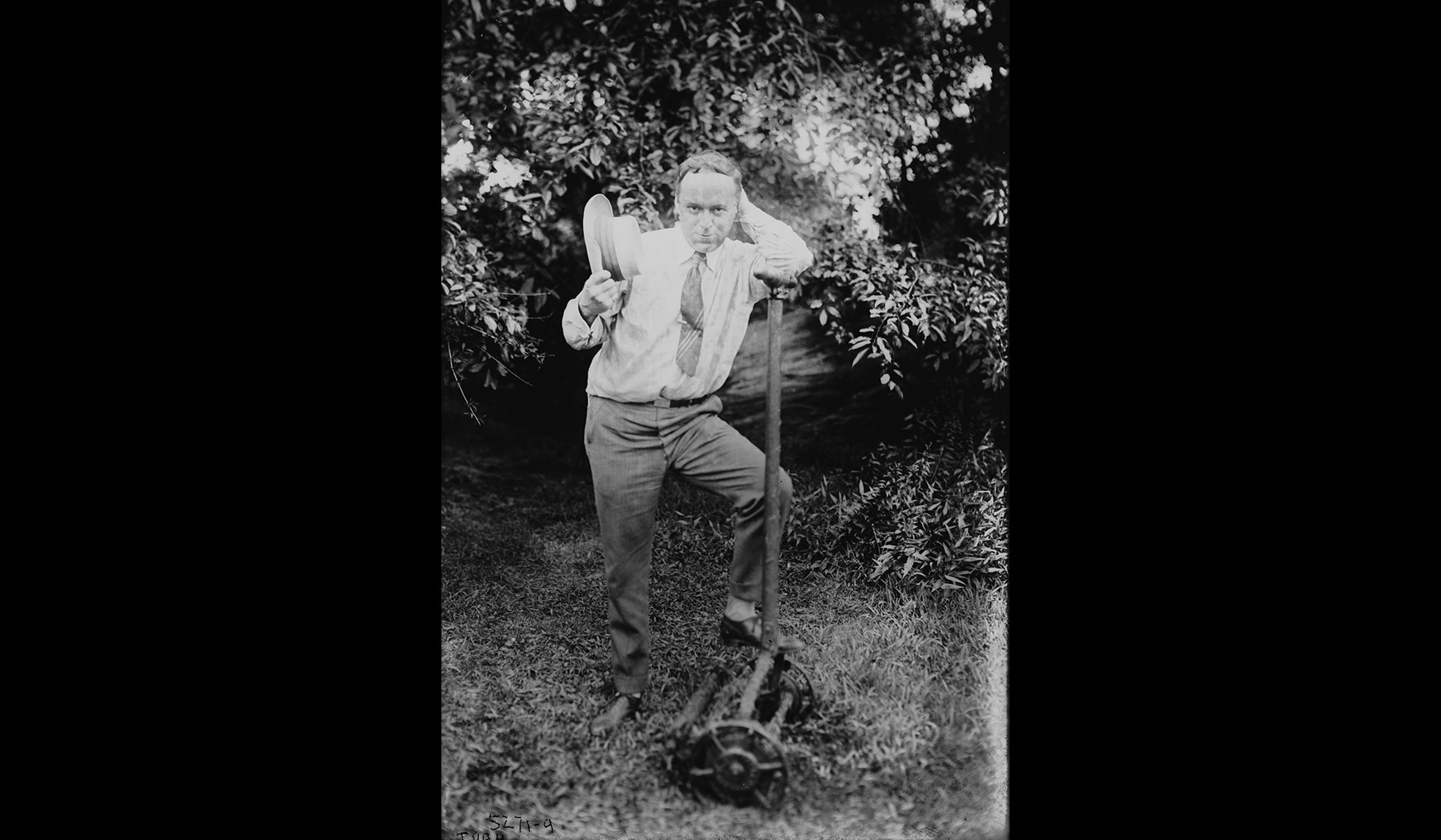

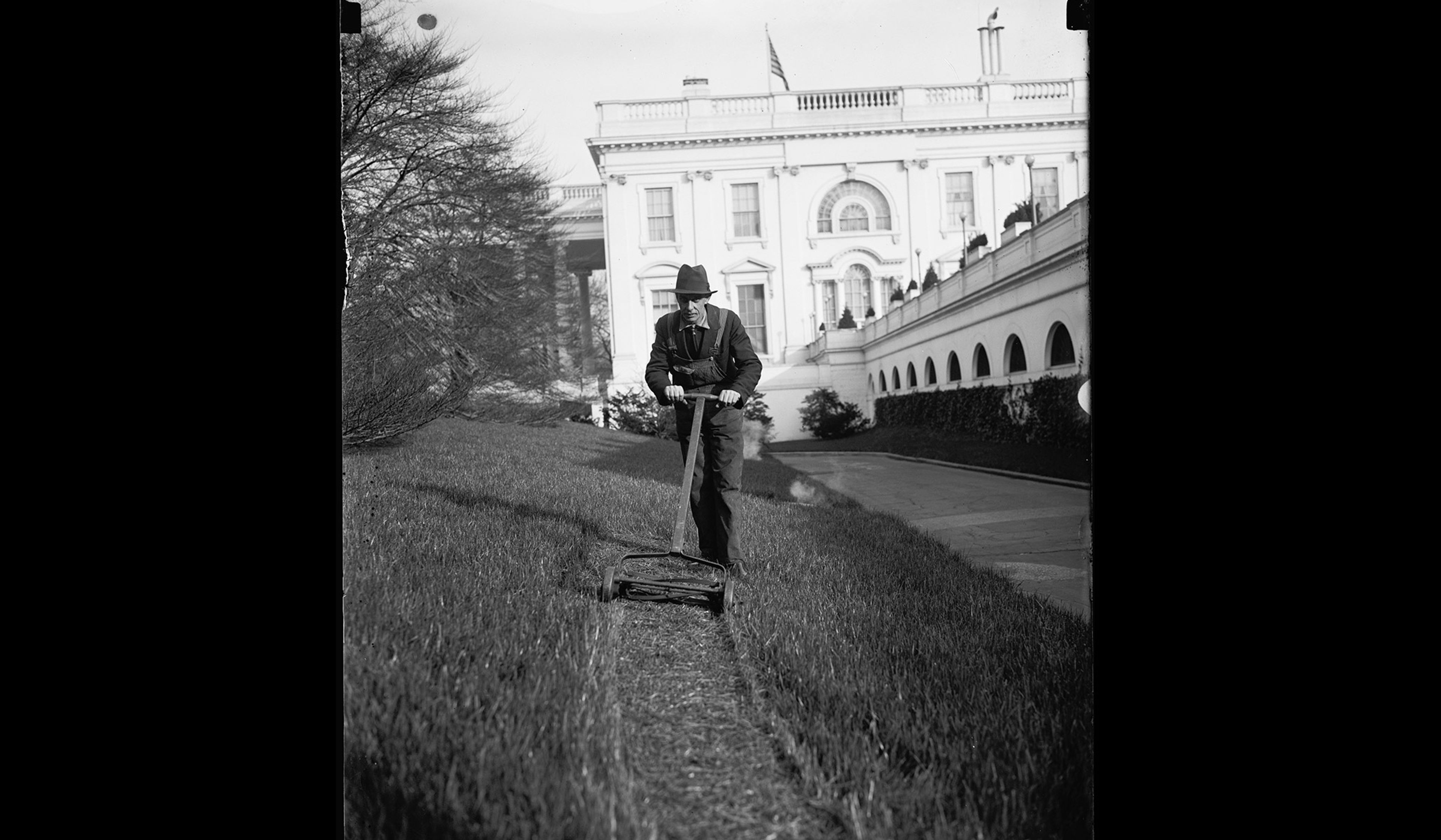
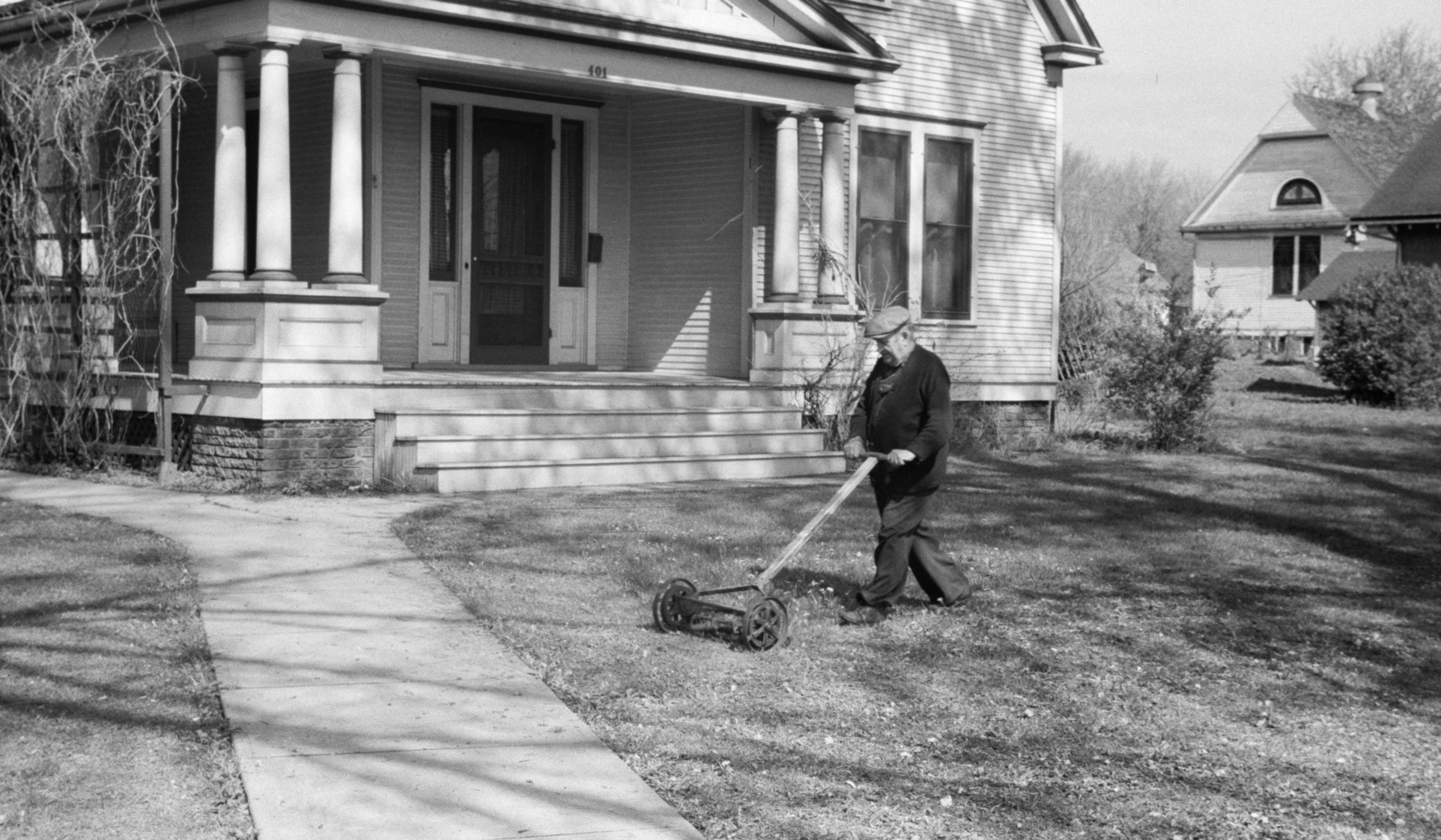
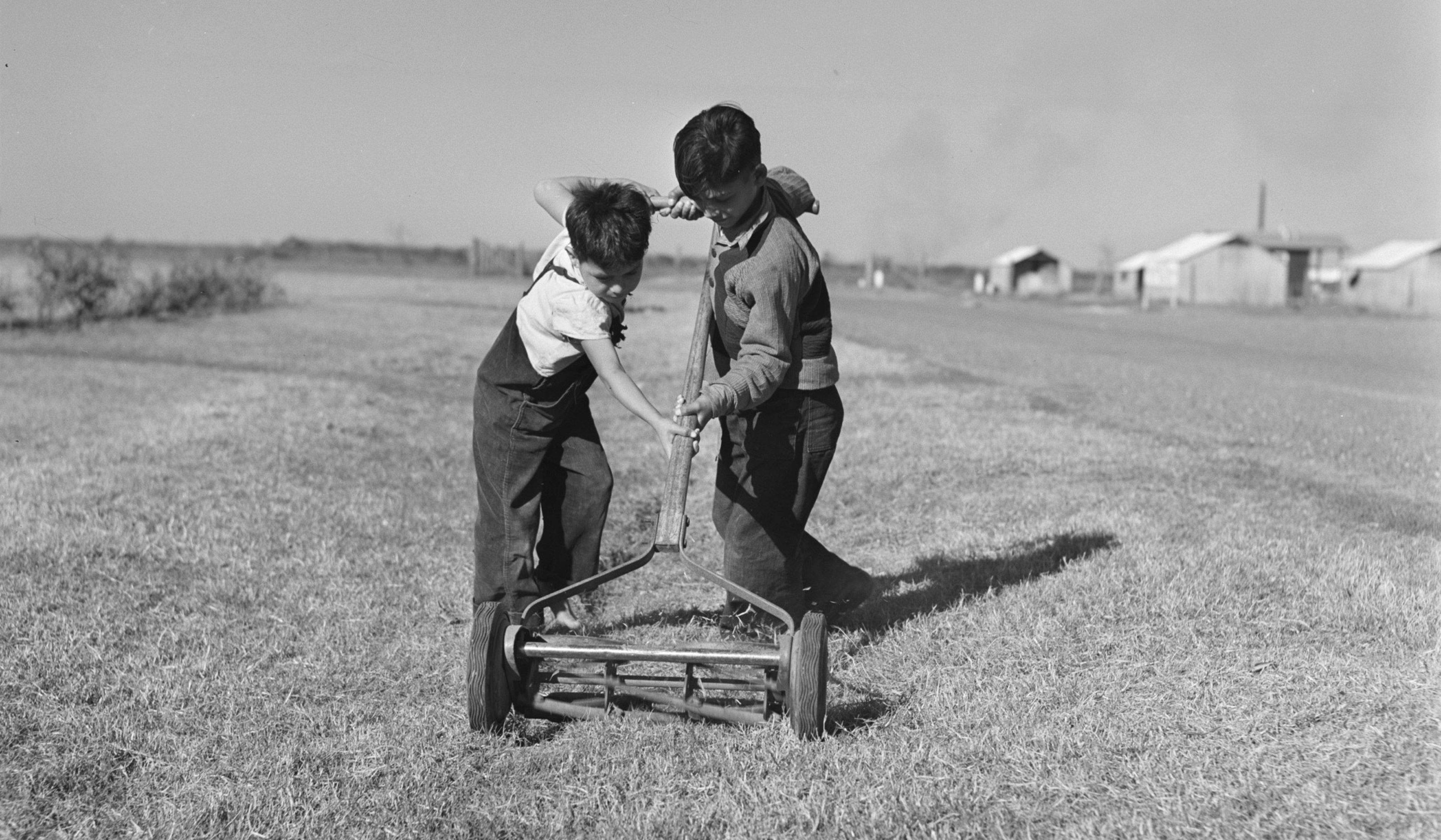
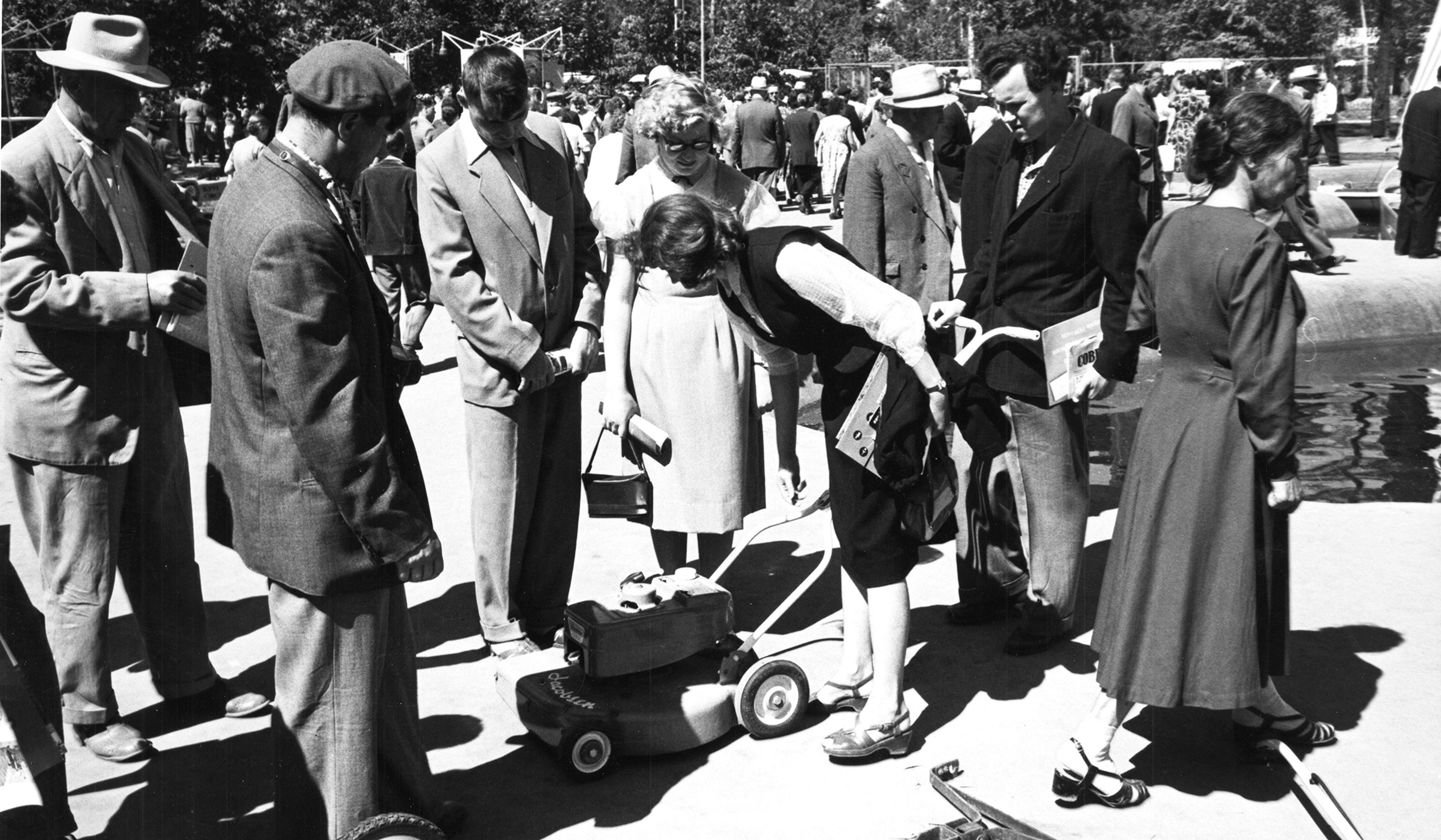
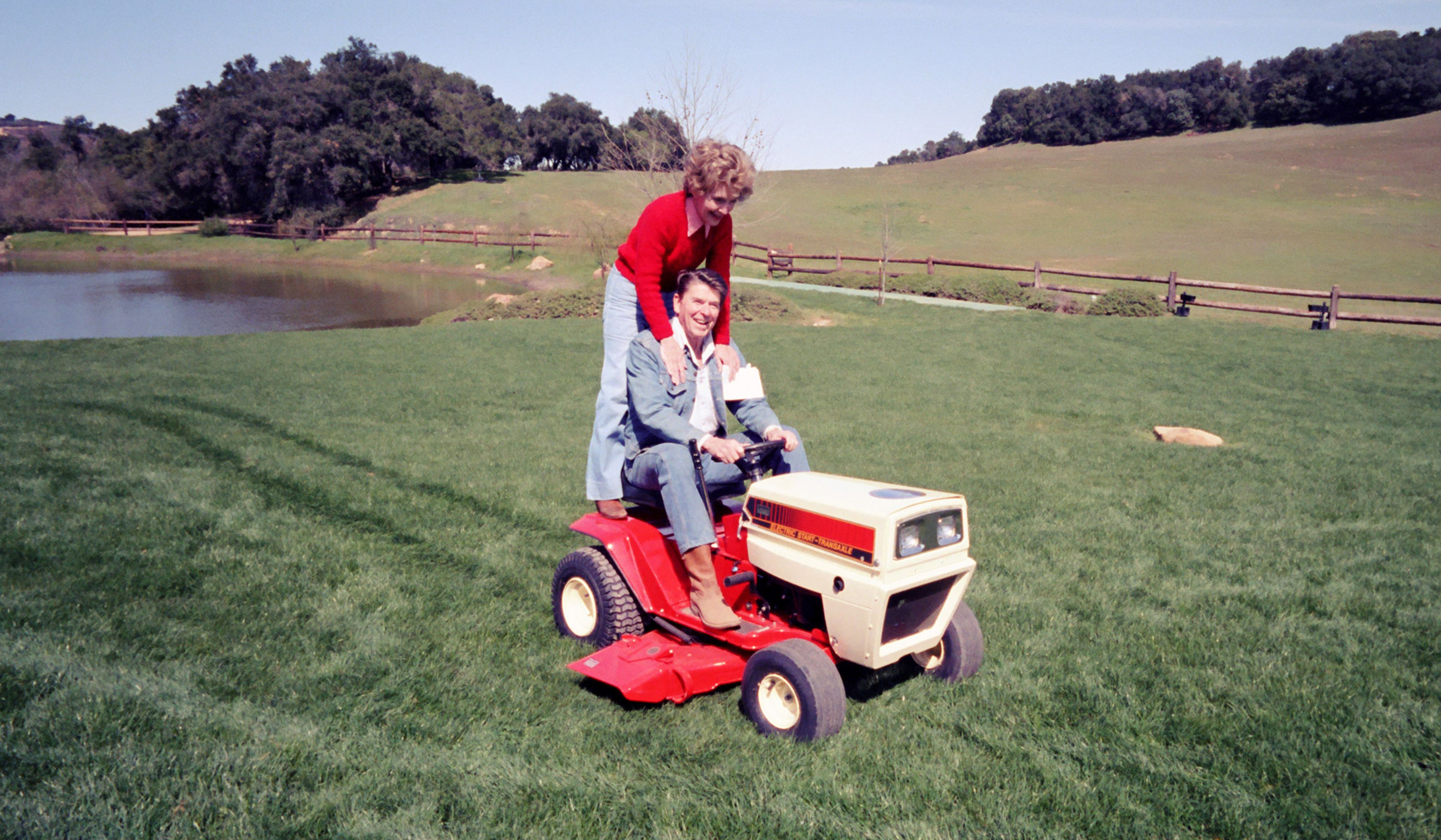
Mowing and raking the lawn at the White House, c. 1939.
Library of Congress
Progressives are correct that lawns are a symbol of American life, associated with wealth. This is now a very democratic wealth. A survey by the National Association of Landscape Professionals found that 81 percent of all Americans have a lawn of some kind. Progressives think they are criticizing lawns and Americans when they say that the green obsession with decorative lawns began with the very wealthiest late-medieval lords, and only in a few favorable climates on the British Isles and in France, yet the lawn is now considered a birthright by many American men. In that story is the very glory of democratic society, advancing human wealth, ingenuity, and progress in chemistry and agriculture. Every man his own king, and his mower is better than scores of scythe-wielding serfs.
They are also correct that lawns reflect the culture of capitalism. The Scotts program for lawn care, which is available at Home Depot, and the TruGreen program, available as a service in many neighborhoods, reflect a mass American consumer culture that only recently reached its zenith. These lawn-care programs were designed to do the most good for the largest number of consumers who want to invest a modest sum of time or money in their lawns, and for the most part they get good results. For Scotts the hope was to get the average man to do four applications of product a year. TruGreen does more. These programs are open to criticism for being overly generic and occasionally wasteful, and for producing only “okay” results. And they reflect the prejudices of the era they were born in, which favored heavier-handed chemical intervention to get results — whether in lawn care, food production, or family planning.
But American capitalism and society evolve, and the lawn evolves with it. Instead of remaining a mass middle-class society, we are segmenting. And that has advantages and its own fetishes and prejudices. Instead of chemical overreach, we have a bias toward working with the strength of our existing crops. People who buy only the “best ingredients” for their food now search out the best turf-grass varietals for their yard. Battery-powered tools are taking over in many gardens. The colonization of “turf management” by college educators and the influence of higher-end golf courses and other sports interests have led to an explosion of research and development into turf grass that requires less water and fertilizer to thrive.
Bespoke lawn-care services that do away with a one-size-fits-all model and make your lawn their personal science project are thriving in the richest suburbs. Following on their heels are the data-rich “full-on nerd out on your lawn” approach of all-organic programs such as Sunday, which is bidding to become Scotts for socially conscious Millennials who want green grass. Fifteen years ago Ted Steinberg could write that looking for phosphorus-free fertilizer was “like hunting for Jimmy Hoffa’s body.” But today, most of the prosumer-level products (a prosumer is a consumer who uses professional equipment) from outlets such as Yard Mastery recommend and sell precisely that. There is even a coming European invasion of lawn equipment: While grass-lovers in Europe have often envied Americans’ freedom to use chemicals, the restraints put on them have led Brits and Czechs to innovate more with the mower’s mechanical manipulation of turf. Some Americans will rent equipment once a year for these jobs, but the European approach is to manage debris and dead material in the soil more aggressively. Electric reel mowers from Allett and Swardman are sold with interchangeable cartridges that do verticutting, detaching, and aerating of turf. The lawn is undergoing a renaissance.
Long before woke explainer journalists were there, it was Chinese Communists who understood the grass lawn as an exclusively colonialist and imperialist project, one that they would not dare appropriate. Lawns were torn up as part of the Cultural Revolution — probably the least important casualty of that upheaval, but worth remembering all the same. Chinese cities still suffer today from a lack of the grassy spaces that are found in Western parks and act as heat sinks in urban spaces.
By contrast, it is American capitalism that does not discriminate or hold a grudge, and welcomes transplants. Frank Meyer was born in the Netherlands in 1875 and emigrated to America at the turn of the century. Meyer became a kind of adventuring botanist, discovering plant varieties around the world that might be suitable for America’s industry or its gardens. In 1918 he traveled up the Yangtze River and found a promising perennial grass “for lawn purposes” in what is now North Korea. It was Zoysia. He sent the seeds he collected to the U.S. Department of Agriculture, which did its tests and eventually released the grass in 1951 as Meyer Zoysia. It’s one of the few mid-century varietals that are still competitive, a warm-season grass loved by southern warm-season turf cultists and golf-course superintendents in the transition zone. It’s also loved by critics of the American lawn, such as Ted Steinberg, because it does not need much chemical intervention or irrigation to thrive.
My pretense of being an agrarian because I fertilize the fescue may be ridiculous, but the case against lawns reduces to a case against human beings. Since we are also natural creatures, there is no reason to discount our preferences for grass out of hand. It is true that industry, history, social pressure from neighbors, and our abundance of resources inform our preferences. And it’s true that concerns about the environment and superstitions about beauty and nature also inform our homes. But all of this is humanity’s social nature at work.
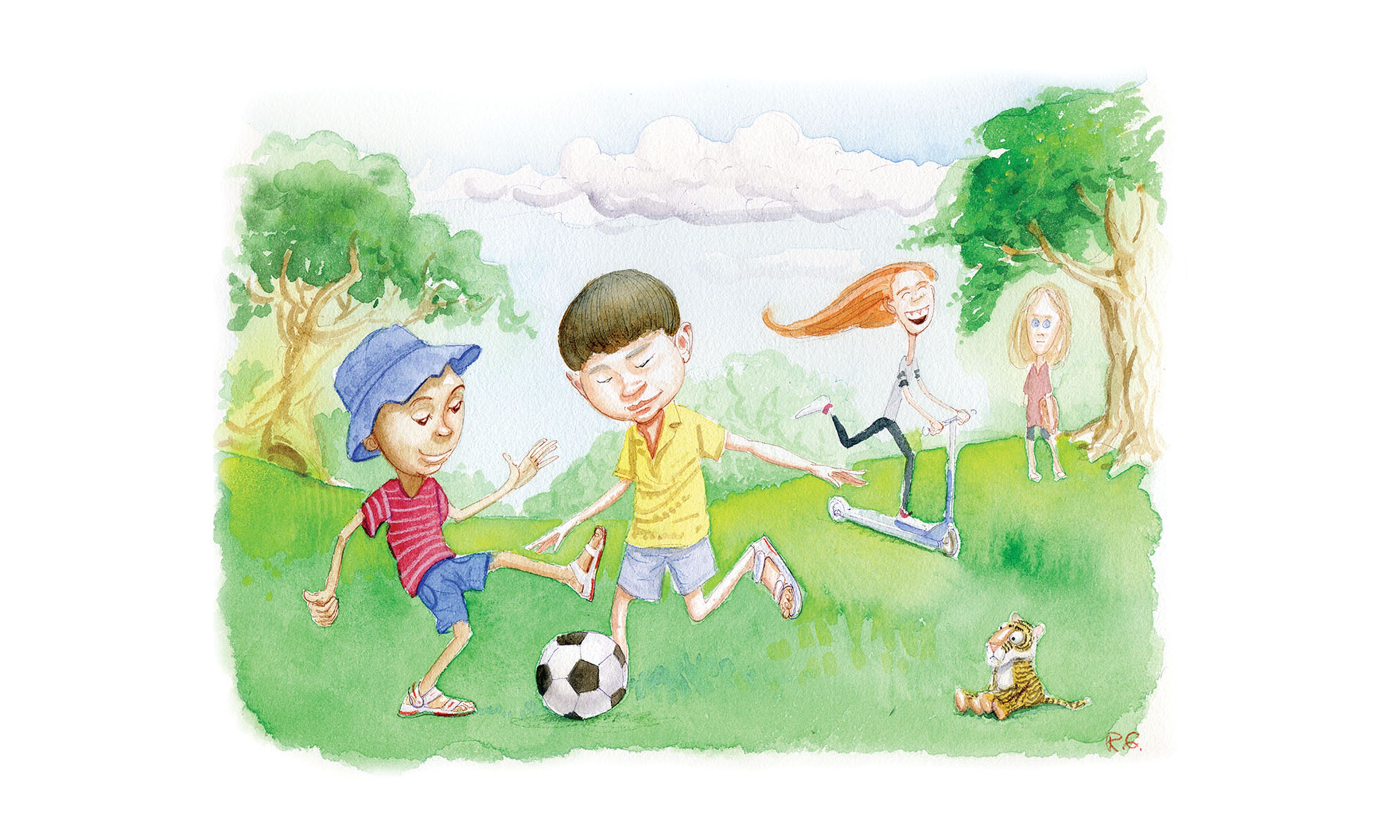
The great green crop makes us safer from pests and helps us feel safer from them too. Yards are a part of human sociability, with nature and with each other. We work on them so that we might play. The flourishing of lawns in public and private spaces acts as an encouragement for picnics and games. In Europe public lawn spaces were the precursor to more sporting leagues: soccer, rugby, golf, and more-exotic pastimes such as hurling. In America we use turf and prefer the real stuff over the fake versions in baseball, lacrosse, or football. I grow grass and cut it down because my children need a place to play. As their father, I want to make their home soft and welcoming, and fun.










Comments