The Declaration of Independence was drafted in secret. The first draft was written by Thomas Jefferson alone; it was revised by John Adams and Benjamin Franklin, and then finalized behind closed doors by the Continental Congress. It was presented to the public as a finished product.
The Constitution was drafted in secret. Delegates to the Constitutional Convention went to great lengths to prevent word of their summerlong debates and deliberations from getting out, and they agreed to present a united front to the public when they settled on the final document. James Madison, the last of the delegates to die, kept his detailed notes of the convention from being published until after his death in 1836, 49 years later.
The Emancipation Proclamation was drafted in secret. Abraham Lincoln informed his cabinet of his intentions in late July 1862 and presented them with a draft in early August, but he continued to deflect pressure from Congress and the media to take further steps on emancipation and insisted on secrecy so that he could announce his decision only when the timing was right — after a Union victory on the battlefield. That came in September at Antietam.
The framers of these fundamental charters of American liberty knew what they were doing. They knew they were writing for the ages and wanted to get their arguments right. But they also knew that the fortitude needed to take these great and momentous steps could be dissipated if they wrote with the world looking over their shoulder, lobbying and pressuring every line. Hashing out their common ground in private helped fortify them to maintain a united stance in public.
For nearly all of its history, with only a few and mostly older and ill-considered exceptions, this is also how the United States Supreme Court has done its work. Opinions are drafted, circulated, and redrafted. Sometimes minds are changed or compromises are made; other times, arguments are sharpened by disagreement. The deliberative, scholarly nature of the Court’s work is essential to what separates it from elected officials mugging for the cameras amid hearings.
The premature leak of Justice Samuel Alito’s draft opinion in Dobbs v. Jackson Women’s Health Organization overturning Roe v. Wade is an assault, quite likely calculated, on this deliberative process. It brings to bear public pressure and scrutiny on an unfinished product, supported by what may be a tenuous majority.
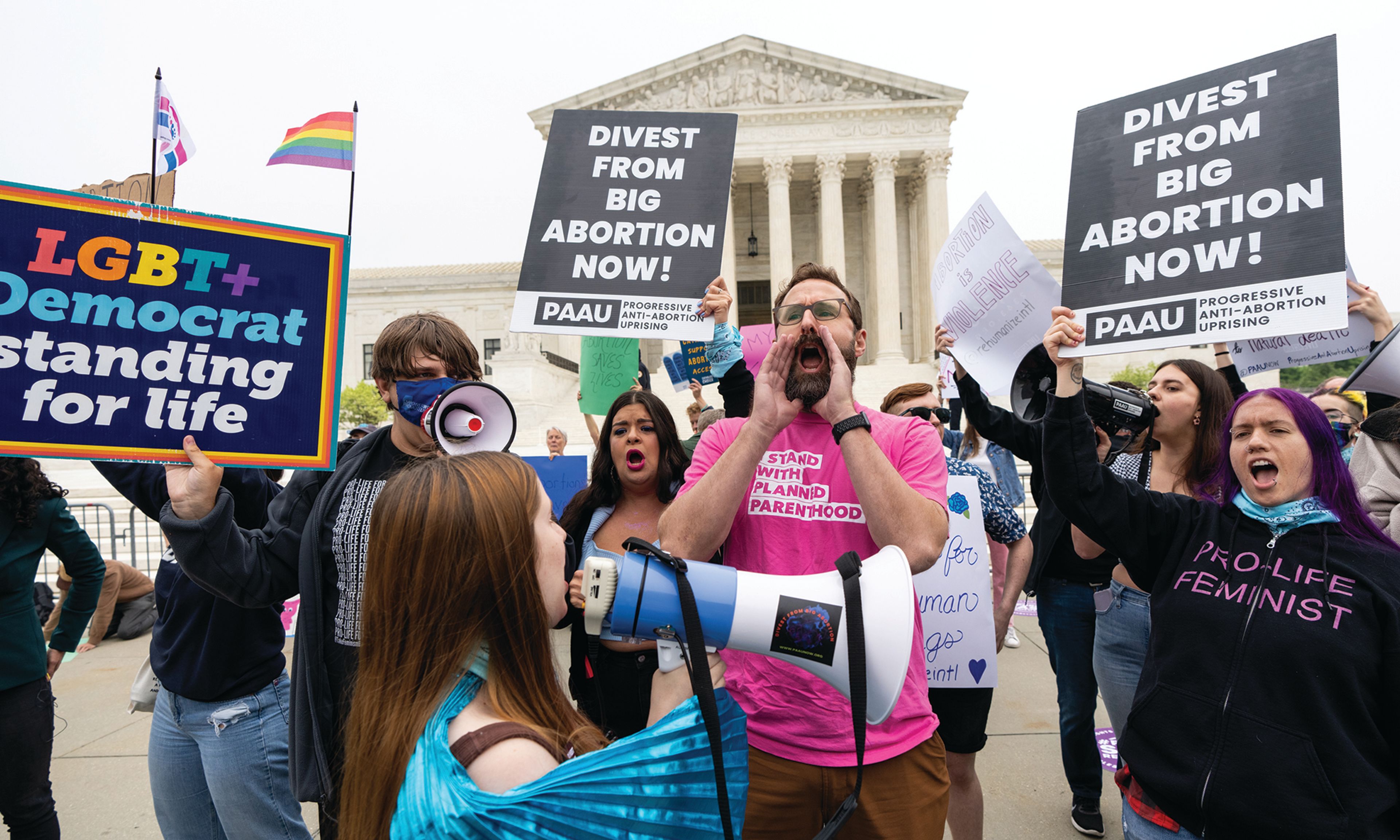
The leak had predictable results. Not only were there immediate protests outside of the Court, but left-wing groups publicly shared maps to the homes of the six Republican-appointed justices, summoning angry mobs there. The protesters assessed, shrewdly, that if the Court’s internal deliberations were now open for public view, they might be open to the pressure of the mob as well. That pressure will now likely continue until the opinion is issued.
And if that opinion reverses course and saves Roe, the mobs will never go away.
Why would they? Mobs test their power; when they find themselves powerful, they press further. The capacity for a mob to prevent the certification of a presidential election was tested not long ago. We may hope that the failure of that mob, and its exemplary punishment by the law, will deter its repetition. But when mobs have had more success — cowing college administrators and local district attorneys — they have stayed, and flourished. The discovery that leaks and chanting crowds could change Supreme Court decisions would be a eureka moment for the forces of direct action in the streets. It would swiftly end the reality, and even the appearance, of a nation of laws.
If the justices bend to the mobs now, what do they think will happen next year, when racial preferences in college admissions are on the docket? Even without the mobs, what Supreme Court justice wants to live like Joe Manchin, who spent every day in 2021 being asked, Groundhog Day–style, the same question by the same CNN reporter about whether he’d changed his mind on the filibuster? At least Manchin lives on a boat, so nobody can camp out on his lawn.
The immediate threat to the Court, if it shrinks from the task of overturning Roe, is from the left. But that is not the only threat. Americans on the right can be pushed only so far before they adopt the same attitudes. And precisely because the American Right has traditionally been the party of order and tradition and the Constitution, it is all the more perilous for the country when the Right abandons them.
Looming over the pro-life movement this past half century has been the awful specter of John Brown. Slavery posed the strongest test to believers in American democracy and the American legal system: How could we tolerate such evils in our midst, unremedied by our system for decades? Abraham Lincoln, Salmon P. Chase, and other proponents of political anti-slavery counseled working within the movement and building incrementally towards the ultimate goal of abolition. William Lloyd Garrison and other radicals argued for abstaining from a political and constitutional system that would sanction such things. Brown, beginning after the 1850 passage of the Fugitive Slave Act, took up arms, eventually leading to murders and a rebellion for which he was hanged. To this day, there remains a powerful moral debate over whether to see Brown as hero or villain. But we know this: Brown paved a path drenched in blood.
In the first three decades after Roe, there were always a few extremists who looked at the carnage of mass abortion and saw themselves as John Brown. They bombed clinics and shot abortionists. They were denounced as furiously by pro-lifers as Brown was denounced by Lincoln, but once men have hardened themselves to extreme measures, they no longer listen to such counsels. Violence spiked after the Court reaffirmed Roe in 1992, most dramatically with Eric Rudolph’s bombings of two abortion clinics and the main venue of the 1996 Summer Olympics in Atlanta. Fortunately, the violence has subsided significantly in this century; it was big news in 2009 when one abortion doctor was gunned down (and smaller news when an anti-abortion protester was, too).
Overturning Roe is vitally important to the American system itself. Doing so vindicates what pro-lifers have done in playing the long game, by the rules, with votes and with persuasion across twelve presidential elections and dozens of Senate races — even at the cost of waiting out the deaths of 60 million innocents. Overturning Roe would prove that, at long last, democracy works, and the voters can get the justices to give back power they seized without warrant. It would prove that the rule of law works: Error can be corrected, and the Constitution can be vindicated against even long-standing usurpations. It would prove that principled advocacy and scholarship work, that faith and reason can be powerful allies. And it would show that these things are, in the long run, a better way than angry mobs or bombs.
But the counsels of trust in the system — in working within the law and the rules — will ring hollow again if the legal system itself is intimidated out of saying what it knows to be true.
The truth is what Alito’s draft opinion wields most forcefully. After 49 years, an opinion drafted for a majority of the Supreme Court dispels long-standing lies with truth after truth. It says that Roe was always illegitimate, wrong from the beginning, exercising a power the people never gave the Court. It says that Roe relied on bogus history, made up its rules as if the Court were a legislature, and was met with scorn even by liberal constitutional scholars at the time. It says that the Court in Planned Parenthood v. Casey rewrote Roe in the name of upholding precedent. It says that the oxymoronic doctrine of “substantive due process” does not license courts to just invent new limits on democracy. And it says another thing we all know: that Roe has driven the Court and our national politics mad by involving them in all-or-nothing constitutional battles over abortion, spawning all manner of other distortions to our law and our politics.
The only way out is out. The Court spent much of the 1960s watching porno films, literally. Having decided to police local bans on obscenity, and having established standards so fact-intensive that Potter Stewart famously remarked, “I know it when I see it,” the Court ended up holding what Bob Woodward in his book The Brethren called “movie day”: The justices and their clerks would make popcorn and watch the latest pornographic films that were presented for decisions on whether they were dirty enough to ban. Eventually, the Court wearied of this debauched task; in 1973, in Miller v. California, it established a test for obscenity that prioritized “contemporary community standards” in local communities. There would be no more movie day; the Court would instead let the whole debate return to the local level.
The same is true here. If the Court tries for half a loaf, upholding the Mississippi abortion law without overturning Roe — the solution apparently favored by Chief Justice Roberts — it will have to return again and again to clarify which laws place an “undue burden” on the made-up abortion right. The mobs will be back every time. But if the Court speaks the truth this once, the battle over Roe will be done for the foreseeable future, and the main theater of the abortion wars will move to state legislatures. Those who would intimidate or harangue the Court will know that they do not face soft targets.
Courage is, they say, the father of all the other virtues, because it makes all the others possible. At least five members of the Supreme Court know that Roe is a lawless lie. Chief Justice Roberts almost certainly does, too. The current Court did not create this mess; Roe did. The current justices did not lead the public to believe that Roe was exempt from the usual rules of precedent; the five justices who salvaged it in Casey did. Justice Antonin Scalia warned then, 30 years ago, that doing so would only plunge the Court deeper into the quagmire of politics and pressure. He was right, and so was his solution: “We should get out of this area, where we have no right to be, and where we do neither ourselves nor the country any good by remaining.” Alito has given his fellow justices the way out. What the Court requires most of all now is the courage to deliver his opinion to term.












Comments