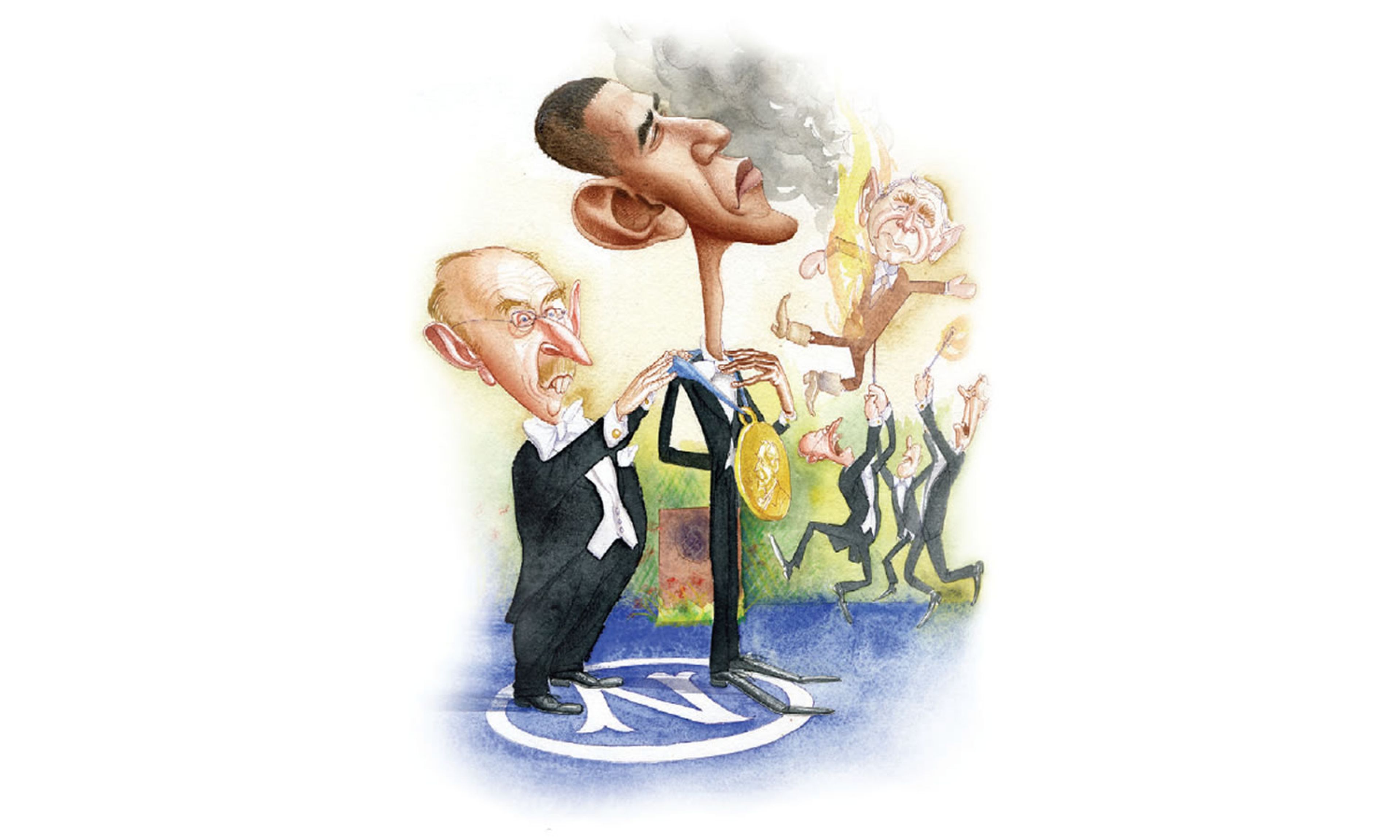
• Our advice to Obama: Take that Nobel Prize money in euros, not dollars.
• The news of President Obama’s Nobel wiped out the news of his failure to persuade the International Olympic Committee to pick Chicago as the site of the 2016 summer games. Lucky man: His Olympic push was unseemly, for three reasons. It is hackish for a president to plug his hometown (Obama is president of the United States, not Hyde Park alderman). The United States is a great nation, which has hosted many Olympic games; other countries — such as Brazil, the 2016 winner — need the PR of being hosts, and need to ask for it, not us. The presidency is rough enough; Obama should not seek out occasions where he might fail.
• Far be it from us to complain about a little Deaverism: the use of stagecraft in politics, even in governance. The best do it. But President Obama and his team were awfully brazen when they staged an event on the White House lawn to promote the president’s health-care ideas. They invited a crowd of Obama-supporting doctors — and asked them to show up in white coats. Some of the doctors, not easily led, apparently, showed up in business suits and dresses. No worries: Team Obama had white coats on hand, to pass out to them to wear — the better for the pictures that would be taken of the event. President Bush or some other Republican would probably have been scored for this brazenness. And what kind of doctor wears a white coat to the White House, in order to listen to a presidential speech?
• Once or twice a year there erupts a story that the oil sheiks or the ChiComs are plotting to dump the dollar as the go-to currency for oil trading or foreign reserves. October’s installment came in the form of a breathless dispatch from the Independent’s unreliable Robert Fisk, who does not seem to appreciate that the foreign-exchange markets, which dwarf the oil markets, allow the Chinese, the petro-emirates, and others to hold as many or as few greenbacks as they like. China holds great bunches of U.S. dollars in reserve not because oil prices are expressed in dollars, but because it prefers U.S. dollars to yen, euros, or Kenyan shillings. For now. The value of the dollar is under siege, it is true, but it is threatened by spendthrift politicians in Washington, not by plots hatched in Beijing or Riyadh.
• “I will end ‘don’t ask, don’t tell,’” President Obama told the Human Rights Campaign, a gay-rights lobbying group, though he did not tell them when. His hesitation is merely prudent, but why does the policy exist? Congress has declared that gays should not serve in the military; “don’t ask, don’t tell” was a Clinton-era administrative compromise, declaring that the military would not look for gays who were discreet. After years of gays on TV shows and in lesson plans, the shock of their presence is gone, which is no bad thing. Still, chains of command and unit cohesion must not be threatened by romance or lust, real or imagined (this is also an argument against women in combat roles). This is especially true of republican armies: Prince Eugene and Frederick the Great didn’t shower with anyone. Don’t ask, don’t tell, don’t change. And to President Obama, don’t lead on your supporters, but that is another matter.
• Jon Corzine, the Democratic governor of New Jersey, is deeply unpopular, and rich. His money has funded ad after ad savaging his opponent, Republican Chris Christie. (The latest goes after Christie for being fat.) Corzine’s numbers have inched up, but Christie’s have dropped — and a third-party candidate sounding conservative themes on taxes and spending has gained. Christie, capitalizing on his record as a prosecutor, has been running an anti-corruption campaign, and one based on vague, numbers-free promises to cut taxes and spending. The race is now tied. We have no problem with Christie’s weight; his policy proposals could use more of it.
• Marco Rubio, the Florida conservative who is running for Senate, is not going to raise as much money as his primary rival, Gov. Charlie Crist. But Rubio does not need to match Crist with money. He merely needs to raise enough money to inform Florida Republicans that he is with them on everything from federal spending to cap-and-trade legislation while Crist is — not. In the last financial quarter, Rubio raised $1 million. Crist has largely been ignoring the trouble on his right flank, but he now has something worse than that: competition.
• Congress apparently has given up on the idea of securing the U.S.–Mexico border with a fence, having excised money for the project from a recent appropriations bill. Washington was never very serious about fencing off the border — the few miles of fence we have are routinely cut through by enterprising smugglers, cheeky crooks who install doors, complete with locks, for their own convenience. Now it seems as though Washington will save them the trouble.
• Citigroup has unloaded its proprietary trading division, Phibro, for a song: $250 million for a business with an average annual net income of $372 million. Have these bankers lost the ability to do basic math? No, but they probably have lost count of the number of members of Congress and the Obama administration who were breathing down their white collars about bonuses at Phibro: The sale was clearly a political decision, not a business call. Citigroup came in for particularly harsh denunciation for compensation owed to Phibro’s most successful trader, an eccentric art collector named Andrew J. Hall, whose performance-based pay was directly related to the profits he generated for the bank. Having earned Citigroup more than $2 billion over five years, Mr. Hall was entitled by contract to collect $100 million. Hall’s tiny trading group was at one point responsible for generating 10 percent of Citigroup’s net income. Obviously, Citigroup needs more Andrew J. Halls, not fewer. It takes a politician to see spending $100 million to make $2 billion as a bad investment.
• The Federal Trade Commission has embarked upon a daft assault on free speech, specifically social-media users’ endorsement of products or businesses. The FTC has propounded rules that will impose fines of up to $11,000 on bloggers, Facebook users, or Twitter tweeters (for whom surely we could invent a more dignified name?) who fail to disclose financial relationships with businesses they write about. Such relationships include the receipt of merchandise gratis — meaning that online critics who receive free books or press passes to a concert will find themselves in violation of federal law if they fail to satisfy Washington’s disclosure demands. Such arrangements are longstanding custom and are of particular value to small, independent publications (print or electronic) that cannot afford to pay retail prices for access to the materials they review. And it ought to go without saying that the FTC has no business policing Facebook updates, period. That the FTC would make a federal case out of such a triviality suggests that this bloated and arrogant agency is overdue for a deep cut in staff and budget. If some unemployed bureaucrats become bloggers, all the better.
• Wait for patients to die before taking their organs, and the organs won’t be as fresh. Let doctors take the organs from living patients — even if it means causing them to die a little faster than they otherwise would — and the supply of usable organs will go up. Some other patient will get a second chance at life, and the dead guy won’t miss anything: What could possibly go wrong with this idea? Nothing that cannot be solved with good PR, in the judgment of the editors of Nature. They want to redefine death so that organs can be removed from patients who are no longer “alive in any meaningful sense.” Their removal will not kill anyone, by (new) definition. The editors suggest “contained focus groups” should give this idea a test run. The proposal may backfire even on its own utilitarian terms: People will not be as willing to list themselves as donors if they fear that doctors will hasten their deaths to get their organs. But the deeper flaw is of course that of utilitarianism itself, which denies the rights and dignity of all human lives in theory and of vulnerable ones in practice. Nature’s recommendation would allow some people to live with new organs, but in a society with less of the nobility that inspired the search for cures in the first place.
Youth Tax
Anyone who has had the misfortune of reading my work over the years knows that I think youth politics is lamer than . . . than something the kids today think is really lame. What would that be? I have no idea. Grunge? Foreplay? Carbon emissions?
Well, as those of my age cohort often said, whatever. My point is that youth politics is usually the cheapest form of identity politics, a kind of secular generational astrology whereby your date of birth is the window to your soul, until you turn 30 and then suddenly you’re part of the “establishment.” I’m not denying that generations have a unique cultural flavor; I’m just saying that what passes for youth politics is a manufactured phenomenon exploited by young liberal activists with impressive haircuts and buzzy lingo who would have had to get an internship at the DNC like everyone else if they hadn’t convinced some balding hippie with a polished pate and a ponytail that they and their peers need to “reach out” to the barely post-pubescent.
When I first came to work in Washington, Generation X was all the rage. Aging baby boomers wracked by nostalgia for their youthful activism (whether or not they had themselves been activists) embraced affirmative action for youngsters with the gusto of a midlife crisis. One of the most prominent groups of GenXers that was not entirely a franchise of the Democratic party (like “Rock the Vote”) was called “Lead or Leave.”
Its big issue was the deficit. It was a Perotist moment after all, and they used the perfectly sound but no less insipid observation that the “children are our future” to harangue the gerontocratic government about saddling us youths with a lot of debt. It’s hard to imagine now, but Lead or Leave was profiled in numerous newsmagazines (back when newsmagazines mattered) and was actively courted by both parties. It was a particular pet of the good-government balance-the-books types, such as Sens. Paul Tsongas and Warren Rudman. I knew the group wasn’t for me when I attended what I thought would be a keg party but instead encountered boxed wine and found myself holding hands in a big circle of activists ostensibly wishing with all our might for fiscal sanity.
And yet I’m starting to grow nostalgic for those hand-holding-young-Turks-for-balanced-budgets. Obama’s spread-the-wealth-around agenda is often defended (though not around here) on the grounds that it is a wealth transfer from the haves to the have-nots. Yes, sure, there’s some of that. But it is more properly understood as a wealth transfer from the young — and the unborn — to the old. Every deficit projection demonstrates what is incandescently obvious: Obama is taxing the productivity and wealth of tomorrow for some progressive magic beans today. For instance, if you strip all the actuarial lingo away from the health-care debate, Obama’s plan is simply to force young people to overpay for health insurance in order to cover older people.
You can defend such policies as part of the social contract, but you can also oppose them on the grounds that young people are getting the shaft. Indeed, this really is the mother of all “youth issues.” But in the age of Obama, youth politics begins and ends with the White House’s Twitter feed.
Come sit by me on my porch, sonny, and I’ll tell you how things were better back in my day.
— JONAH GOLDBERG
• “What does good health mean to you?” the magazine Prevention asked Michelle Obama. “Throughout my life,” she replied, “I’ve learned to make choices that make me happy and make sense for me. Even my husband is happier when I’m happy. . . . So I have freed myself to put me on the priority list and say, yes, I can make choices that make me happy, and it will ripple and benefit my kids, my husband, and my physical health.” This is not entirely untrue. But the first lady’s combination of chirpy cliché and underlying egotism — 13 me/myself/I/my’s in three sentences — should warn her handlers to rein it in, or she may say something that will make her and, by ripples, her husband unhappy.
• In a C-SPAN interview, Justice Antonin Scalia expressed his disappointment that “so many of the best minds in the country” are devoted to lawyering. He will see an attorney “from Podunk,” a woman who is “really brilliant.” And he’ll wonder, “Why isn’t she out inventing the automobile or, you know, doing something productive for this society? I mean, lawyers, after all, don’t produce anything. They enable other people to produce and to go on with their lives efficiently and in an atmosphere of freedom. That’s important” — but so are inventions and businesses and other things to lawyer about. Scalia makes a great point, as usual, although we’re glad he didn’t go into business.
• This could take a while. The Obama administration opened talks with Iran that predictably issued in an agreement to talk more. It obviously serves Iran’s interests to stretch out the negotiations and forestall new sanctions. The news from the first meeting was that Iran agreed in principle to International Atomic Energy Agency inspection of its newly discovered secret facility at Qom and to ship some of its low-enriched uranium temporarily to Russia. Since Qom reportedly isn’t yet operational, the inspections there aren’t a big deal. As for the diversion to Russia, it means only that Iran gives up some of its uranium in the short term; it eventually gets it back and could still enrich it to weapons grade. None of this matters much as long as Iran continues to enrich at Natanz (and other sites yet undiscovered?), where centrifuges spin as we — and Obama’s negotiators — speak.
• Remember the 2007 National Intelligence Estimate on Iran? It was a cruise missile fired by an intellectually dishonest State Department bureaucracy into the heart of George W. Bush’s Iran policy. In a footnote, the authors very cleverly defined the term “nuclear-weapons program” to refer only to facilities and activities explicitly dedicated to the production of warheads; then they revealed that Iran had once operated such a program but had abandoned it in 2003. “Iran Abandoned Nuclear-Weapons Program in 2003” became a headline the world over, as the authors knew it would. Of course, even as those headlines were published, Iran was ramping up its enrichment efforts at sites that could be devoted to civilian or military use. It was these nominally ambiguous sites that had prompted fears in the first place — and the new information that Iran had as recently as 2003 operated an explicit weapons program, if presented non-tendentiously, would only have heightened them. As presented, it tricked the public into thinking the time was right to release a flock of doves in Tehran’s direction. The revelation of the Qom site and further displays of Iranian bellicosity (cf. its recent missile tests) confirm the foolishness of the strategic view that motivated this NIE. But time favors the proliferator, and the price has been paid.
• As we noted in our last issue, the nonpartisan Law Library of Congress (LLC) has published a report affirming that Manuel Zelaya’s removal from the Honduran presidency was lawful and constitutional, even if his subsequent deportation to Costa Rica was not. Notwithstanding the LLC’s findings, the Obama administration still considers Zelaya’s ouster an illegal “coup,” and it still wants the Hugo Chávez disciple reinstalled as president. During a recent trip to Tegucigalpa, Republican senator Jim DeMint asked U.S. ambassador Hugo Llorens to justify the “coup” allegation; Llorens directed him to a report drafted by State Department legal adviser Harold Koh. The problem is, that report has not been released. “I have asked to see Mr. Koh’s report before and since my trip,” DeMint wrote in the Wall Street Journal, “but all requests to publicly disclose it have been denied.” It’s a funny way to go about vindicating the rule of law.
• A few months after the ruling party of Pres. Cristina Kirchner took a drubbing in congressional elections, Argentina enacted legislation that will significantly expand government regulation of the country’s broadcast-media outlets. The timing was not coincidental: Kirchner has complained that negative press coverage contributed to her electoral setbacks over the summer, and the new Argentine congress takes office in December. The chief target of the law is Grupo Clarín, Argentina’s biggest media company, which has exposed and attacked government corruption in the pages of its leading daily, Clarín. While the left-wing Kirchner is not a full-blown Chávez-style autocrat, both she and her husband, Néstor, Argentina’s president from 2003 to 2007, have shown troubling anti-democratic tendencies. The media-regulation bill reflects a contempt for press freedom. Come December, the new Argentine congress should seek to reverse it.
• The handful of politicians who drive the European Union in Brussels have long been trying to create a single state out of 27 countries. The Lisbon Treaty is designed to give the EU a legal personality. If ordinary people everywhere were asked for their opinion, this treaty would be rejected by wide margins. The Irish were exceptional in having a constitution that mandated a referendum on the treaty, and the voters said No. That would never do for the Brussels oligarchs. With a straight face, they obliged the Irish to hold another referendum. Duly bribed and browbeaten, the Irish have now come up with the Yes that Brussels hopes will throw a veil of legitimacy over what is at heart a power grab. Czech president Václav Klaus and the British Tories still have reservations, but the Lisbon Treaty looks set to be certified. In which case, the people of Europe will belong to a bloc, a main feature of which will be a president chosen for them by the 27 heads of state in a process of horse-trading behind closed doors, someone for whom they never asked, and whom they can neither vote for nor dismiss. Perhaps it was too much to hope that little Ireland would stand firm against Brussels, but one of the world’s most famous poems is about the fear of surrendering Irish Home Rule and independence: “Was it for this the wild geese spread / The grey wing upon every tide; / For this that all that blood was shed,” to conclude, “Romantic Ireland’s dead and gone.” Yeats should be living at this hour.
• Hugo Chávez and Moammar Qaddafi, generalissimo and colonelissimo of Venezuela and Libya respectively, have revealed that they are soulmates. In Libya recently, Chávez was awarded a medal commemorating the “40th Anniversary of the Great Revolution of Al Fateh,” in other words, Qaddafi’s seizure of power. During a visit to Venezuela, where a score of Africans and South Americans — most of them top-drawer dictators — were assembled, Qaddafi received a gold-plated replica of a sword that had once belonged to Simón Bolívar. These gewgaws should brighten up both men’s uniforms. Otherwise what they have in common is the sponsorship of terror, which they believe ought to be defined as “the legitimate struggle of the people for liberty and self-determination.”
• MEMRI turns up a little gem of jihadist insanity. An imam in Sweden was complaining that a small number of Jews were able to oppress a much larger number of Arabs, and an al-Arabiya TV broadcast was documenting his tirade. The Arabic subtitles read, “If we were to line the Jews up in one row and spit on them, they would drown.” Nice. However, some desktop experimentation suggests that the holy man’s arithmetic is off by several orders of magnitude. It’s about a hundred spits to the pint; so if all the world’s 300 million Arabs were to follow the Rev. Al-Zarad’s suggestion, the volume expectorated would be only 375,000 gallons — nowhere near enough to fill an Olympic-size swimming pool (660,000 gallons). Not just crazy, but innumerate. Ptui! — we spit.
• Multiculturalism displays many ironies — often where Islam meets homosexuality, and some of the people we are required to respect notably fail to respect others. Créteil, a suburb of Paris, has an amateur soccer league, among whose teams are Bebel, most of whose players are Muslims, and Paris Foot Gay (sic, in the French-language reports), with an entirely homosexual roster. The teams were scheduled to play a match, but Bebel sent PFG an e-mail the day before the fixture, calling off the game “in keeping with the principles of the team.” Quel outrage! Legal threats were made, the fonctionnaires of French soccerdom swung into action, and the news as we go to press is that the differently religioned and the differently oriented will meet on the field of sport after all. Let us hope that the stadium wall is robust enough not to be pushed over.
• We all know that jihadists believe that pious Muslim males will be rewarded with 72 virgins in paradise. What will those virgins actually be like, though? Saudi cleric Sheikh Muhammad al-Munajid has been telling us on Saudi Arabia’s Al-Majd TV. Main point: They will be white. Very white. “Allah said that the black-eyed virgins are beautiful white young women . . . whose skin is so delicate and bright that it causes confusion. . . . They are like precious gems and pearls in their splendor, their clarity, their purity, and their whiteness.” We confess to some slight confusion ourselves. Is there a separate afterlife for pious but unwhite Muslim females? If not, where do their souls go? If so, what’s their reward? Perhaps we all get new bodies in paradise, with the gals guaranteed to get white ones. Another possibility is that Sheikh Muhammad al-Munajid is a gibbering lunatic. This is, after all, the man who last year issued a fatwa against Mickey Mouse, whom he described as “one of Satan’s soldiers.”
• In May this year the new administration got the U.S. elected to the United Nations Human Rights Council. The first fruits of that victory are now on display in the form of a Resolution on Freedom of Opinion and Expression jointly hammered out by the representatives of the United States and Egypt and adopted by the Council without a vote on October 2. The resolution is a masterpiece of ambiguity. It “recognizes the positive contribution that the exercise of the right to freedom of expression . . . can make to the fight against racism, racial discrimination, xenophobia and related intolerance.” So freedom of speech is a jolly good thing when employed to bolster political correctness. What about those Mohammed cartoons, though? The resolution deplores “negative racial and religious stereotyping,” and “condemns . . . any advocacy of national, racial or religious hatred . . . and urges States to take effective measures . . . to address and combat such incidents.” Looks like jail for those cartoonists, under the authority of a U.N. Resolution cooked up by our man at Turtle Bay.
• In the Canadian parliament, Mark Steyn and Ezra Levant testified against Section 13 of the Canadian Human Rights Act. This is the section that allows apparatchiks — a nicer word is unfitting — to investigate and punish online “hate speech.” Both Steyn and Levant were hauled up for “hate speech” when they warned against a free society’s capitulating to radical Islam. In his testimony before parliament, Steyn said, “Under Section 13, citizens are subject to lifetime speech bans — not in the Soviet Union, not in Saudi Arabia, but in Canada.” And he concluded, “Section 13’s underlying philosophy is incompatible with a free society; its effect is entirely irrelevant to the Queen’s peace; and its use by agents of [Canada’s Human Rights Commission] has been corrupted and diseased beyond salvation.” Both Steyn and Levant were magnificent in their defenses of free speech. They were informed, measured, wise — and stylish. You can understand why the enemies of freedom would want to censor them.
• Dudley Do-Right would be proud. When a policeman outside Windsor, Ontario, saw a tractor-trailer driver smoking a cigarette alone in his cab, he sprang into action, pulling the miscreant over and writing a ticket for a fine of $305 Canadian. The driver’s offense: violating the Smoke-Free Ontario Act, which bans smoking in enclosed workplaces, including vehicles. Officials interviewed after the incident all vigorously defended the law, though they seemed unsure about what purpose it is meant to serve (a safety measure to avoid distraction, a protection for other drivers who might later use the same truck, an encouragement to quit) and whether it applies to truckers who own their vehicles. To make things even more confusing, trucks that are driven in more than one province are apparently governed by a separate federal law that allows smoking in designated vehicles, though even this is subject to dispute. Such are the results when a nanny province meets a bureaucratic state. We suggest a simple solution: Let drivers light up, if they wish, and let Canada’s numerous busybodies lighten up.
• Rush Limbaugh is part of a group bidding to buy the St. Louis Rams, a professional football team. Many liberals have reacted with outrage, charging that Limbaugh is “racist” and therefore unfit to be part-owner of a team, or to do much else in life. Al Sharpton is leading the anti-Rush push, or trying to. The NFL Players Association (the union) is officially against Rush. There seems to be a consensus that nice and good people must stop Rush. The racism charge, of course, is a smear. But it is probably the most potent kind of smear there is in our country. In other Rush news, he has been selected as a judge in next year’s Miss America contest. The Left has long sought to banish Limbaugh to the margins of American life; the White House itself was leading the effort earlier this year; and even a few conservatives have played along. We will see about the NFL team. But the effort seems not to be working, thankfully.
• When lust meets power, favoritism ensues (consult the lives of Louis XIV, the twelve Caesars, and the first Neanderthal clan leader). David Letterman’s entanglement in a blackmail scheme — the live-in boyfriend of one of his assistant/mistresses allegedly tried to shake him down — is thus hardly stop-press news. It is interesting to note how common royal behavior patterns are in the entertainment industry; the stars really do think they are important, and so long as we agree, they will keep thinking so. Government sometimes rightly flags our bad habits, but generally the market is the best escape hatch, and disciplinary tool: Anyone who would not want to work alongside a predatory boss and his compliant underlings can try Conan or Leno, and if Letterman has to do too many on-air apologies, his monologues and his ratings will suffer. Don’t expect the problem to go away, though, so long as there is hierarchy and desire.
• Colonialism and its aftermath have been themes of postmodern literature, generating both masterpieces and literary prizes (sometimes the prizes have gone to masters, e.g., V. S. Naipaul). The especially brutish form of colonialism under which Herta Müller, 56, winner of this year’s Nobel Prize in Literature, grew up was Communism. She was doubly hobbled, belonging to a minority (ethnic Germans in Romania), and living under a despot (Nicolae Ceausescu) who presided over a regime grim even by the standards of Eastern Europe. Müller fell foul of the secret police in her twenties, and her first collection of short stories was censored. In time she moved to West Germany. The Nobel Prize in Literature has more to do with trendology than any coherent standard of excellence. But not all trends are bad. We look forward to making Müller’s further acquaintance.
• Encounter books, under the leadership of the idea- and good idea–filled Roger Kimball, is now embarked on a project called “Encounter Broadsides”: “a series of pamphlet-like essays,” says the house, that will reflect “an 18th-century sense of political urgency and rhetorical wit.” Models are Common Sense and the Federalist Papers. The problems to be addressed, of course, are all our own. We will hear from John Fund on the threat to electoral integrity of ACORN; from Andrew C. McCarthy on the politicization of the Justice Department; and so on. Encounter promises “pocket-sized literary cannonades on today’s most important issues.” We are to read them in one sitting, and “come away knowing the best we can hope for and the worst we must fear.” Bravo.
• The golden road to unlimited devotion is paved with taxpayer dollars. Last year, surviving members of the Grateful Dead donated the band’s archives — including business records, flyers, posters, stage props, and “an extensive collection of Deadhead fan mail and gifts” — to UC Santa Cruz. Now those materials are being digitized and put online, to (among other things) “extend the reach of the Grateful Dead Archive to the academic research community.” And you’re paying the $615,175 cost of this vital blow for scholarship, through a grant by the federal government’s Institute of Museum and Library Services. Even conceding the dubious proposition that underwriting the enshrinement of 1960s hippie relics is a proper function of government, why waste it on a band that’s already as obsessively documented as the Dead? Why not, say, the sadly neglected Strawberry Alarm Clock, or the pioneering Electric Prunes? More to the point, why fund this project out of general government revenues instead of marketing proceeds, contributions from the band’s legion of fanatical fans, or, at the very least, a targeted tax on rolling papers and Doritos?
Facing Facts in Afghanistan
Gen. Stanley McChrystal, who’s not the least bit showy, makes an unlikely MacArthur. But that’s the role he’s been cast in as President Obama reconsiders the Afghanistan strategy he announced in March. McChrystal’s mistake has been to call — in an assessment leaked to the Washington Post, in a 60 Minutes interview, and in a talk at a London think tank — for properly resourcing what everyone believed was the strategy of the United States government to fight a war of counterinsurgency against the Taliban and associated militants in Afghanistan.
Until Obama decided to reconsider. The blame in this flare-up in civil-military relations goes mostly to Obama, who hired McChrystal to implement the strategy and spoke of it in stalwart terms as late as August. He decided to throw it up in the air when confronted with McChrystal’s politically inconvenient request for more troops. Obama’s base has suddenly soured on the Afghan War it used as a club with which to beat President Bush for years. The likes of Frank Rich and E. J. Dionne, who once declared Afghanistan the central front in the War on Terror and demanded more resources for it, now find it much less important than further nationalizing American health care and warn BHO that he must avoid the fate of LBJ.
Obama has told congressional leaders that he won’t embrace the most disastrous of the alternative strategies: beginning to draw down our troops and waging a counterterrorist campaign targeting top terrorist leaders in Afghanistan and Pakistan from the air. This would instantly hand the Taliban much of the south, likely cause the collapse of the Kabul government, and create a Hobbesian nightmare — a civil war and fleeing refugees — that would destabilize Pakistan. Al-Qaeda would be strengthened on both sides of the Durand line. General McChrystal spoke the truth when he said in London that the counterterrorism option would create “Chaos-istan.”
If Obama is not going to change strategies wholesale, that leaves the question whether he is going to give McChrystal — who wants at least 40,000 additional troops — the forces he says he needs. The temptation will be to try to economize, which is what Sen. Carl Levin advocates. Levin wants only to expand our training of the Afghan security forces.
This unworkable approach has already been tried. The commanding general in Afghanistan whom Obama fired, Gen. David McKiernan, tried to kill enough enemy leaders to make a difference, to hold off the Taliban in an essentially defensive approach, and to train up the Afghan army to take on the fight. This tack was and is failing, just as it failed under Gen. George Casey in Iraq for years.
McChrystal’s request shouldn’t be finessed or bid down. This isn’t a negotiation in the Senate Finance Committee. If we are to pursue a proper counterinsurgency strategy and not just pay it lip service, McChrystal must have enough troops to achieve a decisive effect. Anything short of that is folly. Our troops will continue to make heartbreaking sacrifices — but without the desired result. In Iraq, we had troops patrolling Baghdad but couldn’t secure the city until we had enough forces to confront the enemy in Baghdad’s surrounding belts. With enough troops in Iraq, focused on a true counterinsurgency mission, we could squeeze al-Qaeda, the Sunni insurgents, and the Shiite militia out of neighborhoods, then out of cities, then out of entire regions of the country, until they were isolated in a few areas and no longer a serious threat to the government of Iraq (or to our interests).
Comparisons to Vietnam inevitably are in the air. There are two lessons Obama should learn from Vietnam: Only a counterinsurgency campaign that secures the population can defeat a guerrilla force, and half-measures, no matter how seductive in the political moment, will fail on the ground and waste domestic support for the war. In terms of President Bush and Iraq, Obama has two choices. He can be the Bush of 2005 and 2006, who stuck with a failing strategy despite all the evidence it wasn’t working. Or he can be the Bush of 2007 and 2008, who gave his commanders what they needed to succeed. Obama’s choice is a momentous one, but it shouldn’t be hard.
An Expensive Way to Die
Max Baucus, the chairman of the Senate Finance Committee, had his staff design a bill to exploit every oddity of the Congressional Budget Office’s methodology, so that the bill would be found to “save money.” The CBO, constrained by its peculiar rules, has now found that the bill will, indeed, net $81 billion over ten years for the federal government. But those savings will be realized only within the CBO’s model. In the real world, enactment of Baucus’s bill would make federal deficits bigger by hundreds of billions of dollars. Only in the CBO model, for example, will Congress ignore the screams of doctors protesting sharp cuts in Medicare payment rates.
The bill is enormously expensive and goes far beyond its advertised $829 billion cost to the federal government. Baucus would tax employers for hiring, insurers for offering plans that he deems too expensive, and medical-device makers for staying in business. His legislation also mandates increased spending by states, businesses, and individuals. Its regulations will surely increase insurance premiums for most people; there is no way to require that insurers charge sick people and healthy people the same rate while avoiding that outcome. Prohibiting insurers from offering no-frills coverage will also raise prices. The legislation will require insurers to offer an expensive product that a lot of people will not want to buy. So Baucus forces them to buy it or pay a fine.
Even the bill’s few spending cuts are perverse. The bill kneecaps the successful Medicare Advantage program, in which senior citizens are allowed to get their benefits from private insurers. Baucus would cut the insurers’ payment rates, forcing them to drop many of their customers even if they are outperforming the federal government.
For all of these exertions, the bill increases the percentage of Americans with insurance from 83 to 94 (and even that is disputed). There are better, cheaper, more liberty-respecting ways to reform health care. Defeating Baucus’s bill is a precondition for their consideration.
A Fitting Prize
It was almost inevitable, the awarding of the Nobel Peace Prize to Barack Obama. As “the world” hated President George W. Bush, “the world” loves President Obama. By “the world,” we mean the editors of Le Monde, Der Spiegel, and the Guardian. The faculty at Brown University. The secretariat of the United Nations. And so on.
Very much counting as “the world” is the Nobel Peace Prize committee. And they are well pleased with President Obama. They appreciate him for his repudiation of all things Bush: for his scotching of missile defense in Eastern Europe; for the “daylight” he has put between the United States and Israel; for his friendliness with Chávez; for his determination to negotiate with Tehran, apparently no matter what; for his deference to the U.N.; etc., etc.
President Obama gave a Medal of Freedom to Mary Robinson, the U.N. official who presided over the Durban conference, that orgy of anti-Americanism and anti-Semitism. President Bush gave a Medal of Freedom to Oscar Biscet, the Afro-Cuban political prisoner. One kind of president is the type to win the Nobel Prize; the other is not.
Our Declaration of Independence speaks of “a decent respect to the opinions of mankind.” A decent respect is not a need for approval. Besides, how do you define “mankind”? Scandinavian leftists, yes, but also grateful people in Iraq, free of Saddam Hussein.
Many on the left — and a few on the right — have been saying that conservatives and Republicans are unpatriotic, un-American, not to rejoice in Obama’s peace prize. This is misguided. Americans are within their rights to worry about why Obama won the prize, and what it might bode for the future: Being president sometimes means displeasing the Nobel Committee. Will the peace laureate be willing to incur such displeasure? National Review once quipped, editorially, that the peace prize should go, every year, to the U.S. military: No. 1 guarantor of the world’s peace.
Alfred Nobel was no fool. He wanted his prize to go to “champions of peace,” men and women who genuinely contributed to peace in the world. He deplored the “absurd and futile efforts of windbags who are capable of thwarting the best of aims.” Can Barack Obama make a true contribution to peace, as Ronald Reagan did (and there was a man who could never win the peace prize)? If so, he might earn his prize, which, as given — and when given — is basically a sad joke.










Comments