Sometimes, the best ideas start out nebulous. We were in a bar in Chicago, looking idly out of the window at the L train rumbling past, when it occurred to us that, with the summer rapidly approaching, it might be time for a road trip. Beyond that faint outline, though, the details were as hazy as a San Francisco afternoon.
What we wanted, we agreed, was “Whizzbang.” This would not be merely a “road trip”; it would be a “Whizzbang” road trip. It would have no obvious destination — though it would, of course, have to end. Its starting point would be home to neither of us — though it must, of course, be in America. It would be a road trip for the sake of a road trip, with the attractions we found along the way providing the purpose. It would, we decided, be Charlie and Luther’s Most Excellent Whizzbang American Road-Trip Adventure.
And yet, despite that jumble of words and ideas, it seemed to us that there was an ingredient still missing. The taco was ready, but the hot sauce was lacking. And then, like a fly landing on the end of our noses, it appeared: roller coaster.
Really, what else could it be? Is it even possible to string together such a title without injecting “roller coaster” into it? What could be more excellent? What could be more American? What could be more adventurous? “Charlie and Luther’s Most Excellent American Roller-Coaster Adventure.” Whizzbang!
And so, over the course of eight cyclonic, madcap, sun-and-rain-soaked days, the two of us drove 2,765 miles by car, flew 2,591 miles by plane, rode 34 roller coasters — which, taken together, threw us upside-down 107 times and dropped us 5,570 feet (that’s more than a mile and twice the height of the Burj Khalifa) — stayed in hotels and motels of profoundly varying repute, ate every type of roadside food we could imagine, and made our mark on 15 of these United States. We visited cities and got lost in the wilderness. We saw splendor and dilapidation. We rummaged back roads and we drove highways. We went, that is to say, to America — with all its many faces, fantasies, and foibles. Simon, Garfunkel, Kathy, and that man in the gabardine suit — eat your hearts out!
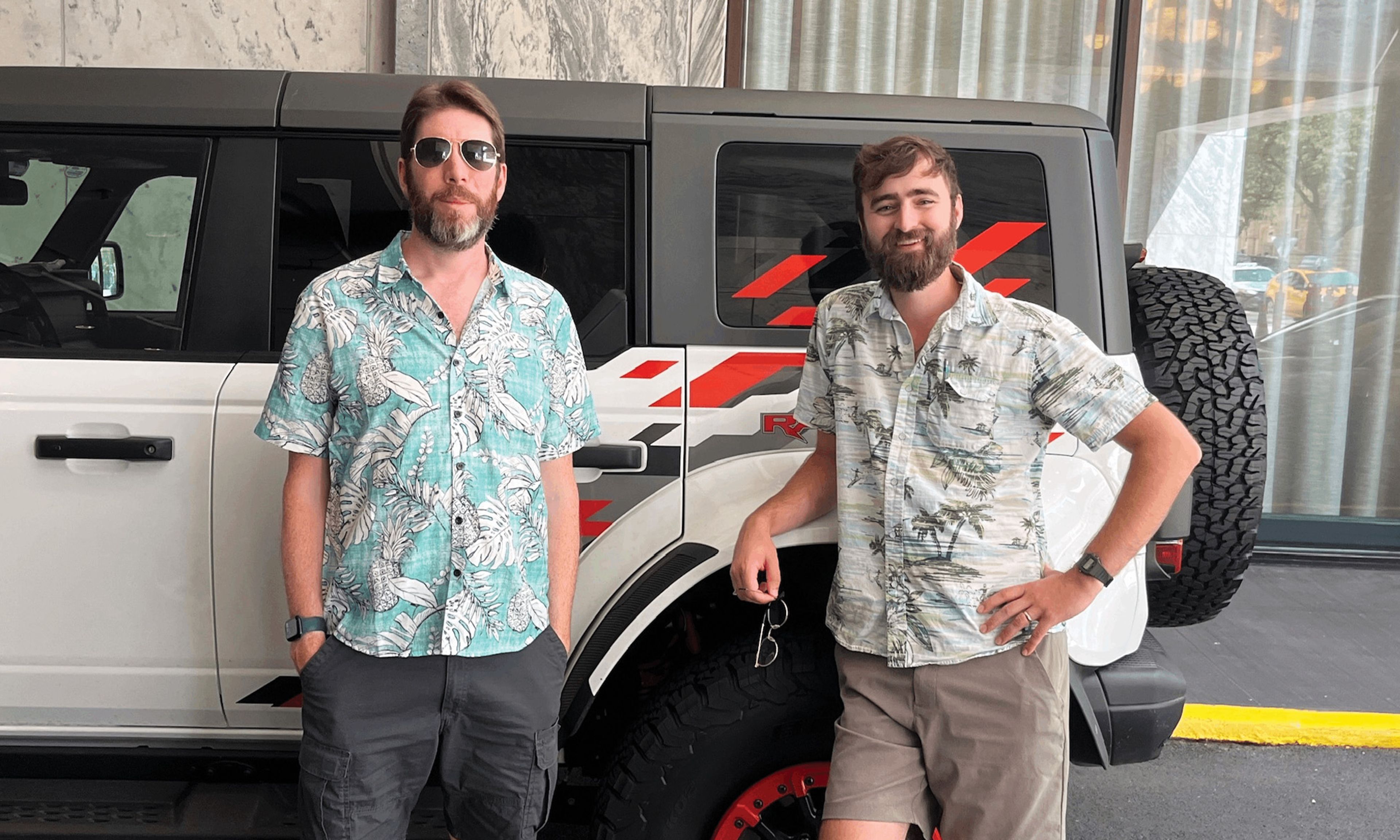
But first: what we didn’t do. What we didn’t do — by a mutual and sacred agreement — was take advantage of any modern technology or predictable convenience. Our ground rules for the journey were as follows. We would navigate by paper maps alone, book nothing in advance except our airfare, and neither eat nor lodge in any chain. We would not stare into our phones. We would stream no music; only local radio and pre-compiled mixtapes were permitted. And, to add a touch of surreality for ourselves and an unsuspecting public, we would wear Hawaiian shirts for the duration. Our one concession to comfort: We were permitted to stay with any friends or acquaintances we had along the route. But, if we did, we could not ask them to do anything on our behalf that we were forbidden to do ourselves. Our budget, door to door, was $2,000, including gas.
The plan was to begin in New York, at Coney Island, and to end in California, at Disneyland. But, perhaps as was to be expected, that immediately got blown out of the water. Luther made it to the Big Apple, but Charlie’s flight from Jacksonville was canceled at the last minute. So, in the absence of an acceptable alternative, the decision was made that we would drive toward one another at speed and meet in the middle. That middle, it turned out, was Richmond, Va., and it was there, 338 miles from Coney Island, in the midst of a Carnian rainstorm, that our adventure belatedly began. Our first objective was Kings Dominion, still open for another hour. Hoping against all reason that the thunder and lightning crashing down all around us might be limited to precisely where we were, we called the park’s guest-relations line and asked whether we should come down. “I almost never say this,” said the man who answered, “but I would definitely not do that.”
Rats.
With the prospect of late-night roller coasters firmly foreclosed, we took the only option that was left to us: We drove off to look for food — a task that, given the late hour, the fact that we were forbidden to visit any chains, and our having sworn off all forms of digital navigation, proved much more difficult than one might have thought. From a distance, we learned quickly, pretty much every building with lights in the window looks as if it could be a restaurant or bar.
“Is that one?”
“No, I think that’s an auto-body-repair shop?”
“How about that?”
“It sells marijuana.”
“What about that?”
“Yeah, but it closed an hour ago.”
Eventually, from our station under a swinging red light, we saw some magical words off in the distance: “US Best Wings.” We were sold.
US Best Wings, it turns out, was one of those ambitious little places that, in spite of its small size, tries to serve every sort of semi–fast food that you can find in the United States. It offered salads and seafood and subs and pizza and rice bowls and burgers and gyros and, of course, wings. Independently, we both ordered the same thing — the lamb gyro — and then, to the bemused looks of the other patrons who were waiting with us at the window, sat down on the establishment’s sole plastic bench to chart our course on our paper map. To where? Naturally, Coney Island was out. But Hersheypark wasn’t too far away. We determined to go there instead.
This, almost certainly, was our most self-conscious moment on the whole trip. There we were, at 10 p.m., by the side of the road in Mechanicsville, Va., standing out like a pair of sore thumbs that had been kicked out of a sore-thumb competition for being excessively sore and thumb-like. We were wearing brightly colored Hawaiian shirts. The Ford Motor Company had kindly lent us a Brobdingnagian Bronco Raptor, with an arty white, gray, black, and orange paint job and wheels the circumference of eastern Alaska. Awesome. We were trying to navigate guided by a large paper map that had almost no detail on it at all. (Because we had not imagined that we’d be in Virginia, we had ordered no Virginia-specific cartography.) And, as was our wont throughout the trip, we were filling the time with interesting hypotheticals, such as “What would you do first if pursued by the Mob?” and “How many centipedes would it take to bring a man down?” Nobody said anything to us. But it was clear what they were thinking. (Seven thousand three hundred, obviously.)
Our gyros having been consumed — and the locals having been thoroughly entertained — we drove off into the darkness, in the general direction of Hershey, Pa. After a couple of hours of remote and rain-soaked exploration, fatigue set in, and, having noticed an independent motel, we pulled into its parking lot in search of shelter and sleep.
Within moments of entering our rooms, it became clear exactly why this motel was both remote and independent. Neither of us is especially prissy about these things, but, as motels go, this one pushed the edges of even our substantial tolerance. It exhibited a peculiar odor, what one might get if one were to combine tobacco and microwaved fish, and the sheets and the blanket were full of small holes — two facts that, when combined, left us wondering whether the last occupant had spent his evening stabbing a Long John Silver’s–branded cigarette into the bedclothes. The robin’s-egg-blue bathrooms were passable, but each contained a weird bow-legged sink so unbothered by Newtonian mechanics that we were not sure it would survive the night. Naturally, we slept like babies until the alarm went off at 5:45 a.m.
The next morning brought the summer — sunshine, cloudless skies, a light breeze, glorious — and, after a quick refueling stop at the local Shell (87-octane for the car, Bunn-brewed octane for us), we were off. To our surprise and delight, we not only managed to navigate our way to Hersheypark with just our paper map but we arrived on time as well. Things were looking up! We had no more canceled flights to contend with, no more traffic jams to importune us, no more monsoons to dampen our prospects. We were here, in Hawaiian shirts, baseball hats, and a pint of sunscreen, at one of the great roller-coaster destinations of the world.
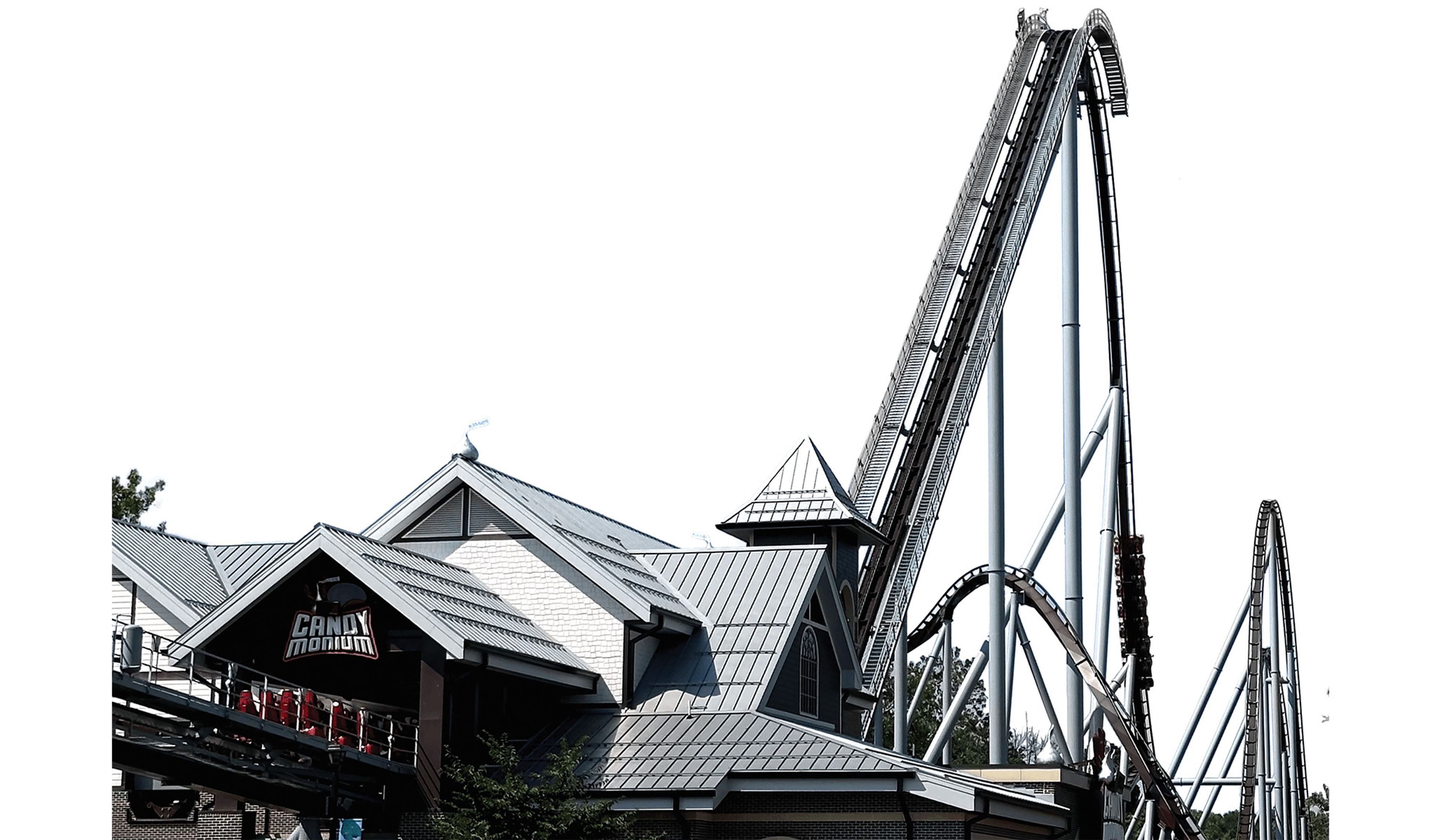
When most people imagine Hersheypark, they presumably think of chocolate. And, at both its factory and on its famous Chocolate Tour, it has that in abundance. Less known, though, is that it has 14 roller coasters — 15 if you count its dual-tracked racing attraction, Lightning Racer, as two — many of which are among the best in the world. As with cocktails, the key to a great amusement park lies as much in the mixture as in the quantity, and Hershey’s blend is as diverse as can be. It has two enormous hyper-coasters (Candymonium and Skyrush); it has a whippy inverted coaster (Great Bear); it has a sit-down multi-looper (Fahrenheit) with a freakish-looking vertical lift and an initial drop that bends inward beyond 90 degrees; it has an excessively fun launched coaster named Storm Runner, which takes riders from 0 to 72 mph in two seconds before pulling them through a 150-foot top hat, a cobra loop, a heartline roll, and a snake dive; and, above all, it has Wildcat’s Revenge — a wood-steel hybrid built by Rocky Mountain Construction that looks and feels as if it were dreamed up in a madcap Bugs Bunny cartoon in the early 1940s.
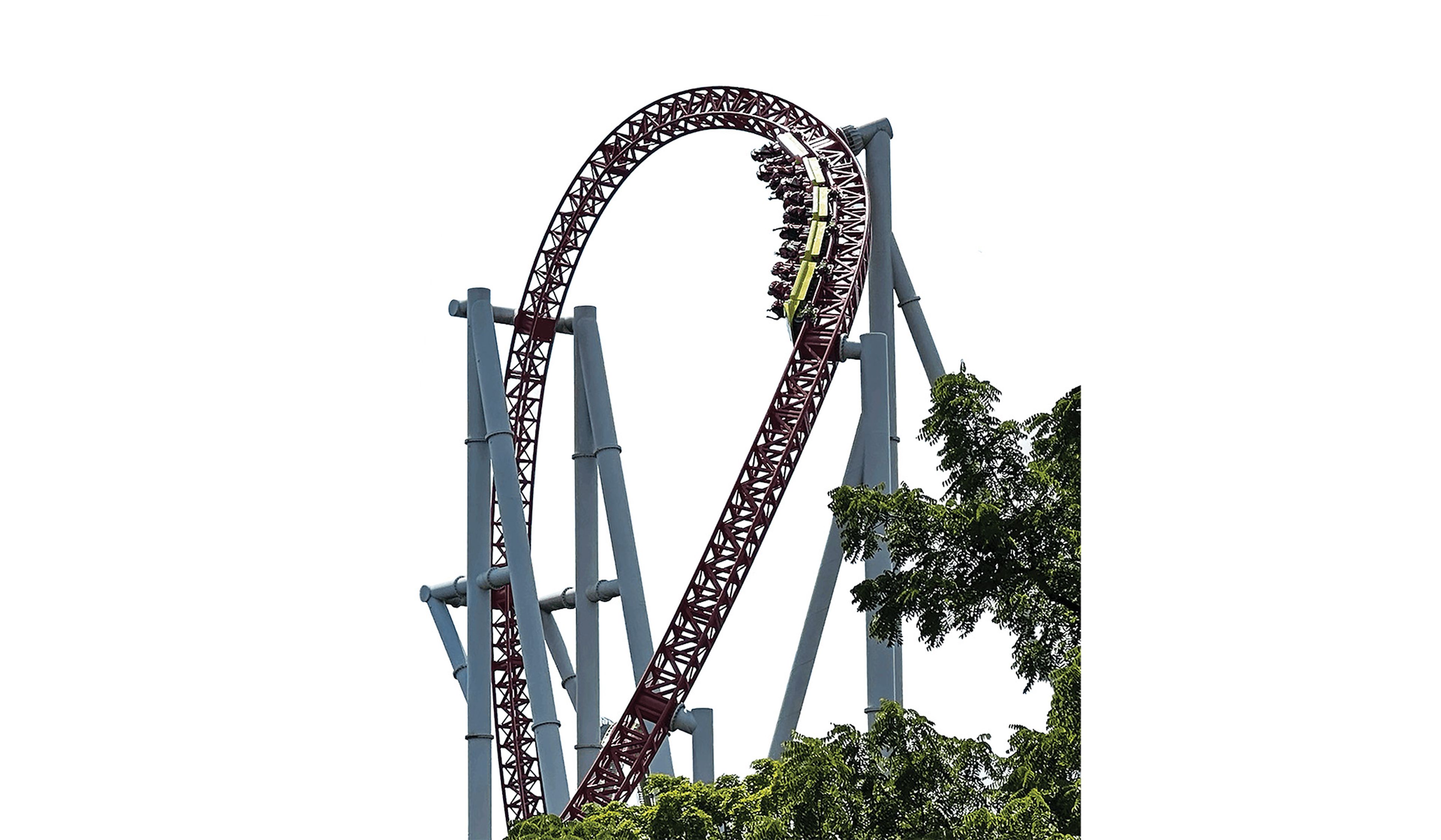
Both of us were new to Hersheypark, and we were impressed by what an unusually pleasant place it is. Many American amusement parks are glorified parking lots. This one was not. It was well run, clean, and had excellent food — we opted for the pulled-pork and brisket sandwiches — and it was built into such dramatically hilly terrain that each section of the place felt intimate and self-contained. By the time we had finished all that we wanted to do, we’d both completed nearly 15,000 steps, as well as climbed the equivalent of 22 flights of stairs. Relative to what Coney Island offered, the place was a definite upgrade.
We were an hour and a half into our trek toward Ohio when, atop a strange-looking mountain in the distance, we saw what seemed to our tired eyes to be an enormous football stadium. From what we could discern, it was every bit as large as The Swamp or The Big House. But what was it doing here? In the middle of nowhere? It didn’t make any sense. There were signs dotted around for “State College,” but neither of us knew what that meant — which state? what college? — and, without the internet at our disposal, we were unable to find out. Intrigued, we drove up the hill and discovered that we were on the campus of Penn State, and that the field that crowned the peak was no less than Beaver Stadium, the second-most capacious football stadium in the United States, and the home of the Nittany Lions. A college town! That could be fun.
But it was deserted. A ghost town. A haven for students, without any students in attendance.
Undeterred, we parked the car and wandered toward any signs of life. We found them in a pool bar named Sharkies, which, among other delights, offered “Cold Beer to Go.” True to its promise, Sharkies had both pool and cold beer. But it had little else besides, and so, after a quick game of pool that Luther lost at the last minute, we took our cue to exit and ended up in a Chinese restaurant that had 50 tables in it but not a single customer other than ourselves. We ordered our food, and, as if to underscore that nobody was around, the guy who took our order went back into the kitchen to cook it himself. It was delicious.
That night, we stayed down the road from Grove City College, in what had to be the best motel for the price in all of America (clean, comfortable beds for $55 per room), and then got up at the crack of dawn to drive to Cedar Point, on Lake Erie. For both of us, this was a highlight of the trip, for Cedar Point not only has the world’s greatest assortment of roller coasters and thrill rides but is one of the most beautiful amusement parks in the United States. The view from across the lake when one enters from nearby Sandusky is spectacular. There, on that picturesque chersonese, behind the boats and the rocks and the water lapping up at the peninsula, one finds no fewer than 17 roller coasters — five of which stand 200 feet or higher. (One of those is 420 feet tall.)
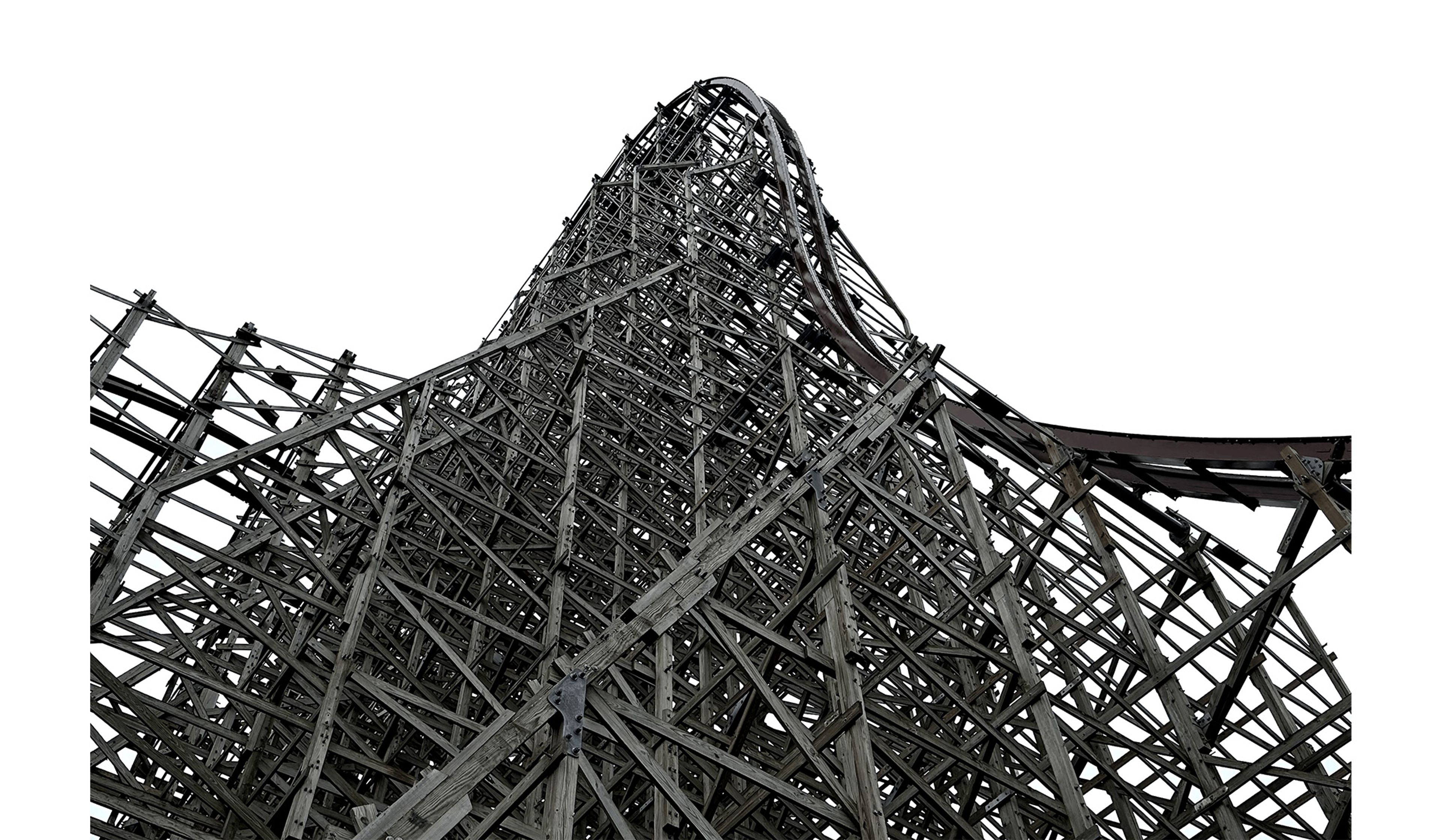
When we had set out that morning, we had resolved to do all 17 of them, plus any among the park’s other offerings that we found enticing. Unfortunately, the weather did not play ball. As far as we could see, we’d have from about 10 a.m. to 3 p.m. to get our fix, and after that we’d be serving at Erie’s tempestuous pleasure. Thus motivated, we prioritized Cedar Point’s star turns. We rode Millennium Force, a 310-foot-tall Bond villain’s murder machine that dropped us at 93 miles per hour at 80 degrees (the drop is so long that one feels one’s stomach levitate enough to tickle the clavicles) and then sped along the shores of the lake; we rode Steel Vengeance, the lunatic older brother of Hersheypark’s Wildcat’s Revenge; we rode Maverick, a surprisingly intense double-launched “blitz” coaster whose best parts have been cleverly hidden from view; and we rode Raptor, one of the original (and best) efforts of famed Swiss design firm Bolliger & Mabillard. We stayed ahead of the weather and got them done, one after the other, until, eventually, as we got to the front of the line for Cedar Point’s converted floorless looping roller coaster, Rougarou, the storm that had been threatening us all day finally rolled in, and the park all but shut down.
Holding out hope that the weather would improve and not yet ready to leave, we ducked inside a saloon, ordered a couple of beers, and watched a genuinely entertaining country-and-western cover band put on a show. But, by the time the show was over, it was clear that our day at the park was done, and that it was time to get back into the Bronco and drive toward our next stop: Six Flags Great America, outside Chicago.
We were near Hillsdale College, in Michigan, when, just after eight, we found a small, slightly run-down town with a charming-looking Italian place called Cascarelli’s that offered “pizza,” “sandwiches,” and “cocktails” and that seemed to be exactly what we were looking for. Walking in, we confirmed this suspicion. It was family-run. It had a relaxed and friendly atmosphere. The pizza smelled terrific. And it was . . . closing. Aargh! From behind the bar, the proprietress kindly tried to assuage our obvious disappointment. “I can do you a quick drink,” she said, pointing to the handful of taps. “But then we’ll have to close.” For now, pizza was off the agenda.
The following morning brought back the good weather — and just in time for us to drive past the astonishing Chicago skyline on our way to our destination. This, we remarked, was something that you lose when flying. The plane leaves, it hangs in the air, it lands, and, unless you’re paying remarkably close attention, you feel as if you’ve been teleported. In a car, you see everything: every turn, every pothole, every sign. Over time, the anticipation builds. “Chicago 50.” “Chicago 30.” “Chicago 15.” And then, in the distance: Chicago. You were back there, and now you’re here, and you know exactly how one state of affairs became the other.
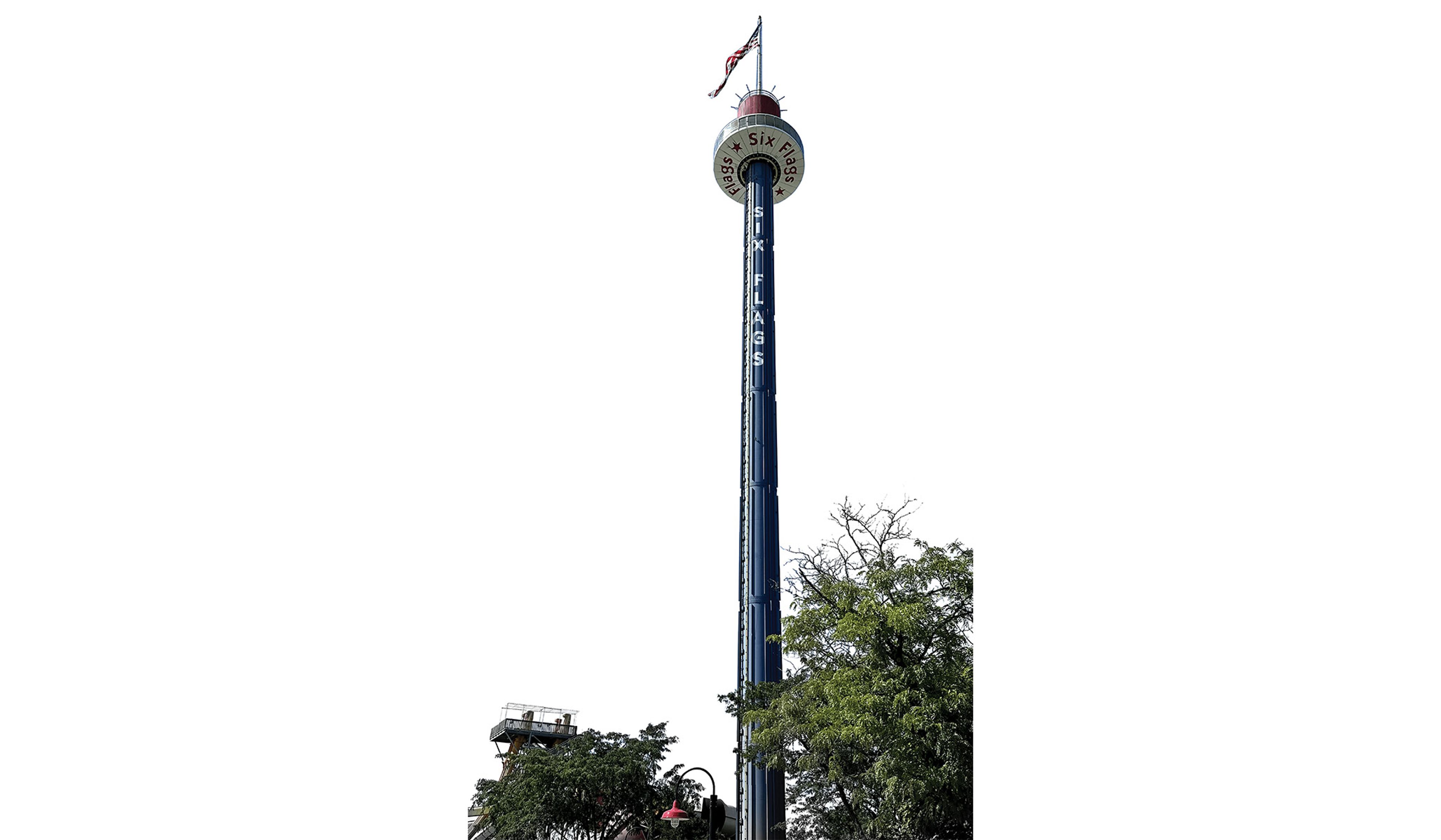
But, of course, we weren’t going to Chicago. We were going to Great America, which markets itself as being in Chicago but, in reality, is closer to the Mars Cheese Castle in neighboring Wisconsin. Before we’d left home, we’d made a list of which among the major rides we hoped to get done at each park, and our list for Great America was no different from any of the others. We wanted the tallest, the fastest, the loopiest. But here, we were thrown a fastball, for while Great America has some standout attractions on offer, the highlight for both of us was the humble American Eagle, a 43-year-old wooden throwback with Victorian design elements, vintage trains, and the American flag flying from its highest point. At 127 feet, the American Eagle is a veritable midget relative to some of the park’s other attractions, but there is something about the protracted clack-clacket-click of the lift’s anti-rollbacks and the swaying of the wood that makes the whole thing feel infinitely more precarious. On the American Eagle, you feel and hear everything. It’s violent. It’s rough. It’s fast. And, above all, it’s loud — in that throcketa-throcketa-thunk-chock-chock-chock manner that you get only from rides that hew to the old rules. As with the SooperDooperLooper at Hersheypark and Gemini at Cedar Point, the American Eagle is a time machine that evokes the second golden era of roller coasters in the late ’70s and early ’80s. We loved every minute.
At lunchtime, in the park’s small and bustling food court, we made our second failed attempt to get a pizza. Unlike Cascarelli’s, the joint was open. But a single slice was $17, and so, having concluded that $17 for a slice of pizza was a bit dear, we did what any principled economizing travelers would do and bought a pair of $16 beers instead.
That evening, having exhausted all that Great America had to offer, we called on some family friends of Luther’s in the Chicago suburbs and got a luxurious break from motel mattresses and tiny bar soaps. Sitting in the backyard of their John Hughes–esque suburban house, we ate an alfresco dinner of hamburgers, chips and salsa, and red wine, and told them all about our trip. The next morning, after doing laundry, eating a hearty breakfast, and taking a too-brief detour into the city, we headed to O’Hare for our flight to San Francisco. Nearing the airport, we expressed our profound disappointment that we were obliged to leave the open road and our beloved white Bronco. Per the tickets, our flight would take four hours. How long, we wondered naïvely, could it take to forswear air travel and drive instead? At least thirty hours, the map suggested. Flying it was.
In San Francisco, we picked up our second vehicle: a manual Ford Mustang Dark Horse (500 hp, 418 lb.-ft. of torque). The car’s subtle periwinkle-blue exterior belied what the sarcophagus-like Recaro seats and grumbling burble in the exhaust confirmed the first time we accelerated: This girl could go. And what a place to open it up! From Santa Clara, we took the Pacific Coast Highway — Highway 1, perhaps the single greatest stretch of road in the world — and watched in admiration as the scenery changed and the sun slowly sank into the sea. In Carmel, we stopped for the wood-fired pizza that we’d twice been so cruelly denied and then started toward Southern California via Big Sur.
And then . . . we were stopped. At dinner, over a glass of Chianti classico, we had resolved to drive down the Pacific Coast Highway to wherever we ended up when we got tired and then, the next morning, to duck inland at San Luis Obispo. But, ten miles or so south of Carmel, we encountered a flashing sign informing us that that stretch of the PCH was closed. This, of course, is the sort of thing that one knows well in advance when one is using Waze or Google Maps or what you will. But, with only our AAA maps, we had no way of knowing until we got there. Reeling, and by dome light, we scrutinized our atlas for a little while and then, with assured shrugs, put our fates into the hands of a tiny little back road called the G16.
On paper, the G16 was a respectable-looking, if unusually thin, curvy line. In reality, it took us far away from civilization and into a world of gated ranches, dark woods, and stars so brilliant that they shone through the windshield. Narrow, bumpy, and prone to dramatic shifts in elevation, the trail served to remind what a big, wild, beautiful country this is. For around an hour and a half, with the Mustang in an extended trot in its third and fourth gears, our stomachs were sloshed around a series of hairpin turns that we shared only with lynx, jackrabbits, and a host of other furry and suicidal pedestrians. It was an exhilarating, uncertain drive.
We spent an uneventful night at a nondescript motel in King City, and then it was time to head toward Six Flags Magic Mountain, a famous Southern California thrill park 35 miles north of Los Angeles that, at the time of our visit, had 20 roller coasters — more than any other facility on earth. On our way, we passed through the Santa Lucia Wilderness, with its amber peaks framing a cauldron of fog, and, in the Santa Ynez Valley, we sped past Buellton, the home of split-pea soup. Surrounded by our American muscle car, powering effortlessly down the 101, we took satisfaction in our nation’s ability to split peas, atoms, empires, and anything else it so chose. Where else, after all, do people build hundreds of millions of dollars’ worth of roller coasters in the desert?
Magic Mountain is best described as what a kids’ playground might look like if kids’ playgrounds were fed anabolic steroids. It is a Wassily Kandinsky painting of a park, with strands of brightly colored roller-coaster track — yellow, green, red, blue — running everywhere the eye can see. At its center stands Superman: Escape from Krypton, a behemoth of a ride at 415 feet tall. Generating a sound that is as loud as a jet engine, Superman launches its riders backward out of a dark tunnel at 100 mph, before dropping them at 90 degrees back to earth. If the rest of the coasters are spaghetti against the open California sky, Superman is the fork sticking out of the middle.
If it exists, Magic Mountain has it. It has a hyper-coaster, and an inverted coaster, and a hybrid coaster, and a flying coaster, and a monorail coaster, and a suspended coaster, and a floorless coaster, and a “4D” spinning coaster, and a racing coaster, and a wooden coaster, and a coaster on which you remain standing up while riding. It has the world’s tallest vertical loop and the world’s first vertical loop. It is pretty, because California is pretty, but, knowing what it’s good for, it makes little attempt at landscaping or theming and, unlike Cedar Point, it does nothing to preserve the sense of Victoriana that attaches to the best of the old boardwalk-style parks. One goes to Magic Mountain to have fun in the sun, and for no other reason. Were you to prompt AI with “insane roller coasters in the middle of nowhere” 10,000 times in a row, no computer would come up with a superior model. “Thrill Capital of the World,” the sign at the entrance reads. Indeed so.
In the evening, we met up with a friend in Santa Barbara and had dinner and beer at a Mexican hole-in-the-wall named La Super-Rica, which we had been told was a favorite of Julia Child’s. La Super-Rica took no reservations, accepted only cash, and had not updated its chairs or tables since 1980. It was perfect. That night, we couch-surfed in nearby Ojai — a spectacular little town nestled near St. Thomas Aquinas College in the valley of the Topatopa Mountains — and, the next day, set off for our final stop of the trip, Disneyland, where, in 1955, the story of the modern amusement park began.
The locals complain that Disneyland has all but taken over Anaheim, and, for better or for worse, they are right. Disney now has two parks on the site — in addition to The Happiest Place on Earth, there is Disney’s California Adventure, a second gate that is (mostly) themed to the Golden State — plus a “Downtown Disney” area, three hotels, and a sprawling collection of parking garages that serve as a barrier between the world that Walt created and the quotidian outside world. Compared with Florida’s Walt Disney World, Disneyland remains small, but compared with every other amusement park in the United States, it is a wonder.
Within minutes of entering the ecosystem, we looked at each other and said, almost simultaneously, “It’s just different, isn’t it?” And it is. The theming, the attention to detail, the care that has gone into each and every last item on display — there’s nothing else like it. Having spent four wonderful days eschewing art and strapping ourselves to the world’s finest thrill machines, we found it a nice change of pace to submit to some old-fashioned Hollywood escapism. Transported, we ranged far and wide, from the edge of the Star Wars galaxy, to the deck of the Mark Twain (a Mississippi paddle steamer), to the midst of a Toy Story–inspired shoot-out (final score: Charles 151,000 to 149,100 Luther), to the cursed temples of Indiana Jones and his crew. We crossed an ersatz Golden Gate Bridge, had a glass of California wine at the Golden Vine Winery, visited the dynamite-laden canyons of Big Thunder Mountain, and, when we finally tired, collapsed into a riverboat for a leisurely jaunt around the jungle. We had come a long way from Richmond, Va.
Driving out of Disneyland that evening, we found our bearings toward the flashing lights of Los Angeles and then turned up the Mustang’s radio in time to hear the turbulent introduction to Chuck Berry’s “Back in the U.S.A.” roaring through the speakers.
Well, I’m so glad I’m livin’ in the U.S.A. Yes, I’m so glad I’m livin’ in the U.S.A. Anything you want, we got it right here in the U.S.A.
Amen.












Comments