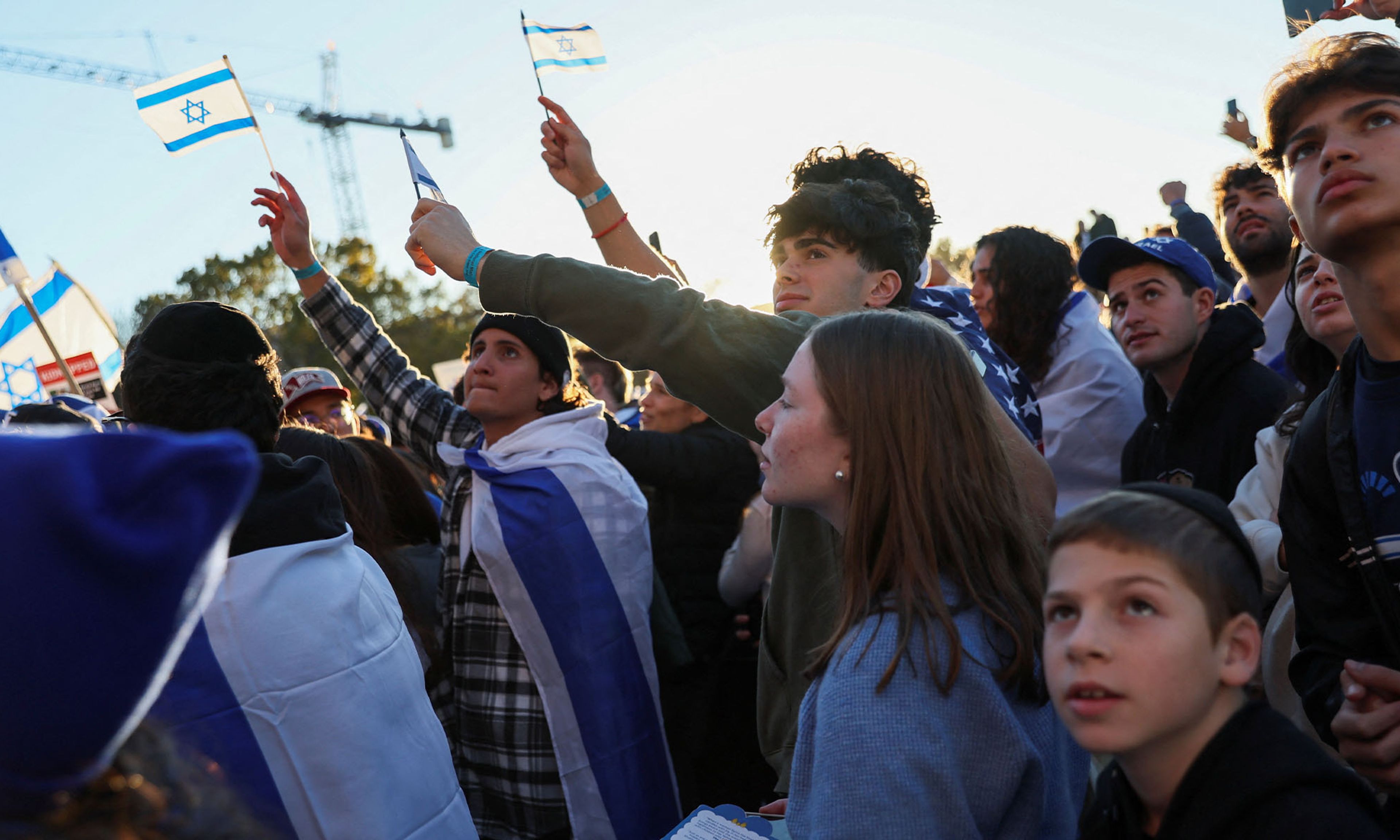
‘How do we know we’re on the good side?”
So asked an eight-year-old of his mother. A sensitive boy, he’s aware of his family’s Zionism and also perceptive enough to wonder about the “Israel commits genocide” sign that he sees every morning on the drive to school outside the Israeli embassy in Washington, D.C. Children are supposed to be shielded from harsh realities, to be happily preoccupied with make-believe, to have their innocence protected. But for Jewish parents, protecting their children from those realities has become painfully difficult in the year since Hamas attacked Israel. Jewish parents in the United States have had to find a way to talk to their children about what happened, about the world they’re growing up in and the way it’s changed since October 7, 2023. What should parents tell their children about the evil of Hamas, something that the adults themselves still find unimaginable?
I spoke with several Jewish parents, some in person in D.C. and others by phone, to get a sense of how they are answering their children’s post-10/7 questions. One mother told me about an upsetting experience her son had at school. Like Rachel Goldberg-Polin, the mother of Hersh Goldberg-Polin, who was murdered by Hamas after eleven months in captivity, this woman has been wearing a piece of masking tape on her shirt marked with the number of days that Israeli hostages have been held in Gaza. Her son, age twelve, wanted to follow his mother’s lead, so he also put a piece of tape on his shirt every day before going to school. One day, he realized he’d forgotten to put it on. When he asked his math teacher for a piece of tape and a marker and explained why, she asked whether she could join him. But this teacher did not write the number of days of captivity for the hostages on her piece of tape. She wrote “75+” — a reference to the years since Israel’s founding in 1948. For her, that number marks what Palestinians call the nakba, or “catastrophe.” She chided the boy and told him in front of the class that Israel is “evil.”
Although he didn’t completely understand the historical context of the situation, the boy knew instinctively that what his teacher said was wrong. He knew that in the current war, he supports Israel because Israel deserves support. His mother, who has taken the family to visit Israel several times, has been honest with her three children about the reality of war. She has taught them why Israel has the right to exist, and to view Israel as the Jewish homeland. “People will always try to kill the Jews,” she told me, but she wants her children to “think of life, not death.”
“Everything happens in the car,” another mother said. It is in the car that her exasperated daughter has asked if she’s “listening to Hamas again.” That’s because the girl has grown accustomed to hearing the word “Hamas” on the Commentary magazine podcast her mother often listens to. It is in the car that the girl, having seen a poster through the car window accusing Israel of genocide, asked, “Mommy, what’s genocide?” Many parents find that children ask difficult questions in the car, perhaps because it’s a place separate from home, which in a way can make it feel easier to bring up hard subjects. Questions like “What happens to the soldiers who die?” and “Why did terrorists take a baby?” There’s just no way for parents to shield their children from the news; kids will find out details, whether in the media or from other kids, that their parents would rather they didn’t have to know — yet. “Did terrorists bomb a kindergarten in Israel?” The truth is gruesome, but lying is impossible.
It’s uncomfortable, and heartrending, to explain to children the depths of evil that Hamas has perpetrated. Hamas’s abuse of its own people — maximizing civilian deaths by using them as human shields — is a type of evil that challenges a parent’s ability to explain it. The same is true when trying to distinguish “civilian” from “terrorist” if one’s child has heard that some of the hostages were held by civilians in their homes.
One way to help children make sense of post-10/7 realities is to teach them about Israeli resilience and the values of Western civilization. So says Caroline Bryk, the executive director of the Tikvah Fund’s Jewish Parents Forum. When discussing October 7, a parent’s goal should be to “draw inspiration from the strength and heroism of the Israeli people,” she told me, because out of the war’s devastation emerged stories of courage: the security officers at the kibbutzim who defended their communities from terror, the medics who ran back into the carnage at the Nova music festival to save the wounded, the children who prayed together in safe rooms. “This is a world with good and evil — that’s not a reality I’d like to shield [my children] from,” Bryk said.
Many have drawn parallels between the shock of October 7 for Israelis and the shock of September 11, 2001, for Americans. The days after the 9/11 attacks were also a time when parents had to find ways to explain a new reality to their children. One of the “deepest problem[s] in facing terrorism,” Charles Krauthammer wrote days after the attack, is “failure of the imagination.” By that he meant an inability to imagine “the nature of the evil” that the terrorists were capable of. This, again, is a subject that’s wrenching for adults, let alone for children.
For Jewish parents and educators, it is more important than ever to make sure children understand Israel’s history. Doran Katz, Tikvah’s director of day-school initiatives, sees this as a moment to ponder what it means to be a Jew in America and to teach Jewish children to take pride in their connection with Israel. Israeli history is an essential component of Jewish education. Kids need to know why Israel is America’s strongest ally in the Middle East; they need to understand the astounding success of the Zionist movement in creating the world’s only Jewish state; and they need to know why it is just to support Israel in its defensive war against people who want to destroy it.
The majority of American Jews are Democrats, according to the Pew Research Center, and for many of them, it came as a shock that the progressive Left largely abandoned them after October 7. Just days after Hamas’s attack, the Chicago chapter of Black Lives Matter, for example, posted on social media an image of a person paragliding with a Palestinian flag — a reference to one of the ways Hamas terrorists invaded Israeli territory to commit massacres and rape — with the caption “I stand with Palestine.” U.S. feminist organizations were silent about Hamas’s rape and mutilation of Israeli women until months into the war. Public-school Jewish parents, who may have appreciated and wanted their children to inherit liberal ideals before October, now feel homeless — left out of the protected classes they once pledged to help defend. Jewish children are berated in classrooms and subject to antisemitic slurs. In schools where “identities” are celebrated, Jewish identity doesn’t count or is denigrated. For some parents, sending their kids to Hebrew school has become at least as important as regular school.
Tikvah has also noticed a broad willingness on the part of American Jews after October 7 to engage in American civic life, even as students in college encampments glorified Hamas, and protesters on streets called for Israel’s destruction. Jewish day schools sent students to a pro-Israel rally in Washington, families sang Hebrew songs in front of United Nations headquarters in New York, and communities across the nation have organized Shabbat dinners with empty seats to remember the hostages.
Jewish history now includes the story of October 7. But it also includes the story of a people whose resilience in the aftermath of that horror is a new chapter in Jewish survival.












Comments