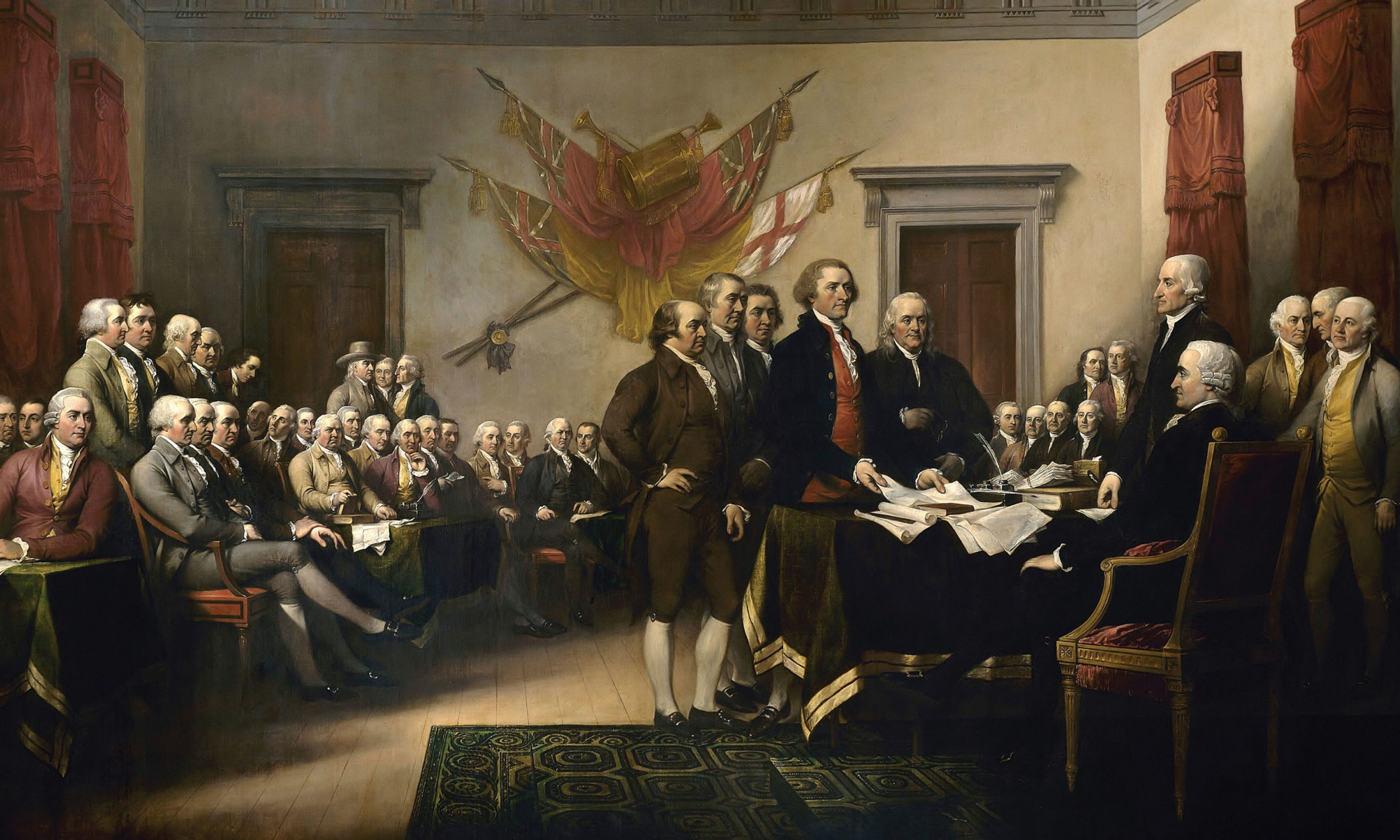
The history of America’s founding has been well taught in elite American universities for 50 years. That is thanks to a great cohort of scholars — Douglass Adair, Edmund Morgan, Bernard Bailyn, Forrest McDonald — of whom Gordon Wood is one of the last. Despite their differences in emphasis and point of view, these historians agreed in throwing off the Charles Beard paradigm of history: Money made them do it. They noticed that leaders and ordinary Americans in the founding generation had ideas, and they proposed to take those ideas seriously. As a result, early American history withstood the storms of fashion and theory that devastated so many high-end humanities departments, while historians like Wood nourished the popular founders’ revival that has been with us for about 15 years.
Empire of Liberty is Wood’s contribution to the multivolume Oxford History of the United States. Wood covers the quarter century from the maiden voyage of the new federal government to the end of the War of 1812 — from theory to populism, from George Washington to Old Hickory. There are two mainstream interpretations of this period. Everyone likes Washington, and most credit his Treasury secretary, Alexander Hamilton, with important bookkeeping. But in the administration of John Adams (1797–1801) the ruling Federalist party lost its way. Arthur Schlesinger Jr. and modern followers like Sean Wilentz see the Republican party of Thomas Jefferson and James Madison saving the country from Federalist crimes and excesses, and paving the way for Jacksonian Democracy, the New Deal, and the Great Society. Henry Adams, John’s great-grandson, argued, with unmatchable style and bile, that all leaders after 1801, including Jefferson and Madison, were morons and bunglers, but the people and the forces of History thrust the United States into greatness. Wood combines these two views.
America had no victory lap after the Revolutionary War. Debt and misgovernment made the mid-1780s an anxious time. Wood quotes the English radical Richard Price, warning that if “the fairest experiment ever tried in human affairs” miscarried, “a revolution which had revived the hopes of good men . . . will become a discouragement to all future efforts in favor of liberty.” The new federal system designed by the Constitution was meant to resolve and avert conflicts between the states and to curb their oppressive and arbitrary ways. But what sort of system would it erect instead?
Wood calls the government from 1789 to 1801 the “monarchical republic.” George Washington fought a monarch and his ministers for eight and a half years; his childlessness made dynastic temptation impossible, and he scorned to be president for life, retiring after two terms. Yet his grave demeanor was the closest thing to royalty America had; anxious to cement a national governing class, he and Martha arranged 16 marriages of younger friends and associates, including Madison’s with Dolley Payne. Hamilton, his right-hand man, solved America’s debt crisis by establishing a national bank, and hoped to nurture a standing army to defend the nation against enemies foreign and domestic.
They were resisted by their sometime revolutionary colleagues Jefferson and Madison, who came to fear that they were steering — Washington unwittingly, Hamilton with eyes wide open — toward statism, corruption, and literal monarchy. To save America from this fate, Jefferson and Madison founded the Republican party (ancestor of today’s Democrats, not the GOP). Jefferson, eight years older, was the senior partner of their decades-long relationship. But, as Wood explains, their dynamics were complex. “Perhaps it was the very innocence and impracticality of many of Jefferson’s opinions . . . that attracted the more sober-minded and skeptical Madison. Jefferson’s vision of a world free from corruption and war, free from the accumulated debts and regulations of the past . . . was an inspiring antidote to the prudential, mundane, and humdrum world of congressional politics that Madison often had to contend with.” Wood also highlights their followers — “middling men” like Matthew Lyon, who arrived from Ireland as an indentured servant, then became a rich entrepreneur in Vermont. Lyon thought the political class should be open to new men like himself, and resented Federalist pretensions and slights. When Lyon, elected to Congress at last, was mocked by a Federalist colleague, he spat in his tormentor’s face. The Federalist caned him, and the two rumbled on the House floor. Inspired and organized by Jefferson and Madison, politicians like Lyon rallied urban artisans and small farmers.
Early American politics was envenomed by the French Revolution and its attendant world wars. In the late 1790s the Federalists went off the rails, jacking up taxes to fight France and passing the Alien and Sedition Acts to muzzle dissent. Wood notes that 57 newspapers and magazines were edited by Irish and British immigrants; one of them was Matthew Lyon, who was jailed under the Sedition Act. When the Republicans swept to power after the election of 1800, they committed mistakes of their own. Jefferson pursued a peace policy, fighting European bullies with commercial retaliation. In 1807 he chose to fight his own people by forbidding all foreign trade. Enforcing Jefferson’s embargo required measures as draconian as anything the Federalists had imposed. Five years later, Madison, his successor in the White House, went to war with Britain, even though Congress had abolished the national bank and the army had only 6,700 men. A flurry of disasters followed until victories on Lake Erie and Lake Champlain, and at New Orleans, turned the British back. The people stood by the Republicans even so.
Wood is most interesting when he describes the mores of republicanism. Americans chafed at hierarchy in every area of life. “I’d have you know, man,” one female domestic lectured her employer, “that I am no sarvant; none but negers are sarvants.” Americans gobbled their food and drank like fish — five gallons of hard liquor per person per year. Premarital pregnancy soared to “rates not reached again until the 1960s,” Wood writes. American art, never robust — we had a few great political writers and a handful of good painters — languished. “Desiring to make the arts safe for republicanism,” writes Wood, Americans left “little room for autonomy and originality.” Piety flourished, perhaps partly to clean up after the boozing and fornicating. Americans cherished religious liberty but expected their politicians to respect their faiths. “Had you not better go to church?” one of Aaron Burr’s friends suggested (he didn’t). A Baptist fan of Jefferson wrote of him as if he did. “Thomas Jefferson is the angel who poured out his vial upon the river Euphrates, that the way of the kings of the East be prepared.” In these years America came to be ruled by what Tocqueville would describe a generation later on: public opinion. The “aggregation of individual sentiments,” wrote Tunis Wortman, a New York Republican, produces “the ultimate triumph of Truth.”
There was no place for Indians or blacks in republican America (or in the works of its historians — Schlesinger barely mentioned them, Henry Adams discussed only Indians). Wood tells the sad tales. Washington, himself an old Indian-fighter, tried to regulate westward expansion. But it was hopeless. America’s population doubled every 20 years, and settlers poured into the frontier, igniting Indian wars from Ohio to Alabama. Back east, states eliminated black suffrage even as they broadened the (white) franchise. Wood shuffles his feet: “Such were the strange and perverse consequences of republican equality and democracy.” But perhaps that is exactly what a party of land-hungry middling men led by southern planters was bound to do.
Here and there Wood makes mistakes. He says, as almost everyone does, that farmers beyond the Appalachians distilled their grain into whiskey because that was the only convenient way to ship and sell it. I have seen the barrel of the still that started the Whiskey Rebellion in Washington’s second term (an attempt to serve a writ on its owner provoked the first angry confrontation). It is no hillbilly contraption, but an early industrial artifact, with rivets as big as nickels. There was a lot of distilling in them thar hills. But Forrest McDonald studied two decades of Philadelphia newspapers and found no price listings for western whiskey. Wood’s drinking statistics suggest that it was consumed locally. Can’t historians resolve this rather simple issue?
Sometimes Wood’s generalizations go off. The triumph of republicanism, he says, meant that “heroic individuals . . . no longer mattered as much as they had in the past.” I have often wondered why, after the War of 1812, Andrew Jackson, William Henry Harrison, Zachary Taylor, and Sam Houston fell into sudden and lifelong obscurity. Wood’s assertion must be the reason.
Wood’s prose is workmanlike, which over 700-plus pages could be a lot of work. But well-chosen quotations and lively passages like this description of Washington, D.C., in 1801 lure the reader on: “It was surrounded by woods, its streets were muddy and filled with tree stumps, its landscape was swampy and mosquito-infested, and its unfinished government buildings stood like Roman ruins in a deserted ancient city. . . . Cows grazed on the Mall, and Pierre L’Enfant’s splendid squares were used as vegetable gardens.” We see from this that Washington has changed materially, though not culturally or intellectually.
Wood has been a professor for 45 years. Joseph Ellis, the very last of his great academic cohort, told me once that when he retires he will not be replaced by a scholar of the founding, but by a specialist “in looms.” Empire of Liberty can be savored as an envoi. Let us hope it will be followed instead by a rebirth of the sweep and seriousness of its author, and of his peers.












Comments