On Inauguration Day 1989, National Review gave a celebratory dinner in Washington at which the guests included Jeane Kirkpatrick, Bill Safire, and the Soviet ambassador and his wife. Contrary to stereotypes, the ambassador was charming and his wife both charming and attractive. But what the ambassador said went beyond charm. He remarked, apparently in passing, that the Soviet Union had no interest in what kind of regimes existed in Eastern Europe. They were independent countries. What kind of government they had was a matter for the voters.
We had just heard what became known as the Sinatra Doctrine: They can do it their way. Safire took out his notebook and pen. He wanted to take down the lyrics.
“Does that mean they can leave the Warsaw Pact?” asked Jeane suspiciously, probably recalling that it was Hungary’s decision to do so that had made a Soviet invasion inevitable.
“We would be sorry if they did so,” replied the ambassador suavely, “but that’s really a matter for them, not us.” So the Brezhnev Doctrine — “once a socialist country, always a socialist country” — no longer applied either. When the ambassador left for his next dinner — his wife told me apologetically that they had three that night — we all fell to discussing the significance of his remark. Was it true? And even if it was, why had he told us? What was going on?
Of those present, I had the least excuse for being skeptical or surprised. Shortly before the dinner, our first issue of 1989 had hit the newsstands with a cover story by our roving correspondent, Radek Sikorski (now Poland’s foreign minister), with the title “The Coming Crack-Up of Communism” and a picture of Lenin under shattered glass. There had been other forecasts of a Soviet collapse too — notably, Andrei Amalrik’s book Will the Soviet Union Survive Until 1984? Above all, we had just won the Cold War. Not everyone quite realizes that, because we tend to think that the collapse of Communism and the end of the Cold War were the same thing. In fact, the Cold War really ended in 1984 — score one for Amalrik — when America’s cruise and Pershing missiles were successfully stationed in Europe despite a massive “peace” campaign against their installation.
Gorbachev went to Geneva and Reykjavik with the intention of getting an arms-reduction agreement that would allow Moscow to argue that the Cold War had ended in a draw. He failed to get such an agreement because Reagan refused to abandon strategic missile defense. So he returned to Washington a year later and made all his previous concessions without getting his quid pro quo. America won the Cold War at that point.
But Soviet Communism still ruled a large part of the world. Most observers in 1987 and 1988 expected that the two blocs would continue a peaceful competition of systems more or less indefinitely. It would not be hard to carry out a thought experiment — there’s a different one below — about a world in which that happened. In such a world, socialism would not be a synonym for economic waste and collapse. European social-democratic parties would not have embraced the market (however inadequately). Moscow would regularly seek export credits and other subsidies. Etc., etc.
So what turned the Soviet defeat of 1984–86 into the Soviet dissolution of 1989–91? Take a look at the opening paragraph of Sikorski’s article:
An elderly woman in a peasant scarf lights a candle and kneels piously at the altar in the Vilnius Cathedral — recently restored to the Catholic Church after decades of serving as a Museum of Atheism. A food queue several dozen strong stands pliantly in the dawn cold in front of a shabby state monopoly store in Moscow. Deputies of the Supreme Soviet of the Estonian Republic spectacularly declare for genuine autonomy, defying the line from Moscow. In Yerevan soldiers enforcing the state of emergency keep themselves warm around a fire next to a snow-shrouded tank.
If I could not read plainly that this piece was published in January 1989, I would guess that it describes 1990 to 1991, after the fall of the Berlin Wall. Everything Sikorski writes about in that passage is taking place not in one of the USSR’s restive Eastern European neighbors but within the borders of the USSR itself. He depicts dissolution under way. The rot has already set in: widespread economic inefficiency, nationalist uprisings everywhere, military failure in Afghanistan, the Kremlin’s growing inability to finance anti-American subversion, its similar impotence in the face of Solidarity’s rebellion, the evaporation of the perestroika illusion, and — not surprisingly — the collapse of elite morale within the party. Around this time, political philosopher John Gray returned from a visit to Poland with a new joke: The Communist party held a competition to recruit new members. If you recruited one new member, you got a vacation on the Black Sea; two, and you could resign from the party yourself; three, and you got a written certificate testifying that you had never been a member. The joke was told to Gray by a member of the Polish Central Committee. Communism was definitely over — it was itself a joke.
But what would replace it — especially in Eastern Europe? Gorbachev seems to have intended to replace the hardliners there with some form of local perestroika. His former college roommate, a Czech, later arrived in Prague to help the velvet revolution move towards the “socialism with a human face” of 1968. But he was shouted down when he slipped unwittingly into leftist jargon. 1968 represented a socialist simulacrum of freedom. By 1989 Eastern Europeans wanted something better and more real. The tectonic plates of politics were shifting. An earthquake was simply a matter of time. The earthquake, when it came, was a picnic. And it marked the return to European history of the Hapsburgs.
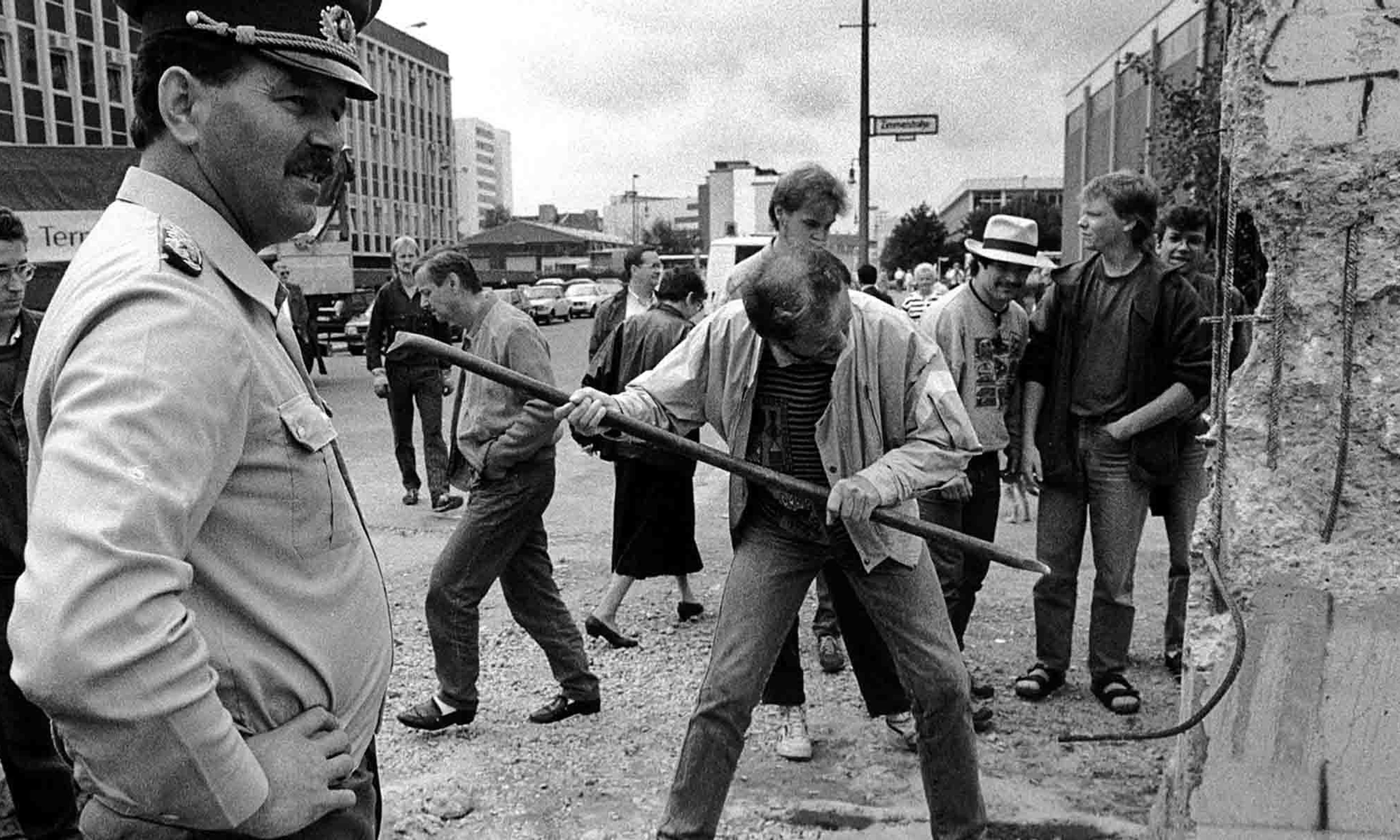
On Aug. 19, 1989, a “pan-European picnic” was held near the town of Sopron on the Austria–Hungary border by Hungary’s four opposition parties, under the joint patronage of Otto von Hapsburg and the Hungarian reform Communist Imre Poszgay. Hungary had already started to demolish its fortified border with Austria. East Germans now took the opportunity to flee in large numbers. By September the Hungarian government gave up all pretense of guarding the border, despite protests from East Germany’s dinosaur leader, Erich Honecker. The Iron Curtain was trampled down by an exodus of refugees from all the Eastern-bloc countries except East Germany. And in November that final domino fell when, in an entirely fitting epilogue to Communism, the Berlin Wall fell too — because the bureaucrats in charge of it couldn’t make sense of their orders.
All these revolutions were “velvet” (i.e., non-violent), except for the revolution in Romania, which was a fraudulent pantomime camouflaging a struggle for power between hardline and perestroika Communists, and thus very bloody indeed. With Eastern Europe now independent and heading for democracy, Gorbachev told Thatcher that his willingness to appease stopped at the Soviet borders. In fact, Communism continued to unravel, ending in the farce of the failed counter-coup.
Gorbachev deserves credit for not sending in the tanks, but it was not entirely a question of moral restraint. In Yugoslavia, the Communists did fight — disguised as nationalists launching wars against Slovenia, Croatia, Bosnia, etc. — to hold on to power; but they failed. There was simply no longer any fight in Communism. It was exhausted — and it left behind a series of exhausted nations and bankrupt economies. What would happen next?
Before examining what did happen, it may be useful to look at what failed to happen. Western observers in 1989 and 1990 feared that Eastern Europe and Russia would develop along the lines that actually characterized Yugoslavia: There would be border disputes, attacks on minorities, anti-Semitism, even fascism and civil wars. Some of these, such as anti-Semitism, did crop up — but, disconcertingly, in Western Europe and on the left rather than in Eastern Europe and on the right. Between 1989 and 2000, Eastern and Central Europe escaped most of the ills forecast for them and introduced democracy and market economics with a good deal of social pain but with relatively little upheaval. Most are now established market democracies, some facing real difficulties in the world recession, but none looking likely to abandon the political and market reforms they embraced in the Nineties.
How is this success to be explained? The first explanation is that NATO, under U.S. leadership, promised them entry into the alliance if they reformed themselves. This was a powerful incentive. Poland, Hungary, the Czech Republic, et al. wanted U.S. protection against Russia, to be sure, but they also wanted to be “normal” countries inside “Europe.” “Europe” — meaning in this context both the European Union and the Western European members of NATO — was less keen. It was nervous about angering Russia by moving NATO to its borders, and it wanted to concentrate on “deepening” the EU with stronger political integration rather than “widening” (and perhaps weakening) it with new members.
It was the U.S., under presidents of both parties, that pushed the unwilling Europeans into NATO expansion. The prospect of NATO membership persuaded the Eastern Europeans to modernize their economies and reform their political systems along liberal lines. That success gave the Europeans the justification for expanding the EU eastwards as well. By the early 21st century, Eastern and Central Europe, including the Baltic states, were full members of both “Europe” and “the West.”
A second explanation is that the free-market reforms worked. All the countries that adopted them have prospered after early setbacks — and in general, the more thoroughgoing the reforms (Poland, the Czech Republic, Estonia), the stronger the economic revival. Some countries are suffering in the current recession; some over-borrowed (Latvia, Hungary) and are facing a painful financial readjustment; and there has been a modest intellectual reaction against “neo-liberalism” or “market fundamentalism” in the region (encouraged by local boy George Soros). But no politician with realistic hopes of office proposes to reverse the market reforms. They know from bitter experience the truth of the devastating retort by Columbia University’s Jagdish Bhagwati to his colleague Joseph Stiglitz:
Stiglitz made a much-cited claim that the current crisis was for capitalism (and markets) the equivalent of the collapse of the Berlin Wall. Now, we know that all analogies are imperfect, but this one is particularly dicey. When the Berlin Wall collapsed, we saw the bankruptcy of both authoritarian politics and an economics of extensive, almost universal, ownership of the means of production and central planning. We saw a wasteland. When Wall Street and Main Street were shaken by crisis, however, we witnessed merely a pause in prosperity, not a devastation of it.
The experience of Central Europe in particular underscores this truth, since in Poland there has not even been a pause in prosperity. It is the only EU country not to have experienced recession.
A third explanation is that those on both sides of the 1989 barricades showed restraint before, during, and after the velvet revolutions. Beforehand the Communist authorities in Hungary and Poland sought a compromise peace with their dissident opponents in the hope (subsequently realized) that they would be able to participate and even regain power in any new democracy. Afterwards the new democrats sought, with a few exceptions, to preserve this “social peace” by not pursuing justice (let alone revenge) against the people and parties who had misgoverned them for half a century. Few indictments have been brought even against police torturers; fewer have succeeded; and attempts to restore property to its owners or restrict the political offices open to former officials have been kept to a bare minimum by the courts. Some ill consequences have flowed from this restraint — see below — but it did at least ensure that the new democratic order was very quickly accepted by entire societies. There were no outlaws nursing resentment and plotting return.
Finally, a different kind of restraint — the restrained diplomacy of the Bush administration and its major allies — helped to bring about the dissolution of the Soviet empire, the absorption of a united Germany into NATO, and the creation of a free Europe right up to (and into) the borders of the USSR, all without inviting massive bloodshed. In part this was because the peoples behind the Iron Curtain took their revolutions further and faster than governments and diplomats really thought possible or perhaps even wanted. Gorbachev hoped the revolutions in Eastern Europe would go no further than perestroika or “socialism with a human face.” Many Western politicians, notably President Bush in his “Chicken Kiev” speech, similarly wanted the Soviet Union to remain intact. It was a known quantity in international affairs — a force for “stability.” Who knew what Ukraine or Georgia would get up to?
This caution failed in the end; the empire struck out; everywhere peoples forced governments to give them the independent democracies they wanted. During the crisis, however, this restraint reassured the Kremlin that the West was not planning to exploit the crisis to obtain a more conventional kind of victory. And that, paradoxically, allowed the Kremlin to be more — well, more liberal in its response to the multiplication of rebellions.
For these and other reasons, 1989 and 1991 produced the most significant and beneficial peaceful political change in history. Not only did those years see the liberation of millions of people who only ten years before had been living under what looked like durable oppression, but their secondary effects included the globalization of markets and a marked rise in living standards for billions of Asian workers. With such results it is hard to cavil.
Yet within Europe itself there were failures of policy and imagination that have lingered to disturb the apparently peaceful continent. Some “market” reforms included corrupt privatizations that in effect handed massive economic and financial assets to Communist apparatchiks. They quickly became capitalist oligarchs. Shadowy networks between them, their former intelligence services, and the Russian FSB meant that they retained a sometimes unaccountable power and position under the new democracies. That in turn fostered cynicism among the populace. There is a widespread sense of a moral vacuum at the heart of a democracy sundered from justice — coupled with anger that no one has been made to pay for the horrendous crimes of Communism.
This failure to de-Communize has come back to haunt Europeans in international affairs as well as in domestic ones. When Yeltsin tried to hold a constitutional trial of the Communist party — something that might have exorcised the Communist demons — he was discouraged from conducting such a “witch hunt” by the West. One result is the qualified attempt in Russia today to rehabilitate Stalin. Another result is in Western Europe, where the Left still resists the attempt of the Baltic states to obtain a reckoning for one of the largest mass murders in history. But the most ominous result lies in foreign policy.
Because Soviet crimes were never established beyond doubt in a court of law, as Nazi crimes were condemned at Nuremberg, many Russians have the sense that their nation is an innocent victim of Western deceit and bullying. They sympathize with Vladimir Putin’s description of the fall of the Soviet Union as “the greatest geopolitical catastrophe of the century.” They have accordingly embraced a grievance mentality in foreign affairs. And today Russians are easily tempted to support a foreign policy that, in the words of the Eastern European intellectuals who wrote an open letter to President Obama earlier this year, “challenges our claims to our own historical experiences . . . asserts a privileged position in determining our security choices . . . uses overt and covert means of economic warfare, ranging from energy blockades and politically motivated investments to bribery and media manipulation in order to advance its interests and to challenge the transatlantic orientation of Central and Eastern Europe.”
Could it have been different? Let’s try a thought experiment: What if the events of 1989 and 1991 had occurred in 1986 and 1988, when Reagan was still president and Thatcher still enjoyed a firm grip on power? Would the outcomes have been significantly different?
We have some idea of what Thatcher might have attempted because, in her 1996 reprise of Churchill’s Fulton speech, she outlined a full program of post–Cold War institution-making. It included the admission of Central and Eastern Europe’s new democracies into NATO, the abandonment of any separate European “defense identity,” and the creation of a transatlantic free-trade area encompassing the former Soviet satellites. It was a thoroughgoing Atlanticist program that would have united Europe economically but — quite explicitly — under American political and diplomatic leadership.
Reagan would probably have agreed. But he would also have seen that such a program needed both European acquiescence and a means of soothing Russia’s sense of defeat and humiliation. How? Well, Reagan might have celebrated victory over the Soviet Union in the festive (a.k.a. “triumphalist”) way that the Bush administration avoided doing — yet treated Russia as among the nations liberated by the Soviet collapse and Russians as the first victims of Soviet oppression. We can glimpse how Reagan might have attempted this from the imaginative and generous speech he gave to the students during his 1988 visit to Moscow University.
But speeches and public-relations gestures would not have been enough. Reagan would have seen that a grand strategic offer was needed to convince the Russians that he was not seeking their surrender in disguise. Might he then have suggested that Russia join NATO and other institutions of Western cooperation — something that Yeltsin himself floated in the early, heady days of post-Communist euphoria? If such an offer had been made and accepted, the Western Europeans would have been unable to resist the tsunami of popular enthusiasm that would then have followed. Concentrating on “deepening” the EU when Reagan and Yeltsin were shaping a new free world from Vladivostok to Vancouver (and not just over water) would have looked like the pettiest kind of envious irrelevance. A very different and more united Europe and West would then have emerged in the 1990s.
Fanciful? Without any doubt. Counterfactual history is little more than an intellectual game to remind us that actual history was not necessarily inevitable. There were other possibilities — roads not taken. Had this particular road been taken, of course, it might have led to a very different destination from that outlined above. It would certainly have negated some of the benefits that emerged from the actual history of the day. For instance, Timothy Garton Ash in The New York Review of Books argues persuasively that it was the Bush administration’s diplomatic restraint in 1989 and 1991 (rooted in an underestimation of what would happen) that enabled the Soviet Union to retreat and collapse without massive bloodshed. Events would presumably have taken a different course if a policy shaped by Reagan’s more adventurous outlook had been pursued. We shall never know.
What we do know, however, is that the current situation of a Europe increasingly divergent from the U.S. but divided between its own East and West on how to deal with a revanchist Russia is the outcome of the cautious “realism” of Western governments in 1989, 1991, and the years following. Their peoples were braver and more imaginative, and they deserved better. But perhaps that thought is secondary to a permanent truth: However sensibly we act, history will always throw up unpleasant surprises.










Comments