Outpost Man Bear Pig
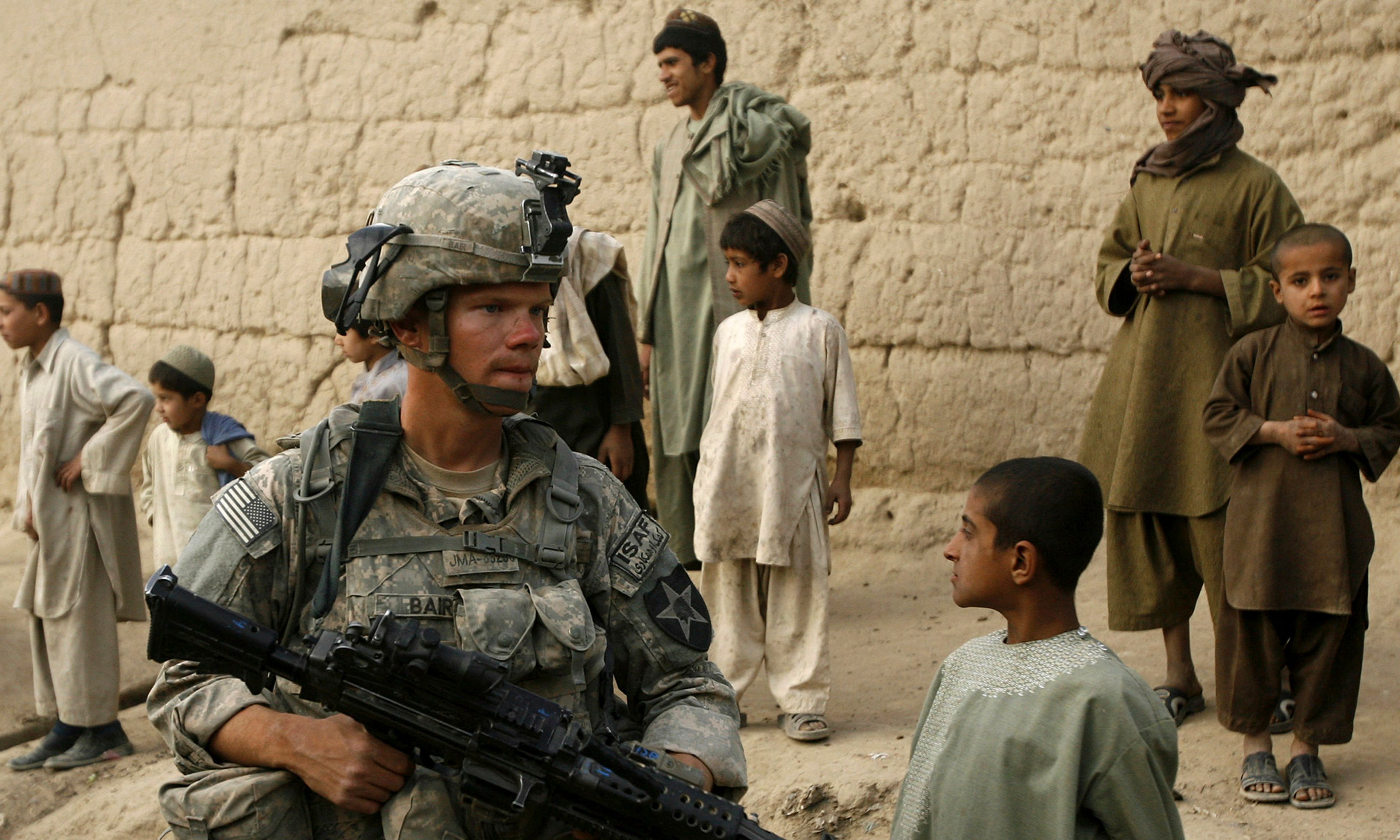
After the AK rounds cracked over the sandbags, Sgt. Robert Kightlinger, 23, of Jackson, Calif., muttered “Insolent bastards” and led a dozen Marines and Afghan soldiers outside the wire in pursuit. Leaving behind six Marines to guard this isolated outpost in Helmand province, they bounded across dry poppy fields and soon found cartridges dropped by the shooters. A kilometer farther on, their attackers stopped to fire from a mosque. The mosque was off-limits unless the Marines could positively identify an enemy holding a rifle. Instead of providing the Marines with that opportunity, the shooters slipped away.
As we walked back, Sergeant Kightlinger bumped into a prominent local farmer. “When those Taliban cut across your fields, they put your family in danger,” Kightlinger said. “Tell them to stay away or point them out to me — right now!”
“I can’t,” the farmer pleaded, drawing a finger across his neck before hurrying away.
It was my third visit since April to rifle companies in northern and southern Afghanistan. In all, those visits included 40 to 50 shuras (meetings with village elders) and patrols. Some of those patrols stayed on the move for several days, and there were numerous small-arms engagements. In the field, I talked with about 500 American, British, and Afghan troops of all ranks.
Kightlinger’s squad was typical. They were manning one of two dozen outposts nestled among 75,000 residents in a remote district called Nawa. In June, many observers had doubted the wisdom of inserting a Marine brigade into Helmand, which is the center of the world’s heroin supply. All summer, the district market had stood empty; by October thousands of farmers were gathering to trade produce.
But five months has not erased years of distrust and turbulence. After the district governor met with the elders in a key village, the Taliban called their own meeting, which was attended by several of the same elders. The population, though thankful for the security, was hedging its bets. They know the Marines will not stay forever. Billions of dollars already have been spent in development projects to make Americans feel good about our generosity, but nation-building is an endless task. The tribes expect everything but give nothing in return.
It is not obvious that winning the hearts and minds of village elders, or linking villages to Kabul, wins the war. Our soldiers note that the Afghans are happy to accept what we give them but do not reciprocate by turning against the Taliban. The elders don’t raise militias or secure recruits for the army, and they don’t fight; there has been no replay of that scene from The Magnificent Seven in which the terrorized villagers finally rise up against their oppressors. Instead, fearful locals plead with migratory Taliban gangs to move on. A rural population, no matter how content with its government, cannot stand up to such a tough enemy.
This enemy fights with the elusive cunning of Apaches. Unencumbered by armor and hardy of foot, the assorted insurgent groups loosely known as “taliban with a small ‘t’” engage in maneuver warfare. Weighed down by their heavy gear, our troops respond with firepower. Local police turn a blind eye to the ubiquitous watchers — called “dickers” — who warn the Taliban about most of our patrols. Tribal relationships ensure that there are few arrests. By shooting from concealment at a distance, the enemy can proclaim his tribal or jihadist determination but stay alive. We are in a war of attrition, not one of decisive confrontations — a war that pits the will of NATO against the endurance of enemies who can retreat to sanctuary in Pakistan, behind a porous 2,400-kilometer border.
Because of that unsecured border, a strong Afghan security force will remain essential even after most of the country’s districts have been pacified. We are creating Afghan security forces in our image: They wear heavy armor and rely on our medevacs and artillery. To support them, we’re probably going to have to spend $20 billion to $40 billion annually for years to come, on top of the cost of U.S. combat units.
That will require a lot of support from Congress. But there is one important and relatively inexpensive move that Congress should make immediately: Useless and corrupt Afghan officers cling to command because there are no pensions, and Congress could boost the effectiveness of the entire Afghan army by funding its pensions in return for a stipulation that the Coalition be given a real voice in forcing incompetent and corrupt leaders to retire.
Until the Afghan forces are more capable, security will require that the Coalition employ what are called “framework” ops, defined as meetings in villages or districts, combined with thousands of patrols that occasionally are punctuated by enemy contact. Tribal elders will not wean their young men from the Taliban without such aggressive patrols, which would suggest the United States seriously intends victory. Implacable pressure in every firefight and incessant patrolling are critical. But risk-avoidance regulations handed down from the top are frustrating our rifle companies.
General McChrystal’s assessment held that units should take risks equivalent to those run by the population, but senior staffs have altered none of the directives installed to minimize risk. Only a four-star may remove his body armor without reprimand. Many units insist upon 16 U.S. troops and four armored vehicles on each patrol. Eventually, companies stop trying to evade these restrictive rules and settle into status quo routines. In theory, we endorse small-unit initiative; in practice, we frequently prevent it.
Constant patrolling (the squad at Man Bear Pig patrols twice a day) is easier for the Marines, who do seven months, than for Army soldiers, who are assigned for a year — and a year on the line is too long when General McChrystal’s strategy demands constant patrolling among the people.
Driving the insurgents away from the population primarily by military means was Phase I of the counterinsurgency strategy. Phase II requires replacing the Coalition presence with competent Afghan leaders, which means instituting responsible Afghan governance. That project will fail if Karzai continues his dodgy ways. “Governance, not security, is my main concern,” an important NATO general told me. “Karzai governs by an informal network that ignores his own chain of command.”
Pressuring Karzai depends on our succeeding in Phase I and not abandoning him. When Iraq was falling apart in 2006, Prime Minister Maliki caved in at first, trying to placate his enemies. Maliki exhibited decisiveness a year later only because the counterinsurgency strategy of General Petraeus and the attendant surge of American troops were succeeding. Similarly, Karzai and his clique are more likely to build a competent government once they can be confident of success on the ground.
General Petraeus and Ambassador Crocker changed the course of the Iraq War by exploiting the change in Sunni attitudes. The Pashtun tribes, however, are deeply divided and lack the overall cohesiveness of the Iraqi tribal structure. Plus it’s not their fight — not while their government exploits them rather than offers them incentives.
Well-founded doubt about Afghan national cohesiveness and self-reliance pervades all ranks in our military. Gone is the post-9/11 zeal. There is no shared definition of victory. To the troops, patrolling and meeting with village elders are jobs to be done while hoping to get home alive and uninjured. On the other hand, it was precisely the persistence and toughness of our grunts that persuaded the Iraqi Sunnis to come over to us, to the strongest tribe. Similarly, the Afghans understand the lethality of our riflemen as well as their decency. Our military succeeded in creating a capable Iraqi force; similarly, an acceptably governed Afghan state can emerge — provided we continue the fight for years. Whether we do depends on our political leadership, not our military. Morale and performance will decline if our leaders do not lead.
Outpost Man Bear Pig — no electricity, no shelter, a handful of troops — represents the raw front line of the counterinsurgency strategy. Afghan soldiers remark that their poorest farmers live better than the Marines, but progress is more important than living conditions to our troops’ morale. To the west of Man Bear Pig lies the town of Marjah, the hub of drug trafficking and insurgent activity throughout Helmand. At night, our Marines look at the glow of lights from Marjah and talk about the need for reinforcements to push the Taliban out. Seizing Marjah will throttle exports of opium and show the momentum of the McChrystal strategy, but it will require two more brigades in the south — and other American brigade commanders can point to Marjah-type strongholds that need to be cleared and held in their areas, too.
Barack Obama began his presidency by declaring that Afghanistan is a war of necessity, not choice, and that it must be won. In March he endorsed the counterinsurgency strategy, and our grunts are out there practicing counterinsurgency. The Afghan army is with them. If the war is to be won, that is how it will happen. High-level deals cut by Karzai or by American plenipotentiaries will not win over the Taliban. Afghanistan’s fate will be determined by power at the district level. Afghan forces must mature, growing stronger and more willing to fight than the fundamentalists they face. That strategy is slowly working, but it takes a lot of manpower.
Washington owns the team but shouldn’t call the plays. It’s like the Redskins: The problem isn’t the plays being called, but their execution. You have to trust the coaches — the generals actually in the field — to be in touch with their players. Obama is repeating Bush’s 2001–06 mistake of accepting top-down wisdom. He risks becoming a geopolitical version of the Redskins’ owner, Dan Snyder: a man who assembles an all-star cast in Washington that constantly refines the game plan but falters in the execution. America’s dithering has made us look weak and has encouraged our enemies. Let us hope the president decides to send in the troops — and then stays out of the play-calling.











Comments