Here’s the good news: I picked the right week to delete my Facebook account.
Here’s the bad news: I picked the wrong week — to steal a line from the glorious 1980 movie Airplane! — to quit sniffing glue.
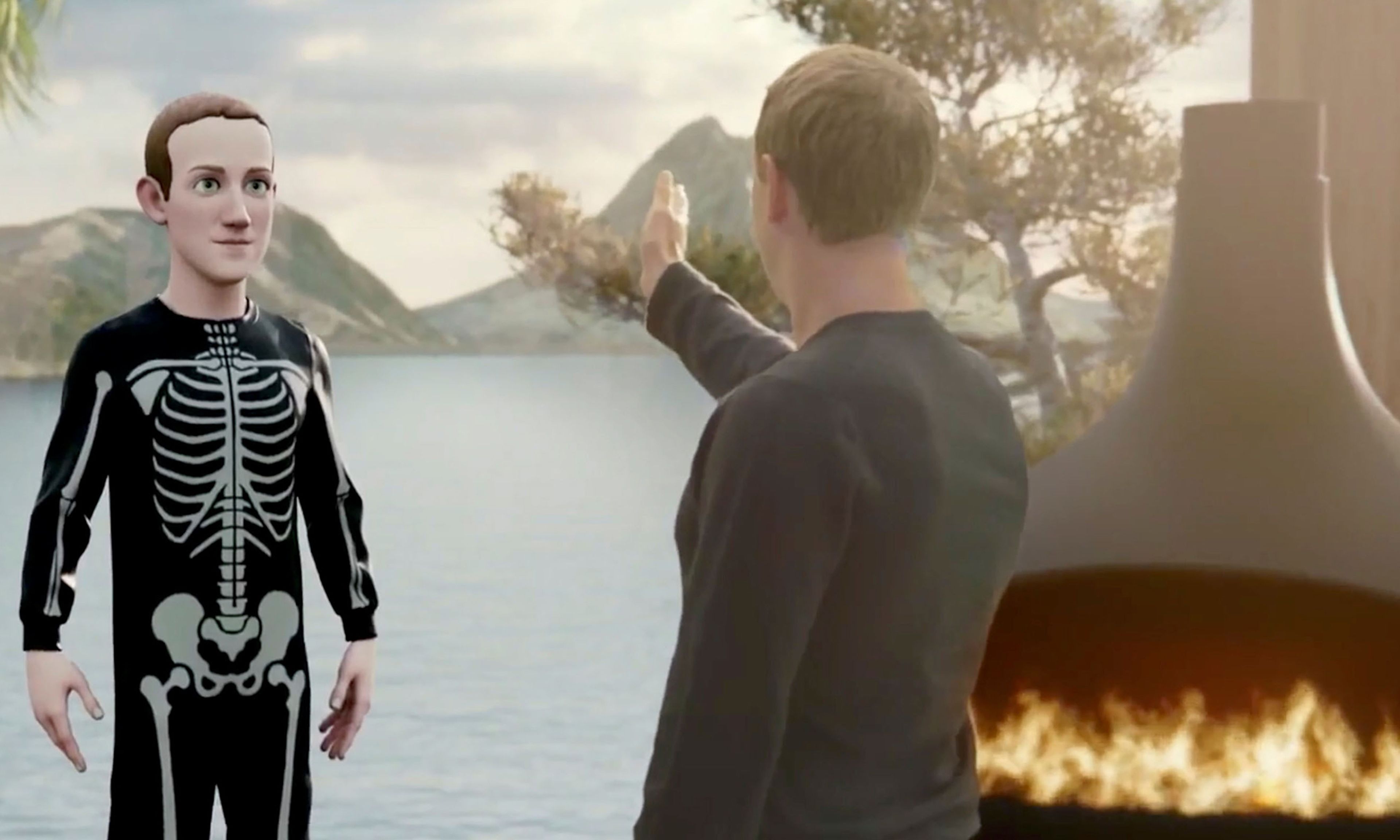
Don’t worry, and don’t place a panicked call to my parents, my doctor, my nonexistent fantasy personal stylist, or the police: I didn’t really quit sniffing glue, nor did I ever sniff glue in the first place. What I did do, however, could be described as its mental and spiritual equivalent: I watched Mark Zuckerberg’s baffling new promotional video for Meta, which is Facebook’s new company name.
“Welcome,” Meta crows on its new Twitter landing page, “to the next chapter of social connection.” Brace yourself, for the Company Formerly Known as Facebook is apparently ready to move beyond sharing cute dog photos or arguments about whether certain medicines might make you grow a second spleen or not so subtle, completely coincidental advertisements for things like the very specific camping stove that you were just discussing while sitting in front of your computer only moments before. Ahem.
“Meta is helping to build the metaverse,” the company continues, “a place where we’ll play and connect in 3D.” So, in short, it’s just like real life. But it’s better, you see, because you’ll be wearing virtual-reality goggles and pretending to be somewhere you’re not! Wait a minute — isn’t that actually kind of creepy and depressing? Oh, whatever. Just give Silicon Valley your money. Or at least your time. And most definitely all of your personal data.
I recommend watching at least part of the Meta launch video, if you haven’t: It’s a doozy. In case you are currently perplexed or otherwise unimpressed by this entire concept, let’s go over some of the purported benefits of joining the metaverse. Please note that each of the following items actually exists in Meta’s video, and that I am not concocting any of them out of thin air as some kind of half-hearted joke.
(1) In the metaverse, you can build a virtual, architecturally significant house featuring breathtaking, otherworldly, and awe-inspiring views. That is because they are not real. You can even have fake palm trees on one side of your fake house and fake Swiss snow-capped mountains on the other side. You can also have a fake astronaut suit in your fake closet and a fake bottle of Sweet Baby Ray’s barbecue sauce on your otherwise meticulous fake bookshelf. (As an aside, if you happen to be slightly deranged, you can build this same scenario in your own head, no strings attached!)
(2) You can play cards with friends who are apparently too far away, too busy, or too lazy to join you in person, one of whom will be dressed like a robot for no particular reason. You can pretend that this is fun, but let’s face it — we’ve all been on a Zoom call before. Then you can fly around together — but not really fly around together — and marvel at some mediocre virtual 3D art that pops out of a beamed-in brick wall. (Please see my note above about being deranged and doing this for free.)
(3) Instead of going outside and absorbing actual vitamin D from the sun — a practice that boasts multiple important health benefits — you can visit a virtual “forest room.” This room will feature fake flying koi fish, perfectly placed to distract you from the dark existential chasm beyond. Mystifyingly, someone will then exclaim “This is new!” and “That’s wild!” (It may be new, but it is not wild, because it is not really happening.) Next, you’ll receive a random video of your dog running back and forth across your lawn. This can already happen on Facebook, on your phone, or in your nightmares — but because there appears to be some sort of black magic afoot in the metaverse, you will declare the video to be amazing. (It is not. The dog isn’t even pretending to fly.)
(4) You can eventually become a real-life version of one of the corpulent sedentary humans in Disney’s WALL-E who manage to survive the earth’s ecological destruction only to live permanently tied to a screen, sucking down high-calorie dessert shakes while a sentient robot could go ahead and completely take over the universe and everyone would be too numb to care.
Do I sound negative? I’m sorry. I just have a weird bias in that I believe our society needs a heck of a lot less screen time and a heck of a lot more face-to-face contact. While I’m at it, I also find it alarming that the average American child, according to new research from the University of California, San Francisco, spends almost eight hours a day looking at screens of different kinds — and that this doesn’t even include the hours upon hours spent staring at computers or iPads for “school.” Since I’m now serving as the skunk at the garden party, I’ll also point out what we all really know deep down inside: Social media are a hot disastrous mess and can suck the marrow out of your very soul.
But wait! There’s more. Not to be outdone, Microsoft is also leaping into the metaverse, blessing the world with Mesh, in which giant corporations can beam avatars of their workers into virtual conference rooms, where they can then be tortured with banal team-building exercises forever and ever, amen. Mesh, Microsoft claims, “doesn’t just feel real. It is real.” At press time, this made me chortle, given that the Mesh promotional video showed a bunch of depressed-looking, empty-eyed specters floating around, cut off at the waist. Reader, they literally had no legs.
There’s a joke here, I suppose, about this whole cockamamie idea of the metaverse having no legs, or a metaphor of how we’re all going to be carted around by Big Tech for the rest of our lives. But the real bottom line, as commentators more cynical than I have pointed out, is, of course, the money: Facebook’s popularity has been plummeting among the young, and Microsoft clearly sees giant dollar signs in cornering the corporate market.
Alas, shockingly, I remain unsold. Those flying koi fish will just have to wait.












Comments